Hearing
 Call Kai
 Learn
 Practice Test
 Spaced Repetition
 Match
 Flashcards
 Knowt Play
1/57

Earn XP
58 Terms
What are the 3 parts of a sine wave and their functions?
amplitude - volume
frequency- pitch
phase- localisation
formula for wavelength
λ = c/f
What is dB SPL
the volume relative to the local pressure
usually 20 uPa
formula for dB SPL scale
20 log(pressure / 20)
What are the 3 types of filter and what do they let through?
Low pass- frequencies below a threshold
high pass- frequencies above a threshold
band pass- between 2 thresholds
What makes up the peripheral auditory system?
The ear and auditory nerve
What are the 3 parts of the ear and their constituents?
Outer ear
pinna
external auditory meatus
Middle
tympanic membrane
ossicles (mallues, incus, stapes)
middle ear cavity
inner
cochlea
semicircular canals
auditory nerve
How does the shape of the external auditory meatus affect it’s function?
It acts like a tube with resonant peaks so that the best heard frequencies are those involved in human speech.
What is the use of the pinna?
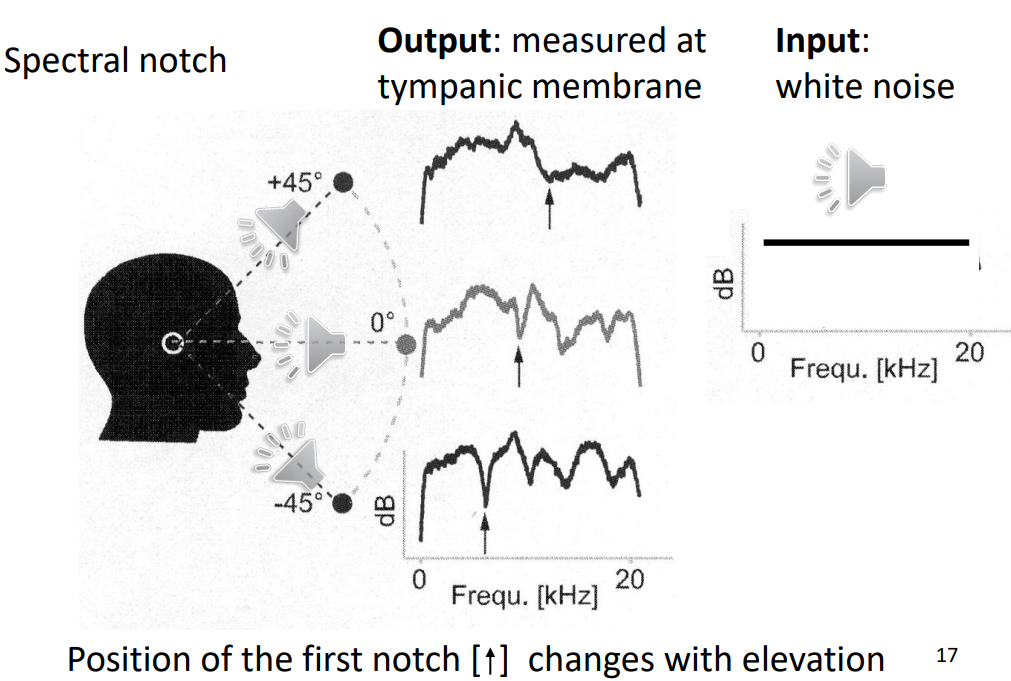
The head related transfer function
Helps with elevation detection
The location of the first notch in the output vibration is at a lower frequency at lower elevations.
Caused by the interaction of the direct and reflected vibrations entering the ear off the pinna
How was plasticity of sound localisation experimentally explored?
subjects fitted with molds in their ears to disrupt elevation estimates
localisation ability was regained after a few weeks
subjects could hear well immediately afterwards, 2 maps of auditory space can exist together
What three bones are between the tympanic membrane and the oval window?
Malleus, incus, stapes
What are the 3 functions of the middle ear?
Impedance matching
Protection from loud sounds
Antimasking of high frequency sounds by lower frequency ones.
What is impedance matching?
the faithful and useful transfer of vibrations between the air and cochlear fluids
How does impedance matching occur?
Uses pascal’s principal (P1A1 = P2A2) to increase the pressure from the oval window
Incus and Malleus muscles amplify vibrations
What are the Middle ear muscles (MEM)?
Tensor tympani and stapedius muscles
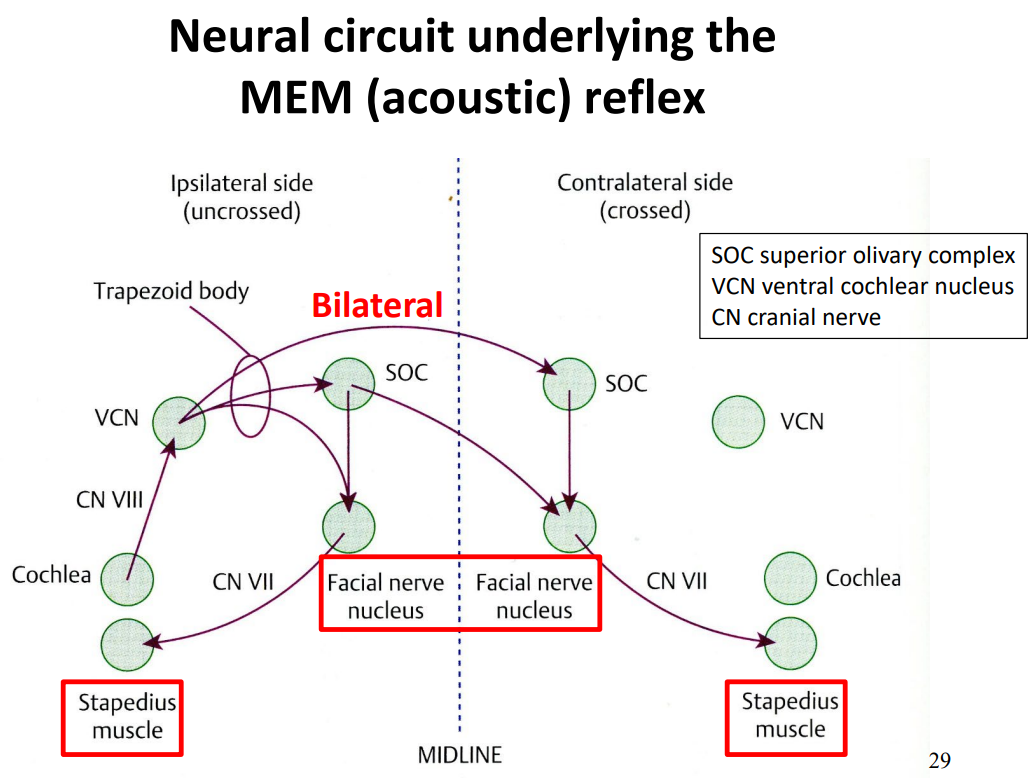
What is the MEM reflex and how does it work?
Protects the ear from loud sounds
The stampdeius contracts about 100 ms after a loud sound
dampens the frequencies transmitted
Where do the MEM connect to?
Stepedius connects to the neck of the staped
Tensor tympani connects to the neck of the Malleus
What is the neural circuit for the MEM reflex?
How do you test if hearing loss is conductive or sensorineural?
The Rinne test
Put a tuning fork against the temple and then before the ear
If the hearing is better with air conduction the issue is sensorineural
if the hearing is better with bone conduction then the issue is conductive
What path do vibrations take along the cochlea?
vibrations enter through the oval window
travel down the scala vestibuli
travel through the helicotrema into the scala tympani
go down the scala tympani and out through the round window
How does the basilar membrane differentiate between frequencies?
goes from thinner and stiffer to thicker and less stiff, these have different resonant frequencies
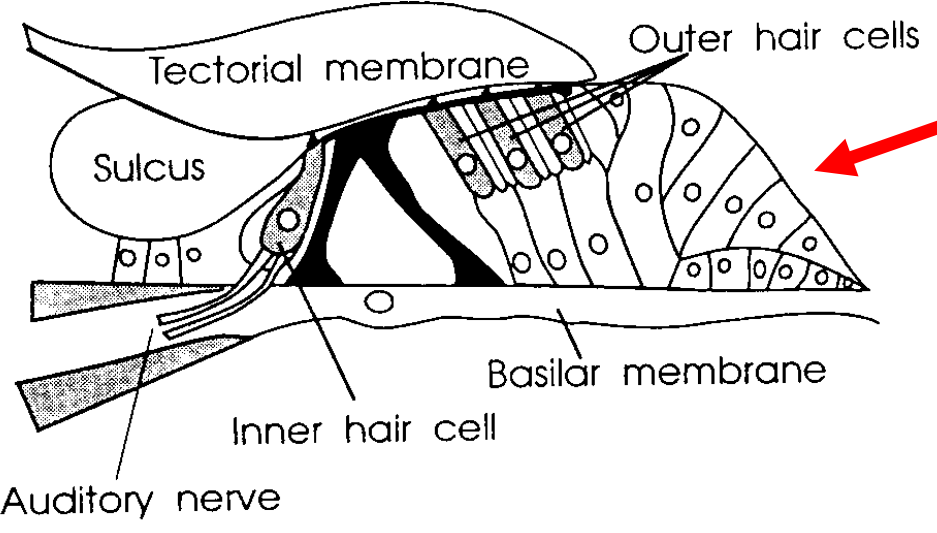
What makes up the organ of corti?
The auditory nerve, inner and outer hair cells and the tectorial membrane.
What is the structure of the organ of corti?
1 row of inner hair cells
3 rows of outer hair cells
tectorial membrane touching the top of the outer hair cells
How is the cochlea innervated?
inner hair cells innervated by type 1 fibres (myelinated)
outer hair cells innervated by type 2 fibres (unmyelinated)
lateral olivary complex neurones project to type 1 fibres near the inner hair cell
medial olivary complex neurone project onto outer hair cells
How many of each type of hair cell are there?
3500 inner hair cells
12000- 13000 outer hair cells
What is the ratio of type 1 nerve fibres to inner hair cells?
20 fibres to 1 cell
What is the ratio of type 2 fibres to outer hair cells
multiple hair cells innervated by each neurone
What is the main function of an outer hair cell?
Magnify basilar membrane vibrations by contracting in time
What are outer hair cells responsible for?
sensitivity
sharpness of tuning
oto-acoustic emissions
How are oto-acoustic emissions created?
Triggered or spontaneous contractions of the Outer hair cells
What is the function of inner hair cells?
Transduce vibrations into electrical impulses
How to inner hair cells function?
3 stereocillia atop each IHC
Small, middle, large
connected by tip links
tip links are connected to mechanoreceptive ion channels
vibrations cause tips to be pushsed against the tectorial membrane
If stereocillia are pushed towards a larger stereocillium, then the channel opens.
depolarisation
Why can IHCs discharge quickly?
Endolymph of the scala media is low in Na+ and high in K+
charge is +80mV
opposite to cytoplasm of IHC
charge is -50mV
potential difference between IHC and endolymph is 130mV
What produces the endolymph of the scala media?
The stria vascularis
What propery of the endolymph can change over time to give hearing loss?
The positivity
What type of synapse is between IHCs and Type 1 fibres, and what neurotransmitter and receptor is used?
Ribbon synapse using glutamate on AMPA receptors
What is the reason behind the name for a ribbon synapse?
Vesicles are held close to the cleft for fast release
What is spontaneous discharge rate?
How frequently an auditory neurone discharges without stimulation
What are the 2 categories when sorting nerve fibres by spontaneous discharge rate (SR)?
High SR and low SR
What are the differences between high SR and low SR auditory fibres?
High SRs originate from pillar side of inner hair cell
Low SRs originate from modiolar side of inner hair cell
fibres terminate in different places in the cochlear nucleus
How is frequency coded for?
Each auditory nerve resonds to a narrow range of frequencies so they act like a set of parallel and overlapping band-pass filters
How is the sensitivity of frequency coding measured?
Using a Q(quality) factor to compare the widths of the sensitive frequencies
Q10 = Characteristic frequency/ bandwidth 10dB above CF threshold
What is the characteristic frequency (CF) of a nerve fibre?
The frequency at which the corresponding IHC most strongly fires
How are the signals arranged physically as they go further along the processing pathway?
Frequency is spatially conserved (tonotopicity)
How does Q10 change with higher CFs?
It increases
How does phase locking help us hear high frequencies?
Low frequency neurones discharge in phase, but not every cycle
the upper limit of dishcarge rate is 1000Hz, but analysing populations of neurones discharging to the same phase can help us hear up to 5000Hz
How can the olivary complex raise the threshold for to hear vibrations?
Depressing outer hair cells raises the threshold for the basilar membrane to vibrate
Inhibiting the auditory nerve
What are the 2 aspects of the olivocochlear efferent system?
Lateral system
Medial system
What is the structure and function of the lateral olivocochlear system?
Cell bodies in/around the superior olive nucleus
Terminates on dendrites of auditory nerve fibres
function is unknown
What is the structure and function of the medial olivocochlear system?
Bodies medial to the lateral olive
Fibres terminate directly onto outer hair cells
Reduces the electromotility of the outer hair cells to reduce basilar membrane motion and decrease the responses of the inner hair cells
What is the central auditory pathway?
Cochlear
Cochlear nucleus
Superior olivary complex
Dorsal and ventral nuclei of the lateral lemiscus
Inferior colliculus of the thalamus
Medial geniculate body
Cortex
What is the obligatory synapse for all auditory nerve fibres?
Cochlear nucleus
What is the first sight of binaural convergence?
Superior Olivary Complex
What are the 3 parts of the Superior Olivary Complex
Lateral
Medial
Medial nucleus of the trapezoid body
Which cells carry out locatlisation?
Spherical bushy cells
Does sound localisation occur in the ear?
No representation of space on the basilar membrane so has to be centrally computed
What is the resolution in azimuth and elevation of human hearing?
2 deg azimuth and 10 deg elevation
How are low frequency sounds localised?
Interaural time differences
for sinusoidal tones time difference = phase difference
until wavelength approximates head width at 1500Hz
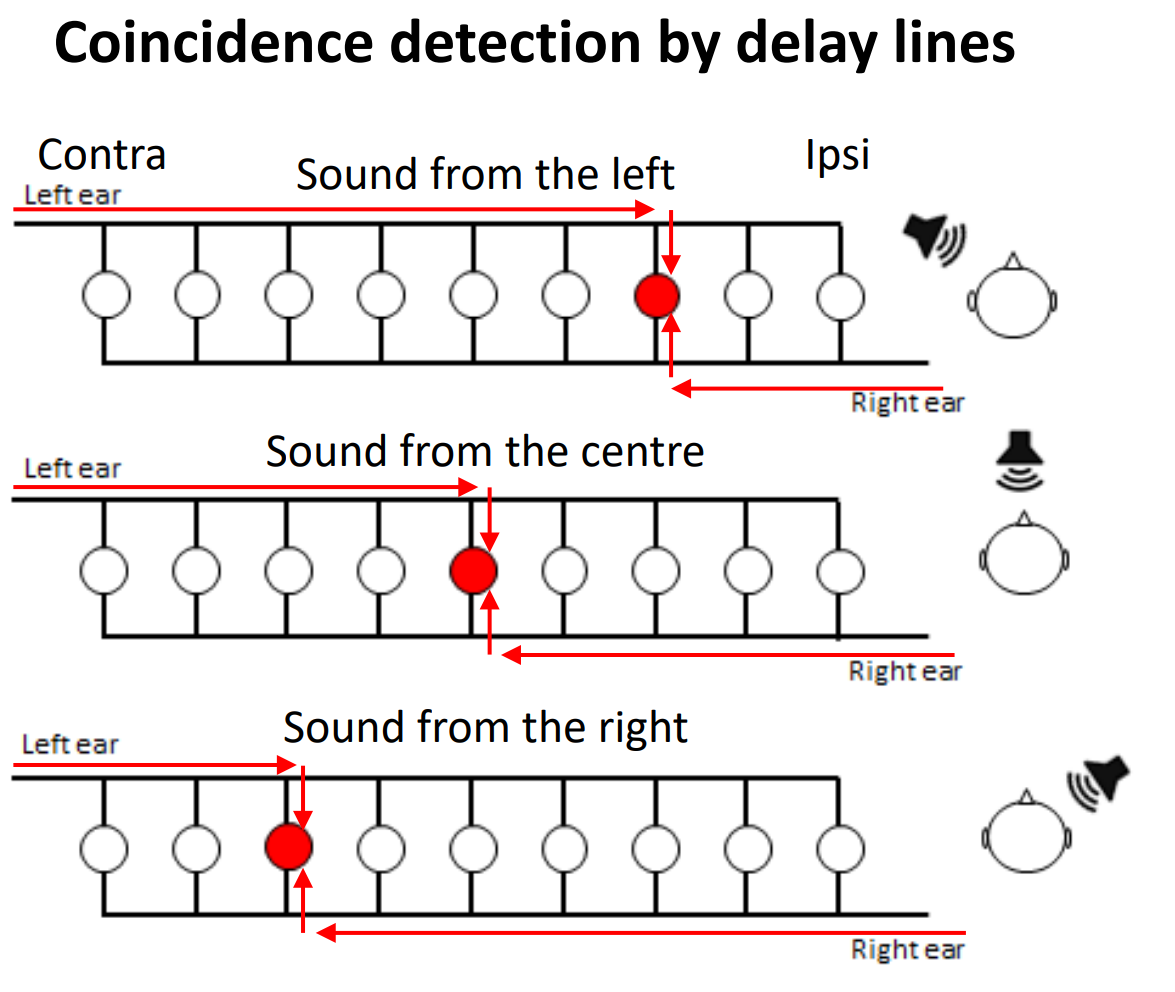
Medial superior olive uses coincidence detection and delay lines to measure the ITD in different frequencies
Lines of neurones, with each firing maximally when APs from both directions arrive in phase.