Herpetology- Locomotion
 Call Kai
 Learn
 Practice Test
 Spaced Repetition
 Match
 Flashcards
 Knowt Play
1/15

There's no tags or description
Looks like no tags are added yet.
16 Terms
Basics of Locomotion
Movement is about physics
Force must be generated against substrate to move
Constraints of Locomotion
Phylogenetic constraints lead to lateral undulation
Support and center of gravity
Habitat
Aquatic vs terrestrial
Fossorial, arboreal, ground-dwelling
Lateral Undulation in Herps
Sprawling limbs swing out to side
Limbed reptiles and amphibians do not remain standing for long, resting bodies on substrate

Locomotor Adaptations in Squamates
Many show limblessness
All snakes, most Amphisbaenians (worm lizards), and legless lizards lack pectoral girdle
Pelvic Spur- Boidae
Moving Without Legs
Lateral Undulation- lateral movement of body in contact with ground results in net forward propulsion
Caecilians, Amphisbaenieans, Legless Lizards, Many Snakes

Serpentine Locomotion
Can be classified into 4 distinctive types:
Lateral Undulation
Rectilinear
Concertina
Sidewinding
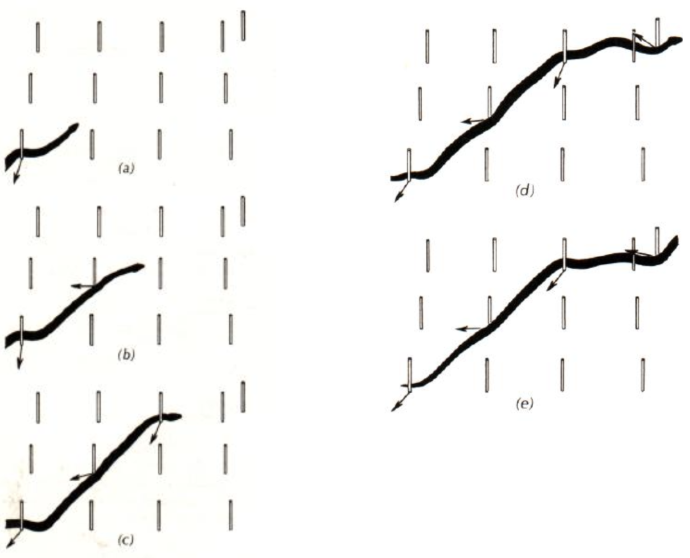
Serpentine Locomotion: Lateral Undulation
“Standing wave force”- each coil follows path head took- must have 3+ objects on different sides
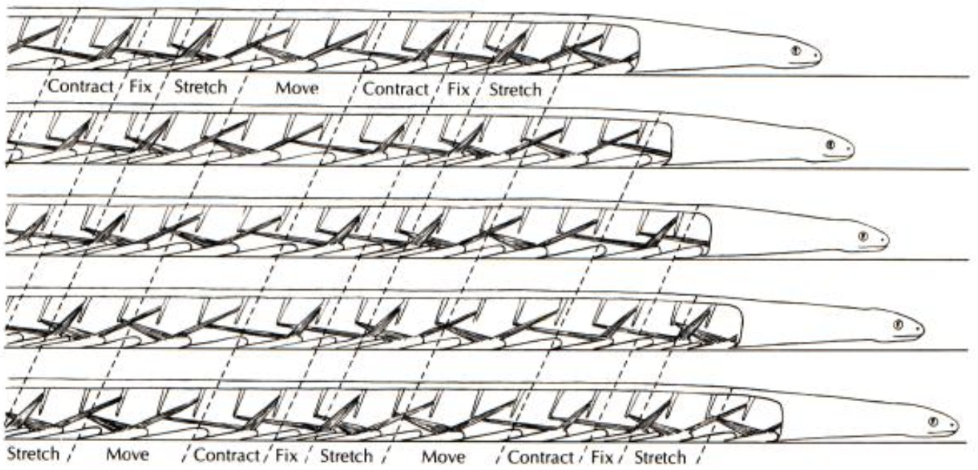
Serpentine Locomotion: Rectilinear
Scutes are “gathered” and pulled forward
Serpentine Locomotion: Concertina
Anchors self with sections of itself and pulls or pushes with other sections to move forward

Serpentine Locomotion: Sidewinding
Throws its raised body loops sideways in the direction of travel, placing them down while simultaneously lifting the trailing edge
Only 2 points of snake's body touch the ground at any given moment
For travel across slippery/loose substrate (desert)

Additional Serpentine Locomotion Types
Saltation- throw itself forward, its whole body leaving the ground; “jumping”
Horned adder
Somersaulting- curls into C-shape with its head lifted, whips its tail behind, becomes airborne, and flips its tail forward past its head to initiate a rolling cartwheel
Dwarf reed snake
Saltation (Jumping) Ancestral in Frogs
Highly derived pelvic girdle, fused vertebrae, and stout from limbs
Muscle attachment
Shock absorption
Limb length significantly modified in Anurans
And axial skeleton shows further modification
Average jumping distance increase with body size (SVL)
Bufo- smallest relative distance
Hyla- greatest relative distances
Rana- greatest absolute distance
Digits modified for climbing in Hylids
Intercalary cartilage, lacking in other Anurans

Turtles Gets Off Balance
Turtles cannot bend laterally, so they pitch and roll as center of gravity changes; additional locomotor adaptions include:
Tortoises with phalangeal reduction
Sea turtle flippers
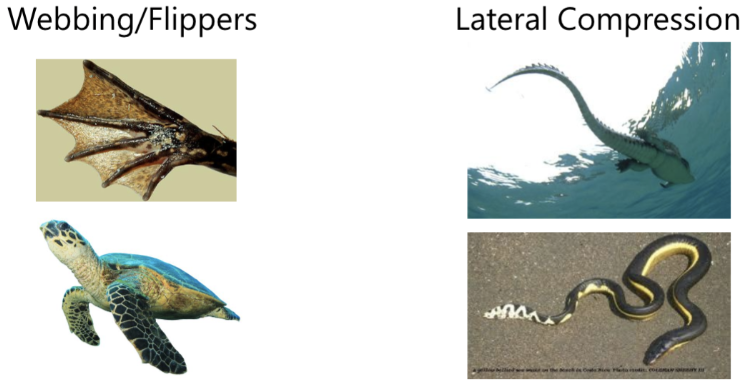
Aquatic turtles with digital webbing

Aquatic Locomotion Leads to Convergence for Flat Surfaces
Climbing Leads to Convergence on Toe Pads

Gliding (like swimming) Leads to Evolution of Flat Surfaces

Herp Movement Phylogenetic Tree
