Lecture 3: Diagnostic testing for Dynamic Repeat Disorders
 Call Kai
 Learn
 Practice Test
 Spaced Repetition
 Match
 Flashcards
 Knowt Play
1/28

There's no tags or description
Looks like no tags are added yet.
29 Terms

*****What do we need to get started with Diagnosis testing?
What are things that are required to initiate (4)
Reason for referral: (why are they getting this diagnosis test) the genetic condition you believe is segregating in the family or the clinical presentation eg. developmental delay + description of clinical features/other tests preformed
avoid psychiatric symptoms as reasons because of Complex Genetics = makes it less stressful on the patient and the lab
Reason for test: intent behind the current test order Eg. Diagnosis, prenatal diagnosis (LMP/gestation)
Other details = FAMILY HISTORY + ETHNICITY (names/mut of others tested)
Sample type: blood, bone marrow, Amniotic fluid etc. Submit the type and amount needed
Collection + shipping of the correct sample
Certain complex genetic tests are restricted and can only be ordered by specific medical specialties.
Which types of tests can be ordered by MULTIPLE medical specialties (give 4 examples of possible diseases tested)
Which types of test are typically a referral to GENETICS and who would typically be tested?
Multiple Medical specialties = DIAGNOSIS - patient is showing clinical presentations consistent with the disorder (diagnosis is to confirm + identify the disease)
Fragile X - Developmental delay
POF (premature ovarian failure) - female infertility, suggestive of ovarian failure
Myotonic dystrophy - cataracts, wasting + myotonia
HTT - progressive characteristic movement disorder
Referral to Genetics=
CARRIER TESTING (at risk relative eg. potential FMR1 premutation carriers, FXTN carrier
PREDICTIVE/PRESYMPTOMATIC TESTING (current unaffected individual in an at risk family)
Is getting DNA for testing an issue?
No
******What are 4 ISSUES/DIFFICUTIES with providing diagnostic testing
Length of expanded repeats in some conditions and the difficulty of polymerases used to amplify or sequence repeat sequence to read through the repeats.
Getting enough diagnostic or family history to confirm the right test is being ordered
Sometimes issues with getting samples from key family members (best person to test might not be patient but another family member + they are not available)
Turn around time – sometimes issues with time needed for a result eg. Fragile X cultivating Amniotic fluid = takes a long time
*****Back in the day was the method to detect/analyze HUNTINGTONS?
Radioactively labelled ntd + PCR

*****What is the Method NOW used for HTT CAG repeat analysis
capillary electrophoresis - PCR based analysis using fluorescently labelled primers
same stuttering, same loss of higher repeat sizes (PCR bias)
But easier to run

What are things always done to ensure results are correct?
Always run blank controls + size standards
Done multiple time:
one time by technologist
Check by another tech
Checked again by person interpreting results
*****What is the original PCR method of analyzing HTT now only used for?
reflex testing to assess METHYLATION
*****HOW does the OG method of analyzing HTT assess methylation?
What is the mechanism?
What enzymes are used and why are they special?
What was the DNA probed with?
Southern blot (SNoW DRoP)
DNA digested with EcoRI + BssHII (Methylation sensitive) + probed with pE5.1
If the DNA was METHYLATED = RE would NOT CUT
Thus in DISEASE individuals/long repeat their PCR segment would be LONGER when run through the gel
In healthy/normal individuals the PCR segment would be cleaved by BssHI into 2.1 + 2.8 size pieces

****What is the size of the Full area Resulting from Digestion with EcoRI + probed with pE5.1 in the PCR methylation assay HTT?
****Would someone with a FULL mutation (large repeat) have exactly this size?
5.1 = size of digest
NO, RE digest will also not result in 5.1 but a LARGER segment as the repeat sizes increases the sequence size

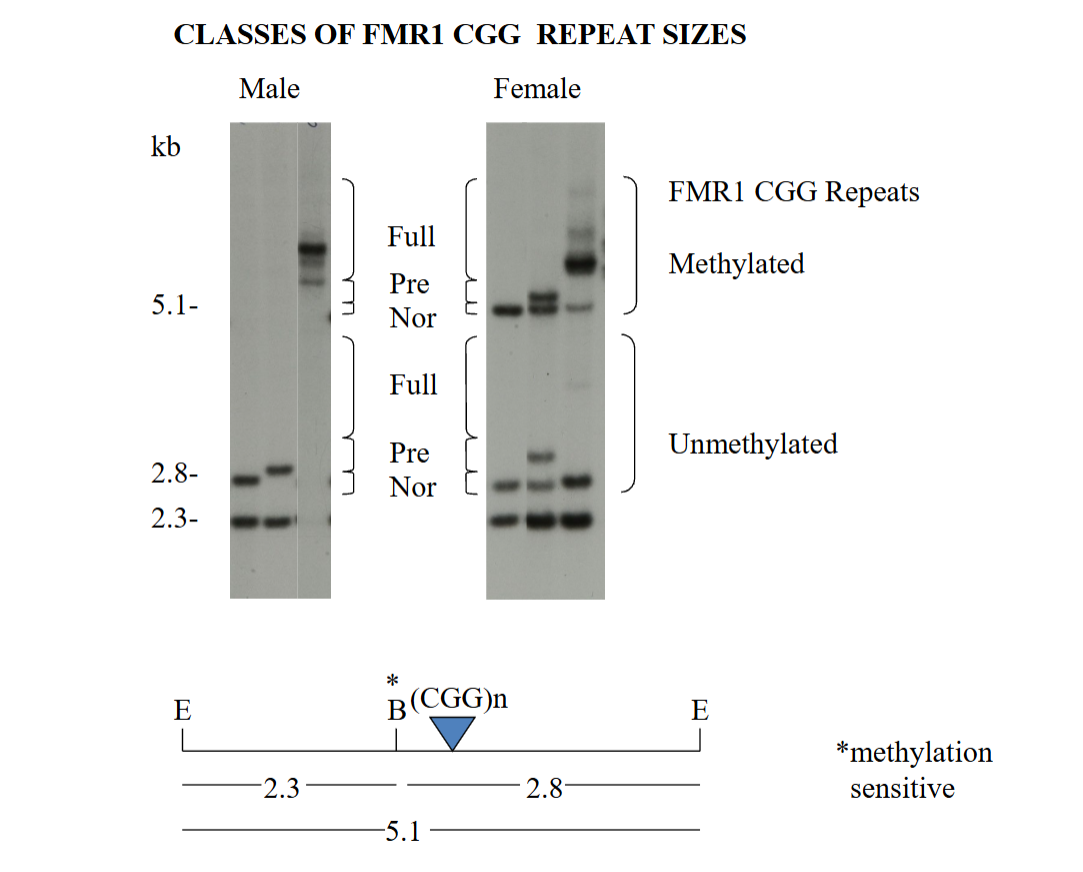
********Compare and contrast between the PCR results of a male vs. female when assessing methylation HTT
Why do these results occur?
Male = only has 1 X chromosome thus only 1 result
Female = 2 X chromosomes + 1 undergoes inactivation randomly in all cells = BOTH NORM and FULL mutation bands can be seen
but depending on if mut. is the active or inactivated chr diff phenotypes are seen
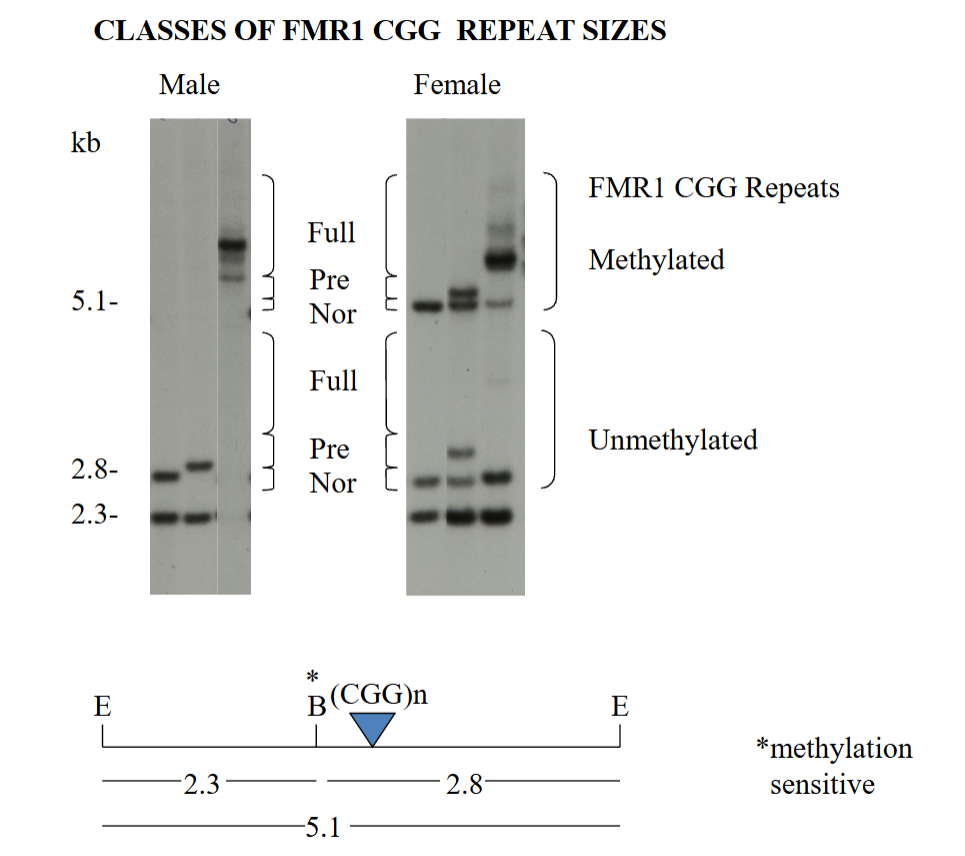
*****What size of repeats can be assessed with this method? WHY?
PCR normally wipes out methylation so RE are used to detect methylation = only small repeats can be used in this instance

**********What method of assay can be used to assist with PCR of LONG repeat expansions?
Why is this needed?
Fluorescent REPEAT PRIMED assay = In addition to flanking primers, this method introduces special CGG primers that hybridize directly to multiple areas inside the repetitive tract itself. Avoiding the need to amplify the entire long expansion in a single, unbroken piece.
Result: This generates a collection of varying-length fragments that form a characteristic "ladder" pattern.
If a patient has a very large expansion (a full mutation with \(>200\) repeats), standard PCR (situation A - primers flanking both sides of the repeat) often fails or struggles to amplify it because GC-rich DNA regions are extremely difficult to replicate in a test tube.

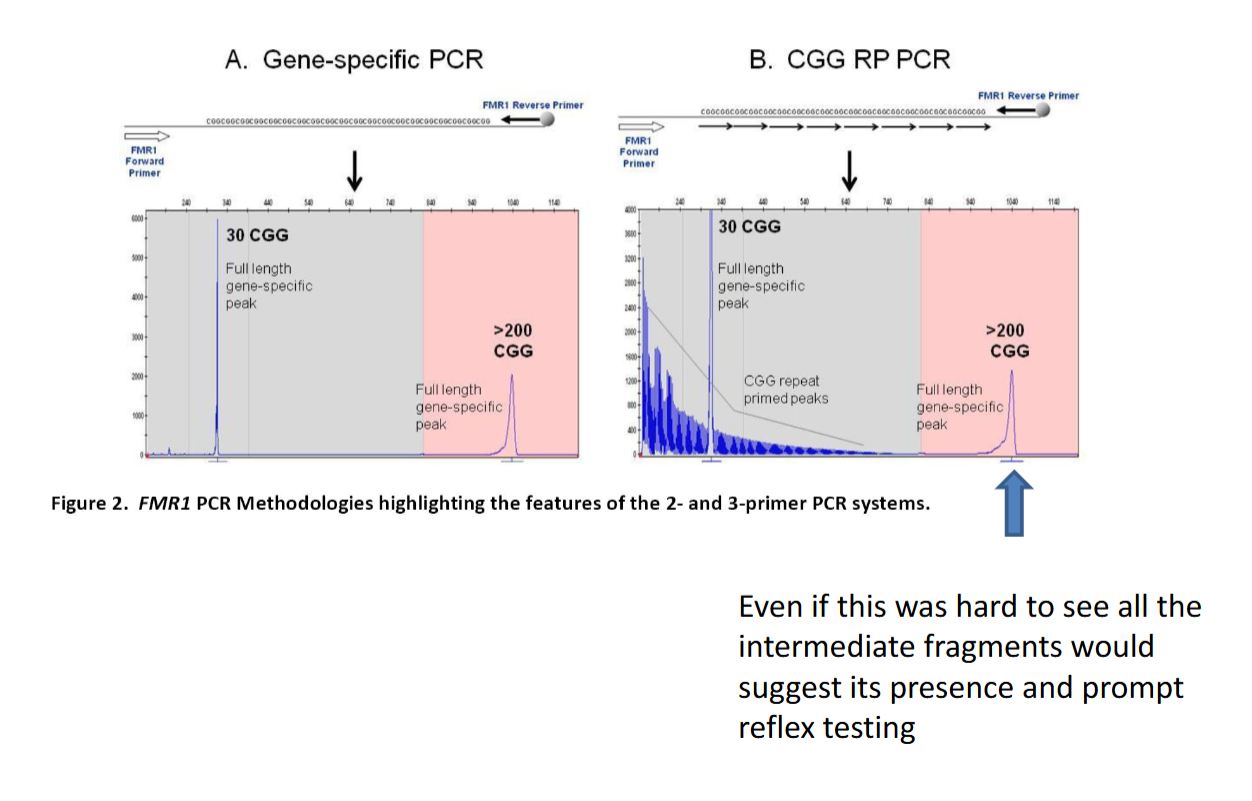
******Compare between how the results of a Gene specific PCR (only 1 forward primer + Reverse primer) and a CGG RP (Repeat primer) PCR would be different
*****How does it REDUCE THE CHANCE OF MISDIAGNOSIS?
Gene specific = 1 peak normal + 1 peak Abnormal/FULL LENGTH
RP PCR = Nested fragments/ Ladder fragments + Full length
How does it reduce chance of misdiagnosis?
the Full length abnormal sequence size fragment can be HARD TO SEE + thus missed in the gene specific method BUT
In Repeat primed the INTERMEDIATE FRAGMENTS would suggest the presence of the full length abnormal sequence and PROMT REFLECT TESTING = reduce chance of it being missed + misdiagnosis
*****Other than reducing misdiagnosis of HTT What else does repeat priming also make it easier to see?
if there are AGG interruptions in the FMR-1 CGG repeat = There will be breaks in the nested intermediate fragments
can be used to modify risk of expansion of premutation alleles


Flip for why these risks reported are not that simple
AGG interruptions = decrease expansion

****What methods are used in C9orf72 to confirm size of repeat present
also uses PCR and two repeat primed PCR reactions
same concept where the normal Gene specific PCR would miss the full mutation repeats but repeat primed would catch it

****What does an individual with Affected C9orf72 results be at an increased risk for?
ALS + FTD (Amyotrophic Lateral Sclerosis + Frontotemporal Dementia)
***What can be used to confirm the full expansion of the C9Orf72 gene?
Southern blot - typically don’t do this, but may if PCR results are atypical
may also attempt sequencing
just looking to see if bigger than normal (no methylation is checked in this case unlike HTT)

****New issues: Why do we need replacement strategies for ISOTOPE use?
Isotope use is an issue
safety, disposal, and regulatory hurdles = should shift toward newer, safer alternative technologies.
**********What are 3 replacement strategies to avoid Isotope used mentioned in the slides?
Assess methylation by PCR + avoiding use of isotopes (Asuragen AmplideX mPCR)
Nanopore Long-Read Sequencing
PacBio SMRT Long-Read Sequencing
All three an test for methylation
****Explain the The PCR-Based Solution (Asuragen AmplideX mPCR) Mechanism
How does it work to determines repeat size and methylation status simultaneously.
Is PCR needed
HOW TO INTERPRET RESULTS how to determine if methylated or not?
gDNA is obtains
2 digestions are run:
1) = CONTROL (no methylation enzyme)
2) = METHYLATION SENSITIVE digestion = if DNA is unmethylated it will CUT + cut = NOT AMPLIFY
Primers are added + PCR = run (YES need PCR)
Capillary electrophoresis
Compare the size of peaks in Control vs. methylation digestion
if size of peak is decreased means they are unmethylated or partially methylated = can determine the amount of methylation for each repeat size

****Explain the The NANOPORE long read sequencing Mechanism
How does it work to determines repeat size and methylation status simultaneously.
Is PCR needed?
NO PCR needed - can used naked DNA (has Methylation status preserved) or cut and concentrate one or more regions using CRISPR Cas9 to cleave in a site specific manner
Repeat length + methylation status are preserved via this direct sequencing through the nanopore (the nucleotide that is added as the DNA is passed through the pore)

****Explain the The PACBIO SMRT (nxt gen) long read sequencing Mechanism
How does it work to determines repeat size and methylation status simultaneously.
Is PCR needed?
No PCR needed + Methylation status is maintained
DNA ntd are fluor labelled = can detect which are added as the polymerase adds them
It is quite easy to see repeats with this method + VERY long sequences can be assessed in this way

******How to extract CpG methylation status from PacBio whole genome sequencing?
heat map of methylated and not

******What are the Challenges/Dilemmas (Lab perspective) with testing ADULT onset disorders?
What are the ethical + legal issues associated?
Ethical/legal issues with Pre-symptomatic testing
autonomy to not know, confidentiality, justice, doing no harm, avoid harm
Restrictions on ordering (always in best interest of patient)
Making exceptions
Prenatal testing for adult onset disorders (nothing that says no this shouldn’t be offered = proper counselling should be done)
“our comfort” in certain situations (personal opinions shouldn’t matter, focus on patient) “get comfy with being uncomfy”
*****Overall wrap up from the last couple classes
Things that are common to disorders involving unstable dynamic repeats
They are polymorphic in the normal range, disease alleles are expanded in coding region and can be greatly increased if in noncoding regions
Genome location in terms of being found regions of the genome prone to instability TAD domains
four Cellular mechanisms underlying pathology both LOF and GOF Transcriptional silencing, RNA binding protein mediated aggregation, Abnormal toxic protein aggregation and RAN synthesis of toxic peptides
DNA repair mechanisms which can generate repeat expansions. Role of DNA methylation and mismatch repair
THIS LECTURE: Challenges for diagnostic and predictive testing, finding techniques that can assay the broad range of diseases, repeat types and length of expanded repeats and methylation status