D315 - Network and Security Foundations
 Call Kai
 Learn
 Practice Test
 Spaced Repetition
 Match
 Flashcards
 Knowt Play
1/22

There's no tags or description
Looks like no tags are added yet.
23 Terms
Hub
Connects multiple wired devices and sends incoming data to every connected port (Layer 1)
Repeater
Re-transmits a signal to extend over a long distance (Layer 1)
Switch
Forwards frames to the appropriate device using MAC addresses (Layer 2)
Wireless Access Point (WAP)
Connects wired networks to wireless client and provides Wi-Fi to an existing network, allows more devices and cover long distance (Layer 2)
Bridge
Connects LAN segments and forwards or filters frames using MAC addresses (Layer 2)
Wireless Range Extender
Listens for wireless signal and repeats it to extend range (Layer 1)
Router
Forwards packets between different IP networks using routing information (Layer 3)
Modem
Connects a network to the internet (Layer 1)
Firewall
Filters traffic coming into and out of your network. It decides what to allow and what to block based on set of rules (Layers 3 & 4)
Personal Area Network (PAN)
A short-range network that connects personal devices like smartphones, tablets, and computers
Local Area Network (LAN)
Connects computers and devices within a small area like a home, office, school, or hospital
Wireless Local Area Network (WLAN)
Networks that allow devices to connect and communicate over Wi-Fi within a localized area like a home or office
Campus Area Network (CAN)
A network spanning multiple LANs but smaller than a MAN, such as on a university or local business campus
Metropolitan Area Network (MAN)
Connects computers across a city or between nearby cities and provide high-speed connectivity (in Mbps) and can act as ISPs
Wide Area Network (WAN)
Covers large geographical areas (above 50 km), often connecting multiple LANs through telephone lines, radio waves, or satellites
Storage Area Network (SAN)
Connects servers to data storage devices through technology like Fibre Channel

Bus
All devices connect to a single main cable called the backbone
(A backbone failure can disrupt the entire network)
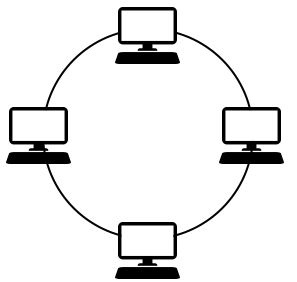
Ring
Devices connect in a circular arrangement, with data traveling from one device to the next around the ring

Star
All devices connect to a central device, typically a switch. If the central device fails, connected devices lose network connectivity

Mesh
Devices connect to multiple other devices, providing multiple paths for data. This improves reliability but increases cost and complexity

Hybrid
Combines two or more different network topologies, such as star and bus, into one network
Infrastructure Mode
Wireless devices communicate through a central Wireless Access Point (WAP) that connects them to the network
Ad Hoc Mode
Wireless devices communicate directly with one another without requiring a central access point