Carbohydrates + fats
 Call Kai
 Learn
 Practice Test
 Spaced Repetition
 Match
 Flashcards
 Knowt Play
1/28

There's no tags or description
Looks like no tags are added yet.
29 Terms
D-glyceraldehyde (aldose)

Dihydroxyacetone (ketose)

D-fructose (ketose)
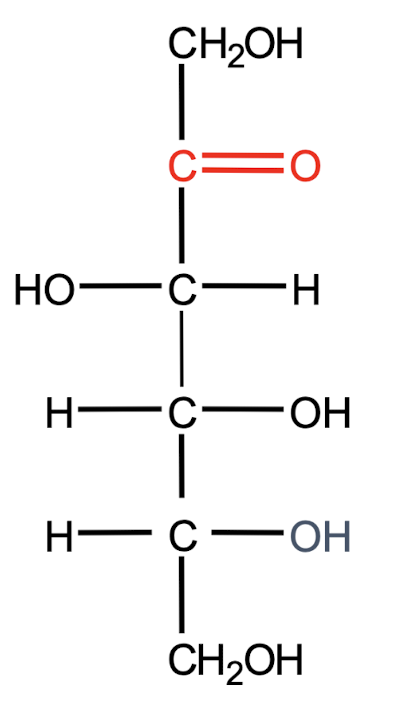
D-glucose (aldose)

α-D-glucose

β-D-glucose
most stable

β-D-fructose

α-D-fructose

Maltose
2 β-D-glucose

Lactose
β-D-galactose + β-D-glucose

Sucrose
α-D-glucose + β-D-fructose

Homoglycans
Starch, Glycogen (how we store sugar), Cellulose, Chitin
Heteroglycans
Heparin, Chondroitin, Sulfate, Keratan sulfate, Hyaluronic acid
Glycogen
glucose chains w/ α-1→4 linkages and branches every 8-12 sugars, animal sugar storage

Amylopectin
glucose chains w/ α-1→4 linkages and branches every 24-30 sugars

Palmitic acid
saturated fatty acid 16C
Linolenic acid
unsaturated fatty acid 18C
Elaidic acid
Trans fat, unsaturated fat with trans bond instead of cis (mimics saturated fats), Crisco
Triacylglycerols (TAGs)
Storage form of fatty acids, also known as triglycerides
Glycerophospholipids
Phospholipids, amphipathic → major component of cell membranes, polar phosphate group, nonpolar hydrocarbon tails
Lactose bond
β-1→4, free reducing end
Maltose bond
α-1→4, free reducing end
Sucrose bond
α-1→2, no reducing end
Amylose
α-1→4
Amylopectin
α-1→4 in chains, α-1→6 at branch points
Glycogen
α-1→4, branches more often that amylopectin
Cellulose
β-1→4
Chitin
β-1→4, amide bond
Diasaccrides with no reducing carbon
Sucrose