week 1: introductory concepts in microbiology
 Call Kai
 Learn
Learn Practice Test
 Spaced Repetition
 Match
Match Flashcards
 Knowt Play
1/28

There's no tags or description
Looks like no tags are added yet.
Name | Mastery | Learn | Test | Matching | Spaced | Call with Kai | Chat |
|---|
No analytics yet
Send a link to your students to track their progress
29 Terms
microbes
aka: microorganisms, tiny living things too small to see
acellular infectious agents
prions, viruses
cellular microorganisms
prokaryotes: archaea, bacteria
eukaryotes: algae, fungi, protozoa
microbe is not a pathogen, but ___
it does when it becomes a disease/harmful
infection
includes microorganism in host; colonizes
intoxication
results from exposure to microbial toxin; in vitro: outside living host (food or external environment)
indigenous (resident) microbiota vs. opportunistic pathogen
indigenous microbiota → coexist with host → may cause disease when conditions change
what conditions support indigenous microbiota becoming opportunistic:
different or normal sterile body site (ex: bladder free of microbes; if it is = problem)
disrupted protective barrier (ex: skin breakdown)
altered microbiota or overgrown (ex: colon has good bacteria; if take good + bad = bad outgrows = problem)
weakened host defenses (ex: immunocompromised patient)
benefits and harmful roles of microorganisms:
ecosystem: decomposition, nutrient cycling, food webs
human body: microbiota, digestion, colonization resistance
food & industry: fermentation, biotechnology
medicine: antibiotics, vaccines, models of cells
microbe to microbe interaction
antagonism: microbes vs microbes
synergism: two or more microbes interact in ways that may increase their combined effects
microbes = microscopic
human cell (~10-100 μm)
bacterium (~1 μm)
virus (~μm scale)

magnification
how much larger image appears; image = bigger
resolution
how clearly 2 close objects be seen as separate; image = fine details clearer
light microscopy
uses visible light + system of lenses to magnify and observe small species
electron microscopy
uses beam of electrons to view objects
TEM: internal detail
SEM: external detail, surfaces

prokaryotic cells
no true nucleus
non membrane-bound organelles
smaller ribosomes
ex: bacteria, archaea
DNA present, not in true nucleus
binary fission for reproduction

eukaryotic
true nucleus present
present membrane-bound organelles
larger ribosomes
ex: fungi, protoza, human cells
DNA present in nucleus
mitosis and meiosis for reproduction

cell membrane
selective barrier (homeostasis)
many bacteria generate ATP across cell membrane
some antimicrobials disrupt the bacteria cell membrane (ex: daptomycin - antibiotic)

bacterial cell wall
provides shape, protection, and structural integrity
most ___ contain peptidoglycan
____ differences determine gram-stain reactions + some antimicrobials inhibit peptidoglycan synthesis, weakning the _________

cell walls: present vs absent
present: plants, algae, fungi, most bacteria
absent: animals, protozoa, mycoplasma species

capsule
highly organized glycocalyx
some ___ resist phagocytosis, help bacteria evade host defenses
ex: klebsiella pneumonia, neisseria meningitidis, and streptococcus pneumoniae
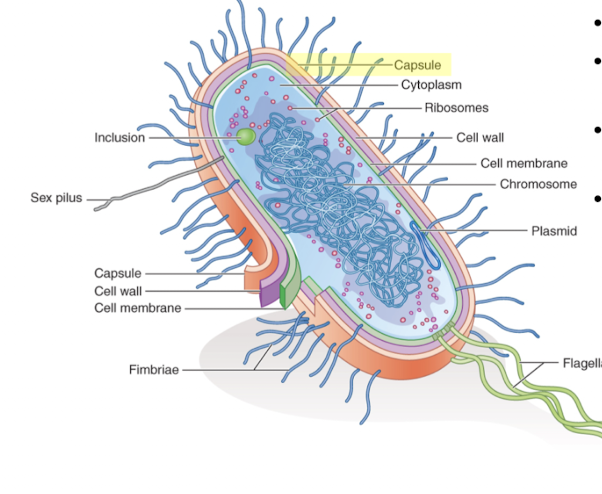
chromosome
DNA molecule, contains genetic information
prokaryotic DNA has no nucleus

plasmid
extrachromosomal DNA
it may carry antimicrobial-resistance genes

flagella
for motility → colonization + pathogenesis

fimbriae
allows bacteria to attach to surfaces (adhesion)
not for motility
adhesion → colonization

sxx pilus
enable DNA transfer between bacteria during conjugation
may spread antimicrobial resistance genes

endospore
highly resistant survival structure, not reproductive structures
resist harsh environmental conditions + many disinfectants
not a reproductive structure
helps some bacteria persist in environment
ex: bacillus spp., clostridium spp.
**alcohol not work, need to use soap and water instead
slime layer
loosely attached glycocalyx (capsule = more organized)
promotes surface attachent, contributes to biofilm formation → persistence on tissues and devices (ex: endotracheal tubes, urinary catheters, IV catheters)
ex: pseudomonas aeruginosa
binary fission
parent cell; dna replication → cell divides → two daughter cells
