AP Microeconomics Unit 1 Progress Check MCQ (Collegeboard)
 Call Kai
 Learn
Learn Practice Test
 Spaced Repetition
 Match
Match Flashcards
 Knowt Play
1/17

There's no tags or description
Looks like no tags are added yet.
Name | Mastery | Learn | Test | Matching | Spaced | Call with Kai | Chat |
|---|
No analytics yet
Send a link to your students to track their progress
18 Terms
Number of Apples Total Utility
2 130
3 180
4 220
5 250
6 270
7 280
If the price of an apple is $0.50, the marginal utility per dollar spent for the fifth apple is:
20, 30, 40, 60, or 100
60
Make the MB and MU/$ columns:
MB MU/$ (MB divided by price)
-- -- 2
50 100 3
40 80 4
30 60 5
20 40 6
10 20 7
MU/$ of the 5th apple is 60!
(same table as number 1) The marginal utility per dollar spent on the last orange consumed is 75. If the price of an apple is $0.50, how many apples would Johnny have to consume before he considers purchasing another orange?
2, 3, 4, 5, or 6
4
this is the last apple that has a MU/$ greater than 75
Which of the following best explains why individuals and societies must make choices when presented with alternatives?
A) People possess limited knowledge.
B) Resources are scarce.
C) People cannot agree on societal goals.
D) Resources are not fully employed.
E) People are more interested in their own well-being than in society's well-being.
B
Which of the following is the best example of a scarce factor of production?
A) Money
B) Food
C) Air
D) Airplanes
E) Established knowledge
D
Remember that money is NOT a factor of production/resource.
Airplanes are capital goods used to produce transportation services; therefore, they are a factor of production.
Which of the following is an example of a nonrival resource?
A) National park camping sites that can be reserved by anyone
B) Farmland that can be used to grow corn or soybeans
C) Solar energy
D) Fish in the ocean
E) Timber in a forest
C
It can be enjoyed jointly by all, and one person's enjoyment of the sun will not reduce its availability to others.
A power company decides to use wind turbines to provide electricity instead of coal. Which basic economic question does this decision answer in a free market economy?
A) What goods or services will be produced?
B) How will goods or services be produced?
C) Who will consume the goods or services?
D) What economic system should be adopted?
E) Who gets to decide?
B
HOW will we provide electricity, using wind turbines or coal?
Compared to a market economy, in a command economy there is greater:
A) government involvement in the allocation of resources
B) protection of private property rights
C) reliance on prices for allocating scarce resources
D) reliance on private businesses for the allocation of resources and distribution of goods
E) consumption of consumer goods
A
Which of the following economic systems primarily relies on prices for allocating resources and goods?
A) Free-market
B) Traditional
C) Command
D) Mixed
E) Socialism
A
Not D because resource allocation in a mixed economy depends on the cooperation of the private and the public sector to respond to market signals.
Because of conflict and political instability in Country Y, millions of its citizens emigrate to Country X. Which of the following best explains what will happen to Country X?
A) Country X's PPC will not change, but its consumption of goods will decrease.
B) Country X's production will move to a point inside its PPC, indicating slower growth.
C) Country X's production will move to a point on its PPC at which it produces only consumer goods.
D) Country X ' s PPC will shift outward over time.
E) Country X's PPC will shift inward over time.
D
Economic growth through more resources will cause an outward shift in the PPC. The growth in the labor force is one factor that causes economic growth.
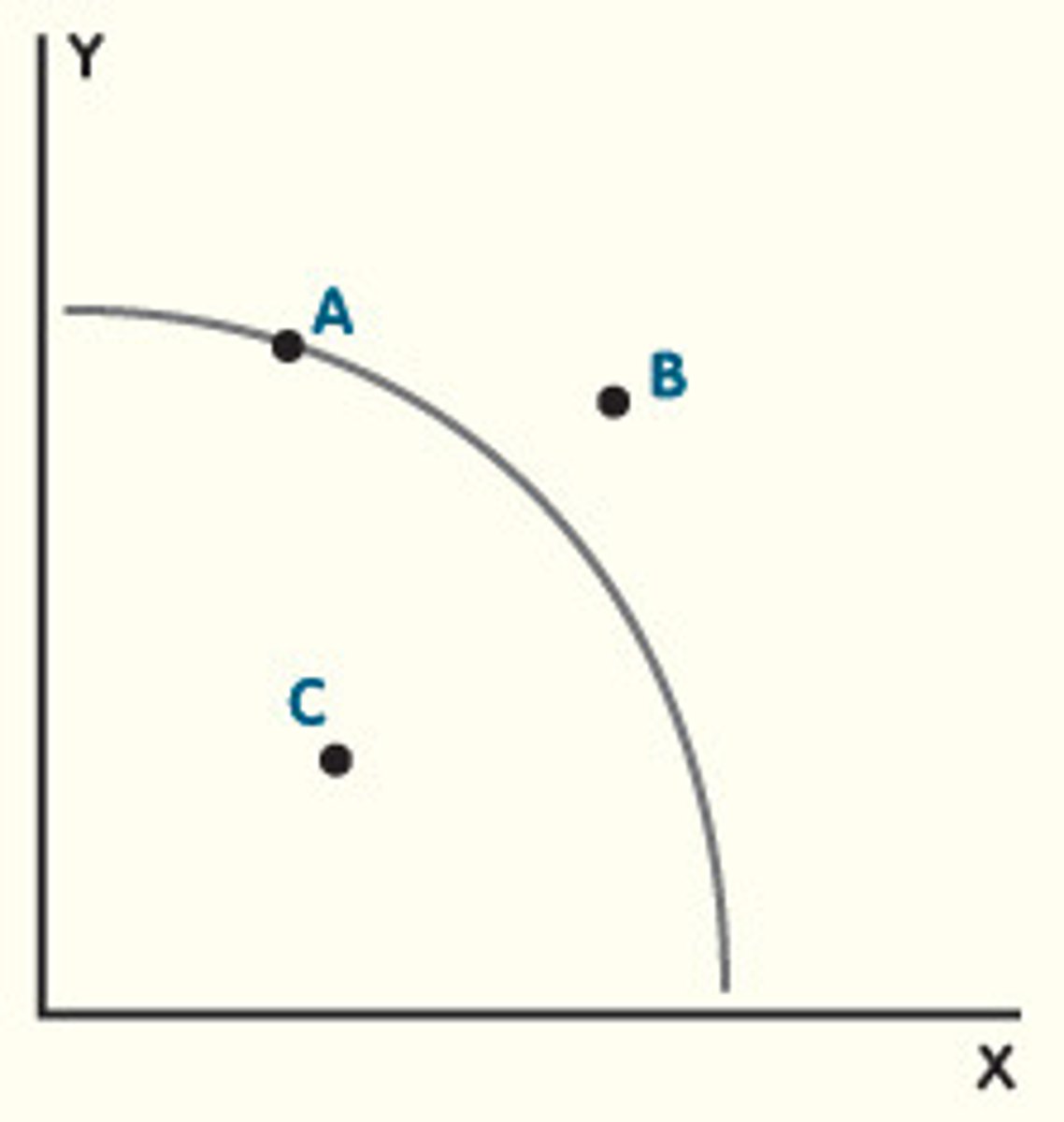
Ignore points A and C and pretend B is F
Which of the following will enable an economy to reach point F on the diagram above?
A) Reallocating currently available resources from apple production to production of oranges
B) Reallocating currently available resources from orange production to production of apples
C) Fully allocating currently available and unemployed resources efficiently
D) Creating or discovering new resources
E) Becoming a mixed economy
D
Doughnuts 140 120 90 50 0
Sweet Rolls 0 10 20 30 40
The above data describes a bakery's daily production possibilities curve for doughnuts and sweet rolls. Which of the following is true about the PPC?
A) The PPC illustrates decreasing opportunity cost.
B) The PPC illustrates increasing opportunity cost.
C) The PPC illustrates constant opportunity cost.
D) Producing 100 doughnuts and 10 sweet rolls illustrates efficiency in production.
E) Producing 0 doughnuts and 40 sweet rolls illustrates inefficiency in production.
B
If Nation X produces coffee at a higher opportunity cost than Nation Y, which of the following is true?
A) Nation X must have an absolute advantage in producing coffee.
B) Nation X must have a comparative advantage in producing coffee.
C) Nation Y must have an absolute advantage in producing coffee.
D) Nation Y must have a comparative advantage in producing coffee.
E) There is insufficient information to determine both absolute and comparative advantage.
D
Nation Alpha can produce either 3 units of good X or 1 unit of good Y with one hour of labor, whereas nation Beta can produce either 4 units of good X or 2 units of good Y with one hour of labor. Assuming that labor is the only input, which of the following is true?
A) Beta has an absolute advantage in the production of good X .
B) Alpha has an absolute advantage in the production of good Y .
C) Beta has a comparative advantage in the production of good X .
D) Alpha has a comparative advantage in the production of good Y .
E) Alpha has both an absolute and comparative advantage in the production of good Y.
A
Nation Aga can produce either 3 units of good XX or 1 unit of good YY with one hour of labor, while nation Kaza can produce either 4 units of good XX or 2 units of good YY with one hour of labor.
Assuming that labor is the only input, mutually beneficial exchange can take place between Aga and Kaza if:
A) Aga exchanges one half unit of good X for 1 unit of good Y from Kaza.
B) Aga exchanges 1 and one half units of good X for 1 unit of good Y from Kaza.
C) Aga exchanges 2 and one half units of good X for 1 unit of good Y from Kaza.
D) Kaza exchanges 1 unit of good Y for 1 unit of good X from Aga.
E) Kaza exchanges 2 units of good Y for 1 unit of good X from Aga.
D
Kaza's opportunity cost of producing 1 unit of Y is 2 units of X and Aga's opportunity cost of producing 1 unit of Y is 3 units of X; thus, exchanging 1 unit of Y for 2.5 units of X is beneficial to both nations.
Cost-benefit analysis assumes rational agents do which of the following?
A) Always make a decision that is best for society
B) Compare additional costs and additional benefits when making a decision
C) Consider only what they will lose when making a decision
D) Consider only what they will gain when making a decision
E) Always make the same decision
B
Oren's father tells Oren he can have one dessert after dinner. He can choose from a scoop of ice cream, a slice of apple pie, a cup of chocolate pudding, or a piece of fruit. Oren prefers chocolate pudding to a piece of fruit; he prefers apple pie to chocolate pudding; and he prefers ice cream to apple pie. If Oren chooses a scoop of ice cream, what is his opportunity cost?
A) piece of fruit.
B) A cup of chocolate pudding.
C) A slice of apple pie.
D) A scoop of ice cream.
E) A piece of fruit, a cup of pudding and a slice of apple pie.
C
Apple pie is the next best alternative.
A city is considering building playgrounds in city parks located near residential areas. The city planner presented to the township the following cost and benefit estimates to help the city council decide how many playgrounds to build.
Number of Playgrounds Total Cost ()TotalBenefit()
1 20,000 30,000
2 50,000 70,000
3 80,000 105,000
4 110,000 140,000
5 160,000 150,000
6 170,000 165,000
What is the optimal number of playgrounds to maximize net benefits?
6
5
4
3
2
4
4 playgrounds yields the largest net benefits.
net benefits = total benefits - total costs $140,000-$110,000 = $30,000
Suppose that Habib has a weekly fixed budget and spends it all on music downloads and snacks. At his current combination of consumption, the marginal utility of the last dollar spent on music downloads is greater than the marginal utility of the last dollar spent on snacks. Has Habib maximized his utility?
A) Yes, because he has purchased the maximum possible with his limited budget.
B) Yes, because he has purchased the two goods in proportion so that he can get the maximum utility from each.
C) Yes, because changing his current consumption combination will reduce his total utility.
D) No, because he can increase his total utility by purchasing more music downloads and fewer snacks.
E) No, because he can increase his total utility by purchasing fewer music downloads and more snacks.
D
Remember that MU/$ decreases as each additional unit of a good/service is purchased; so if he purchased more downloads, his MU/$ for the downloads would decrease to become equal to the MU/$ of snacks.