3.1.2 Theories of corporate objectives
 Call Kai
 Learn
 Practice Test
 Spaced Repetition
 Match
 Flashcards
 Knowt Play
1/22

There's no tags or description
Looks like no tags are added yet.
23 Terms
What is Corporate Strategy?
This is the course or route that a business has chosen to follow in order to achieve its corporate objectives
What does a corporate strategy help to provide?
A competitive advantage
What are Corporate Strategy influenced by?
Corporate objectives
distinctive capabilities
Competitive environment
Leaders’ attitudes to risk
Local, national and global economic environment
What is The Ansoff Matrix?
The Ansoff Matrix is a tool for business with a growth objective
It is used to identify an appropriate corporate strategy and the level of risk associated with the chosen strategy
The model considers four elements, which are broken down into two categories:
The market - existing and new markets
The product - existing and new products
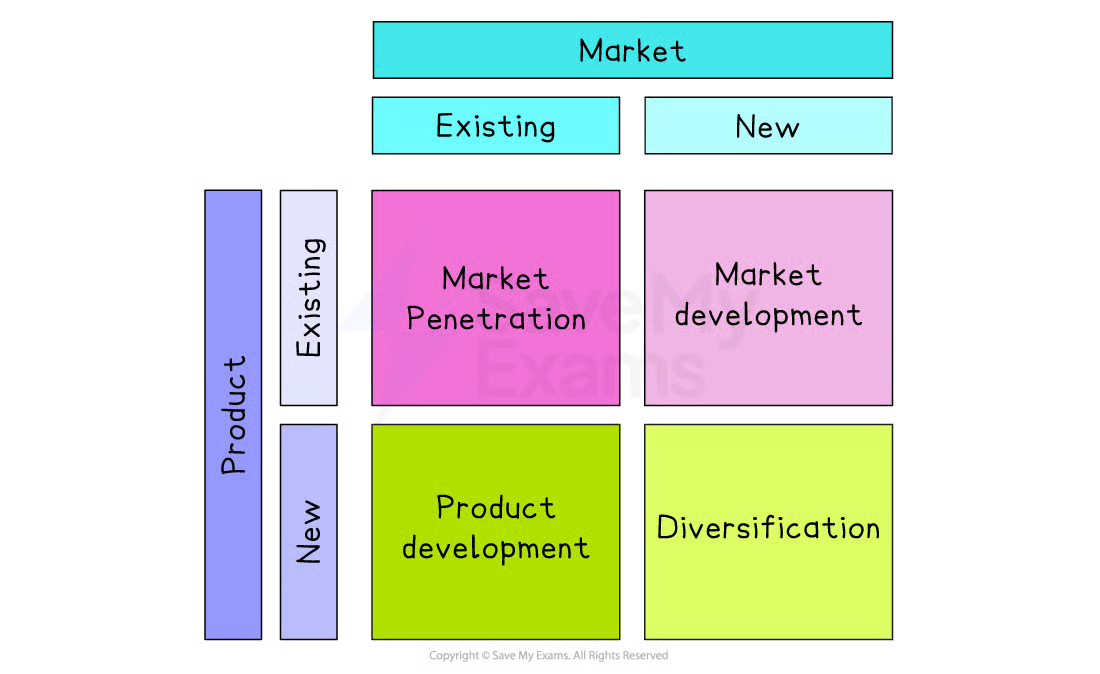
What does Market Penetration involve?
This involves selling more products to existing customers by encouraging:
More regular use of the product
Increased use of the product
Brand loyalty of customers
This is the least risky strategy to achieve growth
What does Market Development involve?
This involves finding and exploiting new markets opportunities for existing products by
Entering new markets at home or abroad
Depositing the product by selling to different customer profiles (selling to other businesses as well as directly to consumers)
Seeking complementary locations
What does Product Development involve?
This involves selling new or improved products to existing customers by
Developing new versions or upgrades of existing successful products
Redesigning packaging and aesthetic features
Relaunching heritage products at commercially convenient intervals
What does Diversification involve?
It is the most risky growth strategy, as it involves targeting new customers with entirely new or redeveloped products
Examples of diversification include
easyJet diversifying from flights alone into easyJet Holidays, a package holiday business offering flights, hotels and transfers
Greggs launching a range of themes clothing products
What is the Matrix useful for?
Can be useful for spotting ‘gaps’ in your corporate strategy
Supports the development of new corporate strategies → helps achieve corporate objectives
Encourages leadership to think ‘more creatively’ about potential strategies
Focuses managers on strategy + helps to build consensus across the functions
Simple and easy to understand
What are limitations of the Ansoff Matrix?
Simplistic: only shows part of the picture - large PLCs need far more analysis than a basic 2×2 grid, with many possible sub-strategies; it doesn’t tell you which strategy to pick
Static in a dynamic world: growth takes time, and markets change - an “empty” market may fill up with competitors by launch, and long-term forecasts can become inaccurate
Needs pairing with other tools: should be used alongside PESTLE for a fuller picture, since the best strategic answers usually come from combining tools
Doesn’t address implementation: it may suggest a “good” strategy, but doesn’t conform the company has the capabilities (finance, people) to actually achieve it
What is Portfolio analysis?
Portfolio analysis involves a business carrying out a detailed evaluation of its full range of products so that appropriate strategies may be identified and pursued
What is the Boston Matrix?
The Boston Matrix is a portfolio analysis tool that considers the relative market share of a firm’s products and the rate of growth within the market in which each product is sold
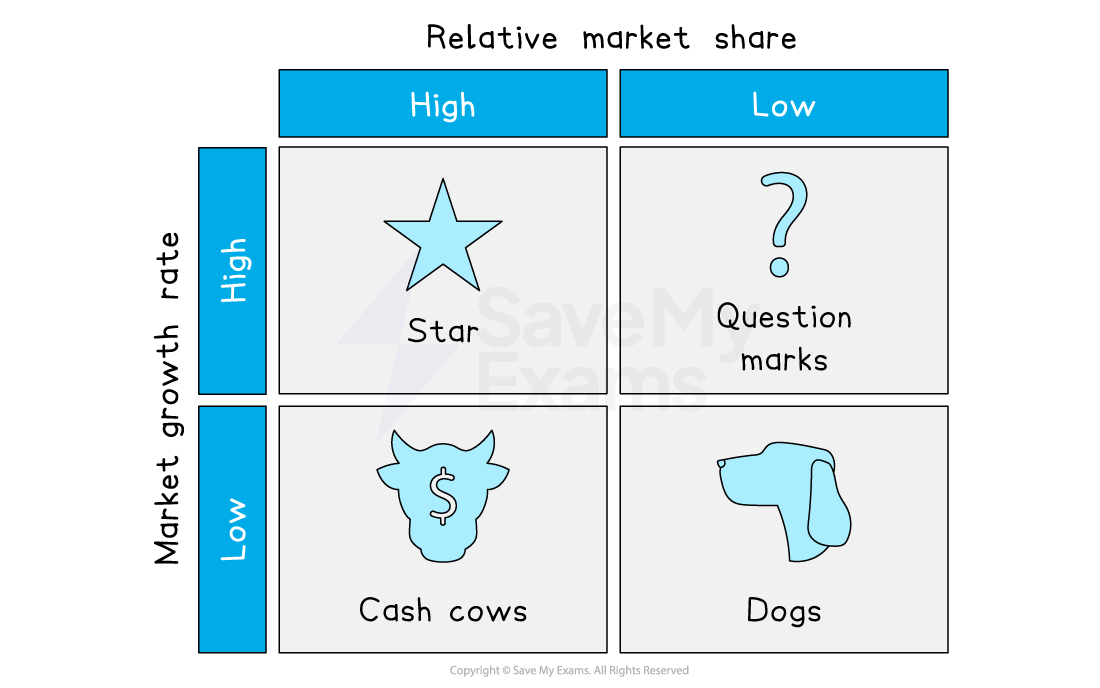
Explain the Star products
Star products are sold in high-growth markets and have a high level of market share
Stars require some ongoing investment to maintain their market position and, if managed well, they are likely to become cash cows in the future
A market penetration strategy to increase sales revenue and maximise market share is likely to be appropriate
Explain the Cash Cow products
Cash cows are sold in lower-growth markets and have a high market share
Cash cows generate more cash than they need to maintain their market position and can be used to fund the development of other products in the portfolio
Businesses may seek new markets for these products if they are relatively risk-free
Explain the Question Mark products
Question marks are sold in high-growth markets and have a relatively low market share
Question marks require significant investment if they are to improve their level of market share and become stars
There is a risk that question marks will become dogs when market growth rates slow
Explain the Dog products
Dogs are skid in high-growth markets and have a relatively low market share
Dogs have little potential for future growth and should be divested so that finance and effort may be invested in other products
What is Porter’s Generic Strategic Matrix?
Porter’s Generic Strategic Matrix identifies a range of strategies a business might adopt, considering
Its source of competitive advantage (cost or differentiation)
The scope of the market in which it operates (mass or niche)
Porter argues that failing to adopt one of these strategies risks a business being stuck in the middle” and unable to compete successfully with rivals in the market

Explain Cost Leadership
Mass market and low cost
The firm uses economies of scale, efficient operations and bargaining power over suppliers to become the lowest-cost producer, then competes on price across the whole market
For example: a discount supermarket like Aldi
Explain Differentiation Leadership
Mass market and differentiation
The firm makes its products stand out (branding, quality, innovation, design) to justify a premium price, while selling to a broad, mass-market customer base
For example: Apple
Explain Cost Focus
Niche market and low cost
The firm targets one narrow customer segment and wins within that segment by being the cheapest option, rather than trying to compete on price across the whole market
For example: A local no-frills budget gym
Explain Differentiation Focus
Niche market and differentiation
The firm tailors a distinctive, often premium product specifically to the needs of one narrow segment, rather than trying to appeal broadly
For example: A bespoke luxury tailor
What is a distinctive capability?
When a business has a particular strength that is very difficult for competitors to copy
The nature of that distinctive capability will determine the aims and objectives of the business and the strategies it will pursue to achieve them
Examples of distinctive capabilities
Operational skills and expertise within the business - a business may have an outstanding and committed design team, this may mean that product development is a suitable strategy
Relationships and networks established within and around the business - a business may have developed close trading relationships with suppliers, this may mean that a low-cost strategy is possible
Reputation and image of the business - a business may develop an excellent reputation for quality, a differentiation strategy is likely to be appropriate
Innovation and the ability to change - a business may be particularly effective at responding to external change, a market development strategy is likely to be suitable