6. Dermatological Disorders - Systemic Disease Fall 2026
 Call Kai
 Learn
 Practice Test
 Spaced Repetition
 Match
 Flashcards
 Knowt Play
1/115

There's no tags or description
Looks like no tags are added yet.
116 Terms
What is atopic dermatitis?
a chronic, relapsing inflammatory skin disorder characterized by pruitus, xerosis, and a defective skin barrier (dermatitis)
What is the pathophysiology of atopic dermatitis?
-Genetically complex disease
-Interaction between genes themselves and between genes and external environment
What are the 2 categories of atopic dermatitis?
-Allergic (extrinsic)
-Non allergic (intrinsic)
____% of patients with atopic dermatitis have allergic subset
80
What is allergic atopic dermatitis?
IgE mediated hypersensitivity to environmental allergens (food, inhalants)
What is allergic atopic dermatitis associated with?
Other atopic diseases: asthma, allergic rhinitis (hay fever)
What is non-allergic atopic dermatitis?
IgE normal, not sensitive to exogenous allergens
What is the epidemiology of atopic dermatitis?
2-5% of all children
90% of all children with atopic dermatitis will develop it by what age?
age 5
At 2 years old, ____% of children with atopic dermatitis will have clear skin, ____% have recurrences which may end around age 9
50;50
What is impetiginization as related to atopic dermatitis?
-a secondary bacterial skin infection that develops on top of a pre-existing skin condition or injury
-Can occur d/t skin barrier being broken down; patients are more susceptible to Staph infections

What are the signs/symptoms of atopic dermatitis?
-Pruritis
-Lichenification
-Xerosis
-Ichthyosis
-Flexural involvement in adults

What is puritis as related to atopic dermatitis?
-Itching macules and papules on cheeks and forehead
-May worsen with soaps, wool, lotions, sun

What is Lichenification as related to atopic dermatitis?
Thickening of the skin from chronic scratching; leathery appearance

What is Xerosis as related to atopic dermatitis?
dry skin

What is Ichthyosis as related to atopic dermatitis?
keratinization of the skin

Where is the flexural involvement of atopic dermatitis in adults?
-elbow
-popliteal fossa

Ocular findings occur in ____% of patients with atopic dermatitis
42

What are the characteristics of AKC?
-chronic
-bilateral
-severe allergic rxn
-pruitis, burning, redness, slight mucus discharge
-eyelid and conj erythema and edema
-blepharitis
-papillary rxn
-PEEs
-May show symblepharon, forniceal shortening, keratinization of the caruncle

What are the ocular signs/symptoms of atopic dermatitis?
-Dennie-Morgan folds
-Periorbital hyperpigmentation
-Keratoconus
-Cataracts
-Retinal detachment
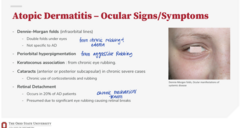
What are Dennie-Morgan folds?
Infraorbital lines; double folds under the eyes
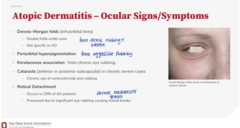
Are Dennie-Morgan folds specific to atopic dermatitis?
No
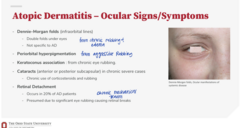
What are Dennie-Morgan folds d/t?
chronic rubbing and edema
What is keratoconus from with atopic dermatitis?
chronic rubbing
Describe the cataracts that are associated with atopic dermatitis
-Anterior or posterior subcapsular; usually in chronic and severe cases
-From corticosteroid use or rubbing
retinal detachment will occur in ____% of patients with atopic dermatitis
20
What are retinal detachments from atopic dermatitis d/t?
significant eye rubbing causing retinal breaks
What is the diagnosis of atopic dermatitis based on?
Clinical presentation + chronic relapsing course
____ elevation can support the diagnosis of atopic dermatitis
IgE elevation
If the diagnosis of atopic dermatitis is uncertain, what can be done?
Histological verification biopsy (not routine)
When diagnosing atopic dermatitis, what needs to be ruled out?
Eczema, contact dermatitis, psoriasis
What are the systemic treatments for atopic dermatitis?
-Remove the irritating agent
-Skin hydration, oil baths (emollients)
-Topical steroids
-Topical calcineurin inhibitors
-Biologics (Dupilumab)
-Antihistamines
-Topical and systemic antibiotics
What is the effect of topical calcineurin inhibitors for atopic dermatitis?
-Have anti-inflammatory effect
-Strong anti-puritic effect without side effects of corticosteroids
-Can be administered for a long time
What are antihistamines used for in atopic dermatitis?
pruitus
What are topical and systemic antibiotics used for in atopic dermatitis?
impetiginization
What are the ocular management/treatments for AKC?
-Eyelid hygiene
-Topical steroids, Cyclosporine
-Antihistamines
-Mast cell stabilizers
-Therapeutic CLs for corneal involvement
What are the ocular management/treatments for keratoconus d/t atopic dermatitis?
Correct RE and corneal cross linking
What are the ocular management/treatments for cataracts/retinal detachment d/t atopic dermatitis?
-Refer to ophthalmology for surgical intervention
What is rosacea?
a chronic inflammatory skin condition affecting the central face; frequently associated with significant ocular involvement
What is the pathophysiology of rosacea?
Dysregulation of innate immunity leading to chronic inflammation
What are the triggers for rosacea?
-Demodex
-UV exposure
-heat
-alcohol
-stress
What is the epidemiology for rosacea?
-High prevalence in people with fair skin from Irish, English, and Scottish ancestry
-30-60 years old
-Highest frequency after 50yo

What are the systemic signs/symptoms of rosacea?
-facial flushing
-persistent erythema
-telangectasia
-papules and macules w/ no comedones
-facial edema
-rough texture and dry skin

What are the symptoms of rosacea?
-burning
-stinging in the face

What differentiates rosacea from acne?
No comedones

What are the 4 subtypes of rosacea?
-Erythematotelangiectatic Rosacea
-Papulopustular Rosacea
-Phymatous Rosacea
-Ocular Rosacea

What are the key skin features of Erythematotelangiectatic Rosacea?
Persistent central facial erythema, flushing, visible telangiectasia

What are the common ocular findings of Erythematotelangiectatic Rosacea?
-Mild ocular involvement
-Burning
-Stinging
-Mild dry eye

Most often Erythematotelangiectatic Rosacea is associated with _____
facial telangiectasia

What are the key skin features of Papulopustular Rosacea?
Central facial erythema with papules/pustules (Acne like but no comedones) centrofacially, periorbitally, perinasally, and periorally

What are the common ocular features of Papulopustular Rosacea?
-Strongly associated with ocular involvement
-Blepharitis
-MGD
-Recurrent chalazia

What are the key skin features of Phymatous Rosacea?
Skin thickening and roughness; irregular surface; rhinophyma most common

What are the common ocular features of Phymatous Rosacea?
-Ocular signs vary
-Dryness and MGD may be present

Who is Phymatous Rosacea most common in?
Older men; not common in young patients
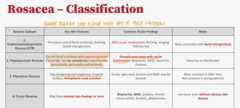
What are the key skin findings in Ocular Rosacea?
May have minimal skin findings or none

What are the common ocular fndings of Ocular Rosacea?
-Blepharitis
-MGD
-Chalazia
-Chronic conjunctivitis
-Keratitis
-Phlyctenules

Can ocular rosacea occur even without obvious skin findings?
Yes
Ocular signs and symptoms of rosacea will occur in ____% of cases
70
Most often ocular rosacea is (unilateral/bilateral)
bilateral
What are the symptoms of ocular rosacea?
-FBS
-Burning
-Itching
-Watery eyes
-Decreased VA d/t corneal involvement
What are the common eyelid findings (signs) of ocular rosacea?
MGD most common, blepharitis, recurrent chalazia and hordeola
What are the common chronic conjunctivitis findings (signs) of ocular rosacea?
Hyperemia, papillary rxn
What are the common keratitis findings (signs) of ocular rosacea?
-Superficial punctate keratitis
-Limbal infiltrate can progress centrally
-Corneal ulcers and thinning
Can phlyctenules present with rosacea?
yes
How is rosacea diagnosed?
Clinical presentation; dermatological exam
What should be identified if rosacea is presumed?
triggers (sun exposure, hot/cold, stress, alcohol, and spicy food
What test can assess the degree of dry eye symptoms d/t ocular rosacea?
Schirmer and TBUT
Even if the patient does not report skin symptoms with rosacea should you still examine their face?
Yes
What is the systemic management of rosacea?
-Long term management
-Identify and avoid triggers
-Topical metronidazole or azelaic acid cream
-Oral Doxy (low dose for anti-inflammatory effect)
What is the topical management of rosacea?
-Lid hygiene and WC
-AT/Cyclosporine
-Short term corticosteroids
-Doxy if severe MGD
-Amniotic membrane for severe corneal involvement
What is the dosage of Doxycycline for MGD?
-Initial Dose: 100mg PO QAM x 1 month
-Maintenance dose: 50mg PO QAM x 1 month
What is mucosal membranous pemphigoid?
Rare chronic autoimmune blistering disease, with predominant involvement of mucosal membranes including conjunctiva
What does mucosal membranous pemphigoid lead to?
progressive conjunctival scarring, leading to severe ocular surface disease
What is the pathophysiology of ocular cicatricial pemphigoid?
-Autoantibodies against basement membrane proteins
-Triggers Inflammation
-Leads to blistering, fibrosis, and scarring
What is the epidemiology of ocular cicatricial pemphigoid?
-Very rare (2 cases per 1 million individuals)
-Women > Men

What are the systemic signs/symptoms of ocular cicatricial pemphigoid?
-Oral mucosal blisters and erosions
-Nasal mucosal blisters and erosions
-Skin lesions
-Perianal or genital area affected

What is the effect of the Oral mucosal blisters and erosions of mucosal cicatricial pemphigoid?
-Desquamative gingivitis: painful, red, peeling, blistering gums
-Supraglottic Stenosis
-Hoarseness, Difficulty breathing, Dysphagia
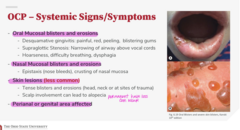
What is Supraglottic Stenosis?
Narrowing of airway above the vocal cords

What is the effect of nasal mucosal blisters and erosions?
Epistaxis (nose bleeds), crusting of nasal mucosa

Describe the skin lesions that can be present with mucosal membrane pemphigoid?
-Tense blisters and erosions (head, neck or at sites of trauma)
-Scalp involvement can lead to alopecia

What are the ocular signs/symptoms of cicatricial conjunctivitis?
-Scarring/Fibrosis
-Symblepharon
-Forniceal shortening
-Ankyloblepharon
-Trichiasis/Entropion
-Chronic blepharitis and keratinization of the lid margin
-Severe dry eye
-Corneal epithelial defects, scarring, vascularization
-Keratinization and conjunctivalization of the corneal surface due to epithelial stem cell failure
-Corneal symblepharon and corneal opacification
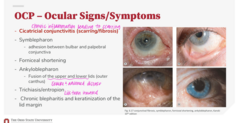
What is a Symblepharon (effect of cicatricial conjunctivitis)?
Adhesion between bulbar and palpebral conjunctiva

What is a Ankyloblepharon (outer canthus)?
Fusion of the upper and lower lids (outer canthus)

Why does ocular cicatricial pemphigoid cause severe dry eye?
-Destruction of goblet cells and lacrimal gland
-Reduced tear formation

What does corneal symblepharon and corneal opacification lead to?
Blindness; Eye will be completely opaque
How to diagnose ocular cicatricial pemphigoid?
-Dx and treatment must be made as early as possible
-Diagnosed based on clinical presentation
What is the gold standard for ocular cicatricial pemphigoid diagnosis?
Mucous membrane biopsy
What will a mucous membrane biopsy show for patients with ocular cicatricial pemphigoid?
Conj biopsy will slow linear antibody and complement deposition at the basement membrane
What is the systemic management/treatment of ocular cicatricial pemphigoid?
-Immunosuppression is mandatory
-Dapsone (First line treatment)
-Oral steroids (short term)
What is the ocular management/treatment of ocular cicatricial pemphigoid?
-Lubrication with PFAT
-Punctal occlusion
-Topical steorids
-Cyclosporin
-Subconj mitomycin C
-Bandage CLs
What are the reconstructive/surgical options for treatment/management of ocular cicatricial pemphigoid??
-Aberrent eyelashes
-Punctal occlusion
-Lateral tarsorrhaphy
When is surgery indicated for ocular cicatricial pemphigoid?
After disease stabilization
A severe mucotaneous reaction characterized by epidermal necrosis; caused by cell mediated delayed hypersensitivity rxn usually related to medications
Stevens Johnson Syndrome
What does Stevens Johnson Syndrome affect?
skin and mucus membranes
What is the severe variant of SJS?
Toxic Epidermal Necrolysis (TEN-Lyell syndrome)
When is SJS classified as TEN?
>30 body surface affected; extensive skin loss, higher mortality
What are the common causes for Stevens Johnson Syndrome?
-Antibiotics (sulfonamides, trimethoprim)
-Anticonvulsants (Lamotrigine, Carbamazepine)
-NSAIDs
-Infections (Mycoplasma pneumoniae, HSV, some cancer)
What is the mortality of SJS? What is mortality commonly d/t?
5% (commonly due infection, sepsis, multiorgan failure)
Mortality rates are higher in (SJS/TEN)
TEN
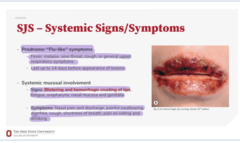
What are the prodromal signs/symptoms of SJS?
-Flu like symptoms
-Fever, malaise, sore throat, cough, general upper resp symptoms