Orno Test 2
 Call Kai
 Learn
 Practice Test
 Spaced Repetition
 Match
 Flashcards
 Knowt Play
1/107

There's no tags or description
Looks like no tags are added yet.
108 Terms

Spotted Dikkop

Black-Necked Stilt

Masked Lapwing
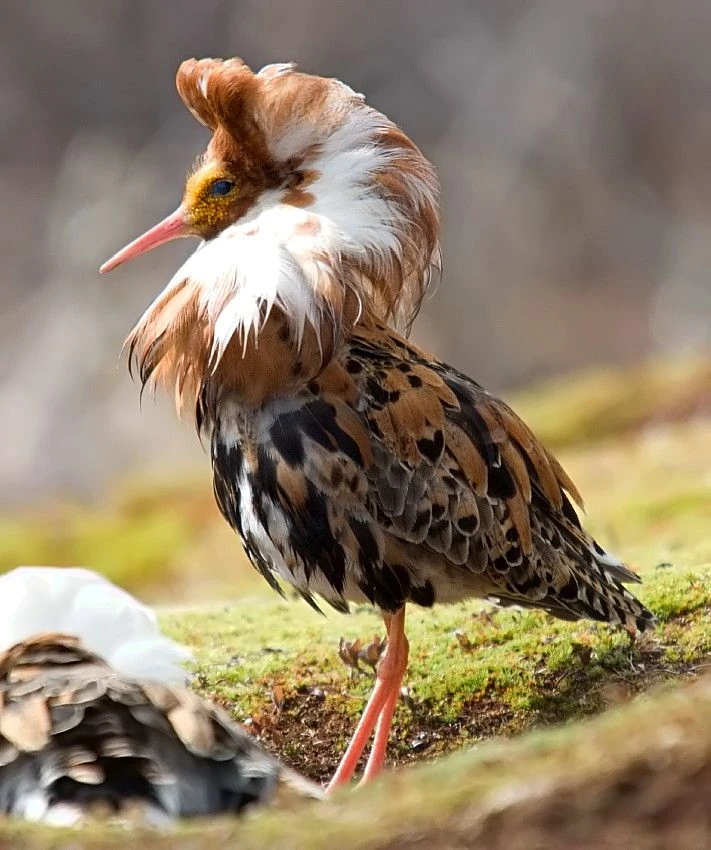
Ruff

Tufted Puffin

Atlantic Puffin

Horned Puffin
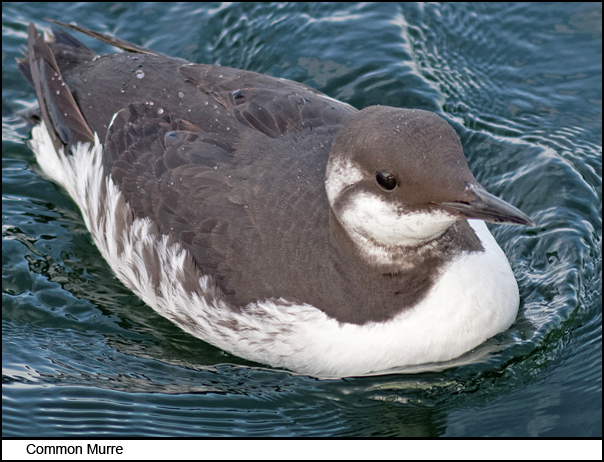
Common Murre

Grey Gull

Inca Tern

King Penguin

Emperor Penguin

Adelie Penguin

Gentoo Penguin

Chinstrap Penguin

Little Blue Penguin

African Penguin

Humboldt Penguin

Magellanic Penguin

Macaroni Penguin

Southern Rockhopper

Northern Rockhopper

Kori Bustard

Buff-Crested Bustard
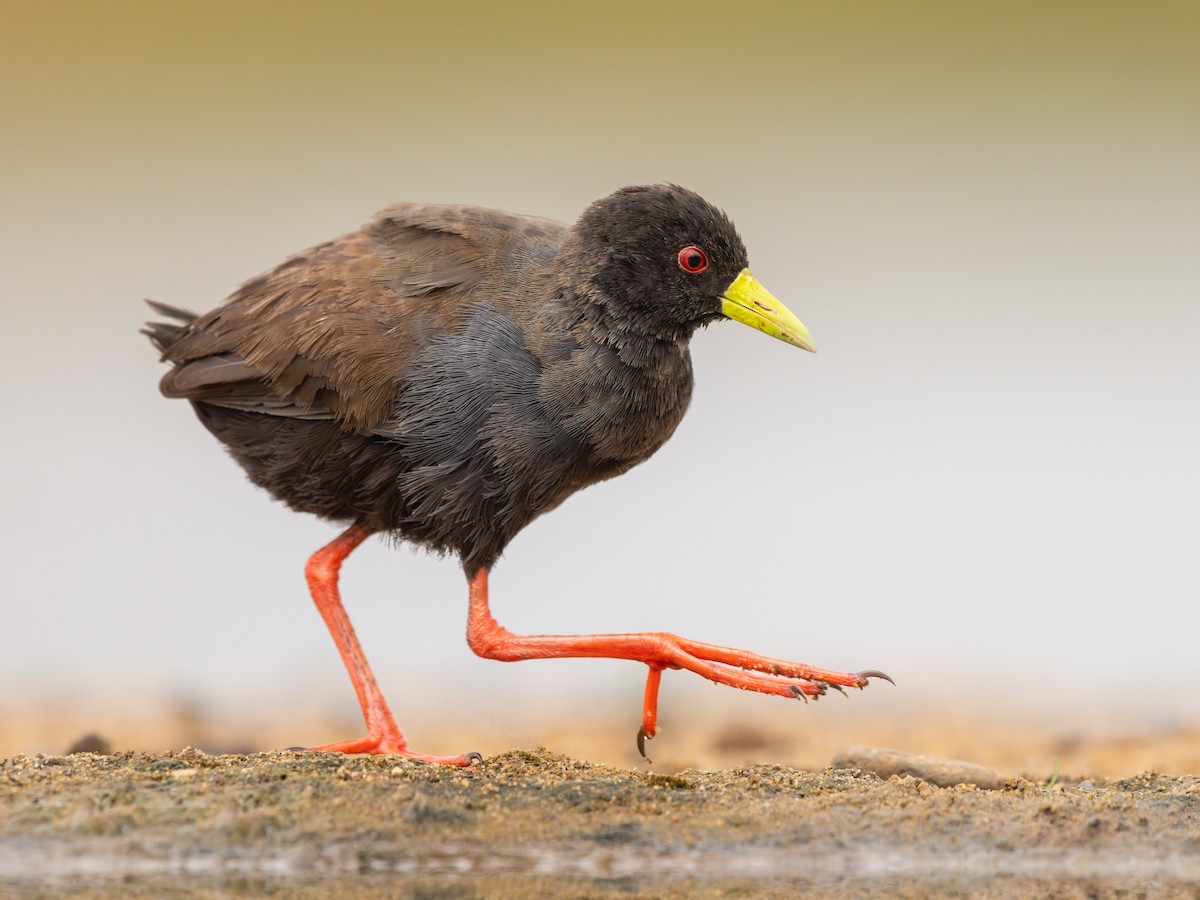
Black Crake

Gray Crowned Crane

Black Crowned Crane

White Naped Crane

Sarus Crane

Wattled Crane

Demoiselle Crane

Blue Crane

Red-Crowned Crane

Whooping crane

Hooded Crane

Sunbittern

Red-Legged Seriema
Spotted Dikkop family
Burhinidae
Black-Necked Stilt family
Recurvirostridae
Masked Lapwing family
Charadriidae
Ruff family
Scolopacidae
Tufted, altantic, horned puffin and common murre family
Alcidae
Grey Gull, inca tern family
Laridae
Kori and buff-crested bustard family
Otididae
Black Crake family
Rallidaes
Cranes family
Gruidae
Sunbittern family
Eurypygidae
Red-Legged Seriema family
Cariamidae
Penguins family
Speheniscidae
How does bound circulation works to create lift in a wing?
A vortex of air around the wing is local flow which creates free stream velocity
How does a wing shape or modification affect how they fly
Camber is the curvature of the wing and greater camber creates greater lift, a bird with greater wing surface area will create more lift
energy efficiency
minimum power is the highest efficiency for staying in the air for as long as possible; maximum power is the highest efficiency for travelling the furthest on a fixed amount of energy
pitch
(y-axis) - facing up or down
retrices importance
generate lift and reduce drag
why do wings move up and down during flapping
must generate both lift and thrust to keep flying
how does a wing foil work
wing acts as the foil (generating lift) and the propellor (thrust)
how is the skeletal system adapted towards life of flight
rigidity, redistribution of mass, limb modifications
how does jaw bones interact to open and close the jaw
the upper and lower jaws move at the same time through an interconnected chain reaction of 4 skull bones

6
maxilla
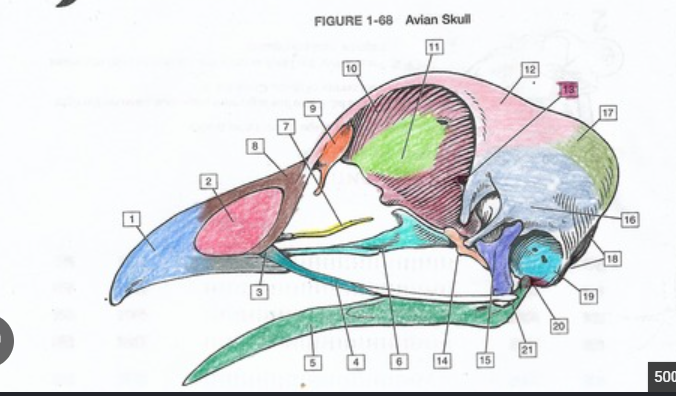
5
dentary
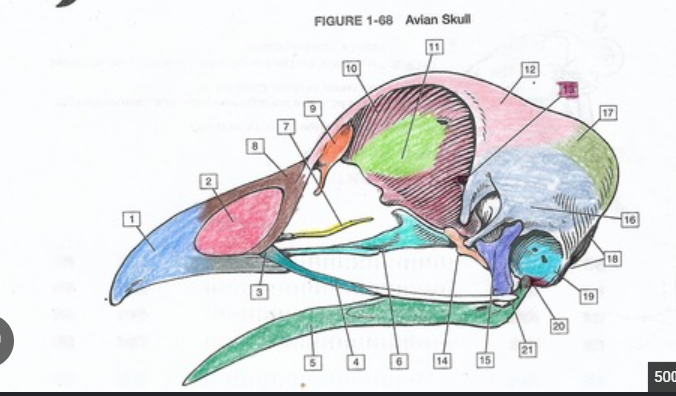
4
jugal
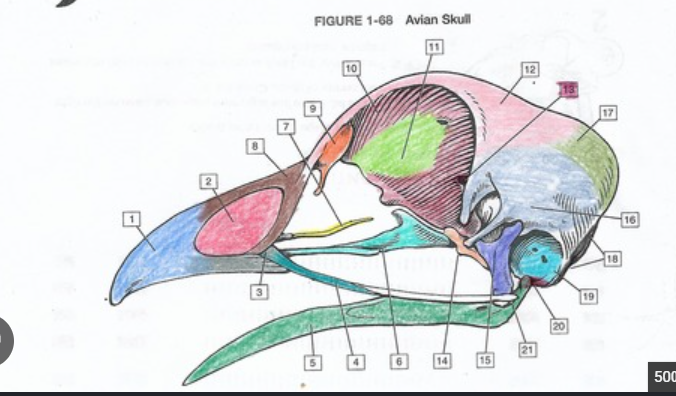
21
articular

2
nasal aperture

3
maxillary process of premaxilla
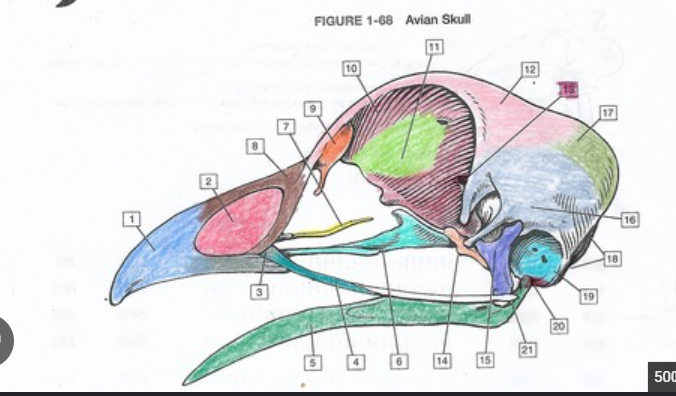
1
nasal process of the premaxilla

5
paraglossale

2
basihyal

3
urohyal

4
ceratobranchial

1
epibranchial
key skeletal structure of the flight mechanism
keeled sternum, coracoid, furcula, humerus, triosseal canal
flight muscles for flight mechanism
pectoralis (downstroke), supracoracoideus muscle (upstroke)
pulley system of flight mechanism
the supracoracoideus muscle sits low on the keeled sternum, the muscle tapers into a long, strong tendon, this tendon travels upward from the chest and threads completely through the triosseal canal at the shoulder joint, after passing through the canal, the tendon loops over the top of the shoulder joint and inserts onto the dorsal (top) side of the humerus, when the supracoracoideus muscle contracts, it pulls the tendon downward. Because the tendon is looped through the triosseal canal like a rope over a pulley, pulling down on the chest end pulls up on the top of the humerus, snapping the wing upward.
why do birds have intricate neck muscles
a bird's body is highly rigid and its eyes are mostly fixed in their sockets, so the neck must do the job of the hands, arms, and moving eyes combined
why are intricate neck muscles important
visual stabilization - keeps vision from blurring; feeding, preening, and tool use - clean, well-aligned feathers are mandatory for flight; shock absorption during landing and impact - neck muscles actively absorb and dissipate the mechanical shock; center of gravity management - shifting the heavy head and beak rebalances their center of gravity
describe the digestive tract
food goes in the mouth and then is swallowed and goes down the esophagus, then to the crop to the proventriculus, then goes to the gizzard to small intestine followed by ceca to large intestine ending with the cloaca

a
esophagus
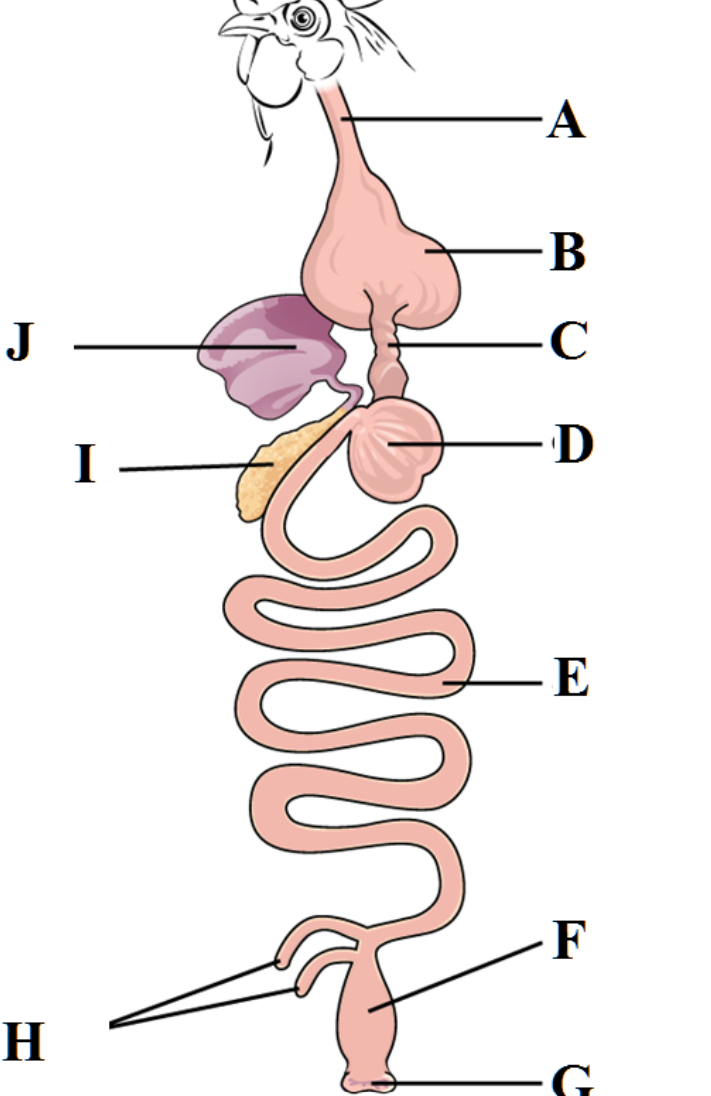
b
crop

c
proventriculus

d
gizzard

e
small intestine

f
large intestine

g
cloaca
digestive system modifications
the size and capabilities of a birds digestive organs change drastically to match their ecological niche; can physically change size within days
how the heart is different
avian hearts are larger than mammal hearts, the valves are configured differently, higher average body temp, heart links to a unique systemic of vascular networks
explain resp system in detail
lungs do not expand or shrink during breathing, air flows in one single direction during both inhalation and exhalation, it takes two full inhalations and two full exhalations for a single bolus of air to travel completely through the resp system, open-ended tubes called parabronchi, which split into thousands of microscopic air capillaries
breeding vs non-breeding
non-breeding - the reproductive organs basically "turn off" and shrink until they are microscopic
breeding - sugar surge and the reproductive organs wake up and swell to 100 to 1,000 times their winter size so they can actually produce eggs and sperm
pineal gland
acts as the biological clock. It senses changing light levels directly through the skull and secretes melatonin
avian brain vs human brain (how it sits in the skull)
avian brain sits horizontally, aligned front-to-back with the horizon, the cerebrum (forebrain), optic lobes (midbrain), and cerebellum (hindbrain) sit roughly in a straight, linear sequence
human brain has a 90-degree bend relative to the spinal cord, the massive cerebral cortex has expanded backward and upward, completely draping over and hiding the brainstem and cerebellum
cerebrum function
lacks a cortex, it powers exceptional spatial memory, problem-solving, tool-making, vocal learning

a
cerebellum

tip of f
spinal cord
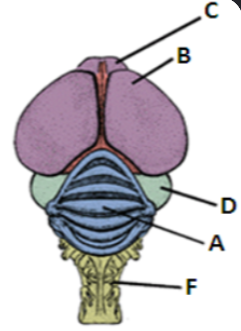
f
medulla oblongata

c
olfactory nerve
how an avian eye function and how it forms a clearer image than humans
bone braces telescope - instead of being soft and round, theirs is shaped like a telescope tube and locked in place by a ring of tiny bones
hyper dense pixels - to see a sharp, high-resolution image during the day, you need cones, not rods and birds have way more cones
no blood vessels in the way - bird's retina has zero blood vessels on it, they have a single comb-like structure called the pecten that feeds the eye from the back
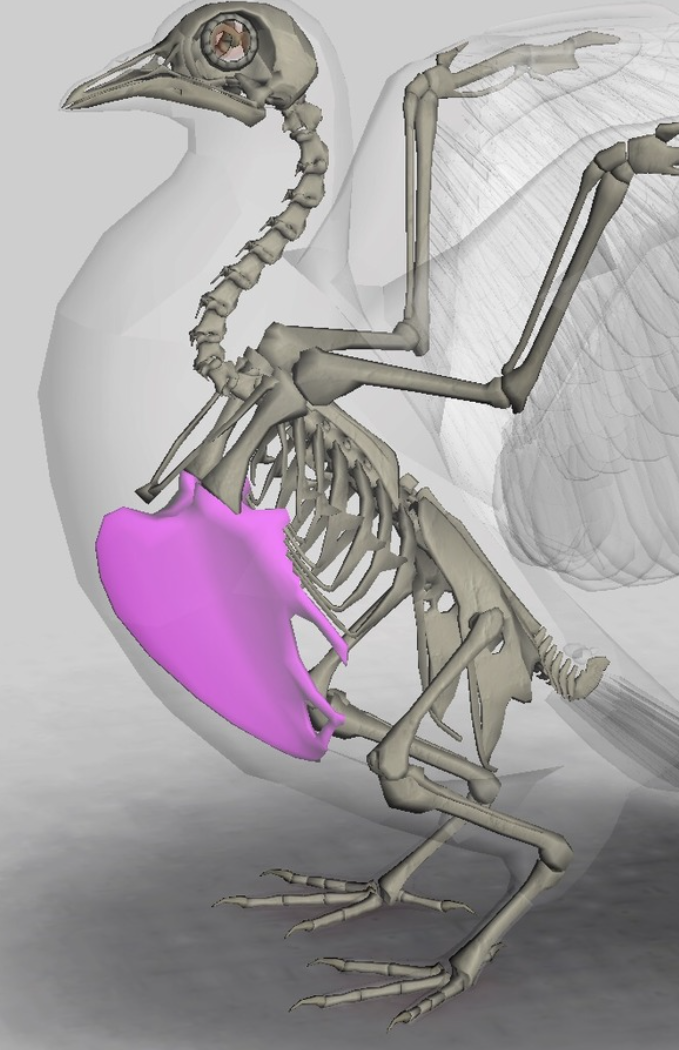
sternum

clavicle

L
coracoid

scapula
hearing
no external ear flaps which helps them stay aerodynamic in flight, instead, they are simple funnel-shaped holes on the sides of their head, feathers that cover them are called auricular feathers, columella efficiently pumps sound vibrations right into their inner ear fluid