Chapter 4: Biodiversity
 Call Kai
 Learn
Learn Practice Test
 Spaced Repetition
 Match
Match Flashcards
1/35

Earn XP
Description and Tags
APES Miller/Spoolman
Name | Mastery | Learn | Test | Matching | Spaced | Call with Kai | Chat |
|---|
No analytics yet
Send a link to your students to track their progress
36 Terms
adaptation
Any genetically controlled structural, physiological, or behavioral characteristic that helps an organism survive and reproduce under a given set of environmental conditions. It usually results from a beneficial mutation.

adaptive trait
Any genetically controlled structural, physiological, or behavioral characteristic that helps an organism survive and reproduce under a given set of environmental conditions. It usually results from a beneficial mutation.

artificial selection
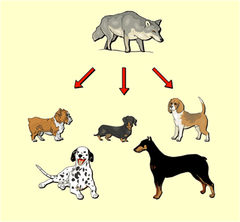
Process by which humans select one or more desirable genetic traits in the population of a plant or animal species and then use selective breeding to produce populations containing many individuals with the desired traits.
background extinction rate
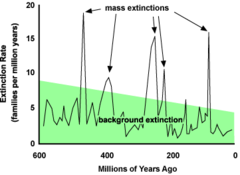
Normal extinction of various species as a result of changes in local environmental conditions.
biological evolution
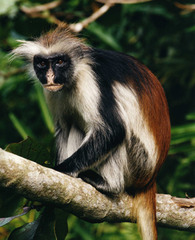
Change in the genetic makeup of a population of a species in successive generations. If continued long enough, it can lead to the formation of a new species. Note that populations, not individuals, evolve.

biome
Terrestrial regions inhabited by certain types of life, especially vegetation. Examples include various types of deserts, grasslands, and forests.

ecological niche
Total way of life or role of a species in an ecosystem. It includes all physical, chemical, and biological conditions that a species needs to live and reproduce in an ecosystem.

endemic species
Species that is found in only one area. Such species are especially vulnerable to extinction.
evolution
Change in the genetic makeup of a population of a species in successive generations. If continued long enough, it can lead to the formation of a new species. Note that populations, not individuals, evolve.

extinction
Complete disappearance of a species from the earth. It happens when a species cannot adapt and successfully reproduce under new environmental conditions or when a species evolves into one or more new species.

fossils
Skeletons, bones, shells, body parts, leaves, seeds, or impressions of such items that provide recognizable evidence of organisms that lived long ago.

gene mutation
Random change in DNA molecules making up genes that can alter anatomy, physiology, or behavior in offspring.

generalist species
Species with a broad ecological niche. They can live in many different places, eat a variety of foods, and tolerate a wide range of environmental conditions. Examples include flies, cockroaches, mice, rats, and humans.

genetic diversity
Variability in the genetic makeup among individuals within a single species.

geographic isolation
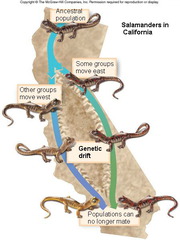
Separation of populations of a species into different areas for long periods of time.

habitat
Place or type of place where an organism or population of organisms lives. Compare ecological niche.

indicator species
Species whose decline serves as early warnings that a community or ecosystem is being degraded.
invasive species
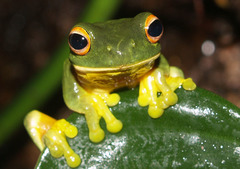
Species that migrate into an ecosystem or are deliberately or accidentally introduced into an ecosystem by humans.

keystone species
Species that play roles affecting many other organisms in an ecosystem.

mass extinction
Catastrophic, widespread, often global event in which major groups of species are wiped out over a short time compared with normal (background) extinctions.

mutation
Random change in DNA molecules making up genes that can alter anatomy, physiology, or behavior in offspring. See mutagen.

native species
Species that normally live and thrive in a particular ecosystem.

natural selection
Process by which a particular beneficial gene (or set of genes) is reproduced in succeeding generations more than other genes. The result of natural selection is a population that contains a greater proportion of organisms better adapted to certain environmental conditions.

niche
Total way of life or role of a species in an ecosystem. It includes all physical, chemical, and biological conditions that a species needs to live and reproduce in an ecosystem.

nonnative species
Species that migrate into an ecosystem or are deliberately or accidentally introduced into an ecosystem by humans.

reproductive isolation
Long-term geographic separation of members of a particular sexually reproducing species.
specialist species
Species with a narrow ecological niche. They may be able to live in only one type of habitat, tolerate only a narrow range of climatic and other environmental conditions, or use only one type or a few types of food.

speciation
Formation of two species from one species because of divergent natural selection in response to changes in environmental conditions; usually takes thousands of years.

species
Group of similar organisms, and for sexually reproducing organisms, they are a set of individuals that can mate and produce fertile offspring. Every organism is a member of a certain species.

species diversity
Number of different species (species richness) combined with the relative abundance of individuals within each of those species (species evenness) in a given area.

species evenness
Degree to which comparative numbers of individuals of each of the species present in a community are similar.

species richness
Variety of species, measured by the number of different species contained in a community.

theory of evolution
Widely accepted scientific idea that all life-forms developed from earlier life-forms. It is the way most biologists explain how life has changed over the past 3.6?3.8 billion years and why it is so diverse today.

biodiversity
The diversity of life forms in an environment

differential reproduction
The idea that those best adapted to their environment will be most likely to survive and have offspring

foundation species
A species that has a strong role in structuring a community (can occupy any tropic level)
