Gene Expression

0.0(0)
Studied by 0 people
call kaiCall Kai
learnLearn
examPractice Test
spaced repetitionSpaced Repetition
heart puzzleMatch
flashcardsFlashcards
GameKnowt Play
Card Sorting

1/30

encourage image

There's no tags or description

Looks like no tags are added yet.

31 Terms

1
New cards

Differential Gene Expression

some genes are expressed similarly across cell types, while some others are expressed in specific cell types

methods:
1. Chromatins Expression

  1. Transcription initiation


2
New cards

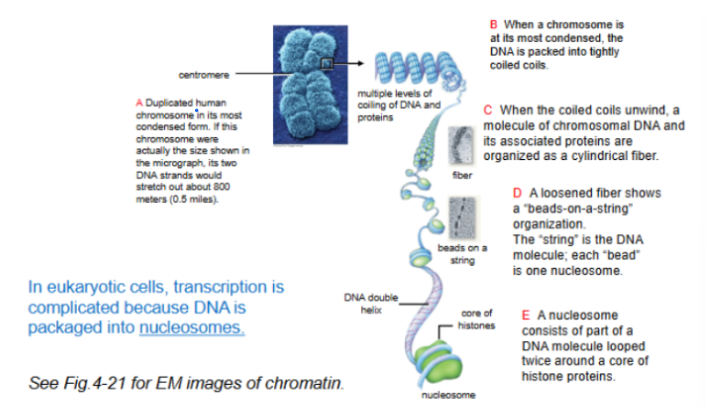
Chromatin modification

knowt flashcard image
3
New cards

Transcription initiation

  • requires both general and regulatory transcription factors.

    • General transcription factors present in all cells.

    • Regulatory transcription factors only present in specific cells.


<ul><li><p><span style="background-color: transparent;">requires both general and regulatory transcription factors.</span></p><ul><li><p><span style="background-color: transparent;">General transcription factors present in all cells.</span></p></li><li><p><span style="background-color: transparent;">Regulatory transcription factors only present in specific cells.</span></p></li></ul></li></ul><p></p>
4
New cards

Three requirements of transcription initation for differential gene expression

requirements:

  1. Transcriptional activators that bind to enhancer sequence on DNA.

  2. a Mediator complex that bridge the communication between transcriptional activator and general transcription factors and RNA Pol II.

  3. Chromatin modifying enzymes that remodels the chromatin.


<p><span style="background-color: transparent;"><strong>requirements:</strong></span></p><ol><li><p><span style="background-color: transparent;"><strong>Transcriptional activators that bind to enhancer sequence on DNA.</strong></span></p></li><li><p><span style="background-color: transparent;"><strong>a Mediator complex that bridge the communication between transcriptional activator and general transcription factors and RNA Pol II.</strong></span></p></li><li><p><span style="background-color: transparent;"><strong>Chromatin modifying enzymes that remodels the chromatin.</strong></span></p></li></ol><p></p>
5
New cards

Mediator complex

bridge the communication between transcriptional activator and general transcription factors and RNA Pol II.

Multiprotein complex (~2 M Da):

  • Forms molecular bridge between an activator bound to an enhancer and RNA Pol II bound to the promoter.

  • Facilitates assembly of RNA Pol II preinitiation complex

  • Some subunits bind to RNA Pol II

  • Some subunits bind activation domains of transcription factors

  • One subunit has histone acetylase activity: maintain a promoter region in a hyperacetylated state.


<p><span style="background-color: transparent;"><strong>bridge the communication between transcriptional activator and general transcription factors and RNA Pol II.</strong></span></p><p><span style="background-color: transparent;"><strong>Multiprotein complex (~2 M Da):</strong></span></p><ul><li><p><span style="background-color: transparent;"><strong>Forms molecular bridge between an activator bound to an enhancer and RNA Pol II bound to the promoter.</strong></span></p></li><li><p><span style="background-color: transparent;"><strong>Facilitates assembly of RNA Pol II preinitiation complex</strong></span></p></li><li><p><span style="background-color: transparent;"><strong>Some subunits bind to RNA Pol II</strong></span></p></li><li><p><span style="background-color: transparent;"><strong>Some subunits bind activation domains of transcription factors</strong></span></p></li><li><p><span style="background-color: transparent;"><strong>One subunit has histone acetylase activity: maintain a promoter region in a hyperacetylated state.</strong></span></p></li></ul><p></p>
6
New cards

Heterochromatin

  • Tightly wound chromatin

  • DNA is NOT accessible for transcription.

  • Histone methylation results in condensed chromatin.
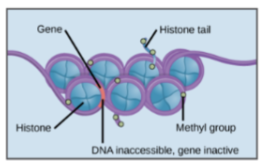

<ul><li><p>Tightly wound chromatin</p></li><li><p>DNA is NOT accessible for transcription.</p></li><li><p>Histone methylation results in condensed chromatin.</p></li></ul><p></p>
7
New cards

Euchromatin

Histone acetylation relaxes DNA, allowing genes to be transcribed

<p>Histone acetylation relaxes DNA, allowing genes to be transcribed </p>
8
New cards

histone methylation

can activate or repress transcription depending on the site and degree of methylation

maintained during replication (at least for mitosis)

<p><span>can </span><strong>activate or repress transcription</strong><span> depending on the site and degree of methylation</span></p><p><span>maintained during replication (at least for mitosis)</span></p>
9
New cards

RNA sequencing

How to determine levels of RNA transcription in different cells?
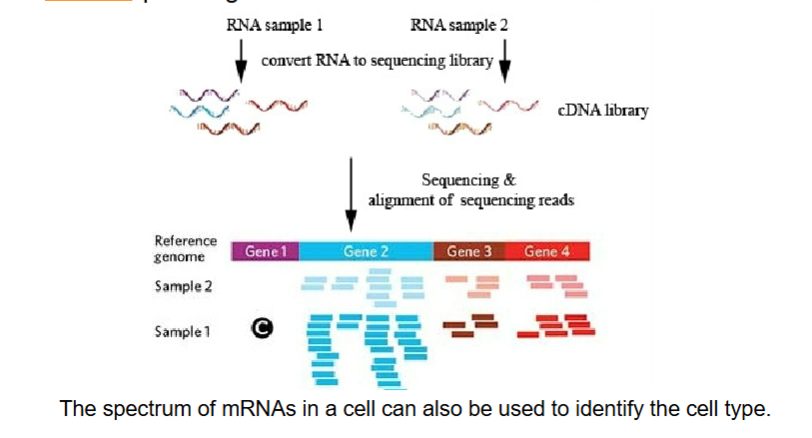
<p>How to determine levels of RNA transcription in different cells?</p>
10
New cards
<p>ChIP (Chromatin ImmunoPrecipitation) -seq</p>

ChIP (Chromatin ImmunoPrecipitation) -seq

How to examine histone modifications in the genome?

11
New cards
<p>ATAC (Assay for Transposase-Accessible Chromatin) -seq</p>

ATAC (Assay for Transposase-Accessible Chromatin) -seq

How to detect chromatin state?

12
New cards

regulatory transcription factors

all contain DNA binding domain and regulatory domain that interacts with the mediator

DNA binding domains of TFs

-- mostly interact with major groove of helical DNA

13
New cards

Transcription Activators

bound to enhancer sequences PROMOTE formation of a transcriptional complex.

facilitate interactions w promoter bound transcription machinery through DNA looping

<p><span style="background-color: transparent;">bound to enhancer sequences PROMOTE formation of a transcriptional complex.</span></p><p><span style="background-color: transparent;">facilitate interactions w promoter bound transcription machinery through DNA looping</span></p>
14
New cards

Transcription Repressor

bound to silencer sequences INHIBIT formation of a transcriptional complex
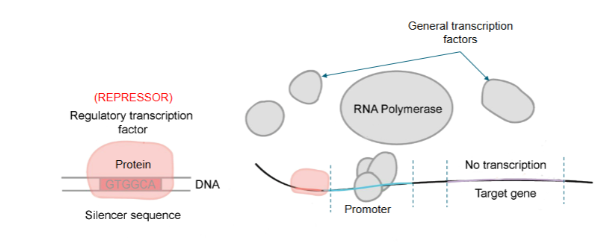
<p><span style="background-color: transparent;">bound to silencer sequences INHIBIT formation of a transcriptional complex</span></p>
15
New cards

enhanceosome

Transcription factors often function together

enhancer sequences can be upstream, downstream of the coding sequence, or within the intronic region of the gene.

DNA loops to bring all elements together.


16
New cards

Epigenetics

 the study of changes in gene expression that happen without altering the DNA sequence

17
New cards

Epigentic modifications

“Epi” (above, over) → modifications that do not change nucleotide sequence.

Ex. methylation/acetylation of histones and methylation of DNA nucleotides.

Reversible; potentially passed to offspring.

<p>“Epi” (above, over) → modifications that do not change nucleotide sequence.</p><p>Ex. methylation/acetylation of histones and methylation of DNA nucleotides.</p><p>Reversible; potentially passed to offspring.</p>
18
New cards

DNA methylation

  • Can inhibit gene expression

  • Prevents binding transcription

  • recruits proteins that recognize 5-methyl cytosine:

    • recruits proteins with repressor activity

    • recruits chromatin modifiers that compress chromatin


<ul><li><p><span style="background-color: transparent;">Can inhibit gene expression</span></p></li><li><p><span style="background-color: transparent;">Prevents binding transcription</span></p></li><li><p><span style="background-color: transparent;">recruits proteins that recognize 5-methyl cytosine:</span></p><ul><li><p><span style="background-color: transparent;">recruits proteins with repressor activity</span></p></li><li><p><span style="background-color: transparent;">recruits chromatin modifiers that compress chromatin</span></p></li></ul></li></ul><p></p>
19
New cards

Epigenetic inheritance

a cell memory that is not based on an inherited change in DNA sequence

20
New cards

RNA decay

knowt flashcard image
21
New cards

Noncoding RNAs

RNA molecules that are not translated into proteins but instead perform structural, catalytic, or regulatory functions in the cell.

ex. tRNA, rRNA, miRNA

22
New cards

tRNA

Carries amino acids during translation.

23
New cards

rRNA

Makes up part of the ribosome and helps catalyze peptide bond formation.

24
New cards

miRNA

Regulates gene expression by inhibiting translation or promoting mRNA degradation

25
New cards

What distinguishes miRNA from siRNA?

Similarities

cleaved by dicer, assembled in RISC

Differences

miRNA → binds to 3'-UTR of targe mRNAs, translation inhibition

siRNA → RNA cleavage; binds to corresponding RNA

<p>Similarities</p><p>cleaved by dicer, assembled in RISC </p><p>Differences </p><p>miRNA → binds to 3'-UTR of targe mRNAs, translation inhibition</p><p>siRNA → RNA cleavage; binds to corresponding RNA</p>
26
New cards

RISC (RNA induced Silencing Complex

knowt flashcard image
27
New cards


Histone acetylation

increased transcriptional activity and chromatin accessibility

28
New cards

Histone deacetylation

decreased transcriptional activity, and less accessible chromatin accessibility

29
New cards

how does gene expression work in specialized cells

the transcription factor that binds to the enhancer of this gene

30
New cards


RNAseq

Addition of a protein X to cells leads to increased expression of multiple genes. A experiment was performed on samples with and without protein X added, which detected different expression levels of many RNAs at the same time. Which experiment will it be?

31
New cards


Histone lysine demethylase

these proteins lead to increased expression of multiple genes, but it doesn’t have a DNA binding domain