Exam One
 Call Kai
 Learn
 Practice Test
 Spaced Repetition
 Match
 Flashcards
 Knowt Play
1/155

There's no tags or description
Looks like no tags are added yet.
156 Terms
Exam One Flashcards
START Pitmann

Fill in the blanks

In the parasympathetic pathway the postganglionic neuron releases ____ whereas in the sympathetic pathway the postganglionic neuron releases ____.
ACh
NE
This receptor is located in the airway smooth muscle and glands and when it is activated it causes bronchoconstriction and glandular secretion
M3
This receptor is located in the airway smooth muscle and when activated it causes bronchodilation
B2
This receptor is located in the heart and when it is activated in causes increased rate and contractility
B1
This receptor is located in the vascular smooth muscle (including the nasal vessels) and when activated in causes vasoconstriction
Alpha 1
For the airway smooth muscle
contraction _____ the airways
relaxation produces _______
it is targeted by ___-agonists and _____ antagonists
narrows
bronchodilation
beta-agonists
muscarinic antagonists
in airway inflammation inflammatory cells and mediators contribute to ______ and ______, targeted by _____ and _____ inhibitors
swelling and hyperresponsiveness
glucocorticoids
PDE4 inhibitors
respiratory anticholinergics
competitively inhibit ______ binding to muscarinic receptors
block ____-mediated airway smooth muscle contraction → _____
acetylcholine binding
M3
bronchodilation
Short aciting muscarinic antagonist example
ipratropium
long acting muscarinic antagonist examples
tiotropium
unmeclidinium
revefenacin
respiratory beta agonists acitvate _____ receptors on broncial smooth muscle
_____ intracellular cAMP → smooth muscle _____ → bronchodilation
B2
increase
relaxation
Short acting B2 agonists examples
albuterol
levalbuterol
Long acting beta 2 agonists examples
formoterol
salmeterol
arformoterol
olodaterol
B2 selectivity _____ cardiovascular effects
reduces (but does not eliminate)
glucocorticoids
bind intracellular ______ receptors
activated receptor regulates ____ expression
suppresses _____ and _____ responses
produces additioanl _____ effects
glucocorticoid receptors
gene expression
inflammatory and immune
metabolic
glucocorticoids in inflammatory airway disease
reduces airway _____
decreases airway _______ particularly in _____
inflammation
hyperresponsiveness
asthma
True or false: glucocorticoids directly produce rapid bronchodilation
FALSE
inhaled glucocorticoids
budesonide
fluticasone
beclomethasone
intranasal glucocorticoids
fluticasone
mometasone
triamcinolone
systemic glucocorticoids
prednisone
prednisolone
Histamine is endogenous signaling molecule involved in ____ and _____ responses
allergic
inflammatory
Histamine is stored in ____ cells in tissues and ____ in blood
mast cells
basophils
H_ is important in allergic symptoms while H_ is important in gastric acid secretion
H1
H2
H1 receptors in the:
vascular endothelium when activated increase vascular permeability → ____ and ___
sensory nerves when activated causes ____ and ____
bronchial smooth muscles when activated cause contraction → ________
edema and hives
itching and sneezing
bronchoconstriction
first generation antihistamines
block ____ receptor signalling
enter the CNS causing ____ and _____ alertness
can cause ___muscarinic acitivity
H1
sedation and impaired alertness
anitmuscarinic
second generation antihistamines
primarily exert peripheral ___ effects because of limited CNS penetration
have ____ sedation than first generation agents
___ antimuscarinic acitivity
H1
less
less
first generation antihistamines
diphenhydramine
chlorpheniramine
hydroxyzine
second generation antihistamines
cetirizine
loratadine
fexofenadine
PDE inhibitors
enzymes ___ and ____ breakdown intracellular ____
inhibitng enzymes ____ cAMP signalling
respiratory effects such as…
PDE3 and PDE4
cAMP
increase
airway smooth muscle relaxation (bronchodilation) and decreased inflammatory cell activity
______ has weak nonselective PDE inhibition causing bronchodilation
theophylline
_____ is selective to PDE4 inhibition and causes antiinflammatory effects NOT bronchodilation
roflumilast
_____ selective to both PDE3 and PDE4 causing bronchodilation and potential antiinflammatory effects
Ensifentrine
Summarize: mechanism and effect
Muscarinic antagonists
B2 agonists
Glucocorticoids
H1 antihistamines
PDE inhibitors

END Pitmann
START Milavetz
what is the primary purpose of the respiratory system
bring air and blood into close contact to allow:
oxygenation of hemoglobin
carbon dioxide diffusion out
What two systems work together to bring oxygen to the organs, tissues, and cells?
cardiovascular (blood)
pulmonary (air)
What are the two separate functional anatomic areas of the respiratory system?
upper airways
lower airways
What separates the upper airway from the lower airway?
carina tracheae
Name the parts of the upper airways
nasopharynx
oropharynx
pharynx
epiglottis
larynx (vocal cords)
eustachian tubes
True or false: upper airways still contain air and are lined with respiratory mucus membrane
true
which lung is larger and separated into 3 lobes?
right lung
What is the order of the lower airways?
trachea → main stem bronchi (left/right) → bronchi → bronchioles → terminal bronchioles → alveoli (not true airways)
gas exchange occurs in the _____. Oxygen exchange for carbon dioxide occurs on the _____.
alveoli
hemoglobin
what is the essential tissue for lung function
pulmonary parenchyma
what are the 3 functional layers of the airways
mucus membrane
smooth muscle
cartilage
mucus membrane purpose
the inner most lining of the airways
protects with cilia and mucus
secretes mucus, cilia moves the mucus up and out
smooth muscle purpose in airways
provides internal structure to airways
sprially wrapped around airway
cartilage purpose in airways
keeps airways open
is inhalation or exhalation an active, muscle driven process?
inhalation
Explain what happens during inhalation
intercostals and diaphram muscles contract
intercostals - pull ribs together and up
diaphram flattens
enlarging thoracic cavity, generating a negative intra-thoracic pressure
explain what happens during exhalation
respiratory muscles relax
air is blown out from a positive intra thoracic presure
What are the four pulmonary defense mechanisms
filtration - particles impact on inside of lumen
mucus clearance - cilia clear mucus and what it contains
innate immunity - immediate, nonspecific, no memory
adaptive immunity - cell mediated antibodies
true or false: the respiratory tract has a limited number of manifestations of disease regardless of etiology
true
A normal protective reflex function of the lungs
coughing
goal of coughin
determine the cause DO NOT SUPPRESS at all costs, treat the cause
Pathophysiology of inflammatory airway obstruction
increased mucus production
mucosal edema
compare asthma to COPD
asthma
increased bronchial responsiveness
bronchospasm
reversible
COPD
mucous hypersecretion (chronic bronchitis)
alveolar tissue destruction (emphysema)
disruption of normal repair and defense mechanisms
reduced gas exchange
When should medical attention be sought.
cyanosis of lips or fingernail beds
inability to catch breath at rest of without exertion
chest pain on inspiration or expiration
confusion, lethargy, loss of consciousness
what is looked at for physical examination
shape of chest
norm = broader than thick
abnormal = barrel chested
shape of thoracic cavity
spinal curvature abormalities
chest wall abnormalities
when are arterial blood gasses used? what do you measure with an arterial blood gas? what blood needs to be collected?
Use: acute situations
Findings: PaO2, PaCO2, pH
Blood: peripheral arterial blood (radial, femoral)
What does oximetry detect? When is it useful? What is a normal oximetry level?
Detect: peripheral capillary oxygen
Used: Chronic treatment
Norm: >95%
Purpose of pulmonary function tests
identify and quantify respiratory abnormalities
what are pulmonary function tests useful for?
diagnosis and evaluation
monitoring course and changes over time
in asthma, most obstructure occur in the ____ airways
smaller
what is FVC
the maxiumum volume of air exhaled forcefully from the point of maximum inspiration
What is FEV1
the volume of air exhaled in one second
indicator of large airway function
normal FEV1/FVC ratio
80%
What is used as an indicator for small airway function, usually decreasd in obstructive diseases
FEF 25-75
Explain the purpose of RV and what you gain from it
measure volume of air remaining in lungs after maximal exhalation
value is increased as more air is trapped in lungs
Explain the RV/TLC ratio and what the norm is
ratio of residual volume to the total lung capacity
norm = 20-30%
_____ responsiveness influences therapeutic choice
chronchodilator
Explain the purpose of DLco and what low results may mean
Assesses gas exchange, indicator of the efficacy of the pulmonary parenchyma
low result = reduced surface area, thickened alveolar walls, anemia, reduced blood flow to lungs
Biomarkers for asthma patients treated with biologic agents
nitrous oxide (FeNO)
IgE in serum
Eosinophils in peripheral blood
what is the indicator of eosinophlic airway inflammation
FeNO (Fractional exhaled nitric oxide)
END Milavetz
START Jin
Describe the structure of histamine
basic primary amino group — short two carbon chain — imidazole ring
imidazole ring contains 5 atoms (2 nitrogens)
planar aromatic ring (acidic AND basic)

At physiologic pH, what is the predominant form of histmamine?
monocation

Histamine exists as a mixture of two _____ forms.
tautomeric
which metal ions can bind to histamine?
Cu2+, Ni2+, Mg2+, Ca2+
What mediates decarboxylation of L-histidine? What does it create?
L-histidine decarboxylase
Histamine
What mediates deamination of histamine? What functional group changes?
DAO
changes primary amine to a carboxylic acid

What mediates methylation of histamine? What functional group changes?
HNMT and MAO
NH → N methyl group
HNMT is inhibted by ___ and ___ agonists, ___ antagonists, and high concentraitons of ____ antagonists.
H1
H2
H1
H2
Explain storage, release, and effects of histamine
Storage: mast cells and basophils
Release: from mast cells (in emergencies)
Effects: capillary dilation, capillary permeability, extravascular smooth muscle effects
Binding of histamine to its receptors activates _____ _____ as the first step in the chain of biochemical events resulting in ____ production and secretion.
adenylate cyclase
acid
Bisdihydrogen has equal ____ and ____ agonism
H1 and H2
Betazole favors ___ over ___ agonism at 10:1
H2 over H1
MOA of H1 antagonists
bind the H1 receptor competitivity (reversible)
ionic binding, electrostatic attraction and van der waals binding
Describe the general structure formula of H1 antagonists
X: O/N/C

the basic amino group on H1 antagonists is _____ at physiological pH
protonated
What are the four areas of modification for h1 antagonists
terminal nitrogen
prefers two methyl groups, teritary
central carbons
can be part of a ring, substituted, or part of a double bond
X → O/N/C
Ar1 and Ar2 aromatic rings
cannot be coplanar small para substituents
heteroaromatic isosteric with benzene
phenyl and pyridinyl similarities
similar size (isosteric)
Benzyl and pyridinylmethylene similarities
similar size (isosteric)

class of H1 antagonists where X is replaced by Nitrogen
Ethylenediamines


Class of H1 antagonists where X is replaced by oxygen
Aminoalkylethers


Class of H1 antagonists where X is replaced by Carbon
Propylamines


Class of H1 antagonists where X is replaced by Nitrogen in a ring
Phenothiazines

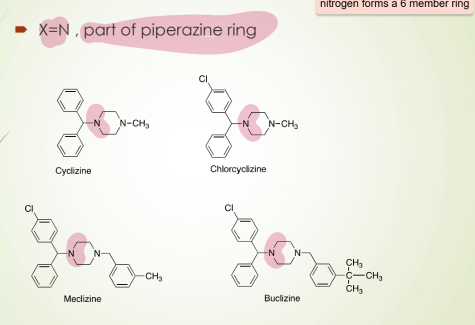
Class of H1 antagonists where X is replaced by a nitrogen that is part of a piperazine ring
Piperazines
