SR Unit 123456
 Call Kai
 Learn
 Practice Test
 Spaced Repetition
 Match
 Flashcards
 Knowt Play
1/143

There's no tags or description
Looks like no tags are added yet.
144 Terms
Exothermic Energy
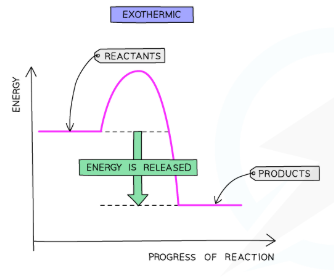
Transfers thermal energy to surroundings leading to an increase in the temperature of the surroundings. Enthalpy change is negative
Endothermic Energy
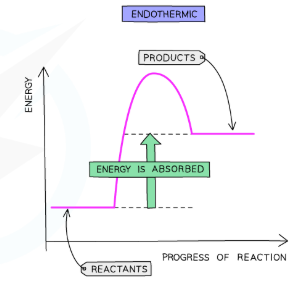
Takes in thermal energy from surroundings leading to a decrease in the temperature of the surroundings. Enthalpy change is positive
Activation Energy
Minimum energy particles must have to react
Bond breaking is an_____ process
endothermic
Bond making is a _____ process
Exothermic
Enthalpy Change=
Bond breaking - Bond Making
Exothermic Reaction pathway diagram
Endo thermic reaction pathway diagram
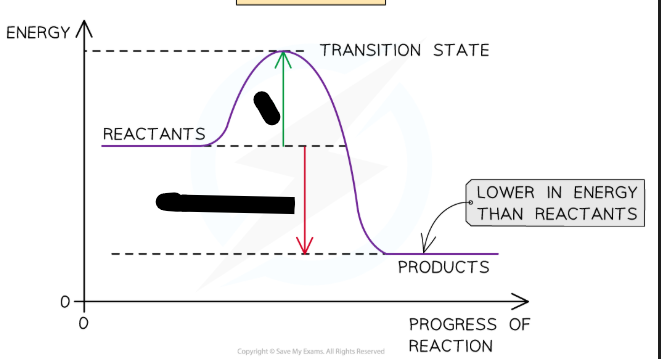
Label
Red arrow is enthalpy Change
Green arrow is activation energy
Enthalpy Change
Transfer of thermal energy during a reaction
Molecular formula
Number and type of different atoms in one molecule
Empirical Formula
Simplest whole number ratio of the different atoms or ions present in a compound
Relative Atomic mass
Average mass of the isotopes of an element compared to 1/12th of the mass of an atom of a carbon 12 one.
Relative Molecular Mass
Sum of the relative atomic masses,
Relative formula mass
Relative atomic mass used for ionic substances
How can concentration be measured?
g/dm³ or mol/dm³
Mole
Unit of amount of one substance and one mole contains 6.02×10²³ particles
Avogadro Constant
6.02×10²³
Molar mass
How much one mole of the substance weighs
How much does one mole of a substance weigh?
Its Relative formula mass
Moles formula
mol = mass (g) / molar mass (g/mol)
How much area does one mole of a gas in room temperature and pressure take up?
24dm³
How to convert in between g/dm³ and mol/dm³
g/dm³ x molar mass = mol/dm³
How do you work out empirical formula?
Divide percentage or mass by the Mr
Work out the simplest whole number ratio
How do you work out percentage yield?
Products produced/ Maximum products which theoretically could be produced
How do you work out percentage composition by mass
Mr of elements/ Mr in total
Solid distinguishing properties [4]
Fixed volume and shape
Packed very closely, regular arrangement
More dense
Particles vibrate in fixed positions but cant change location
Liquids distinguishing properties [4]
Fixed volume, takes shape of the container
Particles very close together but arranged irregularly
Usually less dense than solids but more than gasses
Particles can move and slide past each other
Gas distinguishing properties [5]
No fixed volume, take shape of the container
Low density
Far apart move randomly and quickly in all directions
Can be compresses
Collide with each other and sides of the container
Melting
Solid changes into a liquid
Requires heat energy which transforms into kinetic energy allowing particles to move and slide past each other and not only vibrate in fixed positions
Occurs only at the melting point
Freezing
Liquid into solid
Requires loss of heat energy which leads to less kinetic energy so particles don’t have enough energy to move and only vibrate in fixed positions
Occurs only at freezing point
Evaporation
Liquid turns into a gas over a range of temperatures
Only at the surface of the liquid where high energy particles escape below the boiling point
Larger surface area and warmer temperature increase evaporation
Boiling
Liquid changes into gas
Requires heat which causes bubbles of gas to form below the surface of the liquid
Occurs at a specific temperature, the boiling point
Condensation
Gas changes into a liquid over a range of temperatures,
When gas is cooled, its particles lose energy so they bump into each other and lack energy to bounce away so they clump together to form a liquid
Why is there no increase in temperature during a change of state
Thermal energy is used to overcome attractive forces between particles rather than increase the kinetic energy
Why is there no decrease in temperature during a change of state
Thermal energy lost is used to build intermolecular forces rather than decrease kinetic energy
Combined Gas Law
(P1V1)/T1 = (P2V2)/T2
Why does temperature increase the volume of a gas
As the temperature increases, the kinetic energy will also increase
The gas particles will move faster and spread out
Why does Pressure affect the volume of a gas
As the pressure increases, the particles will collide more frequently
Same number of particles in a lower space
So lower volume
Diffusion definition
Net movement of particles from a region of higher concentration to lower concentration due to their random movement
Molecular mass effect on diffusion
Bigger molecules diffuse slower as they have a higher mass so move slower and travel less in the same amount of time
Which element diffuses the slowest out of the first 30
Chlorine cause it forms Cl2 so more mass than Argon
Are solids always more dense than liquids
NO NO NO NO
Elements
A substance made of atoms that all contain the same number of protons which cannot be broken down into anything simpler through chemical means
Compounds
A substance made of two or more different elements chemically bonded in a fixed ratio requiring a chemical reaction to separate
Mixture
Two or more substances that are physically mixed but not chemically combined. Can be separated by physical means
Compounds vs Mixture
Compounds can only be separated by chemical means while mixtures can be separated by physical means 2. Compounds have different properties from the elements in it while mixtures keep the properties of its parts 3. Compounds have a fixed ratio while mixtures can be in any ratio throughout it
Proton
Positive subatomic particle found in the nucleus with a relative mass of 1
Nuetron
Neutral subatomic particle found in the nucleus with a relative mass of 1
Electron
Negative subatomic particle found in the shells with a relative mass of 1/1840 (negligible)
Proton Number/ Atomic Number
Amount of protons
Mass number
Protons + Neutrons
Electron shell maximum
Shell 1: 2
Shell 2: 8
Shell 3: 8
Atomic configuration of element with 17 electrons
2,8,7
Group number
Vertical column, amount of electrons in outer shell
Period number
Horizontal rows, amount of occupied shells
Why are Group 8 unreactive
Full outer shell Don't need to lose or gain electrons
Isotopes properties
Same chemical properties as they have the same electronic configuration
Different physical properties as they have different masses due to different amount of neutrons in the nucleus
Relative atomic mass formula
Ar = (mass of isotope 1 x abundance + mass of isotope 2 x abundance)/100
Ionic Bonding
Strong electrostatic attraction between oppositely charged ions
Anions
Negative ions
Giant lattice structure of ionic compounds
Regular arrangement of alternating positive and negative ions
Ammonia
NH3
Properties of Simple Covalent Bonds and why?
Low melting/boiling point: Only weak intermolecular forces, easy to overcome, little energy needed 2. Poor conductors of electricity: No free moving ions or delocalised electrons to carry charge
Graphite Structure
Each carbon joined to 3 others 2. Flat hexagonal layers 3. Layers can slide over each other
Graphite Properties
Conducts electricity (has delocalised electrons) 2. Soft and slippery (weak intermolecular forces in between layers allow layers to slide over each other) 3. High melting/boiling point (strong covalent bonds need lots of energy to overcome)
Diamond Structure
Tetrahedral 2. Each carbon joined to 4 others 3. Covalent bonds throughout
Diamond Properties
Extremely hard (each atom locked in place by strong covalent bond) 2. Very high melting/boiling points (strong covalent bonds difficult to overcome) 3. Does not conduct electricity (no delocalised electrons or free moving ions to carry charge)
Silicon Oxide Structure
Each silicon bonded to 4 oxygen 2. Each oxygen bonded to 2 silicon 3. Tetrahedral
Uses of Diamond
Industrial cutting tools
Metallic Bonding
The electrostatic attraction between positive ions in a giant metallic lattice and a sea of delocalised electrons
Properties of metals and why?
Good conductors of electricity (delocalised electrons) 2. Malleable and ductile (metals are arranged in layers which can slide over each other without breaking the metallic bonds)
Ductile
Can be easily drawn out into wires
Ammonia vs Ammonium
Ammonia is NH3 (ends in -a, like air it is a gas)
Ammonium is NH4^+ (ends in -um like Sodium or Potassium)
Electrolysis
Decomposition of an ionic compound when molten or in an aqueous solution through the passage of an electric current
Anode
Positive Electrode
Cathode
Negetive Electrode
Electrolyte
Molten or aquaeous substance that goes electroysis
Which substance can be formed at the cathode
Metal and Hydrogen
What is formed at the anode
Non metals except hydrogen
Why might metals might be electroplated
Improve their appearance and resist corrosion
How do electrons move through the external circuit to transfer charge
Electrons flow from the negative terminal of the power supply to the cathode giving the cathode its negative charge
How does charge transfer during electrolysis from loss or gain of electrons at the electrodes
At the cathode, cations gain electrons to form atoms
Anions move to the anode and lose electrons
These electrons then flow back to the external circuit back to the power supply completing the circuit
Where do cations move to?
The cathode
Where do anions move
Anode
Identify products made in the electrolysis of molten lead (II) bromide
Brown Bromine Gas is given off
Grey lead deposits on the surface of the electrode
Identify the products made in the electrolysis concentrated aqueous sodium chloride
Hydrogen gas made at the negative electrode
Chlorine gas made at the positive electrode
Na + ions and OH- ions react to form NaOH solution which is left behind
Identify substances produced in electrolysis of dilute sulfuric acid
Hydrogen gas produced at cathode
Oxygen gas and water produced at anode
Sulfuric acid stays in electrolyte
What will form at the anode if concentrated group 7 elements are present
halogen will be formed
What will form at the anode if there are no halogens or dilute halogens
Oxygen
What will form at the cathode if it the metal is more reactive than hydrogen
Hydrogen gas
What will happen in the metal is less reactive than hydrogen
Metal will produce and plate onto the cathode
Describe the electrolysis of aqueous copper sulfate using inert carbon electrodes
Copper forms at the Cathode and will coat the cathode in a pink-brown colour
Oxygen will form at the anode
Blue colour of copper sulfate solution fades over time
OH- ions are oxidized to form oxygen in the equation
4OH- → O2 + 2H2O + 4e-
Describe the electrolysis of aqueous copper sulfate with a copper electrode
Copper is formed at the Cathode increasing its mass
Blue colour of copper sulfate remains the same
Anode decreases in mass as it dissolves as copper atoms are oxidised there by the battery taking away electrons
Copper plated on Cathode is the same lost at the anode
Copper sulfate concentration reamins the same
How does electroplating happen
Surface of one metal coats another metal
The cathode gets electroplated
The anode is made from the pure metal which will coat the other substance
The electrolyte is an aqueous solution of a soluble salt of the pure metal at the anode
What does hydrogen oxygen fuel cell use and produce?
Hydrogen and oxygen to produce electricity with water as its only chemical product
Advantages of HOFC
No pollutants produced, only product is water. Petrol engines produce harmful pollutants like carbon dioxide which is a green house gas or carbon monoxide which is toxic to inhale or nitrogen’s oxides which cause acid rain
Higher efficiency, more energy than petrol engines per kilo
Renewable, uses electrolysis of water which is renewable
Disadvantages of HOFC
Required hydrogen which is produced from fossil fuels which is non renewable
Requires lots of energy which may be made by fossil fuels
Hydrogen is flammable which is more difficult to store than liquid petrol
Costs and materials to make hydrogen fuel cells is very expensive
Symbol for reversible reactions
⇌
When is a reversible reaction in a closed system at equilibrium?
The rate of forward reaction is equal to the rate of reverse reaction
Concentration of reactants and products are no longer changing