Thermocouple Psychrometry
 Call Kai
 Learn
Learn Practice Test
 Spaced Repetition
 Match
Match Flashcards
 Knowt Play
1/42

There's no tags or description
Looks like no tags are added yet.
Name | Mastery | Learn | Test | Matching | Spaced | Call with Kai | Chat |
|---|
No analytics yet
Send a link to your students to track their progress
43 Terms
Is there a direct way to measure ψS
No
Solutes depress the amount of
water
vapour above a solution.
Pure water (no solute):
relative humidity
100%
Dissolved solute
depresses the relative
humidity
RH < 100%
This method involves measuring the amount of water vapour above a solution, via determining the
dew point depression of the air.
The magnitude of dew point depression in the air space above the solution is related to the
[solute] in the solution
Pure H2O(l) does not have a
dew point depression
Add solute to pure water →
dew point depression
We care about how much H2O(g) is in the air above
the solution, compared to about much H2O(g) is in
the air when the liquid is
pure water
Warm air can hold
more water vapour (H2O(g)) than cold air
The dew point
temperature at which H2O(g) starts to condense
if you lower the temperature by even a fraction of a degree →
start seeing
condensation
Consider 25°C and RH = 100%. The dew point is
25°C
Raoult’s Law
the partial pressure of H2O(g) above a solution (PH2O(g)) is a function of
the mole fraction of solute (Xi) in the solution.
PH20 equation
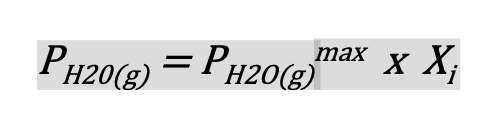
equation fo Xi

If we have pure water, then:

If there is dissolved solute, then:

Greater amounts of
dissolved solute leads to
lower PH2O(g) and a
lower dew point.
the dew point reflects the PH2O(g) at
the original temperature
the PH20(g) reflects
the [solute], or more specifically ψS, of the solution
Thermocouple
Two metal wires of different composition (different metals, different alloys) are
joined at each end (at the “junctions”).
Seebeck Effect If the junctions are at different temperatures (ΔT), there will be a
voltage
Seebeck Effect The larger the ΔT, the larger the
voltage
Seebeck Effect The reference junction has a known
temperature
Seebeck Effect The measuring junction is thus a
thermometer
Seebeck Effect Lots of digital thermometers are based on
thermocouples
The original thermocouple thermometers put the reference junction in an
ice bath (0°C).
Modern thermocouple thermometers use an
electronic reference junction.
Peltiers effect In this case the thermocouple loop is not
passive, as in measuring temperature.
Peltier cooling
If you pass a current through the loop, one junction becomes warmer and the other
junction becomes cooler
Seebeck effect used as a _ and Peltier effect used as a _
thermometer, cooling device
cannot use both effects at the same time but they can be used
sequentially
what do we need to measure PH2O(g)/dew point? 2
A sample in a closed space with a small air volume.
• A thermocouple that can be used for both cooling (Peltier effect) and as a thermometer (Seebeck effect).
Procedure 4
1) Use the Peltier effect to cool the junction.
2) Sufficient cooling will lead to water condensation on the junction.
3) Turn off the cooling, and use the Seebeck effect to measure junction temperature as
it warms up.
4) Junction passively warms up. At the dew point water (H2O(l)) starts to evaporate;
→ plateau in the warming trend, due to enthalpy (latent heat) of vaporization (energy
is required to convert H2O(l) to H2O(g))
procedure of thermocouple psychrometry is the same mechanism for
how evaporation of sweat from the body
leads to cooling
what is actually happening inside the psychrometer
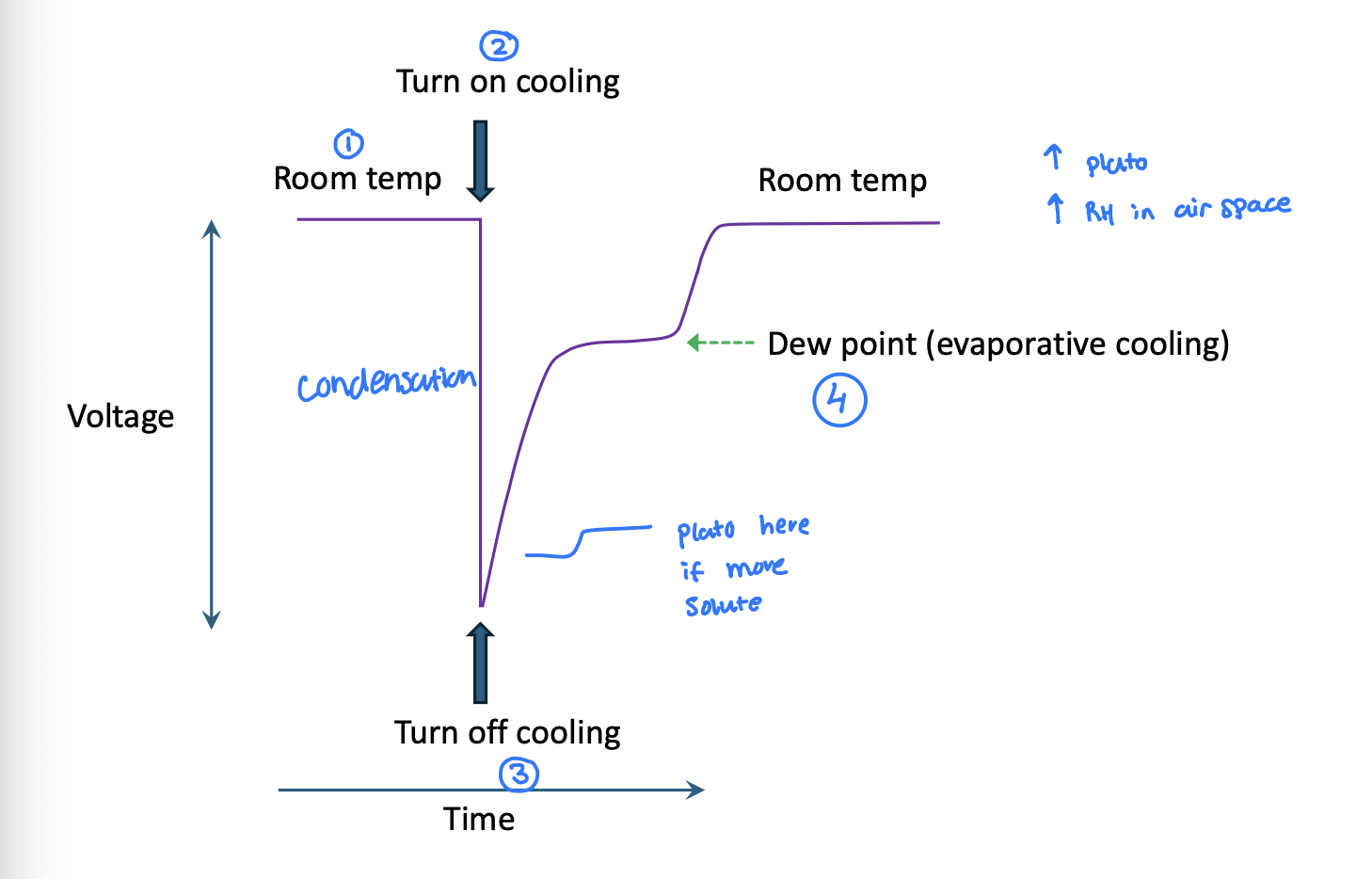
Old school thermocouple psychrometers generated the entire trace in
hard copy, and
users would then generate the data manually.
New school:
things are a lot more automated

Quiz - For the two examples below:
a) what are the relative values of PH2O(g)?
b) what are the relative dew points?
c) what can you say about the relative humidity in each of the chambers?
a) Pure water has the higher \(P_{H_2O(g)}\).
b) Pure water has the higher dew point.
c) Pure water has 100% relative humidity, while the water + solute chamber has a relative humidity below 100%.
The Höfler diagram shows the relationships between
the various components of ψ
think about that plant tissue in an environment that has a very high [solute]. And the [solute] keeps getting higher: what happens to ψ, ψS and ψP?
• What happens to cell size?
a) psis becomes more negative.
b)psip decreases because the cell loses water and turgor pressure drops.
c) psi decreases overall because:
d) Cell size decreases because water moves out of the cell by osmosis.
think about what happens if the external [solute] keeps getting lower? All the way to zero [solute] (= pure H2O).
• What happens to ψ, ψS and ψP?
• What happens to cell size?
a) psis becomes less negative as the external solute concentration decreases.
b) psip increases because water enters the cell and turgor pressure rises.
c) psi increases overall and moves closer to 0.
d) Cell size increases as water moves into the cell.