3. Basics of Life Insurance
 Call Kai
 Learn
Learn Practice Test
 Spaced Repetition
 Match
Match Flashcards
 Knowt Play
1/40

There's no tags or description
Looks like no tags are added yet.
Name | Mastery | Learn | Test | Matching | Spaced | Call with Kai | Chat |
|---|
No analytics yet
Send a link to your students to track their progress
41 Terms
What is a 2-party contract for life insurance?
When the policy’s applicant and insured are the same.
What is a third-party ownership contract in life insurance?
The owner of the life insurance policy is someone other than the insured.
What is insurable interest?
The person applying for the policy must be at risk of suffering a significant loss if the insured dies. The loss may be:
• emotional
• financial / economical
In the personal insurance market, what relationships create an “Insurable Interest”?
• spouses or domestic partners
• parents and children
• other close family members
— it’s assumed you have insurable interest when purchasing a policy on yourself.
Two-party = applicant and insured are the same person
In the business insurance market, what relationships create an “Insurable Interest”?
• business partners
• corporations and their officers and directors
• any type of business and it’s key employees
— insurable interest also exists between lenders (creditors) and people that owe them money ( debtors)
At what time must insurable interest exist?
Property & casualty insurance (auto, homeowners, etc.) = insurable interest must exist at the time a loss or claim occurs.
Life insurance = insurable interest only required at the time of application.
Why does “Survivor Protection” exist when used as personal use for life insurance?
The risk of death makes surviving family members financially vulnerable. Any family member that depends on the financial support of the income earner—even aging parents, a disabled sibling, or stay-at-home mom/dad.
What does “Mortgage Payoff” mean when used as personal use for life insurance?
A mortgage life insurance policy will pay off the debt if the insured dies.
Explain “Estate Creation” when used as personal use for life insurance.
An individual’s estate are the assets they leave behind at death, and pre-mature death can rob them of the time needed to accumulate assets. For people in their working years, life insurance can create an estate if pre-mature death prevents them from doing so themselves.
Explain “Estate Conservation” when used as personal use for life insurance.
Life insurance can ensure the estate is conserved and kept intact for their heirs.
Covers estate (death) taxes and probate expenses—the size of the estate determines the amount of taxes due.
What does “Liquidity” mean when used as personal use for life insurance?
Liquidity = how easily an asset can be turned into cash w/out loss of value.
• liquid assets: bank checking & savings accounts, life insurance proceeds
• illiquid assets: precious metals (gold & silver), gems, stamps, farm equipment, and small or privately held businesses interests
What is “Cash Accumulation” in personal use for life insurance?
To accumulate cash. Permanent life insurance policies have a cash value component that grows over time. The life insurance cash value is called the policies living benefits.
Money can be used for:
• home emergencies; fix heating or leaking roof
• opportunities; start a new business
• education fund for children or grandchildren
• supplementary retirement income
What are the 6 personal uses of life insurance?
• survivor protection
• mortgage payoff
• estate creation
• estate conservation
• liquidity
• cash accumulation
What is the “Human Life Value” approach when determining the amount of life insurance?
Replace an individual’s economic value using this calculation:
Amount of their annual income X number of years until retirement.
For example, $50K/year X 30 years to retirement = $1,500,000
What is the “Needs Approach” when determining the amount of life insurance?
Based on the financial situation the survivors will face if the individual dies.
— more commonly used than the human life value.
What are the 2 categories of survivors’ financial needs?
Cash needs
Income needs
What can cash needs be used for?
• final expenses = funeral/burial, medical bills
• debt payoff = mortgage, credit cards, car loans, etc.
• children’s education = fund for college/trade school
• emergency fund = unexpected expenses
What can income needs be used for?
Ongoing living expenses like food, clothing, utilities, mortgage, etc.
What are the 3 income needs periods?
Family dependency = during the period the surviving children are too young to support themselves.
Preretirement = the children are grown, but the surviving spouse has not yet reached retirement age.
Retirement = the surviving spouse is no longer earning an income.
During what period does social security pay survivor benefits?
During the Family Dependency and Retirement periods.
When does social security suspend survivor benefits, the “blackout” period?
During the preretirement period, and when the youngest child turns 16, and resumes when the spouse turns 60.
Once the survivors’ income needs are determined, what 3 financial sources will reduce the amount?
Bank accounts, investment accounts, or Individual retirement accounts (IRAs).
Employer life insurance or retirement benefits payable to a surviving spouse.
Social Security that can pay benefits to the surviving dependents.
What information must the insurance agent acquire during the “data gathering” or “fact -finding” interview that is required for the needs approach?
• names and birthdays of every family member to determine the length of the 3 income periods.
• sources and amounts of income available upon the individual’s death.
• debt, like mortgages, that must be eliminated.
• existing assets that can be used to offset survivors’ cash needs.
• life insurance amounts already owned, including group life insurance through an employee benefit plan.
• financial objectives — like children’s desired education level and retirement income goals.
What is a buy-sell agreement when businesses use life insurance?
Buy-Sell Agreement = Contract that decides who buys a departing owner’s share and at what price.
They provide for the sale of a business interest at the death or disability of an owner. To make sure purchasers have the money, Life insurance is the most common way to fund it — the death benefit pays for the buyout.
The policy is on the business owner’s life, and the buyer is the beneficiary.
— buy-sell agreements often called “business continuation plans”.
What are the 2 types of buy-sell agreements?
Cross-purchase plan — the surviving owner(s) purchase the deceased owner’s interest in the business. When funded by life insurance, each partner (or shareholder if corporation) buys life insurance on the other owners. If there are more than 2 partners or shareholders, many more policies are needed than an entity plan.
Entity plan — the business itself buys life insurance on all owners. If the business is a corporation, often called stock redemption plans b/c the corporation is redeeming the deceased owner’s stock.
Cross-Purchase vs. Entity-Purchase

What is “key-person coverage”?
The business owns, pays for, and is the beneficiary of the policy on the key person’s life. The insurance proceeds can be used to offset direct financial losses or help pay the costs of finding and training a replacement.
What are “Executive Bonus Plans (section 162 bonus plans)”?
Rather than giving an employee a yearly cash bonus, companies can use the money to buy a policy for the employee. The business pays the premiums on a life insurance policy which the employee owns.
— the employee has full access to the policy’s living benefits
— bonus is tax deductible to the employer as a salary expense
— bonus included in the employee’s gross income as they pay the premiums
— upon death, the beneficiary receives the death proceeds free of income tax
What are “Deferred Compensation Plans”?
An employer agrees to pay an employee a stated amount of income beginning at retirement rather than paying the money now. This benefits the employee b/c the money is not taxable until the employee receives it, usually in a lower tax bracket.
— employee agrees to work for the employer until a specific future date (usually retirement)
— deferred compensation benefits forfeited if employee leaves before the date
— if employee dies before retirement, the benefits become payable immediately to the beneficiary.
Companies often buy a life insurance policy to cover the cost if employee dies. If the policy is permanent insurance, cash value can be used to pay the deferred compensation benefits to the employee lives to retirement.
What are the 4 business uses of life insurance?
• buy sell funding (cross purchase or entity purchase)
• key person
• executive bonus
• deferred compensation
What is “Group Life Insurance”?
A single contract that covers an entire group of people. Typically, policy owner = employer & policy covers employees.
What is Industrial Life Insurance?
Developed as a way for people w/ limited means to obtain some of the benefits of life insurance.
• face amounts usually small — 2k or less
• often bought just to pay burial expenses
• premiums due weekly collected in person by producers who go door to door
What is Home Service Life Insurance?
A variation of Industrial Life Insurance with larger face amounts and more convenient premium payment options.
• Face amounts typically $10K – $25K (larger than industrial)
• Sold by home service or industrial producers in the same neighborhoods
• Premiums usually collected via automatic bank draft (monthly debit) or by mail
• Producers do not have to collect premiums door-to-door every week
Individual vs Group Life Insurance
• Individual: One policy per person, policyowner chooses amount & pays based on their own risk.
• Group: One master policy (usually employer), employer chooses amount, cheaper because risk is spread across the group.

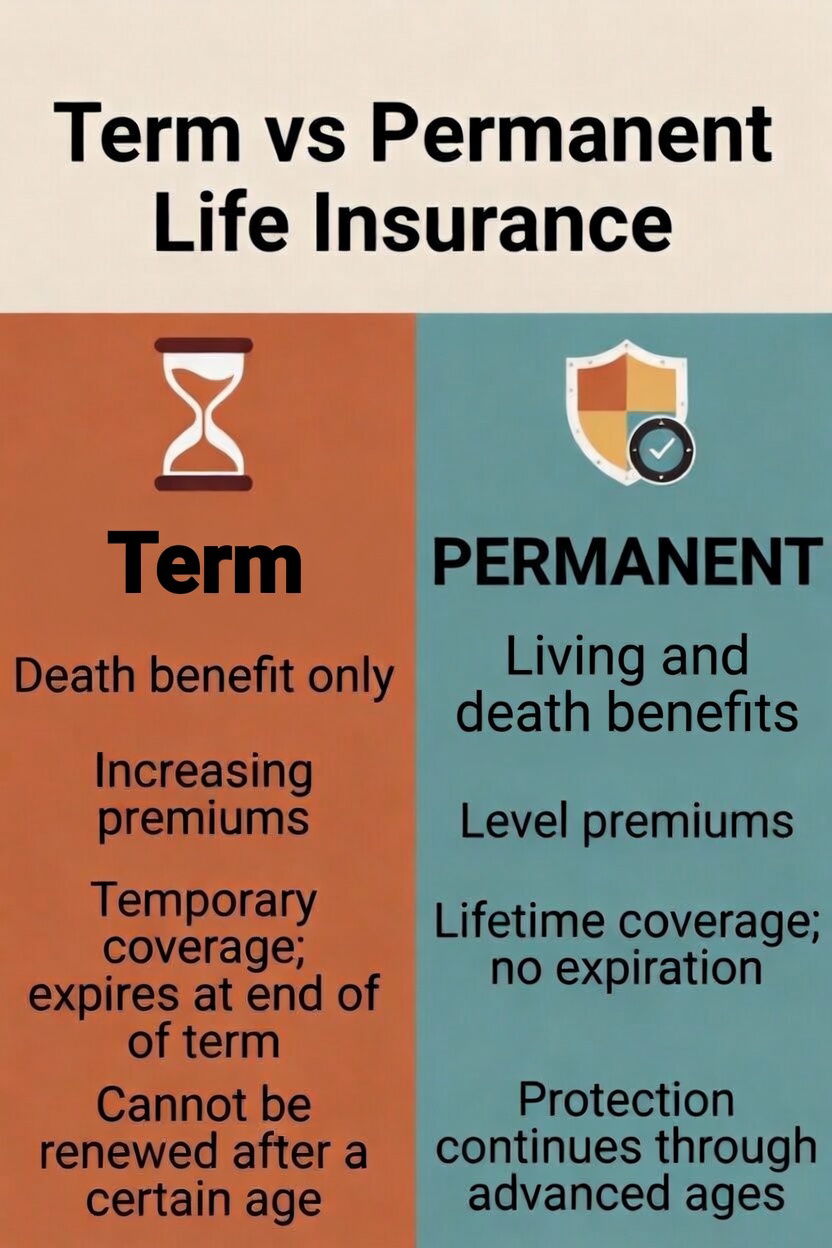
Term vs Permanent Life Insurance
• Term: Death benefit only, temporary coverage, increasing premiums, expires at end of term.
• Permanent: Death + living benefits, lifetime coverage, level premiums, builds cash value.
Participating vs Nonparticipating Life Insurance
• Participating: May pay dividends to policyowner (usually mutual companies), slightly higher premium.
• Nonparticipating: No dividends (usually stock companies), slightly lower premium.

Fixed vs Variable Life Insurance
• Fixed: Guaranteed cash value, values in dollar amounts.
• Variable: No guaranteed cash value, values in investment units (securities product).

What are the 5 classes of life insurance?
• Individual vs. group
• term vs. permanent
• participating vs. non-participating
• fixed vs. variable
• industrial & home service
What are the 3 premium elements — elements to calculate premiums?
• mortality = death rate; relative frequency of deaths in a specific population
• interest = earnings on premium dollars b/w the time they are collected and the time they are paid out as claims
• expenses = insurer operating costs — the expense load. Adding the expense element to premiums is called loading
What is Net Premium & Gross Premium?
• Net Premium = Mortality - Interest
• Gross Premium = Mortality - Interest + Expenses
What is the Premium Payment Mode?
How frequently premiums are due.
Premium mode:
• annual
• semi-annual
• quarterly
• monthly
— annual is the lowest