LCB Exam 2 Guide
 Call Kai
 Learn
 Practice Test
 Spaced Repetition
 Match
 Flashcards
 Knowt Play
1/49

There's no tags or description
Looks like no tags are added yet.
50 Terms
actions
goal-directed, intentionally taken behaviors dependent on the knowledge of and want for the outcome, (an R [response] → O [outcome] association); sensitive to reinforcer devaluation, as they depend on you valuing that goal/outcome
reinforcer devaluation
lessening subjective value of a reinforcer, for example if a response is at first paired with outcome (lever press to food) and that outcome is then paired with an illness, then future extinction responding is decreased (not as many lever presses) because the outcome is now worth less because it is associated with negative illness
habits
automatic, mechanical, or mindless activity, dependent on a stimulus before the response rather than an outcome after the response, and therefore not impacted by reinforcer devaluation
The O, R, and S of consuming sugary food
O = food/positive feelings from sugar
R = eating that food
S = seeing, smelling, touching food; time of day (i.e. lunch); setting (i.e. ice cream shop)
How can reinforcer devaluation be used to distinguish between goal-directed actions and habits?
in a lab setting, if a response decreases in the test phase after an outcome is paired with a negative feeling/outcome (i.e. if a food pellet is then paired with illness/stomach sickness in absence of the response), then that is a goal-directed action, as a habit does not involve/factor in an attractive outcome; if the response remains mainly the same, then the response was likely a habit elicited by a stimulus, rather than the expectation of an outcome (because the outcome being undesirable has no effect)
Evidence that habits replace actions with repetition of said response
more practice makes a behavior less sensitive to reinforcer devaluation, indicating that that response is becoming less dependent on an outcome (action) and more on a stimulus (habit);
evidence that habits are easily “breakable”
surprising outcomes, however, reverses this and returns the habit to an action easily (novel outcome that is desirable returns it to action, as seen in experiment where rats went through 12 sessions of (R→O1) and then one of (R→O2) and were then highly susceptible to reinforcer devaluation of O1, unlike the rats that did 13 trials of O1)
incentive learning
you learn how a reinforcer makes you feel in a particular motivational state (i.e. learn a food pellet makes you feel satiated when hungry); individuals will perform instrumental actions when they KNOW already that it produces a desirable outcome in that state (i.e. rat only lever press for food when hungry if he know food make him full)
incentive learning evidence
first experiment: rats given pellets once they perform a response (lever) when they AREN’T hungry; in test phase, they are high or low hunger and response rate is measured during extinction phase (no significant difference between high/low hunger groups)
next experiment: training: rats eat pellets when hungry and learn that response = pellet; in test phase, low vs high hunger response rate in extinction trial is measured; high hunger has much higher response rat because rat knew pellet make them less hungry
Pavlovian Instrumental Transfer (P.I.T)
pavlovian cues (conditioned stimuli) can remind the organism of a US (Outcome - O) and elicit responses to get ready for US/O, thus motivating instrumental behavior
P.I.T in the lab
Pavlovian training (S [bell ringing] → O [food pellet])
Instrumental training (Response {R} [lever press] → O [food pellet]) (NO STIMULUS INVOLVED IN THIS TRIAL)
Extinction test (allow response without outcome both with and without presence of CS [i.e. one group hears bell while being allowed to press lever, one group is only allowed to press lever]
Expected results: group with CS present responds more for longer in absence of outcome
What can Pavlovian CS’s do in relation to PIT?
CS can increase a behavior or response when the CS and response were previously separate if both the R and CS are connected with an outcome; can invigorate a specific or general response that is associated with either outcome from same motivational system or from only the same outcome
General PIT
CS (S) can invigorate specific instrumental response (R) that is associated with an outcome from the same general motivational system (O) (i.e. food cues like a smell or advertisement motivate us to seek any food, regardless of the specific food being cued [eating a sub after seeing a soup ad])
Outcome Specific PIT
A CS (S) can invigorate an instrumental response (R) that is associated with the same outcome (O) as the CS (S) (i.e. a fast food ad makes you want that specific burger)
General and Specific PIT in the Lab
Pavlovian conditioning phase: 1. bell to food pellet
Tuning fork to sucrose
maracas to bread/food generally
Instrumental conditioning phase: left lever press = food pellet
right lever press = sucrose
PIT phase: Play the CSs at different times (i.e. bell, then fork, then maracas) and allow rats to respond on any of the levers
Expected results: in the test, the bell (CS for pellets) elicits more pressing of the left lever (which previously earned a pellet) and the fork (CS for sucrose) elicits more right lever pressing (previously earned sucrose), while maracas (CS for general food) elicited generally more pressing of both levers
Maracas/food = General PIT
Bell/pellets and Fork/sucrose = specific PIT
congruent responding
showing specific PIT in the lab; doing the response associated with the same outcome as the current stimulus
Continuous reinforcement schedule
response always earns an outcome
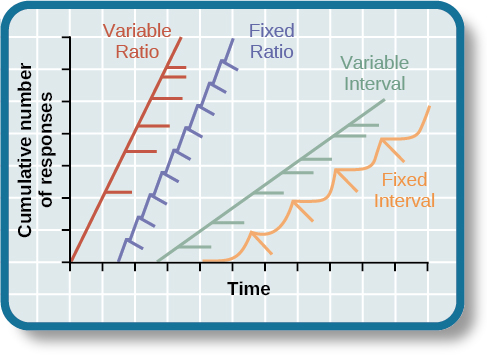
Fixed ratio reinforcement schedule
a set number of responses between reinforcers (always the same number of responses between the outcome)

Variable ratio reinforcement schedule
different number of responses between outcomes (i.e. two responses earns a reinforcer, then it takes five, then it takes three, etc.)
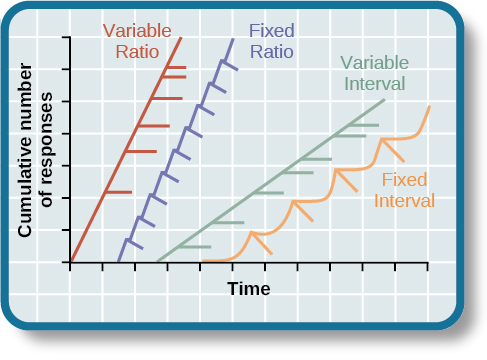
Fixed interval reinforcement schedule
set amount of time between availability of a reinforcer (number of responses does not speed up arrival of a outcome)

Variable interval reinforcement schedule
differing amounts of time between responses (i.e. one minute until outcome is available, then three minutes, then two minutes, then four, then one)
Concurrent reinforcement schedule
two or more possible responses possible, each with their own reinforcement schedule (two buttons for pigeon to press and one could theoretically be on a fixed ratio while the other could be variable interval)
the matching law
describes the relationship between behavior and reinforcement when there is a choice (percentage of behavior devoted to each choice tends to match the percentage of reinforcement of each choice [if pigeon gets food twice as often from button 1, it will press that button twice as much])
the matching law (people example)
if interviewer one nods their head twice as much as interviewer two, then the person will talk to interviewer 1 twice as much (i.e. will look at 1 twice as often/direct their speech to 1 twice as often)
the quantitative law of effect
increase behavior by increasing reinforcement of that behavior and decreasing reinforcement of alternative behaviors
decrease a behavior by decreasing reinforcement of that behavior and increasing reinforcement of alternative behaviors
premack principle
operant behavior will be reinforced by access to a more preferred behavior (i.e. if flap flipping is a preferred/more desirable behavior, then door opening for monkey will be reinforced if it leads to/has flap flipping as an outcome)
how can preferences be determined
preference test - seeing what people or animals do when given option to choose
Delay Discounting
delayed reinforcers are less reinforcing than immediate reinforcers; less value in reinforcers when they are delayed (i.e. $20 dollars is worth less to you in three weeks than it is right now)
How does delay discounting explain behavior when individuals can choose between an immediate small reward and a larger delayed reward?
the immediate reward is worth inherently more than the delayed reward, choosing the immediate reward = impulsive while the delayed reward = self control
if the immediate reward is sufficiently smaller than the delayed so as to be worth less, then the individual may choose it (i.e. if you’re offered $20 now or $100 in a week, then you may choose that $100). the longer the time before the big reward the less desirable it is
impulsivity
choosing the immediate reward
self control
choosing the delayed reward
What is preference reversing?
the switch of a choice for someone from immediate reward to delayed reward or vice versa; happens when time difference between small immediate and large delayed reward becomes more significant (more delay = more likely to prefer immediate) or decreases (less delay = more likely to choose)
the influence of two delayed rewards, a smaller reward shorter delay and a larger later reward, with initial preference for the larger reward; set alarm at time one the night before, and at time two, when the early alarm goes off, the smaller immediate reward is just going back to sleep, while the larger delayed reward is getting up early and being calm and ready for the exam and thus getting the reward of good grades—choosing the smaller immediate reward because it is relatively more value at time two
indifference point
point at which a delayed reward and immediate reward swap priority level/desirability
How can one increase self-control?
make a delayed reward more rewarding (i.e. getting paid for a week of nonsmoking); making an immediate reward less rewarding (paying money from a set account each time you smoke); use precommitment (commit early to a delayed reinforcer [put phone across the room when setting alarm night before to force you out of bed])
Steeper discounting and behavioral problems
theory that people who gamble, smoke, or have a substance use disorder have steeper discounting curves, but this could be a personal tendency or the problems leading to this steeper discounting
one study has compared current, non, and ex smokers on measures of discounting steepness, and the ex/never smokers had very similar curves (less steep) while the current had very steep discounting curve indicating the steepness may be related to the substance use
contingency
if-then relationship between the behavior (R) and its consequence/outcome (O) [if this behavior is present, then this consequence/outcome will occur)
makes a certain undesired behavior less reinforcing compared to the contingency or a certain desired behavior more reinforcing than alternatives by pairing it with a contingency because the behaviors are all ultimately a choice
contingency management
incentive-based treatment: can reinforce alternative, healthy behavior and/or abstinence from an unhealthy behavior; involve choice—between behavior and an alternative behavior (quantitative law of effect), and between an immediate vs delayed reinforcer (delay discounting)
give reward such as voucher for abstaining (for substance use treatment) and/or doing an action (exercising, weight loss, etc.) OR take money away for not abstaining/not meeting a goal (i.e. participants pre-pay into an account and lose some of the returnable money if they don’t meet a goal like a negative urine test)
What does it mean to say that contingencies of reinforcement are manipulated in contingency management treatments?
Because they are operant (instrumental) behaviors, one way to treat problem behaviors is by
manipulating contingencies of reinforcement
reinforce alternative healthy behavior or abstinence from an unhealthy behavior
putting into place reinforcement contingencies that encourage (nudge) the person to choose healthy reinforcers over harmful ones
evidence suggesting that contingency management can be used to influence drug-taking
cocaine users split into two groups: 12 weeks of drug counseling OR 12 weeks of contingency management (given a voucher (can be exchanged for retail items) if urine test is cocaine negative, with the voucher increasing in point value with every consecutive negative and resetting with a positive [don’t earn a voucher for the positive, but can restart earning vouchers with next negative test])
results: contingency management group had 46% abstaining for 8+ weeks
controls: 0% abstained for 8+ weeks
evidence suggesting that contingency management can be used to influence weight loss
veterans with BMI of 30-40
32 weeks with two conditions: weight monitor controls (only weekly weigh ins) and deposit contract condition (also had monthly weigh ins, but clients paid money into an account and got a little back [plus a matching bonus from researchers] every day so long as they met weight loss goal [contingent on meeting that goal])
at end: control lost 1.1 lbs and deposit contract lost 8.7 lbs
but 36 weeks later the amount of weight still left off was: control: 1.2 lbs
deposit: 0.3 lbs (most regained weight)
What happens to behavior when contingency management ends?
it tends to return when no longer in presence of contingency/alternative reinforcer
How can behavior change be maintained?
continued contingency management; longer abstinence seen in participants given a data entry job with pay contingent on negative drug urine tests vs. those allowed to have job regardless of drug test result
phase 1: everybody does data entry job and must have a negative drug test at four weeks
phase 2: can either only continue working when getting negative tests or can work regardless of test
results: the contingent condition produced far more negative drug tests than the not
How can behavior change that is not permanent still make a difference?
improve health/life temporarily:
pregnant smokers in contingency management program (vouchers of increasing value with temporary reset upon positive test) were more consistently abstinent from smoking (confirmed by CO tests) until 12 weeks postpartum and gave birth to healthier, closer to full term babies
improved health of mothers and babies even though most smokers returned to smoking after end of contingency management
Renewal
return of an extinguished behavior; ABA (conditioning in context A then extinction in context B and return of behavior [renewal] in context A) and ABC (conditioning in context A extinction in context B and context in room C); contexts can be location/environmental (exteroceptive) or internal (interoceptive like drug state, hormonal state, time, etc.)
How does renewal show behavior change is difficult to sustain?
extinction does not equal loss of learning, it’s just a different type of learning plastered over the original behavior; a change in context can return the old behavior such as interoceptive contexts (i.e. stress, drug/hormonal/mood/deprivation state, recent reinforcers, recent behaviors, expectation of events, time) or exteroceptive contexts like apparatus, room, place, location, etc. changing and returning that old behavior
Renewal with deprivation state as context (evidence of interoceptive context renewal)
group 1: 1. sated; R→ pellet
deprived; R→ no outcome
sated: R→? or Deprived: R→?
ABA renewal with sated state (i.e. lever press increase with sated state during extinction test)
group 2: 1. deprived: R→pellet
deprived: R→ no outcome
sated: R? or Deprived: R?
would have been ABC renewal (because sated is a new context for these rats) if the response increased during the sated extinction test
what does ABC renewal show?
extinction learning (learning a behavior or stimulus does not predict a certain outcome [i.e. bell no mean shock]) is not easily generalizable to other contexts (as its effects are not generally seen when contexts are swapped)/extinction is context-specific
interoceptive contexts
INTERNAL:
stress
drug/hormonal/mood/deprivation state
recent reinforcers
recent behaviors
expectation of events
time
exteroceptive contexts
apparatus
room
place
location
etc.
What can make behavior change more durable?
learn to inhibit responding in the contexts where relapse will occur
learn to inhibit responding in multiple contexts (including times of stress or other internal contexts)
providing retrieval cues for treatment (allowing one to recall their extinction learning in new context)