EAS 210 METAMORPHIC ROCKS (DEFORMATION & PLATE TECTONICS)
 Call Kai
 Learn
Learn Practice Test
 Spaced Repetition
 Match
Match Flashcards
 Knowt Play
1/37

There's no tags or description
Looks like no tags are added yet.
Name | Mastery | Learn | Test | Matching | Spaced | Call with Kai | Chat |
|---|
No analytics yet
Send a link to your students to track their progress
38 Terms
What is Metamorphism?
The transformation of rocks as the result of heat, pressure, and/or fluid activity. Metamorphic rocks are formed through metamorphism of igneous and sedimentary rocks
Note: Occurs before the melting point in the solid state, because if it is melted then by definition it is an igneous rock
What is Metamorphism dependent on?
-Protolith/Parent rock: What rock we start with ( shale, granite, basalt)
-Metamorphic conditions: What we do to it (temperature, pressure, fluids, how long?)
What are the four Controlling factors in metamorphism?
-Protolith/Parent rock: What rock we start with defines what atoms we have to work with
-Heat: Either through burial heat or igneous intrusions/volcanism
-Pressure: Either confining pressure or directed pressure
-Fluid Interaction: Accelerates chemical changes
Controlling factors in Metamorphism — Heat
-Burial increases temperature, since temperature increases with depth
-Volcanism provides heat, heat from intrusions, lava flows or heat underlying rocks
Controlling factors in Metamorphism — Pressure
-Confining pressure (uniform stress): Lithostatic pressure is a uniform field of pressure experienced by most rocks beneath Earth’s surface (pressure from all directions)
-Directed pressure (differential stress): Causes grains to become preferentially aligned toward the plane of least stress, meaning one direction has more stress than the other, causes deformation of sedimentary beds and/or other features inherited from the parent rock
Controlling factors in Metamorphism — Fluids
Fluids accelerate chemical changes which occur during metamorphism and can help new minerals to form. Fluids can come from pore space in rocks, released by magma, dehydration reactions, hydrothermal circulation, metamorphic reactions at depth
Metamorphic processes to keep in mind
-Orientation of mineral grains (pressure)
-Recrystallization of existing minerals (heat probably)
-Growth of new minerals (fluid activity)
-Segregation of minerals (black and white bands)
-Baking
-Shearing (applies differential stress)
-Partial melting (migmatite, borderline difference between igneous and metamorphic rocks)
What is Metamorphic grade?
Degree of metamorphic change a rock has undergone. How much it resembles its parent rock
What are index minerals?
Certain minerals are known to only form under specific temperatures and pressure at a particular bulk composition (protolith). In-other-words some minerals only form at specific heat and pressures, typically the minerals we use for grade is Andalusite, Garnet, Kyanite, Serpentine, Staurolite, Talc
Classification of metamorphic rocks — Texture
-Foliated texture is produced by the preferred orientation of platy minerals
-Non-foliated texture: do not exhibit preferred orientation of minerals (lack a layered or banded appearance)
Classification of metamorphic rocks — Types of metamorphism
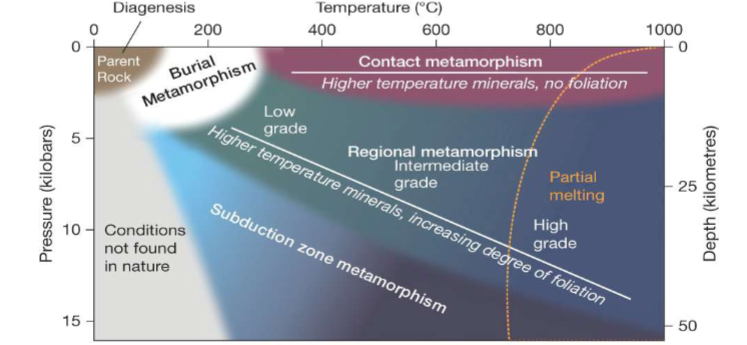
Types of metamorphism — burial metamorphism
Burial:
-Moderate increase in heat and pressure
-increases density of the rock
-Occurs in deep sedimentary basins, ocean trenches, and passive margins
-Bedding and grain size variations can be preserved
Types of metamorphism — contact metamorphism
Contact:
-High temperature and low pressure
-Aureoles: metamorphosed zones that surround plutons or other intrusions (a body of igneous rock that forms when magma cools and solidifies slowly beneath the surface)
-Metamorphic grade is a measure of how much metamorphism has occurred
-High grade occurs closer to the pluton and decreases away
Types of metamorphism — regional metamorphism
Regional:
-Most common type of metamorphism
-covers a large spatial area
-occurs during a tectonic event such as subduction or continent-continent collision
-Temperature and pressure both act as driving forces for metamorphic reactions in regional metamorphism
Metamorphic Grade
Metamorphic grade could be identified by the presence of characteristic index minerals:
chlorite - biotite - garnet - staurolite - kyanite - sillimanite
Low grade Intermediate grade High Grade
-First appearance of a mineral indicates the minimum temperature-pressure conditions that the rock experience (e.g. for a rock to contain chlorite, it must have experienced a temperature >200)

Metamorphic grade and index minerals
-Chlorite: Dark green, sheet silicate (phyllosilicate), flexible to brittle cleavage flakes in contrast to elastic in biotite or muscovite, first appearance at 200 C and is low grade
-Garnet: Medium grade, isolated silica tetrahedra (nesosilicate), dodecahedral crystals, no cleavage just fracture
-Andalusite: Stable at low pressure, high temperature, prismatic crystals
-Kyanite: Elongated columnar crystals, often blue, hardness varies with direction
-Sillimanite: Stable at high temperature
-Staurolite: Isolated tetrahedra, higher grade than garnet, still medium grade, prismatic crystal, hexagonal cross section, often twinned crystals
Types of metamorphism — regional metamorphism
-Slate: Foliated metamorphic rock; lowest grade, mostly grain reorientation, regional metamorphism of shale, composed of quartz, muscovite, slaty cleavage; not necessarily parallel to bedding in the protolith (shale)
-Phyllite: Foliated metamorphic rock, less regular cleavage planes than slate, larger grains than in shale, platy minerals cannot be seen by eye, identified by glossy lustrous sheen
-Schist: intermediate grade, foliated metamorphic rock, platy minerals clearly visible, schistosity — wavy texture of platy minerals
-Gneiss: High grade metamorphic rock, streaked with bands of light and dark colored material, light: quartz & feldspar, dark: biotite & hornblende, more granular minerals than platy minerals
-Migmatite: Name means “mixed rock”, has a mixture of apparently igneous and metamorphic components (separated into light and dark colored patches), represent partial melting

What is Deformation?
A change in shape, volume, position, or orientation of rock layers. It forms folds, fractures and faults
-Primary structures occur when the rock formed (strata, cross bedding, ripple marks, mud-cracks, graded beds etc)
-Secondary Structures occur afterwards (folds, faults, etc)
What is brittle deformation — the rock breaks
Elastic deformation at low values of stress (σ) followed by limited amount of plastic deformation before fracture (cannot withstand tension or compression)
-Lower temperatures/pressures (near surface)
-crystalline igneous rocks are more susceptible to brittle deformation
-Forms joints and faults
What is ductile deformation — the rock bends or flows
Elastic deformation at low values of stress (σ) followed by significant amount of plastic deformation with constant stress (experiences plastic deformation)
-Higher temperatures/Pressures (Deeper - or close to magma body)
-weaker rocks or rocks that have layering (sedimentary)
-Low strain rates (slow deformation)
-forms folds
Deformation of rocks
-Compressional stress: Convergent plate boundaries shortening. Causes folding and faulting
-Tensional stress: divergent plate boundaries (9.2C) extension. Causes faulting
-Shear stress: Transform plate boundaries (9.2D)
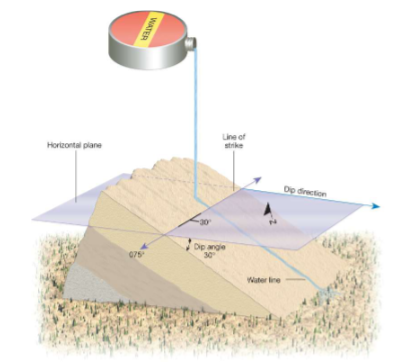
Mapping geological structures — Strike and dip
-Strike direction is the intersection of a horizontal plane with an inclined plane
-Dip angle is the maximum angle of an inclined plane
-Note map symbols to show strike (long line) and dip (short line)
Folds - definitions
-Anticline: concave downwards (arch)
-syncline: concave upwards (saucer)
-Axial plane: axis of symmetry with limb on each side
-Axis: intersection of axial plane and a particular rock layer
-Plunge: difference in angle between horizontal and axis

Folds — anticlines and synclines
-Upright folds: symmetric, axial plane vertical, limbs dip at same angle in opposite directions
-Inclined folds: Asymmetric, axial plane not vertical, limbs dip at different angles in opposite directions
-Overturned folds: Asymmetric, axial plane not vertical, limbs dip at different angles in the same direction

Folds — monoclines
In monoclines, nearly flat layers bend down (dip) in one direction and then flatten out again, often caused by faulting in the bedrock below
What are joints?
Fractures along which no appreciable displacement has occurred. Most common in igneous rocks and sedimentary rocks. Most commonly found when cooling. Forms cracks & breaks but do not move or separate
What are faults?
Fractures along which appreciable displacement has occurred. Range from small scale in road cuts to plate boundary scale. Breaks and slides against each other, very noticeable
Two types of Faults, Defined by offset with respect to the fault plane
Fault plane is the surface along which the motion occurs
-Dip-slip fault: vertical offset along the dip of the fault (along fault plane, up or down the fault plane)
-Strike slip fault: Horizontal offset along the fault plane or along the strike of the fault (left or right of the fault plane)
Faults: Parts of a fault
Hanging wall is always top half of the fault of the dip, while the footwall is on the bottom

Dip-Slip faults
If the slip is parallel to the dip = dip - slip fault, sub-divide into faults formed by compression (reverse fault) or extension (normal fault)
-Normal fault: Hanging wall moves down relative to footwall
-Reverse fault: hanging wall moves up relative to footwall
-Thrust fault is a special case of a reverse fault with dip less than 45 degrees
-Megathrust faults occur in subduction zones and are responsible for the largest earthquakes

Strike-slip faults
If the slip is parallel to the strike > strike-slip fault, sub-divide into faults formed by motion to right (dextral) or left (sinistral), form transform plate boundaries, faults can have a mixture of dip-slip and strike-slip motion

Early ideas about plate tectonics
-Early ideas came from the fit of Africa and South America (Francis Bacon 1600s, Snider-Pellegrini, 1858)
-Extended by Wegener to include various lines of evidence that a supercontinent once existed (Pangea). He believed this because: fit of coastlines, distribution of fossils, location of ancient mountain belts, patterns of past glaciations
What is Paleomagnetism (also known as paleomagic!)
Rocks become magnetized as they solidify. Magnetite grains will align parallel to Earth’s magnetic field as it cools through the Curie temperature. Paleomagnetism = fossil magnetism.
-It was the study of the ancient magnetic field of the Earth preserved in rocks, sediments, or archaeological materials (fossils)
-Looked at fossil magnetism and saw the magnetization direction did not agree with the present day magnetism. If there is a difference, then either the magnetic pole had moved or the continent had moved

Apparent polar wandering
In 1950s it was found that the fossil magnetization was rarely parallel to the present day magnetic field. Looking at rocks with different ages, a polar wandering path was noted, path was different on every continent. There is evidence that magnetic poles have remained close to the geographic poles. Solution was that the continents drift, but this was still too radical for many researchers
A new paradigm — plate tectonics
Lithosphere is strong outer layer and 100-200km thick. Asthenosphere below is a weak layer, lithosphere broken into a set of rigid plates that move relative to each other. Three types of plate boundary (divergent, convergent, transform). Plates contain a mixture of continental crust (thick) and oceanic crust (thin)
A new paradigm — plate tectonics: Divergent plate boundaries
Mid-ocean ridges:
-Plates move apart at 1-20cm per year forming new rift valleys
-plates subducted once become old and cold
-No seafloor older than ~180 million years
Continental rifts:
-Plate develops rift and eventually splits into two plates
-Denser basaltic crust sinks and gets covered by the sea
-Sometimes rifting fails (not clear why this happens)
A new paradigm — plate tectonics: Convergent plate boundaries
Oceanic-continent:
-Denser oceanic plate sinks beneath the continent
-Water released from down going plate
-Around 100km significant water loss causes mantle to melt and a volcanic arc forms
-Examples: Cascadia, Andes
Oceanic-oceanic:
-Older plate usually subducts
-Volcanic island arc forms
-examples: Western Aleutians (Alaska)
Continent-continent:
-Begins as an oceanic-continental boundary
-Both plates relatively low density and cannot subduct
-Form a thickened crust and major mountain belt
-volcanos shut off
-Crust can be double normal thickness (>80km)
-Gets hot and can melt

A new paradigm — plate tectonics: Transform plate boundaries
-Horizontal movement of two tectonics plates
-In the oceans, transform faults join segments of mid-ocean ridges
-Direction of motion was key support of plate tectonics
-Transform plate boundaries also occur on continents
-Plates sliding past each other horizontally without creating or destroying crust