Forensics Unit 1
 Call Kai
 Learn
Learn Practice Test
 Spaced Repetition
 Match
Match Flashcards
 Knowt Play
1/54

There's no tags or description
Looks like no tags are added yet.
Name | Mastery | Learn | Test | Matching | Spaced | Call with Kai | Chat |
|---|
No analytics yet
Send a link to your students to track their progress
55 Terms
Forensics Science
The application of science to criminal and civil laws
Specific Applications of Forensic Science
Fingerprints
Firearms
Computer analysis
DNA
Drugs
Trace evidence
Objective Evidence
Science, not influenced by personal feelings or opinions in considering and representing facts → DNA, fingerprints, trace evidence (NOT PERFECT)
Subjective evidance
based on or influenced by personal feelings, tastes, or opinions → eye witness, confessions etc.
Lochard’s Exchange Principle
Whenever two objects come into contact with one another, materials are exchanged between them
Observations vs. Perceptions
Obs: What you actually see and cannot be confused with perceptions
Per: What you think about what you saw
Steps of memory
Information from our senses → What we pay attention to → perception → short-term memory → long term memory
Memory fades with time
Crime Lab and Units
There is not a national system of crime labs - there are state, city, country crime labs etc.
Units:
Physical Science Unit
Biology Unit
Firearms Unit
Document Examination Unit
Chemistry Unit
Toxicology Unit
Latent Fingerprint Unit
Crime Scene Investigations Unit
Computer Unit
Physical Science Unit
Identifies and Compares Trace Evidence
Biology Unit
investigates anything with DNA (blood samples, body fluids, hair)
Firearms Unit
investigates discharged bullets, cartridge cases, shotgun shells, and ammunition
Document Examination Unit
provides the skills needed for handwriting analysis and other questioned (document issues - fraud)
Chemistry Unit
identifies illegal substances
Toxicology Unit
examines body fluids and organs for the presence of drugs and poisons.
Latent Fingerprint Unit
processes and examines evidence for latent fingerprints
Crime Scene Investigations Unit
dispatches specially trained personnel to the crime scene to collect and preserve physical evidence
Computer Unit
analyzes digital data to confirm alibis, find evidence, etc. (cell phone, computers)
Skills of a forensic scientist
Record observations
Conduct test/experience
Analyze results
Write report
Testify in court
Criminal Law
Could be jail time (like stealing something or killing someone)
Civil law
Don’t go to jail (like traffic violations)
Burden of proof
obligation to provide enough evidence for the jury to reach near certainty, leaving no reasonable doubt of the defendant's guilt
Levels of required proof
Reasonable suspicion → the amount of evidence that officer need “frisk” someone
Probable cause → the amount of evidence that an officer needs to arrest someone
Preponderance → Guilty in a civil case
Clever and convincing → the amount of evidence necessary for the State to take a child away from parent
Beyond a reasonable doubt → Evidence beyond any doubt based on a reason. Guilty in a criminal case
Evidence admissibility standards (Frye)
1923
general acceptance
is the scientific method or technique swifting established
Evidence admissibility standards (Daubert)
1993
judge is the gatekeeper
maryland
judge reviews if “good science”
impericle testing
forensics science begins at the
crime scene
Evidence must be
observed
recorded
preserved
crime scen techs will
search the crime scene
take crime scene notes
create a rough sketch of the crime scne
photograph crime scene
collect evidence
Crime scene Search Patterns
line
spiral
wheel
quadrant/zone
grid
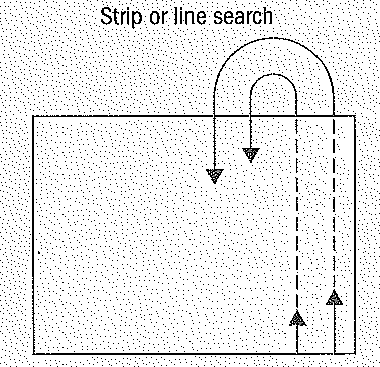
line search pattern
One or two investigators start at the boundary of the crime scene and search in straight lines across to the other side of the crime scene
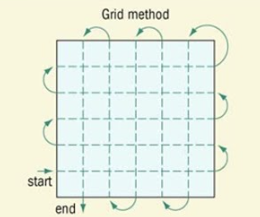
Grid Search Pattern
Two or more investigators form a grid by searching in line patterns that overlap and are perpendicular to each other.
Spiral search pattern
One investigator searches in a spiral path from the center of the crime scene to the boundary (outward) or from the boundary of the crime scene to the center (inward).

Wheel/Ray Search Pattern
Several investigators search in straight lines from the center to the boundary (outward) or from the boundary to the center (inward).

Quadrant/Zone Search Pattern
The crime scene is divided into smaller sections (zones). One or more investigators are assigned to search each zone.

crime scene notes
Layout includes
location of all evidence
how evidence is packaged
field testing of all evidence
title block —> your name, title, location, date, time, case number
All done in bleu or black ink and in a bound notebook
Crime scene sketch
title block same as notes
legend identifying object sketch
compass showing north direction
significant items/depicts layout
possible paths of entry/exit
Photographs at a crime scene
4 minimum
close up → are taken last and show greater detail of individual objects or evidence (90 degree angle without evidence markers and scales)
overview → of the entire scene and surrounding area, including points of exit and entry, are taken first (Include a “visual tag,” an object recorded in multiple overview photographs, to help visually piece the scene together)
close up with scale
medium range → Medium-range photographs show the layout of smaller significant areas of the crime scene
Lighting
Oblique lighting → uses a light source positioned at a low angle (shows us details with shadows on the surface of the evidence)
Types of Physical Evidence
almost anything can be physical evidence
drugs, fibers, fingerprints, weapons and amo, organs and body fluids, impressions, paint, petroleum products, tool marks, vehicle lights, etc.
Packaging Crime Scene Evidence (holders)
pill bottle
envelopes
paper bag
airtight tin container
paper fold
A pill bottle collects and/or paper folds collect
small traces of evidence
ex: white powder
Anything paper (manilla envelope or paper bag)
Anything biological
ex: sweatpants with blood on them or swabs of blood
airtight metal container
anything to do with arson
Packaging biological evidance
if mold grows = dna degression = no result
any contamination or cross contamination = no result/manipulated result
Chain of custody
list of all people who come into possession with of an item of evidence
This means that every person who handled or examined the evidence and where it is at all times must be accounted for.
Known/standard reference sample
Physical evidence whose origin is known, such as blood or buccal (cheek) swab from a suspect, that can be compared to crime-scene evidence.
This is what you are comparing your evidence to
Necessary in order to perform a comparison test
Substrate Control
a sample collected near the evidence to insure the validity of the results
Example: Silver car crashes into red car
Evidence: silver transferred paint on red car
Reference: silver paint from known suspect vehicle
Substrate control: red paint from victim’s car, near the point of impact
Evidence sample
a specific physical, biological, or chemical specimen collected from crime scene victim or suspect that can be analyzed
Crime scene duties
1st responding officer (usually first person on scene police officer) will
Acquiring medical assistance for injured victims
Medical personnel avoid disturbing evidence and approach the victim by an indirect route.
Detaining any potential suspects or witnesses
Statements are taken from victims, witnesses, and suspects
Securing the crime scene to the greatest extent possible
All civilians and unauthorized personnel are excluded from the crime scene.
Calling for any additional personnel needs, such as other officers and/or forensic investigators
The personnel required depends upon the nature of the crime scene.
The Lead Investigator will
Securing the Crime Scene
The boundaries of the crime scene must be secured with crime scene tape, ropes, or cones
Include any area that evidence may be located.
Keep a log of anyone who enters/ leaves the scene
A walk through → initial survey of the crime scene
The perpetrator's point of entry and exit are located
Indirect path is taken to the center of the crime scene
Obvious items of evidence are located and documented
The conditions of the scene are observed and recorded
Special attention is paid to items or conditions that suggest timing of the incident or do not appear they belong
Determine if it is a primary vs secondary crime scene
Primary → where the original incident occurred
Secondary → after initial incident
who ultimately decides the importance of the evidence
jury
Identification test
determine the physical or chemical identity of something (a known/standard doesn’t have to be tested with each sample)
Comparison Analysis
determine whether or not a known/standard and a piece of evidence have a common origin (both samples are subjected to the same tests)
class characteristics
evidence associated only with a group
individual characteristics
evidance that can be associated to one person
Primary crime scene
where the original incident occurred
secondary crime scene
after initial incident