MARK3000 Test 4
 Call Kai
 Learn
 Practice Test
 Spaced Repetition
 Match
 Flashcards
 Knowt Play
1/131

There's no tags or description
Looks like no tags are added yet.
132 Terms
What is marketing channel/supply chain management
4 Ps of marketing mix: place
Within the marketing industry, executive often overlook or underestimate the importance of place in marketing mix, simply because happens behind the scenes
Yet marketing channel management adds value because it gets the products to consumers efficiently, quickly, and at low cost
Importance of supply chain management
Merch is produced and distributed:
In right quantities
To right locations
At right times
Two key definitions to know
Supply chain represents ALL the organizations that figure into any part of the process of producing, promoting, and delivering a service or product to its user
Marketing channels: how the supply chain is organized and managed
Key parties in supply chain
Suppliers sell raw mats such as ingredients, jars, lids, etc. to manufacturer
Manufacturer sells finished products to wholesale companies
Whole say put product around country in distribution centers
Retailer buys from local distribution center then sells to consumer
Having supply chain is more efficient than the manufacturer paying for trucks and hauling goods to thousands of grocery stores over the country

Wholesales (middle man)
Firms that buy products from manufacturers and resell them to retailers
Supplier to manufacturer for $3/unit
Manufacturer to whole sale for $5/unit
Wholesale to retail $7/unit
Retail to consumer $9/unit
Convincing wholesalers and retailers to carry new product can be difficult (top-down approach)
Some wholesalers wont take product unless already have retailer support and acceptance
Viral marketing program can help create interest among consumers, which triggers interest at retailer, which compels wholesale team to say yes (bottom-up approach)
Distribution center
facility for the receipt, storage, and redistribution of goods to company stores and may be operated by retailers, manufacturers, or distribution specialists
Fulfillment centers
Used to ship directly to individual customers
Marketing channels add value
Customers expect to have their goods delivered and services performed on time
Marketing channels can streamline number of transactions an org must make
Increase value for customers→ Costco offers competitive prices by cutting deals with manufacturers
Retailers more efficient and effective→ lower inventory
Have what you need in stock to drive a sales increase
Inventory management through just-in-time systems
Inventory management systems- tracks goods through stores, warehouses, and DCs. As it name implies, just-in-time inventory management ensures goods get delivered only when they are needed
Also known as quick response (QR) inventory systems
Ordering less merch, but on more frequent basis
Many firms, such as H&M, Zata, Mango, Forever 21, have adopted QR inventory system
Designing marketing channels (direct vs. indirect)
What is difference between a direct vs indirect marketing channel?
Direct- moving goods directly from manufacturer to customer
Think e-commerce DTC (direct to consumer) brands such as Warby Parker, Dollar Shave Club
Indirect- you are moving goods from manufacturer through one (or more intermediaries) to get to customer
Intermediaries would include wholesaler and/or retailer

Making information flow through marketing channels
Each step requires collection and dissemination of info
Flow1 (customer to store)
Flow2 (store to buyer)
Flow3 (buyer to manufacturer)
Flow4 (store to manufacturer)
Flow5 (store to distribution center)
Flow6 (manufacturer to distribution center and buyer)
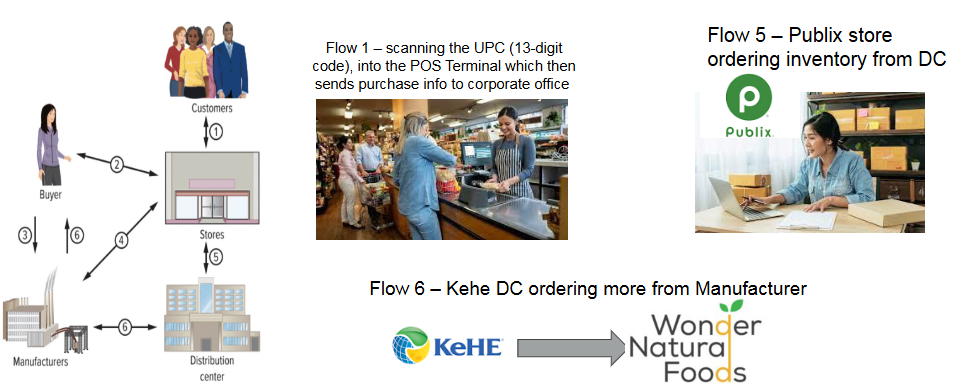
Technologies like RFID help merch flow
RFID- tiny computer chip that can be placed on an item, box, case, or pallet of products that transmits info through a wireless scanner
Creative ways to get product to consumer
Amazon locker, curbside, ship to store for pickup
Deliver merch directly to customer from fulfillment center
Driverless delivery vehicles and drones are currently in the experimentation phase, but safety and federal regulations are still a consideration
Integrated marketing communications
IMC is a holistic approach where all aspects of marketing (advertising, promotion, public relations, direct marketing, digital marketing, sponsorships, events, etc.) work together toward a common goal
IMC unifies all aspects of marketing communications to deliver a consistent customer-focused message using all various communications channels available in today’s market
The goal of IMC is to ensure all various marketing mix (Four P) elements work together to deliver a consistent message
IMC takes the best of each communications medium and combines it to achieve the most effective marketing comms campaign possible
Not new but cointed in 1980s by Don Shultz from Northwestern University
Shultz published integrated marketing comms; putting it together and making it work, first textbook for IMC
Traditional marketing
Company driver
Goal: make sale/increase profits
Media: print and broadcast
One way convo: speaks at consumer
Mass audience/general messages
Uncoordinated messages
Build awareness
Integrated marketing
Consumer driven
Goal: understand and meet needs of consumer
Media: best media option to meet target audience
Two way conversation: speaks with the consumer
Personalized/tailored messages
Coordinated messages
Call to action
Components of comms process
Six comps of comm process
the sender (coke co.)
Transmitter (agency creating ad)
Communication channel (media type used)
Receiver (target consumer): decoding message
Additionally, there are noise and feedback factors at play
Noise from the environment (competitive messages)
any interference that stems from competing messages, lack of clarity in message, or flaw in medium
Integrated marketing comms
Marketers must remember do not have control over decoding process, because each receiver (consumer) decodes message in own way
Senders adjust messages according to medium and receivers’ traits
Same ad may trigger different reaction
AIDA Model
AIDA model provides basis for understanding how marketing comms works

Awareness (AIDA)
Senders first must gain attention of consumer
Awareness metrics include:
aided recall: when someone is prompted to think about brand
Top-of-mind awareness: when someone responds “Harley” when talking motorcycle brands
Interests (AIDA)
The consumer must want to further investigate product/service
Interest can also be sparked by a little controversy
Once consumer is aware that company/product exists, comms must work to increase consumer’s interest level. Isnt enough to let people know that product exists; consumers must be persuaded that its worth investigating
Desire (AIDA)
After the firm has piqued the interest of its target market, the goal of subsequent IMC messages should move the consumer from “I like it” to “I want it”
Action (AIDA)
The ultimate goal of any form of comms is to drive receiver to action.
We want them to buy our product… or subscribe to our service
But purchase is one type of action
What other actions can IMC ask consumers to take?:
Behavioral changes (don’t drink and drive)
Attitude changes (that product is high quality)
Physical actions (pick up the phone, log on to the websites, volunteer)
The lagged effect
Sometimes consumers don’t act immediately after receivijng a marketing comm because lagged effect- delayed response to marketing comm campaign
Marketing comms do not always have immediate impact
Multiple exposures often necessary
Difficult to determine which exposure led to purchase
IMC goal
Delivering right message, to right consumer, at right time
Channels used in an IMC strategy
For any comms to succeed, firm must deliver right message to right audience through right media. Ultimate goals for profits from long-term customers
No single channel necessarily better than other

Personal selling (channels)
A two-way communication between the buyer and seller to influence buying decisions
Salespeople can add significant value, which can make the expense worth it
The cost of communicating directly with a potential customer is quite high compared with other forms of promotion, but is simply the best and most efficient way to sell certain products and services
This form of IMC works best when the purchase is complicated, because the salesperson can customize the comms to meet the needs of that specific buyer and purchase situations, which other IMC elements cannot
Sales promotions (channels) Variety and conjunction
Sales promotions can be used in a wide variety of situations to stimulate demand among either end users or other channel members
Can be aimed at both end user consumers or channel members
Used in conjunction with other forms of IMC
Direct marketing (channels)
Communicating directly with target customers (no middleman) to generate a response or transaction
Growing element of IMC. As advertising has declined as a percentage of total comms budget, direct marketing spend has increased. Improvements to database tech has contributed to rapid growth
Direct marketing allows marketers to carefully target their consumers and personalize their message. This enables marketers to communicate with an audience that is more likely to respond to their message and generate a restul
Includes offline and online tactics such as telemarketing, e-mail and mobile marketing
Direct marketing ads generally include a call to action (CTA)
Email with promotion, coupon, recommendations, etc
Ads with ‘sign up now’, ‘order now’ CTA
Advertising (channels)
Most visible element of IMC
Both online or offline
(generally) Passive: no action required by consumers
Extremely effective at creating awareness and generating interest
Placement of announcements and persuasive messages in time or space purchased by biz firms, nonprofit orgs, gov agencies, and individuals
Public relations (channels)
‘Free’ media attention but requires a ton of work and personal relationships
Importance of PR has grown as the cost of other media has increased
As consumers are becoming more skeptical about marketing, PR is becoming more importance
PR team often facilitates executive interviews in publications, news media, etc.
Press release (channels)
Sprite returns to NBA article
Sales promotions (channels) Coupons/deals
Coupons
Deals from Starbucks (buy1 get1)
Mobile marketing (channels)
Form of online, direct marketing
Geofencing ads- invisible fences found around your store, comp locations, public locations enable you to send personalized messages to customers when ‘break’ fence
Online marketing (channels)
Article, copywriting, SEO, PPC, online directories, email marketing, news, web content, websites, socials, blogs, search
Presence: website
Publish: blog
Promote: email, marketing
Engage: social media
Integrate: marketing, automation
Web (online marketing)
Websites are #1 online tool:
Establish brand image
Educate consumers about products
promote new products
Help them find products
Sell products (e-com sites)
Provide customer service
Blogs (online marketing)
Online dairy with periodic posts:
Brand specific blog
Company blog
Effective to comm tends, announce special events, form community, build long-term relations, connect customers, and create loyalty and positive word of mouth
Google search engine/algorithm rewards websites include a blog
Social media (online marketing)
Creating community w/ consumers and fostering consumer-to-consumer interactions
Greate for promoting brand via 2 way comms
Sharing content, promoting products
Digital display (banner) ads/ sponsored social ads (channels)
Banners on websites and popups
Social media adds when scrolling
Integrated marketing comms (barbie)
Mass awareness: out-of-home billboards and theatrical branding
Experiential marketing: pop-up environments, themed destinations, immersive spaces
Brand partnerships: food, fashion, beauty, gaming, and lifestyle collaboration
Retail & merchandising: branded apparel, accessories, collectibles
Digital & social: highly 'shareable’ visuals designed for insta/TikTok
Visual consistency: one dominant color system and instantly recognizable aesthetic
Lifestyle infiltration: Barbie as an environment, not just a movie
How do firms determine whether their IMC strat worked
Planning for and measuring IMC success:
Understand the outcome the firm hopes to acheive
Determine if objective is short or long-term
Objective should be explicitly defined, measurable, and timebound
SMART objective
Specific: state what youll do. Use action words
Measurable: provide a way to evaluate. Use metrics or data targets
Achievable: within your scope. Possible to accomplish, attainable
Relevant: makes sense within your job function. Improves the biz in some way
Time-bound: state when youll get it done. Be specific on date or time frame
Know what want to achieve, before you begin
Objective to create awareness for product, firm would measure increases in customer knowledge and awareness
If goal to generate sales, promote social media ads, then sales would be objective measure
Type of IMC channel has impact on what we measure
TV and radio- measure viewership ratings, # households that watch program
Internet ads- measure impressions, click through rates
Search- click
Social media- impressions, engagement (likes, follows, views)
Video ads- views, time spent viewing
Mobile apps- downloads, time spent in app
Loyalty program- offers redeemed, points entered, frequency of use
Setting and allocating the IMC budget
Many IMC elements require significant expenditures, and firms are reluctant to invest in marketing comms without some guarantee of return
There are two primary methods of allocating IMC budgets:
Rule of Thumb Methods- use prior sales and comm activities to determine the present comm budget
Objective & Task Method- determines the budget required to undertake specific tasks to accomplish communication objective
Competitive parity (rule of thumb budgets)
Set budget to equal share of market
Problems: we can’t take advantage of unique opportunities. If all brands do this, all market shares will stay the same over time (I want to grow my market share, not stay the same)
Percentage of sales (rule of thumb budgets)
Set budget to fixed % of forecasted sales in upcoming month/quarter/year
Problems: assumes the % used in past was sufficient and is still appropriate. Doesn’t take into account new plans for upcoming quarter/year (If you want to launch of a new product, you may not have enough money to be successful)
Available budget (rule of thumb budgets)
Calculate your sales, expenses, desired profit margin. Whatever is left over becomes IMC budget
Problem: There’s no connection between expenses and sales/profits
Objective and task (budgets)
Determine budget required to accomplish smart objective
Based on facts and data from various agencies and media providers
Advantages: you’re making informed decisions based on SMART and various stakeholders
It considered real-time market dynamics, promotional periods, economic factors, consumer trends
Problems: while appears better than various rule of thumb methods, need to be aware it can be costly and time-consuming to get a real number
While $ figure you get is fact based, might not be able to afford it. Therefore, wasted time and agency fees to create budget can’t implement
Return on investment (marketing metrics)
ROI formula considers costs of creating, maintaining, and promoting a product. Includes cost of purchasing materials, salaries, budget for ad campaigns, etc.
ROI is important for assessing profitability of your business
Return on marketing investment (marketing metrics)
ROMI is used to understand how much is earned from every dollar invested in marketing. Marketing expenses include costs of advertising, promos, events, agency fees and other activities
ROMI is important for evaluating effectiveness overall strategy & promotion
*** Return on ad spend (marketing metrics)
ROAS is measure of return on investment a biz spends on advertising. Used to check how money has returned from investments in individual ad campaigns or channels
ROAS is a metric that shows the effectiveness of a particular advertisement ad campaign or media channel. ROAS is needed to make decisions on specific marketing actions
Traditional media metrics
TV, radio:
Reach (number of people, impressions, you expose to ad)
Frequency (num of times they see or hear your commercial
Gross rating points (GRP): when measuring IMC success, company should examine when and how often consumers have been exposed to various marketing comms
Formula: GRP= Reach*Freq (evaluate effectiveness of media)
Real world- GRP is outdated because measures the total population you’re reaching. For the past 20+ years, marketers have been using TRP (targeted rating points)
Advertising
Paid form of comms delivered through media from an identifiable source about an org, product, service, or idea designed to persuade the receiver
The most visible form of integrated marketing comm
Many actions take place, and opinions formed, before an ad is seen by target audience
Every one of us may encounter the same brand in a given day, but each method of exposure might be different for every person
Integration is important- ensures a cohesive message across all channels
Step 1: identify target audience (ad campaign)
Has to happen in this order
Conduct research to identify target audience
Info is used to set the tone and select the media
Success of an ad program depends on how well advertiser can identify target audience
Firms conduct research to identify target audience, then use info they gain to set tone for advertising program and help them select the media they will use to deliver the message to that audience
Step 2: Step advertising objectives
Objective of an ad campaign are derived from overall objectives of marketing program
Advertising plan must be specific to identified target audience and include the strategic objectives and tactics to be used
All ad campaings aim to achieve certain objectives- inform, persuade, remind
Informative advertising (objectives)
Used to create and build brand awareness
Push consumer through buying cycle to a purchase
Typically used at early stage of product life cycle (PLC) as want to build brand image and initial sales
Persuasive advertising (objectives)
When product has gained a certain level of brand awareness, firms used persuasive advertising to motivate consumers to take action
Consumer goods firms such as Stanley use persuasive advertising to convince consumers to take action- switch brands, try a new product, or continue to buy the product
Generally, occurs in the growth and early maturity stages of the product life cycle (PLC) when competition is most intense
May be used to reposition an established brand in later stage of PLC
Reminder advertising (objectives)
Is communication used to remind or prompt repurchases, especially for products that have gained market acceptance and are in the maturity stage of their life cycle
Communication used to remind, or prompt repurchases
Occurs after products have gained market acceptance and are in maturity stage
Push marketing
A marketing tactic to push your products and services to potential customers.
When you launch a new product, you use push marketing to stand out from a cluttered advertising environment
Examples:
Direct marketing
Digital marketing - banner ads, search
Billboards in high traffic locations
TV advertising
Pull marketing
Marketing tactic to entice consumers to come looking for your product or service. Used for long term relationship building and loyalty programs to keep consumers coming back to your brand/company
Examples:
blogs to inform about your business
SEO to showcase your web content
How-to video series
Social media & influencer
Product focused (focus of advertisements)
Most ads are product focused
Inform, persuade or remind about particular product or service
Institutional focused (focus of advertisements)
Inform, persuade or remind about issues related to places, politics, industry, etc.
Public Service Adverting (PSA) focused (focus of advertisements)
Under Federal Communication Commission (FCC) rules, broadcasters must devote a specific amount of free airtime to PSA
Used to raise awareness of public welfare issues
Step 3: determine the ad budget
Setting the promotional budget is not easy, and advertising often is largest single expenditure in promotional budget
Thus, firms must carefully weigh benefits of advertising vs other comms when deciding how much to allocate
Ad budget considerations
Rule that advertising plays in attempt to meet overall promotional objectives
Expenditures vary over course of Product Life Cycle
Nature of market and product influence size of budget
Step 4: convey the message
The USP (unique selling proposition) concept conveys key benefits to target audience. A good USP communicates the unique attributes of the product and thereby becomes a snapshot of entire campaign
Red bull→ Gives you wiiiiiings!
Nike→ Just Do It
Ford→ Build Ford Tough
They all uniquely identify a brand
Unconventional advertising (convey message)
Guerrilla marketing is an ad strategy concept designed for businesses to promote their products or services in an unconventional way with little budget to spend
Make your message compelling/memorable (convey message)
Appeals depend on target audience, chosen media, and type of product/service
Each appeal persuades in different ways. Whereas informational appeals are more cognitive and persuade using rational thought, emotional appeals persuade by triggering an emotional response rather than offering rational arguments
Informational appeal: helps consumers make purchase decisions by offering factual info
Emotional appeal: aims to satisfy consumers’ emotional desires rather than their utilitarian needs. Create a bond between consumer and brand with emotion. Customers with emotional relation will recommend co. at 71% rate. Relates to Maslow’s hierarchy of needs
Step 5: evaluate and select media
Ability of any one media outlet to reach a mass audience is declining due to fragmentation of media and proliferation of new media outlets
This trend represents a double-edged sword, because fragmenting media has also allowed for very fine targeting in media buys
**entire media landscape is fragmented (i.e. No shortage of ways to see particular show)
Job title: media planner
Key concepts:
Select the media (media planning)
Combination of media used (media matrix)
Mass media (large audience) vs.
Niche media (more targeted)
Mass media: ideal for reaching large, anonymous audiences. include outdoor/billboards, newspapers, magazines, radio, and television
Niche media: more focused, reach narrower segments, target unique demographics or interests, HGTV, Transworld skatebording, Popstar
1st responsibility of media planner
Determine how firm would use both mass and niche media in same campaign
Often firms will use mass media to reach broad audience with a product message and then choose specific niche media to customize that same message for various audiences.
They build out plans that match the media types (mass and niche) to the target audience
Plan would be different if wanted to reach Teen 13-17 vs Women 35-54 vs Men 18-24

Types of media and advertising

2nd responsibility of media planner
determining the Advertising Schedule-
Three types of schedules:
Continuous runs steadily throughout the year
Flighting is implemented in spurts
Pusling combines continuous and fighting with base schedule with increased intensity during certain periods
Ad scheduling
Every advertising campaign has a set duration, and during that period, marketers must determine how often and when to show the ads
Ad campaign duration - Summer 2024 (Memorial Day until Labor Day)
Step 6: create advertisements
Create ads:
Types of medium determines execution style
Creativity plays major role in this stage
Creativity should not overshadow message
Execution style must match medium and objectives
Creating ads
Ads attempt to make max use of medium’s ability to deliver the message
Think about the benefits and limitations of various media
For example, television enables advertisers to combine imagery, movement, and music, whereas radio must rely solely on sound to deliver message
Step 7: assess impact using marketing metrics
Did achieve SMART objectives?
The effectiveness of an ad campaign must be assessed before, during, and after campaign has run
Firms can use Pre-testing, Tracking, and Post-testing
Marketers can also assess impact without detailed dashboards, GRPs/TRPs, impressions, etc.
Experitmental testing:
Conducted in a controlled environment (lab setting)- brain scan to detect emotional response to visual ad, eye tracking, etc.
Conducted in field test- using observation to guage reactions to watching ad (think Super Bowl commercial and live reactions)
Survey testing→ learning consumers’ view through a survey method
Regulatory and ethical issues in advertising
Advertising regulation exists on federal, state, and local levels and host of self-regulatory agencies oversee various forms of advertising
Marketers in US-based corporations need to be aware of US laws (Fed, State, and Local) as well as international laws where they also do business
Ads that ‘pass’ US regulations may not be permissible in other markets
EU laws are stricter the US
Ads from other countries may violate US laws
Products that exist in other countries may not be permissible in US
Federal trade commission
Primary US gov agency to enforce federal consumer protection laws
Enforces truth in ad laws; defines deceptive and unfair ad practices
The FTC often apply more specialized rules for certain industries such as financial and healthcare, because there is more risk to consumers
The FTC also has special rules for social media endorsements. The FTC revised Endorsement Guides in June 2023 to keep them up-to-date with the ways advertisers now reach consumers to promote products and services, including through social media and review
Definition of truth in advertising
Truth in advertising is the FTC-enforced concept of being truthful and accurate about products and services offered
The FTC can issue fines or penalties to businesses that fail to follow truth in advertising standards
Deceptive advertising
Deceptive or false advertising can lead consumers to purchase products that are counterfeit, defective, or even dangerous
Juul E-Cigarettes, for example, are being marketed as safe alternative to cigarettes despite containing more nicotine on average
Federal communications commisions (FCC)
Regulates interstate and international comms by radio, television, satellite, and cable
The FCC does not regulate online content
The FCC does impose certain restraints an obligations on broadcasters and cable networks (not premium cable i.e. HBO, MAX, SHOW)
Enforces restrictions on broadcasting material that promotes lotteries (with some exceptions); promotes cigarettes, little cigars, or smokeless tobacco products; or that perpetuates a fraud.
Also enforce laws that prohibit or limit obscene, indecent, or profane language. CONSUMERS CAN WRITE TO FCC AND COMPLAIN
Food and Drug Admin
Regulates food, dietary supplements, drugs, cosmetics, medical devices (including radiation-emitting devices such as cell phones), biologics (biological issues), and blood products
Regulates package labeling and inserts, definition of terms such as light and organic, and required disclosure statements (warning labels, dosage requirements, etc.)
All product claim ads, regardless of the media in which they appear, must include certain key components within main part of the ad:
The name of the drug (brand and generic)
At least one FDA- approved use for the drug
The most significant risks of the drug
FDA print vs TV guidelines
Print- product claim ads also must include ‘brief summary’ about the drug that generally includes all risks listed in its approved prescribing information
Under the Food and Drug Admin Amendments Act of 2007, print ads need to include following statements: ‘You are encouraged to report negative side effects of prescription drugs to FDA. Visit MedWatch or call 1-800-FDA-1088’
Broadcast- product claim ads (TV, radio, telephone) must include the following:
The drug’s most important risks (‘major statement’) presented in the audio (that is, spoken) AND
Either all the risks listed in the drug’s prescribing info or variety of sources for views to find the prescribing info for the drug
The US Postal Service
USPS delivers mail and packages
Regulates advertising that uses the mail and that involves fraud, obscenity, or lotteries
EDDM- Every Door Direct Mail service
Special rates for non-profit organization advertising mailed
Bureau of alcohol, tobacco, firearms, explosives
Regulates manufacturing and sales of alcohol, tobacco, firearms, and explosives
Regulates the advertising for alcohol, including warning labels, and determines what constitutes false or misleading advertising
The ATF shares jurisdiction the the FTC over alcohol rules and enforcement.
Currently, the standard is that alcohol advertisements can only be placed in TV media where 71.6% of the audience is over the legal drinking age
Responsible drinking messages are not required under federal law. Alcohol industry’s voluntary guidelines for marketing and promotion do not provide a definition of responsible drinking
Legal term: puffery
Legal exaggeration of praise, stopping just short of deception, lavished on a product.
The line between what is legal and illegal is more difficult to discern when it comes to puffery.
Ex: Match.com claims that it leads to ‘better first dates’, puffery because better is subjective
Line between puffery and deception is a fine one. Obvious exaggerations are not problem; it is more subtle issues that create problem
The line is currently drawn by FTC which determines how many individuals hold false belief as result of ad. It is very gray in advertising law
When creating puffery ad, essential that claims stay subjective
Subjective statement is something that is based on opinion, while an objective statement is based on fact
Claiming to have most delicious soft drink is an example of a subjective statement, since every customer will have a different opinion of what ‘delicious’ means
Claiming that knife is so sharp it can cut through stone would be false advertising if it can be shown that knife is not actually sharp
Public relations
Public relations involve managing comms and relationships to achieve various objectives such as:
Building and maintaining a positive image of the firm
Handling unfavorable stories or events
Maintaining positive relations with media
In many cases, public relations activities support other promotional efforts by generating free media attention and general goodwill
It is critical comp of any marketing campaign because maintaining a positive rep in the market essential to success
Designed to build trust, credibility and goodwill between biz and public
PR goals
Build and maintain a positive company image
Raise the co.’s rep with the public
Maintain good relations
Generate goodwill with public
Enhance a co.’s online and offline presence
Manage a co.’s rep during a crisis
ADs vs PR

PR disciplines
Media relations
Community relations
Corp social responsibility
Crisis management
Social media management
Content development and management
Investor relations
Various tactics in PR toolkit
Firms often distribute PR toolkits to communicate with various audiences. Some toolkit elements are designed to inform specific groups directly, whereas others are created to generate media attention and disseminate info
Various elements of PR toolkit could include:
Press releases
Media kits
Media inquiry responses
Newsjacking (most famous example)
Journalists and bloggers
Community event sponsorships
New conferences
‘News-Worth’ PR topics
Mergers/Acquisitions
Hosting/Attending an event
Opening a new office
Launching a new product
Hiring a new executive
Awards received
Rebranding
Effective press release
Use a catchy headline
Convey the value of the press release
Include a quote
Provide a background info on topic
Include co. overview info
Just because you meet all criteria of a ‘news-worthy’ press release it doesn’t mean your story will get picked up by publisher. Odds are 1:100
having a relationship on the inside is key, but no guarantee
PR and consumer trust (vs ads)
In recent years, importance of PR has grown as the costs of other forms of marketing comms have increased
At the same time, influence of PR has become more powerful as consumers have become increasingly skeptical of marketing claims made in other media
In many instances, consumers view media coverage generated through PR as more credible and objective than any other aspects of IMC program because firm not buy space in print media or time on radio or tv
Who manages social media
Depending on the co., social media management is handled by either the marketing team or PR team
PR team is all about relationship builing, trust building, managing questions/crisis
Marketing team is about outward (push) comms with secondary goal of long-term relations and short-term engagements (likes, follows)
From outside view, there’s no wrong answer in terms of who should ‘own’ social
Inside view- bother sides are very opinionated on why should be them
Crisis management
It is process of preparing an org for a major event that threatens the org, its rep, stakeholders, or general public
Public relations professionals play a vital part in crisis comms
During a crisis, main goal of PR dept would be to inform all interested parties about current situations, potential risks, and planned actions. A well-prepared crisis plan should contain the first type of message that will be sent out to the world
This generic message should restore trust in org and give some time to investigate issue at hand
Crisis management key points to remember
Be proactive and build a crisis plan before something goes wrong
React to crisis quickly
Know who from PR/mgmt is in charge of internal and external comms
Pull in customer service and social media teams as they are front line for questions/concerns
Be open with comm; close down all comms and going silent in midst of crisis is biz suicide
Be honest; honest builds trust
Stick to facts and don’t speculate. Don’t overpromise
Own mistakes
Investor relations
Investor relations (or IR) is a specific sub-discipline of public relations
Investor relations teams focus on how a company communicates with investors, shareholders, government authorities and the financial community
PR deals with co to public (external) coms
IR deals with interal relations