Structure and Function - Bio1A
 Call Kai
 Learn
Learn Practice Test
 Spaced Repetition
 Match
Match Flashcards
 Knowt Play
1/87

Earn XP
Description and Tags
Basic units of structure define the function of all living things
Name | Mastery | Learn | Test | Matching | Spaced | Call with Kai | Chat |
|---|
No analytics yet
Send a link to your students to track their progress
88 Terms
Structure and Function
• At each level of the biological hierarchy we find a correlation between structure and function
• Analyzing a biological structure gives us clues about what it does and how it works
• Conversely, knowing the function of something provides insight into its structure and organization
Life can be defined by the laws of physics and chemistry
All biological processes are dictated by the atomic and molecular constituents of cells and organisms
Life depends on water and the search for extraterrestrial life may hinge on discovering water on exoplanets
Life on earth relies on a subset of elements principally hydrogen, oxygen, carbon, nitrogen and phosphorus
Atomic forms of matter
Atomic elements are the foundation of molecules and can not be broken by chemical reactions
Compounds form by the combination of atoms in a fixed ratio - e.g. NaCl – one atom of sodium and one of chlorine
Molecules are atoms held together by chemical bonds; in biological molecules these bonds are covalent (strong) and hydrogen bonds (weak)
Ionic bonds
Involve the transfer of one or more electrons to the outer shell of one element to another
Ions
A positively charged ion is called a cation; a negatively charged ion is called an anion
Water: The essential element of life
Cells are surrounded by water and are composed of 70-95% of water
One oxygen and two hydrogens share electrons to form a covalent bond
The water covalent bond is polar because oxygen is more electronegative and the electron of each hydrogen is drawn closer to the oxygen atom
Properties of water of importance in life
Hydrogen bonds hold water molecules together: Cohesion allows water molecules to help plants to transport water against gravity
Adhesion allows water molecules to remain attracted to other polar molecules
Ability to moderate temperature: High specific heat, high heat of vaporization
Versatile solvent: Dissolves many molecules, acid/base properties
Properties of water (high specific heat)
Cohesion - Adhesion
High specific heat (1 cal/ g / C)
high temperature retention
Stabilizes ocean temperatures
Stabilizes organismal temperatures
Carbon is the basis of most biological molecules
Carbon is especially versatile in covalent bonding to other abundant elements
Carbon is the backbone of many large and complex biological molecules including metabolic intermediates, proteins, nucleic acids, carbohydrates, fats and sterols
Carbon bonds in organic molecules form structural isomers, cis-trans isomers and enantiomers with distinct biological roles
Cis-trans isomers
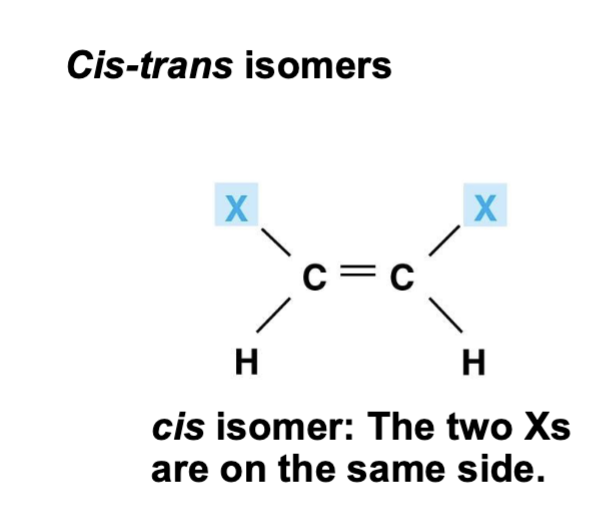
Trans isomer
Enantiomers
Mirror image isomers of same molecule
Sugars: Monosaccharides
Monosaccharides such as glucose serve as an energy source and provide carbon units for amino acid and lipid production
Sugars: Disaccharides and Polysaccharides
Disaccharides and polysaccharides serve as a storage reservoir of sugar units
Polysaccharides serve a structural role in plant and microbial cell walls and as a tissue storage form of glucose
Sugars: Oligosaccharides
Oligosaccharides are covalently bound to lipids such as in the blood group antigens, and covalently bonded to secreted proteins such as on antibody molecules
Monosaccharides in equilibrium between linear and ring form

Isomers of glucose

Dehydration reaction: synthesizing a polymer

Hydrolysis: breaking down a polymer

Lipids are structural building blocks of membranes and signaling molecules
Lipids are built from hydrophobic long chain fatty acids usually attached to a glycerol linker
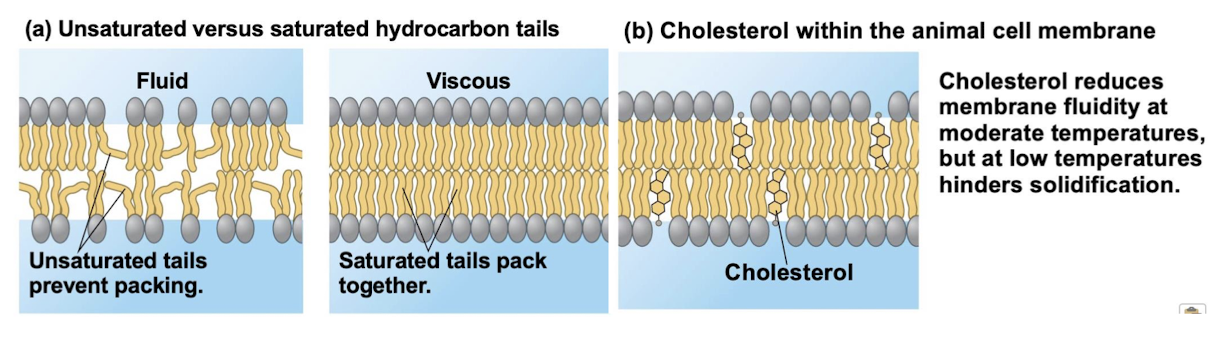
Saturated fatty acid chains with no double bonds pack tightly and are in a solid state at room temperature
Fatty acids with double-bonded carbons - unsaturated –pack less tightly and are liquid at room temperature
Phospholipids in membranes create a bilayer
Sterols stiffen the membrane and also serve as hormone signals transmitted between cells
Attachment of a fatty acid to a carbon of glycerol to create an ester bond

Fat droplets contain triglycerides - 3 fatty acids attached to a glycerol backbone
Protein composition, structure and function
Proteins consist of linear chains of amino acids that fold into 3-dimensional structures that dictate the function of the molecule
Amino acids combine, as dictated by the genetic code, with the release of water to create a peptide bond
Polypeptides are synthesized by a ribosome and fold according to the rules governed by the atomic interactions of the amino acid sequence
Proteins fold in three phases to form secondary, tertiary and quaternary interactions
Amino acid structure
All amino acids have amino and carboxy groups
Amino acids are distinguished by their “R” group side chains

Nonpolar, hydrophobic, amino acids

Polar, hydrophilic, side chains

Electrically charged, hydrophilic, side chains

Determinants of protein folding
Some unfolded proteins spontaneously refold correctly based on the complex chemical and physical interactions of sidechain and peptide bond interactions
In cells, proteins fold as they are made by the ribosome in the amino-to carboxy- terminal direction
Many polypeptides have more than one independently folded domain
Some genetic diseases produce misfolded proteins and some build up aggregates to produce toxic effects
Basic folding units and sequence of interactions

Quaternary structures

Nucleic acids and their constituent bases
DNA strands are arranged in an antiparallel orientation with purine and pyrimidine bases in complementary H-bonds facing inward
DNA strands unwind to permit one DNA strand to be transcribed to make a complementary RNA strand in the 5’-3’ direction
RNA is decoded by the ribosome which reads information in the 5’-3 direction to produce a polypeptide from the amino- to the carboxy-terminus
DNA is replicated by unwinding the helix at a replication fork to expose single strands which are copied to produce complementary strands in the 5’-3’ direction; one strand continuous, the other not
The flow of information in the cell
DNA→ RNA→ Protein
DNA replication
One strand, the leading strand, copied continuously, the lagging strand copied discontinuously

DNA replication fork
strands unwind and new bases are added at the 3’ terminus by the DNA polymerase
The principle tools of discovery in the life sciences
visualization of cells, cell structures (cell biology) and molecules (structural biology) has advanced microscopy from a descriptive craft to a molecularly precise tool
Cell and molecular fractionation has allowed us to discover the function of cell organelles, proteins and nucleic acids
Genetics and genomics allows life scientists to discover novel functions and ascribe roles to known molecules
Fractionation of soluble and membrane proteins is used to understand cellular processes
Biochemical pathways may be understood at a molecular level through the fractionation of soluble proteins to separate them from other unrelated activities
The thousands of different proteins in a cell may be distinguished on the basis of size, shape, surface charge and selective binding affinitie
Proteins embedded in membranes must first be solubilized with a gentle detergent and kept in the presence of the detergent
mRNA
mRNA read from one DNA strand in 5’-3’ direction
DNA replication fork
stands unwind and new bases are added at the 3’ terminus by the DNA polymerase

DNA replication:
One stand, the leading strand, copied continuously, the lagging strand copied discontinuously

The principle tools of discovery in the life sciences
Visualization of cells, cell structures (cell biology) and molecules (structural biology) has advanced microscopy from a descriptive craft to a molecularly precise tool
Cell and molecular fractionation has allowed us to discover the function of cell organelles, proteins and nucleic acids
Genetics and genomics allows life scientists to discover novel functions and to ascribe roles to known molecules
Fractionation of soluble and membrane proteins is used to understand cellular processes
Biochemical pathways may be understood at a molecular level through the fractionation of soluble proteins to separate them from other unrelated activities
The thousands of different proteins in a cell may be distinguished on the basis of size, shape, surface charge and selective binding affinitie
Proteins embedded in membranes must first be solubilized with a gentle detergent and kept in the presence of the detergent
X-ray crystallography has been used to determine the atomic structure of many large molecules
New techniques using the electron microscope has allowed rapid structure determination of macromolecular complexes
Membrane compartments separate unique functions in cells
Major functions such as RNA synthesis in the nucleus, respiration in the mitochondrion and protein degradation in the lysosome are physically segregated from the cytoplasm
Single or double bilayer membranes capture and enclose specific sets of proteins that define an organelle’s functions
Each organelle membrane boundary has specialized proteins that govern the selective uptake or export of proteins or nucleic acids
Some compartments form a boundary by phase separation not involving a membrane boundary
Nuclear pores mediate traffic of proteins and RNA into and out of the nucleus
Ex: from discussion 3

Nuclear pores are size and protein/particle selective

Endoplasmic reticulum
a vast network within the cell that organizes lipid, secretory and cell surface membrane protein synthesis
Ribosomes
Tethered on the cytoplasmic surface of the ER synthesize proteins for secretion and membrane insertion
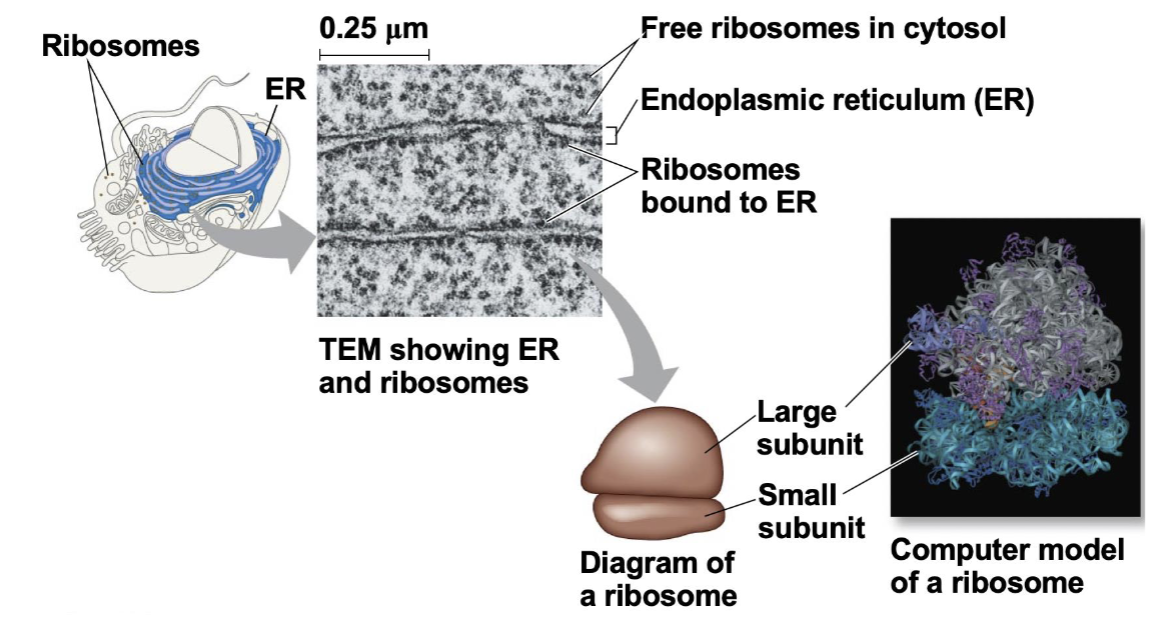
Secretory proteins
synthesized with a signal that directs the ribosome to a channel in the ER membrane

Secretory and membrane proteins
transit in vesicles from the ER through the Golgi apparatus into granules that fuse at the cell surface
Fusion of Insulin
containing secretory granules in a pancreatic beta cell
Lysosome
Acidic compartment fro the degradation of macromolecules
Engulf organelles and invading pathogens by autophagy
Mitochondria
have a two-membrane envelope and a separate chromosome

Chloroplasts
have a two-membrane envelope and internal thylakoid membranes for photosynthesis
The endosymbiont hypothesis for the origin of mitochondria and chloroplasts

ATP
high energy phosphate linkages bonded to base that is also part of RNA

The muscle protein actin and motor protein myosin promote movement of cells and intracellular organelles

Microtubules promote organelle and chromosome movement mediated by different motor proteins

Cilia have an organized set of microtubules that slide back and forth mediated by a motor protein

Membrane structure and function
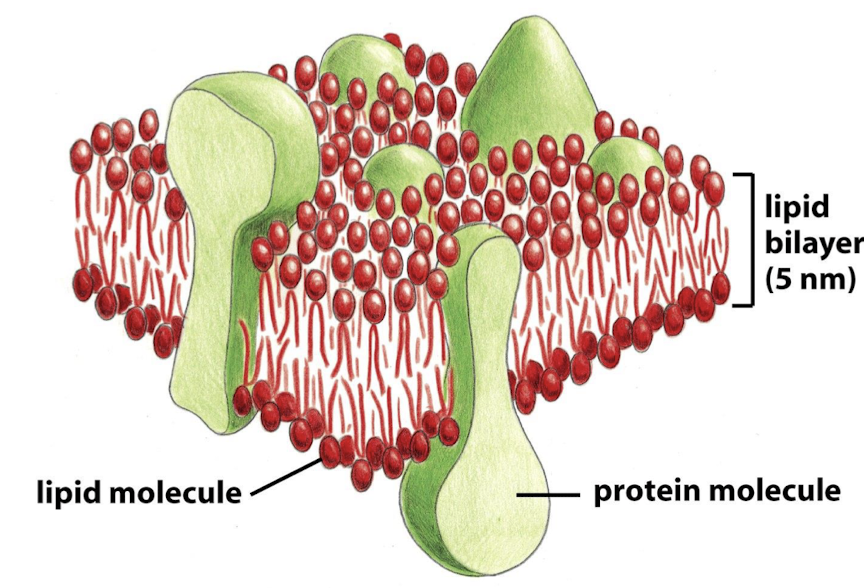
Membrane structure and its influence on function
Membranes are largely 2-dimensional fluids with lipids and proteins free to move laterally, to spin, but not to flip-flop.
Membranes are asymmetric with the polarity of membrane proteins and glycans determined by their insertion in the ER
Selective transport of ions and small molecules is dictated by the geometry of a membrane channel and the concentration gradients of transport substrates and charged ions.
Membrane receptors bind ligands on the cell surface and some are then internalized to control metabolism.
Phospholipid with a saturated and an unsaturated fatty acid
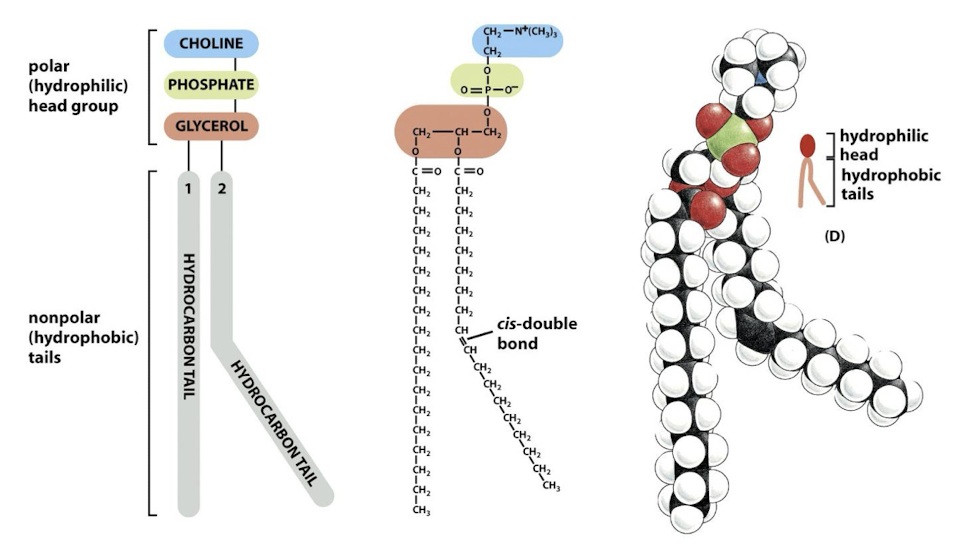
Packing of phospholipids in membranes influenced by saturation, unsaturation and cholesterol
Lateral diffusion of fluorescently labeled molecules in a membrane measured by fluorescence recovery after photobleaching (FRAP)

Organization of an integral membrane glycoprotein of the red blood cell membrane
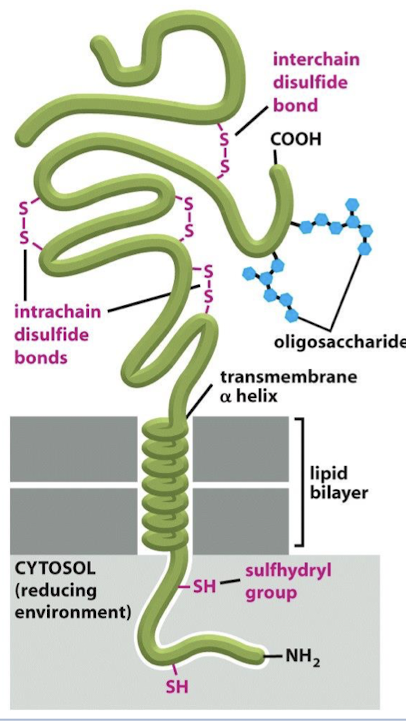
Alpha helical transmembrane domain
Most integral membrane proteins have at least one membrane- spanning domain that forms an alpha helical structure with hydrophobic amino acids facing the phospholipid fatty acid chain interior of the membrane
Glycans attached to lipids and proteins on the lumenal surface of the ER

Inner surface of the red cell membrane showing a cytoskeleton responsible for the shape of the cell

Osmotic pressure: Water moves across a membrane to achieve an equilibrium of free water molecules

Membrane proteins that mediate the transit of ions and small molecules across a membrane

Ion concentrations on the inside and outside of a typical mammalian cell

Ion-coupled transport by a glucose-Na+ symporter

ATP – high energy phosphate linkages bonded to base that is also part of RNA

Energy released by hydrolysis of the terminal phosphate ester bond of ATP

Sodium- K+ ATPase:
Step 1 – 3 Na+ ions bind and ATP is used to add a phosphate to the enzyme
Step 2 – 3 Na+ ions ejected outside, 2 K+ ions bind to sites exposed in the open channel
Step 3 – Phosphate cleaved from enzyme which returns to the resting state exposing K+ to cell interior
Ion channels in nerve cells

Voltage-gated channels: cycle of closed – open – inactivated – relaxed and clos

Structure of the voltage-gated K+ channel – selectivity channel discriminates K+ from Na+

A better fit of anhydrous K+ to carbonyl oxygens in the selectivity filter

Activation of a ligand-gated channel at the synapse

Low density lipoprotein (LDL) binds to a cell surface receptor
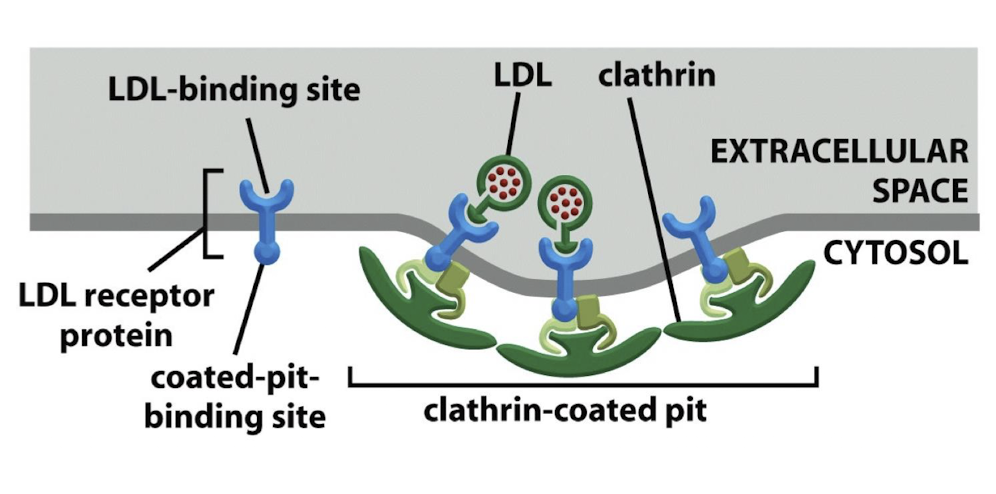
Skin cells from normal and FH disease patients show a profound defect in LDL uptake by mutant cells

Thermodynamics and life
First law of thermodynamics: The energy of the universe is constant. Energy can be transferred and transformed but it cannot be destroyed
During every energy transfer or transformation, some energy
is unusable, and is often lost as heat
Second law of thermodynamics: Every energy transfer or transformation increases the entropy (disorder) of the universe

Life and the transformation of matter
Living cells unavoidably convert organized forms of energy
to heat
Spontaneous processes occur without energy input; they
can be fast or slow
Life does not violate the 2nd law of thermodynamics:
Entropy may decrease locally (in an organism) but the
total entropy of the universe increases
Definition of free-energy change, ∆G
The change in free energy (∆G) during a process is related
to the change in enthalpy, or change in total energy (∆H),
change in entropy (∆S), and temperature in Kelvin (T):
∆G = ∆H – T∆S
Only processes with a negative ∆G are spontaneous
Spontaneous processes can be harnessed to perform work
Actions that result in a negative ∆G

Exergonic vs Endergonic
