SQL
 Call Kai
 Learn
 Practice Test
 Spaced Repetition
 Match
 Flashcards
 Knowt Play
1/65

There's no tags or description
Looks like no tags are added yet.
66 Terms
What are the 2 core functions SQL consists of?
Data Definition Language (DDL)
defining + creating database objects (e.g. tables,relationships,data types,constraints)
Data Manipulation Language (DML)
manipulating + querying data in the db (populating,reading,updating data)
What are literals?
constant values
What must non-numeric literals be enclosed in?
single quotes

Are numeric literals enclosed in quotes?
no

What are the data types that can be used for a character?
CHAR (length) - fixed length
VARCHAR (length) - variable length (max)
TEXT - variable length
What are the data types that can be used for a numeric value?
INTEGER, SMALLINT - integer
OID - obejct identifier
NUMERIC(precision,decimal) - number
FLOAT, DOUBLE - floating point number
What are the data types that can be used for a temporal value?
DATE - date
TIME - time
TIMESTAMP - date & time
INTERVAL - interval of time
What is the data type that can be used for a logical value?
BOOLEAN - boolean (e.g. true/fale, yes/no)
Why should you never use a FLOAT or DOUBLE data type for money?
approximate (inexact) types
may result in discrepancies - rounding errors
What data type should you use for money?
Numeric OR DBMS’s monetary type
How do you delete database objects in SQL?
DROP (delete child objects first & parent objects last)

How do you create a table in SQL?
CREATE TABLE (create parent tables before child tables)

What do constraints in SQL prevent?
accidental damage
changes that may cause data inconsistency
Where are constraints specified in SQL?
specified using clauses in CREATE TABLE statement
OR
specified using database procedures/rules
What are the type of SQL constraints?
Mandatory Data - NOT NULL
Entity Integrity - PRIMARY KEY
Referential Integrity - FOREIGN KEY
Column value constraints - CHECK,UNIQUE,DEFAULT
Enterprise constraints
How would you write an SQL constraint?

How would you write a check SQL constraint?

How do you create a table that has a composite key?
create the key after column definition

What is the referential integrity rule?
value of FK must match existing PK it refers to/be null
When is deletion of a row in a “parent” table not allowed?
if there exists any referenced rows in the “child” table
What happens if the PK in the parent table is deleted/changed?
effects are dependent on actions specified in REFERENCES clause of child table
What are the referential integrity options if a record is deleted in the parent table?
CASCADE
SET NULL
SET DEFAULT
What does “CASCADE” do?
auto delets all referenced records in the child table

What does “SET NULL” do?
sets FK value of all referenced child records to NULL (default option)
What does “SET DEFAULT” do?
auto sets FK of all referenced child records to default value

How do you add a FK in SQL?
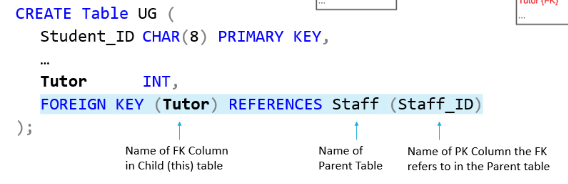
What is altering tables used for?
to make changes to columns in existing table
How do you add a new column to a table in SQL?

How do you add a delete an existing column from a table in SQL?

How do you modify an existing column from a table in SQL?

What are the 4 statements for data manipulation in SQL known as CRUD?
(CREATE) INSERT - add data
(READ) SELECT - retrieve data
(UPDATE) UPDATE - modify data
(DELETE) DELETE - delete data
What are the additional clauses when using the SELECT statement?

How do you select all columns from a table?

How do you select specific column(s) from a table?

How do you select distinct (no duplicates) values of a column?

Give an example of how a SELECT statement can include column expressions to perform calculations

What is the “WHERE” clause used to retrieve?
rows that match a specified filter condition

What are the 5 basic conditions of the “WHERE” clause?
Comparison - compare values of expression
Range - does value of expression fall into range?
Set membership - does value = 1 set of specified values?
Pattern match - does string value match specified pattern?
Null - does column have a null value?
What are operators that can be used in the WHERE clause
= equals
<> not equal
> greater than
< less than
>= greater than or equal to
BETWEEN between inclusive range
IS NULL column expression value is null
LIKE
IN

What are the 3 “WHERE” clause compund conditions?
AND = both 1st & 2nd condition true
OR = 1st or 2nd condition true
NOT = negates a condition
How would you test if something is null in sql?

How would you test if something is not null in sql?

What is the “order by” clause used for?
to sort query results
How would you order query results in ascending order in SQL?

How would you order query results in descending order in SQL?

What is the “limit” clause used for?
to limit the number of rows returned by a query to a max value
How would you use a “LIMIT” clause in SQL?

What is meant by aggregating data?
combining data & derive summary info (e.g. sums,counts,averages, etc.)
What are the 5 aggregate functions defined in SQL?
COUNT - return num of values (in specified column)
SUM - returns sum of values (in specified column)
AVG - returns average of values (in specified column)
MIN - returns smallest value (in specified column)
MAX - returns largest value (in specified column)
What is the syntax for aggregate functions?
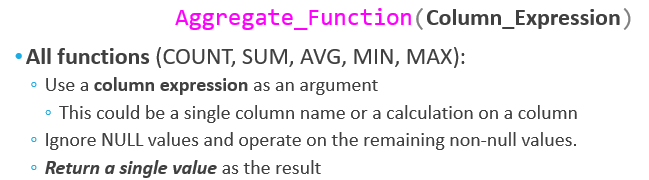
Which of the 5 aggregate fucntions defined in SQL applies to both numeric and non-numeric data?
COUNT, MIN, MAX
Which of the 5 aggregate fucntions defined in SQL applies to numeric data?
SUM, AVG
What does “COUNT(*)” do?
counts all the rows of a table regardless of nulls/duplicates
What is the “GROUP BY” clause used for?
to get sub-totals/summary data (aggregates) by groups
specifies attribute(s) to group records by

What is the rule on what must be included when using the GROUP BY clause?
each item in SELECT list must be single-vaued per group
results of group by can only contain:
grouping attributes
constants
aggregate function results
(every column listed in the SELECT statment has to be associated w/ an aggregate function OR it has to appear in the GROUP BY clause)
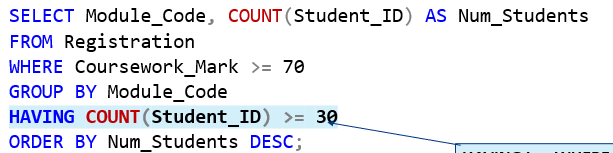
What does the “HAVING” clause do?
used w/ GROUP BY to reduce groups that appear in the query result (filters groups)
What are the 2 ways to remove ambiguity in a multi-table query result? (e.g. if columns have same name but diff table)
prefix attribute w/ required table name
e.g. Staff.Staff_ID
use aliases to simplify/shorten length of query
e.g. s.Staff_ID (‘s’ alias for staff)
What are the steps when querying multiple tables?
what tables needed
idenitfy + give aliases to each table
what columns needed for each column
what are matching columns in tables
specify your JOIN condition
what type of JOIN is needed
are any other clauses required
What does an inner join return?
rows that have a match in both tables

What does a left outer join return?
all rows from the left (1st) table & matched from the right table
(NULLs returned for columns in right side table when there is no match)

What does a right outer join return?
all rows from right table & macthed from left table
(NULLs returned for columns in left side table when there is no match)

What does a full join return?
all rows from both tables whether there’s a match or not
What does a self join return?
rows w/ a match in the same/different columns of the same table
Illustrated types of joins
