BIMM 100 MT 1
 Call Kai
 Learn
 Practice Test
 Spaced Repetition
 Match
 Flashcards
 Knowt Play
1/70

There's no tags or description
Looks like no tags are added yet.
71 Terms
Hershey-Chase Experiments (1952)
Proved deoxyribonucleic acid (DNA), rather than protein, is the genetic material.
Run by infecting E. coli bacteria with phages containing radioactively labeled DNA (32P) or protein (35S), then agitating them in a blender to detach the empty viral coats. Finally, the mixture was spun in a centrifuge to separate the heavy bacterial cells from the viral debris, revealing that only the labeled DNA had entered the bacteria.
Nucleotide Requirements
Phosphate Group
(deoxy) Ribose / sugar pentose
Base
Purines
Bases with two rings: Adenine (A) and Guanine (G)
Pyrimidines
Bases with one ring: Uracil (U), Thymine (T), Cytosine (C)
Adenine
Forms two hydrogen bonds

Guanine
Forms three hydrogen bonds

Thymine
Forms two hydrogen bonds
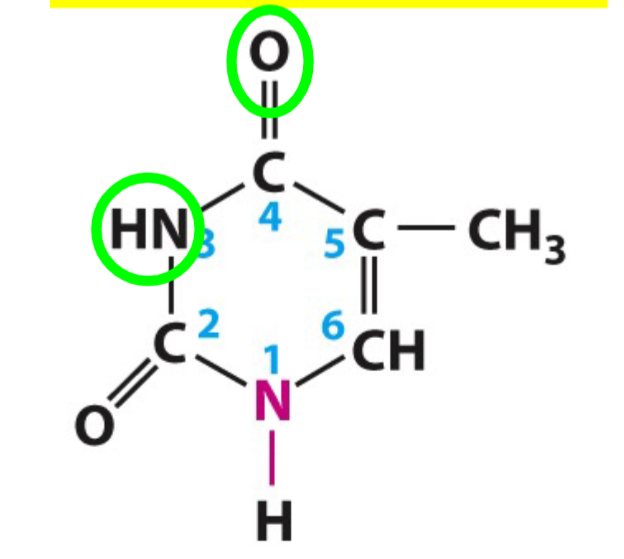
Cytosine
Forms three hydrogen bonds

Uracil
Found only in RNA

Chargaff’s Rules (1947)
A = T, G = C
Tm
Melting temperature, the temperature at which half the bases of a dsDNA become denatured. Higher Tm corresponds to higher G-C content since they have 3 hydrogen bonds, making them more resilient to denaturing.
Gene
The entire nucleic acid sequence that is necessary for the synthesis of a functional product.
Includes:
coding region
transcribed non-coding regions (99% of the human genome)
UTRs (untranslated regions)
introns
transcriptional control regions
splice sites
polyA sites

Solitary Genes
found only once in the genome
core, irreplaceable housekeeping functions
Duplicated Genes
Multiple genes of close but not identical sequences.
often within 5-50kb of one another
gene families encode homologous (closely related) proteins
source of evolutionary novelty and specialization
How are genes duplicated?
Pairing between repeat sequences (L1) allows for unequal recombination

Tandemly Repeated Genes
Encode identical or nearly identical gene products.
(E.g rRNAs, tRNAs, histone coding genes)
DNA Transposon
Cut & paste mechanism into different position in the genome
Retrotransposon (RNA)
Copy & paste mechanism into different position in the genome.
DNA Transposons
Transposase
Blunt cut (cuts through both stands) at specific sites in donor DNA
Staggered cut (cuts through one strand) in target DNA
Ligation of donor to target
LTR (Long Terminal Repeat) Retrotransposons
Reverse Transcriptase (RT) - copies RNA into DNA
Integrase - inserts the NDA into the Genome
Non-LTR Retrotransposons
LINEs
Long Interspersed Elements
encode proteins that enable mobility
21% of total human DNA
SINEs
Short Interspersed Elements
rely on LINE protein for retrotransposition
13% of total human DNA
Transposons and Evolution
Generation of gene families - duplications
Creation of new genes - exon shuffling
Change regulatory regions that control gene expression
Chromatin
Disorganized chain of nucleosomes packed together at different concentration densities.
DNA (wraps around nucleosomes)
Histones (major ones: H1, H2A, H2B, H3, H4)
Other proteins (scaffold, replication, and transcription factors)
Histone Tails
The termini of the histone proteins; beginning and end of proteins. Modification (eg. methylation & acetylation) controls chromatin condensation and function.
Acetylation
Facilitated by Histone Acetyltransferase (HAT). Acetylates lysine 9 on histone 3 (H3K9) and removes the positive charge → looser
Methylation
Facilitated by Histone Methyltransferase (HMT). Methylates lysine 9 on histone 3 → tighter
Trimethylation of lysine 9 (H3K9Me3) allows HP1 to bind
Euchromatin
Loose chromatin that enables transcription/gene expression.
Heterochromatin
Tight chromatin that prevents transcription/gene expression.
Heterochromatin Protein 1 (HP1)
Promotes heterochromatin formation; binds to trimethylated lysine 9 on H3 and pulls other HP1 (oligomerization) & binds to H3K9 HMT → pulls histone together
Boundary Element (Insulator)
sequence of DNA that prevents spreading of a chromatin state, for example, by being bound to non-histone proteins
DNase I Protection Assay
Used to determine the state of chromatin of a gene
Isolate nuclei
DNase I treat sample
Purify DNA (remove DNase) and digest with Bam HI
Southern Blot analysis with labeled probe designed to hybridize to part of gene
Southern Hybridization/Southern Blot (DNA)
Digest DNA with restriction enzyme to cut into smaller pieces
Separate using gel electrophoresis
Transfer from gel to nitrocellulose
Hybridize with labeled (eg. fluorescence or radiation) DNA or RNA probe complementary to target sequence
Detect (eg. via autoradiogram)
Karyotype
The number, size, and shape of metaphase chromosomes in a species
Elements for Chromosomal Replication and Inheritence
Replication origins (ORI) - replicate DNA
Centromeres (CEN) - proper segregation of daughter chromosomes
Telomeres (TEL) - protect ends
DNA Replication Requirements
Template
Primer
dNTP’s
Proteins
Topoisomerase
Relieves the stress of DNA unwinding done by Helicase
Lagging Strand
multiple RNA primers
extended 5’ to 3’ by DNA pol δ
RNA degraded
DNA pol fills gap
ligation
Leading Strand
1 RNA primer
extended 5’ to 3’ by DNA pol ε
DNA Replication Proteins Order
Large T antigen - helicase
RPA (Replication Protein A) - binds unwound parent DNA and keeps it unwound
Topoisomerase - removes stress in front of helicase
Primase (RNA Pol), DNA Pol α - adds dNTPs to both leading and lagging strands
RFC (Replication Factor C) & PCNA (Proliferating Cell Nuclear Ant.) clamp on Pol; DNA Pol δ - synthesizes lagging strand
RNase H + FEN1 - remove primers
DNA Ligase - connect DNA fragments
RFC/PCNA - clamps on DNA Pol ε for synthesis of leading strand
High Fidelity DNA Replication Proteins
DNA Pol δ & DNA Pol ε
Low Fidelity DNA Replication Proteins
Primase & DNA Pol α
Telomerase
RNA serves as template
Reverse transcriptase protein carries out reverse transcription
Polymerase Chain Reaction (PCR)
Amplifies a specific DNA sequence from a DNA sample. Requires:
Template DNA
DNA primers
DNA instead of RNA to prevent need for removal → no end-replication problem
dNTPs
Polymerase
When used to detect a sequence of interest after DNase I Protection Assay, the presence of a PCR product indicates heterochromatin, while the absence indicates euchromatin
PCR Cycle
Denaturation of DNA & annealing of primers
Elongation of primers
Repeat in next cycle
DNA Fingerprinting
Based on Simple Sequence Repeat (SSR) DNA
Sequences of SSR’s are highly conserved but the number of repeats vary
1 band = 1 set of primers
Proofreading
A type of DNA repair done by DNA Pol δ and ε, which have 3’ → 5’ exonuclease activity. Steps:
Pol pauses
Pol removes nucleotide
Pol resumes replication
Mismatch Excision Repair
Corrects single stranded replication errors.
Incorrect base in daughter strand is recognized
The nucleotide with the incorrect base and surrounding nts are removed
Gap is repaired by DNA Pol δ/ε and ligase
Base Excision Repair
Replaces a chemically changed base (eg. deamination of cytosine → uracil → thymine) in ssDNA
Remove incorrect base (eg. T)
Endonucleases remove deoxyribose phosphate
Gap is filled with correct base by DNA Pol β and ligase
Nucleotide Excision Repair
Fixes distorted ssDNA (eg. formation of Thymine dimers)
Distortion is recognized
Helix opened
Endonucleases remove damaged and surrounding nucleotides
Gap is repaired by DNA Pol δ/ε and ligase
Homologous Recombination
An error-free type of dsDNA repair. Undamaged homologous chromosome serves as template.
dsDNA break is recognized and exonucleases remove nucleotides, leaving 3’ end ssDNA overhangs
ssDNA searches for homologous sequence in sister chromatid
Synthesis by DNA Pol using 3’ end of broken DNA as a primer and sister DNA as template
Ligation
Resolution to 2 intact dsDNAs, Holliday structure formed
End-Joining
An error-prone type of dsDNA repair. Two separated ends rejoined or different broken ends joined (translocation).
Recognition of broken ends
Exonucleases remove overhang nucleotides
Ligation
Translocations
Broken ends from different chromosomes are end-joined
RNA Transcription Requirements
RNA Polymerase/proteins
Template
rNTPs
NO PRIMER NEEDED
Transcription Stages
Initiation:
Polymerase binds to promoter sequence in duplex DNA - “Closed complex”
Polymerase melts duplex DNA near transcription start site, forming a transcription bubble - “Open complex”
Polymerase catalyzes phosphodiester linkage of two initial rNTPs
Elongation:
Polymerase advances 3’ → 5’ downstream (+) the template strand, melting duplex DNA and adding rNTPS to growing RNA
note that synthesis is stll 5’ → 3’
Termination:
At transcription stop site, polymerase releases completed RNA and dissociates from DNA
Prokaryotic Operon (Gene Expression) vs Eukaryotic Gene Expression
1 Promoter vs 5 Promoters
1 Transcription stop site vs 5 transcription stop sites
1 mRNA vs 5 mRNA
5 Proteins produced (polycistronic) vs 5 proteins produced
Northern Blot (RNA)
Isolate total RNA
Denature and separate RNA by electrophoresis (no restriction enzymes needed, only in dsDNA)
Transfer to nitrocellulose and fix
Hybridize to probe (must be complementary)
Detect (RNA or DNA probe)
Sigma (σ) Factors
Requires for RNA Pol to initiate transcription
Bind RNA Pol and promoter sequences in DNA
Assist RNA Pol in separating DNA strands
Lac Operon
Encodes 3 proteins needed for lactose metabolism - produces glucose and galactose
Repressed State (No Lactose):
Lac repressor protein complex binds the lac operator DNA
RNA Pol-σ70 cannot bind promoter
Low Expression (Lactose + Glucose):
Lactose molecules bind lac repressor causing it to dissociate from the operator
RNA Pol-σ70 can bind promoter and initiate transcription
Only binds to weak promoter (doesn’t match consensus sequence)
Activated State (Lactose Only):
Lactose molecules bind lac repressor causing it to dissociate from the operator
Low glucose = hi cAMP
cAMP binds CAP proteins, allowing them to bind the CAP site
CAP + cAMP bind to CAP site, stimulates RNA Pol-σ70 to increase transcription initiation
Eukaryotic Transcriptional Control
Activators (decondenses heterochromatin to form euchromatin)
Bind DNA
Recruit co-activators
HATs (histonemethyltransferase)
Mediator
Repressors (condenses euchromatin to form heterochromatin)
Bind DNA
Recruit co-repressors
Histone deacetylases
HMTs (histonemethyltransferase)
Transcription Regulation
Promoter - sequence of DNA for RNA polymerase to bind to for transcription
Transcription Factors (TF) - proteins that regulate transcription
RNA Polymerase II Promoters
General Promoter Elements:
TATA boxes
positions RNA Pol II for transcription
Initiator
at start site
+1
CpG Islands
usually 100-1000nt upstream of start site
Divergent Transcription
Transcripts made in both directions
Usually from CpG promoters
Wrong direction transcripts usually terminate and are unusable
General Transcription Factors
Sequential binding of general transcription factors (TFIIs + Pol II)
position polymerase
unwind DNA
Assembly of Pol II Pre-Initiation Complex (PIC)
TFIID
TBP = TATA Binding Protein
TAFs = TBP Associated Factors
TFIIA, TFIIB, TFIIF, Pol II, TFIIE, TFIIH (helicase)
unwind template
start synthesis
phosphorylation of Pol II CTD (Carboxyl-Terminal Domain, 7 amino acid repeats)
Systematic Mutagenesis
Determines which promoter sequences are regulate/allow transcription
Create reporter genes
introduce mutations (changes in nucleotide sequence) at specific positions in control region sequence
Put reporter in expression system
Assay reporter expression
DNase I Footprinting
In vitro; Reveals whether or not a protein binds to a DNA sequence and where
32P-label dsDNA at one end
Incubate DNA with protein sample
Add DNase I (limiting amount)
Isolate DNA
Denature and separate by electrophoresis
Detect labeled DNA fragments
No cuts by DNase where the protein is sitting
Electrophoretic Mobility Shift Assay (EMSA)
In vitro - Shows binding affinity but not precise location
Incubate 32P-labeled dsDNA probe with protein
Electrophorese under non-denaturing conditions
ChIP (Chromatin Immunoprecipitation)
Used to reveal DNA-Protein interactions
Cross-link, then isolate chromatin
Break chromatin into pieces
Use specific antibody to select chromatin pieces containing protein of interest
Release DNA
Use PCR to determine if a specific gene/DNA sequence was associated with the protein of interest
Nuclear Hormone Receptors
Type of TF
Bind hormone (ligand)
Bind DNA as dimers
Regulate txn
Homodimeric Nuclear Hormone Receptors
- Ligand = cytoplasmic → No txn
+ Ligand = nuclear translocation → Activation of txn
Heterodimeric Nuclear Hormone Receptors
Repress txn in absence of ligand
Activate txn upon binding ligand