Darwin & The Theory of Evolution
 Call Kai
 Learn
 Practice Test
 Spaced Repetition
 Match
 Flashcards
 Knowt Play
1/56

Earn XP
Description and Tags
BIO1131 - Delcourt
57 Terms
Early Greek philosphers viewed the world as ________ and _________, which is incompatible w ___________
eternal, unchanging, evolution
In the middle age and Renaissance period, scholars adapted ideas to accomodate a ___________ view based on literal interpretations of the _____
Christian, bible
St Thomas Aquinas and William Paley promoted the __________ _________
watchmaker analogy
Watchmaker Analogy
The complex structure of living things + the remarkable adaptations of plants/animals are evidence as the work of an intelligent designer
in the 1600s, systematic classifications were based on:
similarities among organisms
Linnaeus developped a __________ ________ in which organisms are arranged in:
taxonomic system, hierarchical groupings based on similarity (NESTED CLASSIFICATION)
New observations in the 18th century promoted a radical shift among ___________. One of which was that the earth is ______ _____, based on observations of:
geologists, very old; sedimentary rocks that had been laid down under ancient oceans.
Hutton argued that based on how ____ were organized, the length of time necessary for _______ and __________, ________ evidence, all pointed to our world being very old.
strata, erosion, sedimentation, fossil
Lyell argued that existing ________ features can be explained by the same ongoing processes we _______ observe; the missing element is ______!
geological, currently, time!
Uniformitarianism replaced ____________
catastrophism
Uniformitarianism
the same natural laws and processes that operate in our present day scientific observations have always operated the past and apply everywhere in the universe; ie geological processes must have operated over long periods of time slowly and gradually
Cuvier
established the fact of extinction! Compared the anatomy of living things to fossil and determiend that species in the fossil records do not live today.
Mary Anning
Discovered many fossils but wasn’t recognized for it
the first to discovery the plesiosaurus
learned paleotology w/o any formal education
her family collected and solf fossils
Lamark
first who developed a complete theory of evolution + a mechansimy by which it occurs
determined that more complex species gradually descend from older, less complex ones
wrongly suggested that traits acquired during an individual’s lifetime were passed down to their offspring (use and disuse of structures)
Lamark was wrong, but he still had a legacy:
he proposed a mechanism for evolution and he explained adaptation as a fit between organisms and their environment
Along Darwin’s 5 year voyage aboard the HMS Beagle, he read ____’s Principles of Geology. This convinced of:
Lyell, that uniformitarianism rather than catastrophism
Darwin’s observations were inconsistent with ___________, the belief that species were created independently by a divine creator.
creationism
Similar environments can produce similar _____________, but geographic history reflects _________.
adaptations, ancestry
2 main insights of Darwin and Wallace
Descent with Modification (common descent) — ie evolution
Natural Selection
Darwin' called evolution:
descent with modification
The modern definition for evolution
a change in a heritable characteristic in a population over time — or — a change in allele frequency in a population over time
Allele
particular form/version of a gene
Gene vs Allele (car analogy)
🚗 if a gene is a car, allele is the brand of car
Can individuals adapt or evolve?
NO!! Only populations do.
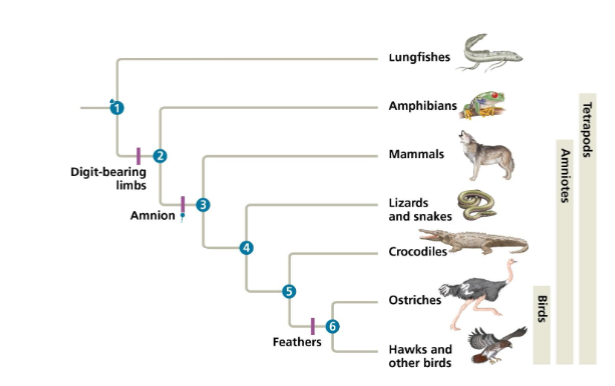
What do the following represent on phylogenetic trees?
Root
Tips
Hatch Mark
Branch
Root: common ancestor
Tips: present day species
Hatch Mark: homologous characteristics
Branch: each branch = the common ancestor of the two lineages diverging from that point (“coming out” of root)

Evidence for common descent (3)
1) Homology
2) Fossils
3) Biogeography
Homology is defined as:
similarity due to inheritance from a common ancestor
why did homology support common descent?
Darwin argued that the similarities in structure between species — especially when function differs — can be explained if those species descended from a common ancestor that possessed that structure
Examples of homology (3)
Structural Homology & Vestigial Structures & Developmental Homology
Structural Homology
different species have similarities in their structures/body parts despite them serving different functions
ex: human arm vs cat paw vs whale flipper vs bat wing

Developmental Homology
similar traits are present in different species at a particular stage of their development

Vestigial Traits
remnants of a trait that served a function in an ancestor, but serve little/no function now
ex: hind legs in whales
Fossils as evidence for common descent
fossil records show the intermediate/transitional species, proving that species aren’t fixed — they change over time or even go extinct.

🔗 Why is there no “missing link”?
It is unreasonable to expect to find fossils of the exact individual at the origin of a specific lineage. Instead, it is much more likely to find the fossil of an individual along a related branch.
Explain the importance of the tiktaalik
it is an intermediate between fish and tetropods, containing both fish and tetrapod traits

Biogeography as proof for evolution
species/fossils that are similar to each other tend to be clustered in time and space, grographically
Natural Selection
the differential reproductive success of individuals due to differences in phenotypes
⚠ Natural selection is NOT evolution, but they are related. How?
natural selection is a force by which evolution can occur
3 critical ingredients for natural selection
Excess fertility such that more offspring are produced than the environment can support (there is a struggle for existence)
There is variation (success is not random)
Much of this variation is heritable

If there is a graph that shows relation btn fitness and frequency, a horizontal line indicates:
no selection! (zero relation between fitness and frequency)
since natural selection only occurs when certain conditions are met, its called:
deductive reasoning
⇨ deterministic, not random!
The following are necessary for:
individuals vary in a trait
there is a relation between trait and reproductive success
natural selection
The following are necessary for:
individuals vary in a trait
there is a relation between trait and reproductive success
the trait is heritable
evolution via natural selection
Adaptation vs Selection
adaptation is the response of the population to natural selection
Adaptation is the change in a ____ over time due to:
trait, evolution through natural selection
Tautology + example
a statement that’s true by definition (a self-defining statement)
ex: “survival of the fittest” basically means “survival of those who survive”
Evidence for natural selection (3)
Deductive reasoning
Explains adaptation (why organisms are so well suited to their environment)
An analogy w artifical selection
Artificial selection as evidence for natural selection
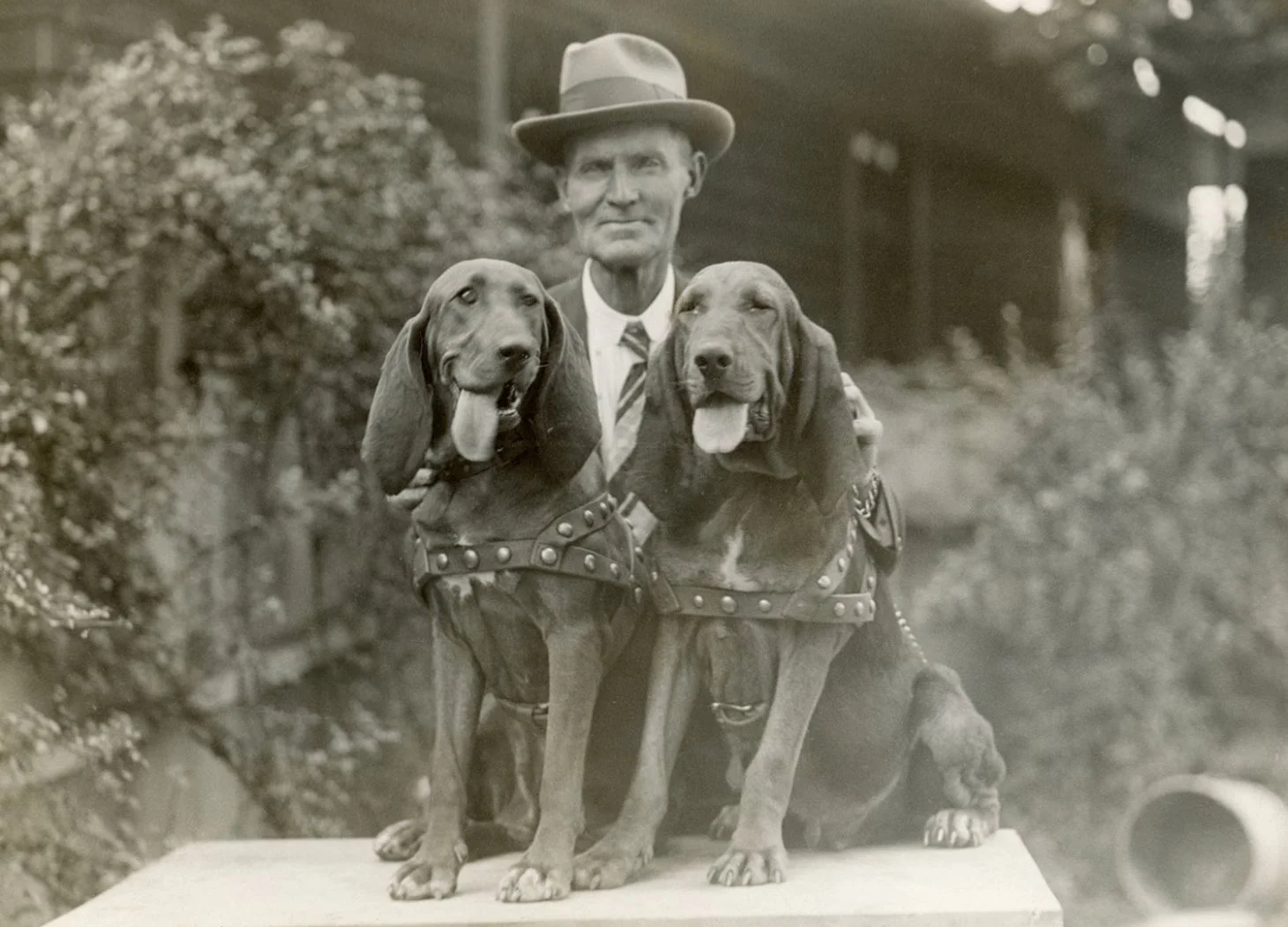
humans have shaped evolution of plants and animals thru systematically breeding those w desired characteristics (ex: dogs, corn)
Experimental Evolution + example
a technique in which conditions are manipulated in replicate pops under control conditions and the evolutionary outcome is studied
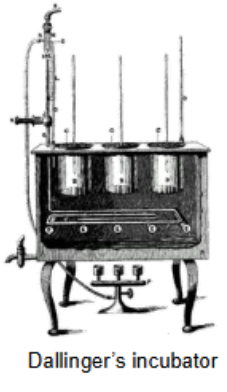
ex: Dallinger and his protists
Dallinger and experimental evolution
Dallinger raised a species of protists at increasing temperatures. Most died from the increase, but some resisted. Over 7 years he evolved populations that could survive in these high temperatures, but there was a cost — they could no longer survive at the lower temperature they used to live at.
Natural selction is not goal driven nor progressive, why?
while it has increased complexity and specialization in some lineages, others have not!
ex: tapeworms no longer have digestive systems, birds no longer have teeth
Evolution, like natural selection, has no “goal”, nor does it act for “the good of the species”. Instead, it is just a ________ that occurs when:
process, when certain conditions are met
Give some examples of when natural selection favours traits that are detrimental to a species
when traits that maximize fitness in one individual are costly to the other
parent/offspring conflict
sexual conflict
selection favours traits that lead to overexploitation of resources (tragedy of the commons)
Intelligent design
a pseudo-scientific rebranding of creationsism
⇨ argues that some things are too complex to have evolved through natural process — they must have been designed by an intelligent being

Why are creationism and intelligent design NOT scientific?
they cannot be tested, nor refuted! They invoke supernatural causes and therefore can’t be proven experimentally. Rather, they seek to confirm predictions and not reject hypothesises.

Irreducible complexity
a flawed argument from creationists that suggests that some biological systems are so complex that removing one part would break the system — making it thus impossible to evolve gradually. So, the system must have appeared in its complete form from the get-go. (by an intelligent designer)
why is irreducible complexity incorrect?
it suggests that evolution is linear.
🔨 We know that evolution can modify/repurpose existing structures, so the real question is “what were these parts doing before they became part of this system?” instead of “can the system work w/o the part?”