Fostering Patient Self-Care
 Call Kai
 Learn
 Practice Test
 Spaced Repetition
 Match
 Flashcards
 Knowt Play
1/5

There's no tags or description
Looks like no tags are added yet.
6 Terms
WHAT IS SELF-CARE IN A COMMUNITY CONTEXT?
“Self-care is the ability of individuals, families and communities to promote and maintain their own health, prevent disease, and to cope with illness – with or without the support of a health or care worker.” (WHO)
SOCIO-ECOLOGICAL FACTORS THAT INFLUENCE SELF-CARE
Individual (Interpersonal) Factors
• Knowledge and Health Literacy
• Skills
• Attitudes and Beliefs
• Demographics
Interpersonal Factors
• Family support
• Peer influence
• Social networks
Community (organizational/Institutional) Factors
• Community Norms & Culture
• Healthcare Access
• Faith Organizations
• Workplaces/ Schools
Societal (Policy/Environmental/Structural) Factors
• Socioeconomic Status
• Policies & Laws
• Physical Environment
• Social Inequality & Discrimination
• Media & Technology
HOW THE COMMUNITY NURSE SUPPORTS SELF- CARE: INDIVIDUAL LEVEL
HOW THE COMMUNITY NURSE SUPPORTS SELF- CARE: INDIVIDUAL LEVEL
▪ Nurses are essential coordinators of care and advocates for patient self- management.
▪ With physicians, pharmacists, and dietitians for coordinated medication management, teaching, and nutrition plans.
▪ With social workers to address barriers such as transportation or housing that affect self-care.
▪ Via case conferences to create unified care plans focused on patient goals.
Examples:
• The CHN co-develops an individualized care plan with a patient following hip replacement, incorporating PT/OT recommendations
• The CHN uses a teach-back method to help a young family learn new parenting skills after the birth of their first child, ensuring consistent health education
• The CHN works with the clinical pharmacist and the patient for medication reconciliation and counseling following diagnoses of T2D
HOW THE COMMUNITY NURSE SUPPORTS SELF- CARE: FAMILY LEVEL
HOW THE COMMUNITY NURSE SUPPORTS SELF- CARE: FAMILY LEVEL
▪ With family therapists and social workers to support caregivers, strengthen family coping, or address family dynamics
▪ With home health aides and visiting nurses ensuring continuity and reinforcement of self-care strategies
▪ With community health workers (CHWs) as cultural liaisons who can bridge communication between families and providers
Examples:
• The CHN organizes multidisciplinary family meetings to set shared self- care goals for a family whose child has been diagnosed with stage IV leukemia
• The CHN coordinates and provides education sessions with dietitians and diabetes educators for family with new onset T2D
• The CHN works with a family support group and counseling for a couple when one spouse seeks treatment for SUD
HOW THE COMMUNITY NURSE SUPPORTS SELF- CARE: COMMUNITY LEVEL
▪ With public health to design and deliver community self-care programs (e.g., chronic disease management, smoking cessation)
▪ With local organizations (e.g., faith groups, cultural centers, fitness programs, schools) to access and promote resources
▪ With social service agencies connecting populations to nutrition programs, housing, or financial aid (e.g., WIC, SNAP, Meals on Wheels)
Examples:
• The CHN leads a community health fairs or screenings with multidisciplinary teams
• The CHN engages with school nurses and teachers to implement wellness and self-care lessons for pre-teens on hygiene
• The CHN builds a local referral network in a small rural community with physical activity programs, food pantries, or transportation services
EVALUATE AND ADVOCATE AN EVIDENCE-BASED STRATEGY
TEACH-BACK METHOD
What is Teach-Back?
Teach pt then ask pt to explain back to you
How could Teach-Back be implemented in a community setting (e.g., school)?
hands on in PE
What are potential barriers and how might you overcome them?
varying literacy levels, intimidating
How would you measure its effectiveness in promoting self-efficacy and health literacy?
GROUP PEER SUPPORT SESSION
▪ How could the CHN implement a group peer support session for patient following bariatric surgery?
▪ What are potential barriers and how might you overcome them?
▪ How would you measure its effectiveness in promoting self-efficacy and health literacy?
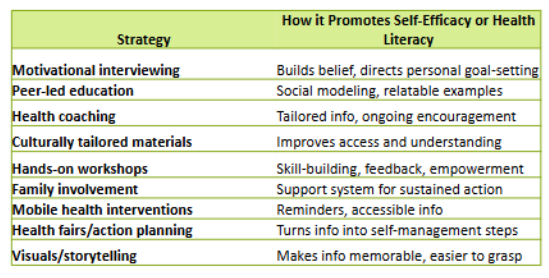
Other Evidence-Based Strategies for Self-care
PUT IT INTO PRACTICE: AVOCA
1. Analyze the determinants influencing Avoca’s chronic health condition using the Socio-Ecological Model.
2. Develop culturally sensitive, patient-centered interventions that empower the client and family toward self-care and address system-level health risks.