Electricity
 Call Kai
 Learn
 Practice Test
 Spaced Repetition
 Match
 Flashcards
 Knowt Play
1/57

There's no tags or description
Looks like no tags are added yet.
58 Terms
What does q and Q refer to?
q = single charge, Q = group of charges

Electric field lines move from positive to negative
True
What is the downwards force acting on an ink droplet in a vertical electric field
Downward weight force (Fw) due to gravity
Difference between q and Q
q represents a single point charge, whereas Q represents a source charge or group of charges.
Electric field lines
Imaginary lines used to show the distribution and direction of an electric field.
Direction of electric field lines
From positive to negative, corresponding to the direction of force experienced by a positive test charge.
Relationship between electric field line spacing and field strength
The closer the field lines are to one another, the stronger the electric field.
Angle at which electric field lines intersect a surface
Right angles (90∘).
Definition of electric field strength (E)
The voltage gradient across a particular distance. V/d
Formula for uniform electric field strength
E=dV, where V is voltage and d is distance.
Medium in which charges can have potential energy
Electric fields (similar to objects with mass storing energy in gravitational fields).
Formula for electric potential energy (Ep) in a uniform electric field
Ep=Eqd, where E is electric field strength, q is charge, and d is distance moved against the field.
How does the total distance a charge travels look like? Used in Eqd
Distance is the straight line of the field, not the total distance traveled, so it cant be a ‘hypotenuse’/diagonal.
Units of measurement for electric field strength (E)
Vm−1 or NC−1.
Energy change when a positive charge moves against an electric field
It stores electric potential energy.
Energy change when a positive charge moves with an electric field
It gains kinetic energy (loses stored potential energy).
Energy change when a negative charge moves against an electric field
It gains kinetic energy (loses stored potential energy).
Energy change when a negative charge moves with an electric field
It gains electric potential energy as its going against the electric field.
Convert q=3200mAh to charge
3200 × 10-3 × 3600s (this is 1 hour) = 1520C

What happens to the total resistance when a lamp from a branch stops working in a parallel circuit?
Total circuit resistance increases as the branch has been removed
Condition for an ink droplet to remain stationary in an electric field
The forces acting on it must be equal in magnitude and opposite in direction so that net force equals zero (Fnet=0Fnet=0).
Are the charges of a proton and electron the same?
Yes
Proton is positive 1.60 × 10⁻¹⁹C
Electron is negative -1.60 × 10⁻¹⁹C
What’s the mass of a proton?
1.67 × 10⁻²⁷kg
Formula for acceleration of a particle
a = F/m

What does “carrying” mean in this context?
It is the charge of the particle
What rule is applied when finding velocity of a particle in an electric field?
Ep=Ek
Rules “Kinetic energy gained, potential energy lost. etc.” apply
What is F in F=Eq?
Electrostatic force
What does |q| mean
“Absolute value”
It means make charge solely a positive number
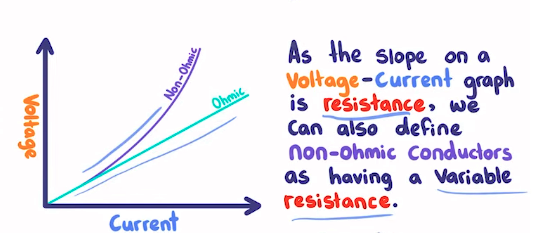
Why differentiates a non-ohmic and ohmic conductor?
Non-ohmic conductors have a changing/variable resistance whilst ohmic conductors have a constant resistance.
Objects and atoms can contain regions of their own magnetic field. What are these called?
Magnetic domains

What happens when the magnetic domains of atoms align?
The overall magnetic field (of an object) gets stronger
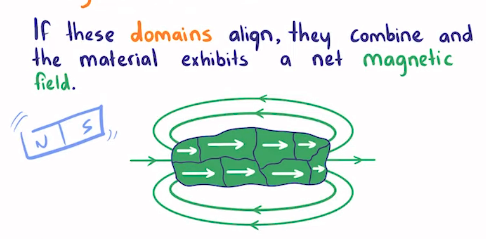
What happens when the magnetic domains of atoms don’t align?
The fields oppose and cancel, they get weaker with each disturbance of the domains.

What are the 2 features of the right hand grip rule?
Right-hand grip
Thumb = direction of charge
Fingers curling in = direction of magnetic field
What happens to the Right-Hand Grip rule when the current is to the left in a wire?
Your knuckles = represent the magnetic field going into the page
Fingertips = magnetic field going out of the page

What are the two options of current direction when we have parallel wires?
Opposite direction (one is into and one is out of the page)
Same direction (both are into/out of the page)
How do the magnetic fields in parallel wires carrying current in opposite directions react?
Thier magnetic fields will repel

How do the magnetic fields in parallel wires carrying current in the same direction react?
Their magnetic fields will attract

When do you use the rules:
Right hand grip
Right hand slap
Right hand grip: When there is no external magnet on a wire
Right hand slap: When the wire or a charge is in a magnetic field
What is the equation associated with the Right Hand Slap rule?
F=BIL
F: Force (N)
B: Magnetic field (T)
I: Current (A)
L: Length of wire in field (m)
F = BIL is an equation for the maximum. What is the condition for it to be a maximum?
If the current and magnetic field are at 90°

What happens and what equation do you use when the direction of current and magnetic field are not 90° to eachother?
The force is weaker and you use the equation F=BILsinθ
If current is parallel to magnetic field, F=BILsin0=0
What equation do you use to find the force of an individual charge in a magnetic field?
F = Bqv
F: Force (N)
B: Magnetic field strength (T)
q: charge (C)
v: positive charge's velocity (ms-1)
What do you do to the Right Hand Slap rule if there’s a negative charge?
Point your thumb in the opposite direction of the charges’ velocity
What does your thumb indicate in the Right Hand Slap rule when it comes to wires and charges (in magnetic fields)?
Wires: Direction of the current
Charge: The direction of the velocity of the charge or wire
How does a charge travel in a magnetic field? (force is perpendicular to the charge velocity)
It travels in a circle (centripetal motion) in the direction of the force


Find the voltage in the wire. What rule and equation do you use here?
Right Hand Slap: Thumb indicates direction of wire’s velocity
V=BvL

Explain this diagram “Loops moving through magnetic fields” and all 4 loops
Loop 1: Right side is in the magnetic field so the charges inside the loop (box) are flowing up, red line stops it from moving up so charges take a left, creating countclockwise current
Loop 2: Charges flow in both right and left section. They meet up, cancelling eachother, no current
Loop 3: Left side is in the magnetic field so charges flow up, hit the red line, and turn right, causing clockwise current.
Loop 4: Has left the magnetic field, no current

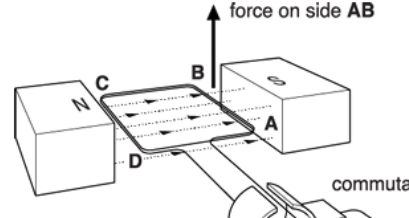
Which are the coils that will actually produce force and voltage?
AB and CD as they are perpendicular to the magnetic field
Everything else is parallel, where θ=0, making F=0 and also V=0 (somehow)
What happens to electric field strength when the field is uniform? And what effect does it have on electrostatic force?
Electric field strength is constant everywhere. F=Eq, constant E and constant q, electrostatic force is also constant EVERYWHERE.
Is there a change in potential energy when the charge moves horizontally in an electric field?
No, as the vertical distance from the plates do not change.
Calculate energy from a resistor in a series circuit. You use these equations: P=IV P=E/t, What’s wrong?
Cannot use V from the power supply as V is shared in a series.
Substitute V=IR into P=IV to turn into P=I2R
What length should you use if you have the equation F=BIL?
The electric field length
What length should you use if you have the equation V=BvL?
Length of the object in the magnetic field, as charges go through the whole object
What happens when a wire is added? What rule do you apply?
It completes the loop, there is now a current, apply the RHS again
What does the force in magnetic fields act on?
Positive charges
When do you get induced voltage?
When charges are separated
When do you get induced current?
When you complete a loop/circuit, giving the separated charges a path to flow
