Art of the Ancient World
 Call Kai
 Learn
Learn Practice Test
 Spaced Repetition
 Match
Match Flashcards
 Knowt Play
1/66

There's no tags or description
Looks like no tags are added yet.
Name | Mastery | Learn | Test | Matching | Spaced | Call with Kai | Chat |
|---|
No analytics yet
Send a link to your students to track their progress
67 Terms
Sumerian, Nanna (Moon) Ziggurat at Ur, c. 2100 BCE
Dedicated to the moon goddess of Nanna and meant to bring people up to the level of the gods to rise to the heavens

Sumerian, Votive statuettes from Tell Asmar, Iraq, c. 2900 BCE
Statue for prayer and features are directed upwards= towards the gods

Egyptian, Imhotep, Stepped pyramid of King Djoser, Saqqara, Egypt, c. 2600 BCE
First built egyptian pyramid and not meant to emphasize ascension but proposed more grand idea of the king by stacking 6 mastabas on top of each other

Egyptian, Great Pyramids, Giza, Egypt, c. 2500 BCE
Built by Khufu, Khafre, and Menkaure and built from july-october when the nile flooded
Clear sand
Level bedrock for flat surface
Build superstructure using range of materials and block sizes
Mortise + tenon
Ramps to transport materials?

Egyptian, Inner Coffin and Mask of Tutankhamen, from his tomb in the Valley of the Kings,
Thebes, Egypt, c. 1323 BCE
Last tomb to still exist and encased in layers for protection, contained gold items to represent wealth and status

Greek, Funerary krater from the Dipylon cemetery, Athens, c. 750 BCE
Shaped as a punch bowl to mix wine and water, with engravings to represent stories of life

Greek, New York kouros, from Attica, c. 600 BCE
Unnatural pose and features, wanted to represent perfect symmetry and patterns instead of realistic features, pushed nudity as an artistic convention

Greek, The Kritios Boy, from the Acropolis at Athens, c. 470 BCE
Start of contrapposto and more realistic human features, change in style after persian war

Greek, The Charioteer of Delphi, c. 470 BCE
Built with bronze to have more realistic details

Greek, Zeus of Artemision, c. 460 BCE
Detailed features represented by lightning bolt, depicts more action oriented pose

Greek, Myron, Discobolus (Discus Thrower), c. 450 BCE
Not realistic pose, unable to be recreated but instead portray tension

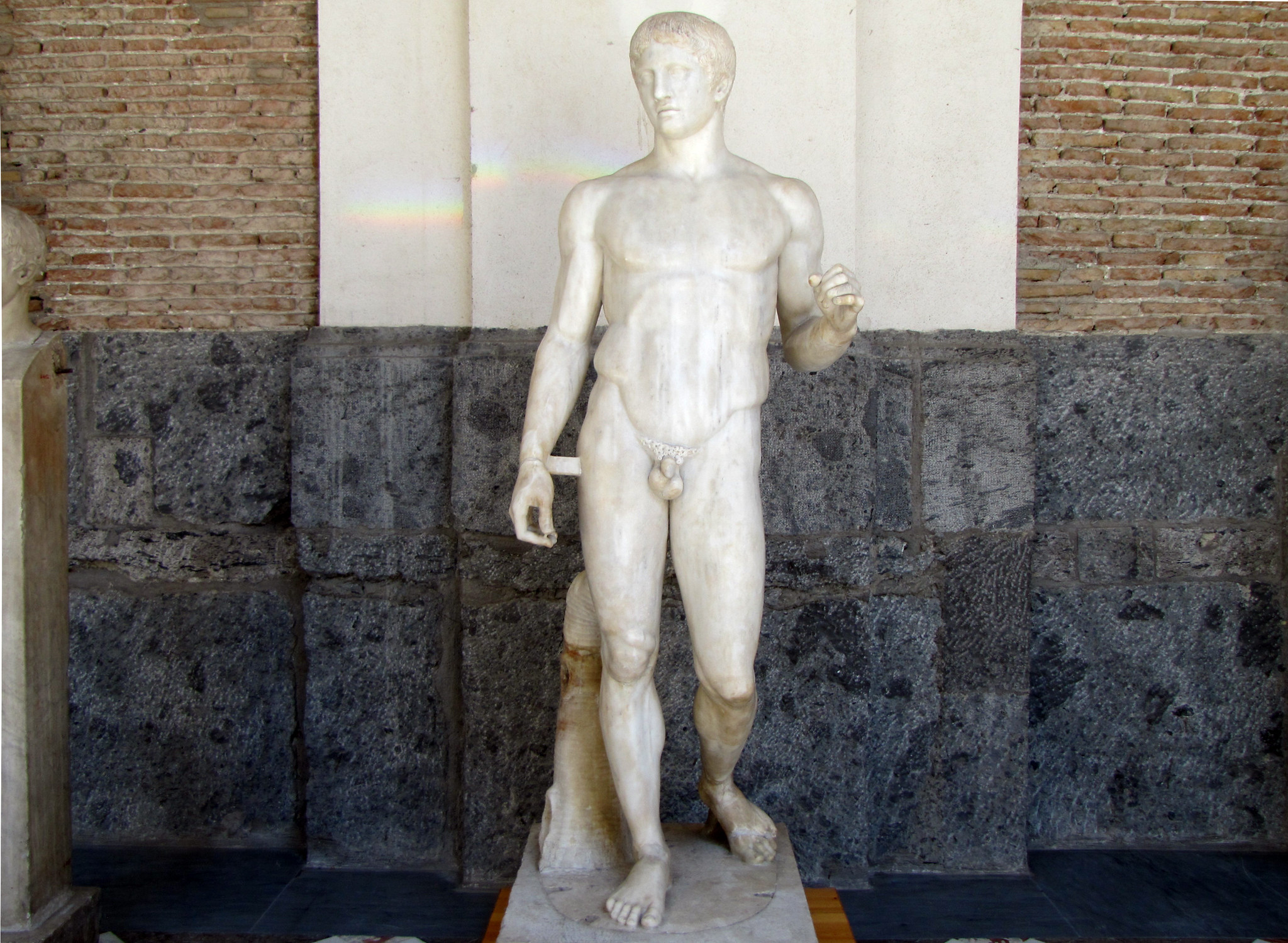
Greek, Polykleitos, The Spear Bearer (Doryphorus), c. 440 BCE
Perfect representation of contrapposto with a balance of motion and stillness within positioning of statue
Greek, Iktinos and Kallikrates, The Parthenon, Athens, Greece, 447-432 BCE
Placed on the acropolis and representative of athenian democracy, buildings had religious significance

Greek, Reconstruction of the gold and ivory statue of Athena Parthenos, after Pheidias, 438
BCE
Colossal scale, placed in parthenon and had been reconstructed after burned in fire

Roman, Temple of Portunus, Rome, Late 2nd century BCE
Devoted to port god and wanted to emphasize the front using staircase and porch to be raised above the ground

Roman, Pont du Gard, Nîmes (France), late 1st century BCE
Largest of all roman monsters and allowed for constant supply of fresh water

Roman, Sanctuary of Fortuna, Palestrina, ca. 100 BCE
Religious building that includes a temple as part of a larger complex

Roman, The Colosseum, Rome, 80 CE
Real name: amphitheater of the Flavians built with combined architectural elements using different forms on each level of structure going from plain to ornate

Roman, The Pantheon, Rome, 125 CE
Temple to all the gods and looking into the psychological impact of architectural space

Circa
around, about, approximately
Sumer
earliest known civilization, southern mesopotamia
Ur
An ancient Sumerian city-state located in modern-day Iraq
Cuneiform
earliest writing system of the Sumerians (3200 BCE)
Hieroglyohics
writing system of egypt, sacred significance, pictograms
Pharaoh
Respectful title for the king himself,
Mastaba
flat-roofed, rectangular ancient egyptian tomb with inward-sloping sides, built from mudbrick or stone
Imhotep
Imhotep was a brilliant ancient Egyptian polymath who lived during the 27th century BCE
Mortise(hole) and tenon(bump)
an ancient and very strong woodworking connection made by inserting a projecting tab (the tenon) into a matching hole or slot (the mortise)
construction
Sledges
sed in burial processions to transport the deceased's coffin and ritual goods
Howard Carter
British archaeologist and artist best known for discovering the intact tomb of Pharaoh Tutankhamun
Geometric Period (c. 900-700 B.C.E)
a foundational phase of ancient Greek Art in Ancient Greece that emerged at the end of the Greek Dark Ages, defined by abstract linear patterns and stylized figurative decoration on pottery
Archaic Period (c. 700-480 B.C.E.)
a formative era of ancient Greek Art that bridged the abstract Geometric Style and the naturalism of the Classical period
Classical Period (c. 480-323 B.C.E.)
a golden age of ancient Greek art defined by a shift toward naturalism, idealized human proportions, balanced harmony, and the revolutionary contrapposto stance
Krater
a large, footed ancient Greek vessel with a wide mouth and two handles, used primarily for mixing wine with water
Frieze
a long, horizontal band of painted, sculpted, or decorated design running along the upper part of a wall or building
Monumentality
a quality of grandeur, permanence, and symbolic power that makes a work of art or architecture feel awe-inspiring and timeless, regardless of its actual physical size abstraction
Kouros, pl. Kouroi
free-standing Ancient Greek sculpture of a nude young man that emerged during the Archaic period around 615–590 BCE
Symmetry/asymmetry
core principles of design used in art history to create visual balance, meaning, and emotional tone.core principles of design used in art history to create visual balance, meaning, and emotional tone
Gymnasium
a specialized public building complex in ancient Greece dedicated to physical education, athletic training, and intellectual instruction
Olympia and the Olympic Games
the intersection of ancient Greek sacred architecture, civic identity, and the idealized human form
Contrapposto
asymmetry, counterbalance
Hubris
an extreme overconfidence or arrogance that drives a mortal character, artist, or builder to challenge divine authority, natural laws, or cosmic limits, inevitably resulting in a catastrophic downfall or divine punishment
Humanism
focused on human potential, individual value, and the study of classical Greek
Roman art and philosophy
the broad visual culture of the Roman Republic and Empire (spanning roughly 509 B.C.E. to 330 C.E.) that synthesized Etruscan, Egyptian, and Greek traditions into practical, monumental, and propagandistic forms
Acropolis
famous archaeological complex in Athens, Greece, rebuilt during the 5th century BCE High Classical period under the statesman Pericles
Agora
the central public open space in an ancient Greek city-state
Polis
the ancient Greek city-state, which served as both the physical setting and the primary thematic inspiration for Greek civic art, architecture, and urban planning from the Archaic period onward
Demos
the representation or inclusion of the ordinary citizenry, working class, or masses, rather than aristocratic, religious, or elite subjects
Pericles
visionary statesman and patron whose leadership sparked the Classical "Golden Age of Athens"
Order
(doric, ionic,corinthian) a specific style of classical building defined by the proportions of its columns and entablature
Antrhopomorphic
giving human physical form, traits, emotions, or behaviors to non-human entities like animals, gods, or objects
Pheidias
greatest sculptor of the Classical period
pediment
a triangular gable placed above an entablature or horizontal cornice, typically supported by columns
curvature
the use of bent, sweeping, or sinuous lines and rounded contours to create a sense of grace, organic movement, and emotional expressiveness
Frontality
the representation of figures, objects, or buildings facing directly forward, aligned in a plane parallel to the picture surface or viewed completely from the front without lateral movement
axiality
the organization of a space, building, or sculptural form symmetrically along a dominant central line or axis
Keystone
the central, wedge-shaped stone at the apex of a masonry arch or vault that locks all other stones into place and allows the structure to bear weight
Voussoir
a wedge-shaped stone or brick used to construct the curved portion of an arch or vault
Aquadect
an engineered water-conveyance system
concrete
a genre of abstract art that is entirely free of any symbolism, figurative meaning, or basis in the natural world, instead treating lines, colors, and planes as autonomous, real entities
barrel vault
a continuous, tunnel-like architectural ceiling or roof formed by extending a single semicircular arch along a given distance
groin vault
an architectural ceiling structure formed by the perpendicular intersection of two barrel vaults
amphitheater
a freestanding, open-air, oval or circular Roman building featuring a central arena surrounded by concentric, rising tiers of seats
Flavian Emperors (Vespasian, Titus)
whose art and architecture marked a deliberate return to realistic portraiture and civic-focused monumental building
arena
the Arena Chapel (also known as the Scrovegni Chapel) in Padua, Italy, famous for its revolutionary early 14th-century fresco cycle by Giotto di Bondone
classicizing
an aesthetic style that imitates the principles, forms, and cultural standards of ancient Greece and Rome
Oculus
a circular opening in a wall or at the apex of a dome that lets in natural light and air