ME115 - Week 4
 Call Kai
 Learn
 Practice Test
 Spaced Repetition
 Match
 Flashcards
 Knowt Play
1/29

Earn XP
Description and Tags
Miller Indices Part 2, Defects in Crystals Part 1 & 2
30 Terms
Miller indices of directions
Basically vectors inside of the unit cell that describe directions from one lattice point to another. These are obviously directional so if two indices have the same numbers but different negatives then they are different vectors.
These index directions can be be multiplied to change magnitude or invert them.
Certain groups of indices are equivalent if you change the perspective that you look at the cube at, you write these families of directions with arrows <>.

Miller indices of planes
The planes inside of the unit cell that are described with miller indices. Deformation happens most easily along the close packed planes of a unit cell.
Planes and their negatives are identical.
In cubic systems, a direction that has the same indices as a plane is perpendicular to that plane
How to find the miller indices of planes
Identify the points at which the plane intercepts the x, y and z coordinates in terms of the number of lattice parameters.
If the plane passes through the origin, the origin of the coordinate system must be moved. You want the origin to be at the centre of all axes that intersect with the plane.
Take reciprocals of the intercepts.
Clear the fractions but do not reduce to lowest integers.
Enclose results in parentheses ( ). (No commas)
Negatives should be written with a bar over the number.
Families of directions and planes
Due to the symmetry of the cube there are many directions and planes that are equivalent these are families. Families of directions are denoted by [] and families of planes are denoted by {}.

Linear and Planar packing densities
Linear - describes how much of a line going through a unit cell is covered by atoms whose centers lie on the direction
Planar - describes how much of the area of plane in a unit cell is covered by atoms whose centers lie on the plane
This matters because slip (dislocations) occur on the directions/planes with the highest density (close-packed)

Close packed directions and planes
SC: Directions - <100>, Planes - none
BCC: Directions - <111>, Planes - none
FCC: Directions - <110>, Planes - {111}
HCP: Directions - <100>, <110> or <1120>, Planes - (0001), (0002), (basal plane)
Interplanar spacing
The distance between two adjacent parallel planes of atoms with the same Miler indices (families). We can measure this with X-rays to determine materials and crystalline structure

Interstitial sites
Spaces between the atoms/ions of a crystal lattice, the atoms in those sites are called interstitial atoms, this interstitial atoms has a coordination number and has to have a small enough radius to fit in between the lattice.
Where in the crystal lattices are the interstitial sites?
SC: in the very center (1/2, 1/2, 1/2)
BCC: Center of each face and edge (octahedral, 18 sites, surrounded by 6 atoms), and at [1, 1/2, 1/4] (tetrahedral, 24 sites, surrounded by 4 atoms)
FCC: 8 tetrahedral sites, 13 octahedral sites (BCC has more interstitial sites because it’s less tightly packed

Point defects
Vacancy, interstitial, substitutional defects
Localized imperfections that disturb perfect crystal structure. Can be caused by defects or by doping/alloying elements
Line defects
Edge and screw dislocations
Surface defects
Grain boundaries
Vacancy defects
An atom/ion is missing from a normal lattice position. The way to calculate the concentration of vacancies in a crystal is with the equation nv = n^(-Qv/R*T).
Where nv = number of vacancies per cm³, n = number of atoms per cm³, Qv = energy required to produce one mole of vacancies (cal/mol or joules/mol), R = gas constant (1.987 cal/(mol*K) or 8.314 J/(mol*K)), T = temp in kelvin
Vacancy concentration increases exponentially with time (Arrhenius-type behaviour)

Frenkel defect
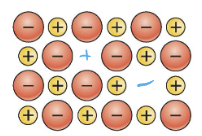
Vacancy-interstitial pair formed when an atom jumps from a normal position to an interstitial site.

Schottky defect
When a positive-negative ion pair are vacant from the crystal to preserve neutrality
Interstitial atoms
Usually smaller than the host atoms and fit into interstitial sites. Usually are a little larger than the sites and push outwards on the crystal lattice. Larger interstitial sites accept more interstitial atoms (FCC>BCC).
Interstitial defects
Extra atoms inserted into the crystal at a normally unoccupied position.
Octahedral site - surrounded by 6 other atoms.
Tetrahedral site - surrounded by 4 other atoms.
Example: steel, where iron atoms create the lattice and carbon atoms are in the interstitial sites
Interstitial atoms are primarily determined by alloy composition. Temperature affects their mobility and solubility but does not directly create additional interstitial atoms like it creates vacancies.

Substitutional defects
One atom/ion is replaced by a different type of atom/ion in normal lattice positions. These are created by impurities or dopants and their concentration is relatively constant once introduced. e.g. silicon is replaced with phosphorus or boron in the lattice for semiconductors.
Depending on the size difference between the guest atom and the host atom there will be different strain energy in the surround lattices that is associates with stretched bonds.

Will a defect atom occupy a substitutional or interstitial site?
Interstitial - usually when the guest atom is much smaller than the host atom (like carbon and iron)
Substitutional - guest atom is usually similar size (about <15% difference in atomic radii) to host atom
Atoms with similar valence electrons and bonding behavior get into the lattices more easily (increase solubility)
Solid Solutions
When one type of atom (the solute) is dissolved into the crystal lattice structure (the solvent) this creates a solid solution which can either be interstitial or substitutional.
Shear force/stress
Force applied parallel to the area.

Dislocations (slip)
All plastic deformation is created by shear stress across close packed planes in crystal (slip plane). Only really occur in metals/alloys, not in amorphous materials because they have no periodic structure.
Slip in metals provides ductility to the material since metals can be bent without breaking (brittle)
Edge dislocations
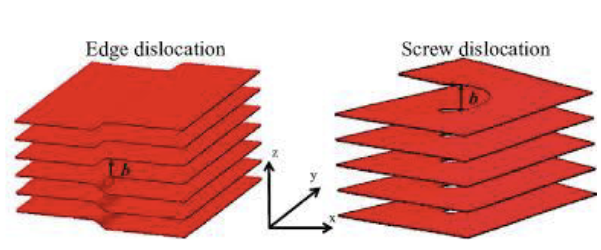
The shear force causes the crystals to slip past each other and this creates an extra half plane of molecules. The half planes can meet and cancel each other out.

Screw dislocations
Caused by a spiral-like shear displacement of atomic planes but not all the way through the material so it becomes a spiral if it’s stretched out.

Mixed dislocations
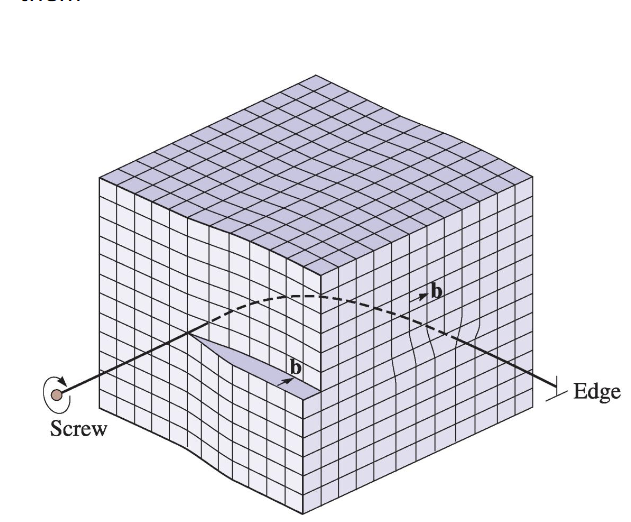
A mixture of a screw and edge dislocation, most common type of dislocation in the real world
Burgers vector
For an edge dislocation, the Burgers vector tells us the size and direction of the lattice mismatch caused by the extra half plane.
Start in the top left and go clockwise completely around the dislocation in a square of molecules and you’ll find that you’re in a different place than where you started. This change in starting position is the burgers vector.
For an edge dislocation, the Burgers vector is: perpendicular to the dislocation line parallel to the slip direction usually about one atomic spacing in magnitude.
For a screw dislocation, the Burgers vector is: parallel to the dislocation line and perpendicular to the slip direction.

Slip plane
The plane along which the edge dislocation occurs and it is accompanied by a slip direction.

When is slip most likely to occur?
Between planes with high planar density and large interplanar spacing (e.g. close-packed planes), if there is large interplanar spacing that means that the bonds between the atom/ion aren’t very strong.
When is slip difficult?
With materials that have ionic or strong covalent bonds, crystals with many defects (these can cancel out dislocations thus creating a lower energy state that required more energy to pull apart again).
Elastic deformation
Due to stretching bonds rather than breaking and reforming bonds. All deformation returns to original once the load has been removed.