Agronomy Exam 1
 Call Kai
 Learn
 Practice Test
 Spaced Repetition
 Match
 Flashcards
 Knowt Play
1/116

There's no tags or description
Looks like no tags are added yet.
117 Terms
what is the definition of growth?
an irreversible increase in the number and size of a cell, organ, or whole organism related to change in size and mass
draw the plant growth graph?

what are the three categories of limitations of plant growth?
crop, soil, and climate factors
what are crop limiting factors of plant growth?
variety, planting date, seeding rate, seed quality, water availability, date of harvest, nutritional differences
what are soil limiting factors of plant growth?
organic matter, texture, structure, CEC, pH and base saturation, slop, soil temperature, Management factors, soil nutrient supply, toxic conditions
what are climate limiting factors of plant growth?
precipitation, air temperature, light, altitude/latitude, wind, CO2 concentration
what are the five global main limiting factors of plant growth?
low moisture, low temperature, seasonal moisture, soil salinity/alkalinity, low nutrient-holding capacity
List the factors that MUST be present for plant growth?
H2O, air, light, nutrients
What factors need to be absent or restricted for plant growth?
insects, disease, weeds, toxic minerals (Cd, Al, Cr, etc.)
what factors need to be within suitable ranges for plant growth?
pH, temperature, day length
what is the law of the minimum?
the most limiting factor will determine the yield; plant growth is proportional to the amount of the most limiting nutrient
what is the law of diminishing returns?
change in yield/change in nutrient amount = (maximum yield - actual yield)*constant; eventually more adding more nutrients leads to diminished returns on yield (less and less for same amount of fertilizer)

Describe Line B
most common true plant response to nutrients
what is bray’s nutrient mobility concept?
immobile nutrients have to be very close to the roots to be absorbed, mobile nutrients can be absorbed around the root area
what is a negative interaction?
increasing factor a decreases factor b; A+B=less than we started with
what is a zero interaction?
increasing factor a does not impact factor b; A+B=A+B
what is a positive interaction?
increasing factor a leads to an increase in factor B; A+B=more than A+B

is this a negative, zero, or positive relationship?
negative
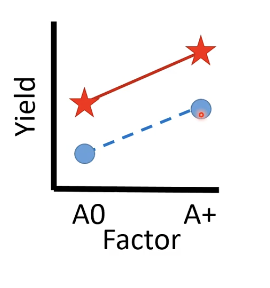
(star is B+, blue is B0) is this a negative, zero, or positive relationship?
zero

(star is B+, blue is B0) is this a negative, zero, or positive relationship?
positive
what are the different interaction types?
nutrient to nutrient (macro or micro), nutrient to crop mgmt (population, variety, planting date), nutrient to soil mgmt (tillage, residue removal), nutrient to water (too little or too much)
what are the three types of tree roots? draw them and give an example of each
tap root, heart root, flat root

what are the three types of crop roots? draw them and give an example of each
fibrous roots, taproots (primary), taproots (storage)

what is the function of roots?
absorb water and nutrients
what is the root cap? draw where it is in the root
front line of growth, cells are continuously replaced, protects the growing tip in plants and meristematic region, secretes mucigel

what is the meristematic zone? draw where it is in the root
responsible for making new cells
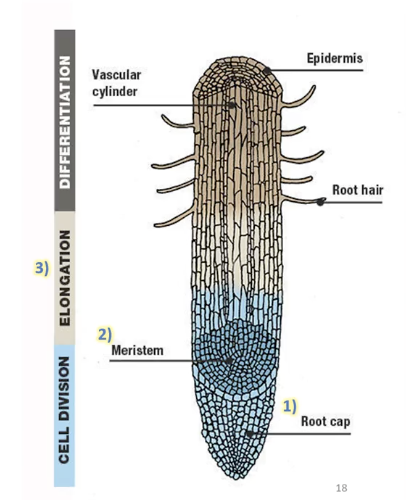
what is the zone of elongation? draw where it is in the root
increases in size through the absorption of food and water, as these cells grow they push the root through the soil

what is the zone of maturation? draw where it is in the root
where cells become specific tissues such as epidermis, cortex, or vascular tissue

what is the rhizosphere?
zone of soil-plant interactions including the root and surround soil under root-influence; both plant/soil
what are the three type of factors impacting root growth?
physical, chemical, and biological
what are some chemical factors impacting root growth?
pH, nutrients (concentration and distribution); plants will change where their roots grow based on where nutrients are located , H20 (amount)
what are some physical factors impacting root growth?
mechanical impedance (ex. rock in the way or soil hardness); compaction, temperature (cold),
what are some biological factors impacting root growth?
genetic potential, competition btw plants, stress within the plant, predation, parasitism
define and compare the endorhizosphere and the extorhizosphere?
endorhizosphere: inner part of the plant root interacting with soil water, chemicals, and soil biota; includes root cortex, endodermis, and apoplastic spaces between root cells
ectorhizosphere: zone of soil under root influence extending outward from the rhizoplane into the bulk soil
what are rhizodeposits?
root-derived, plant-products released to the soil by the root; things being released by the roots to the soil (ex. carbon due to the death of cells)
what are root-microbe relationships?
plant pests and pathogens can inhabit this area; symbionts of N-fixing bacteria and mycorrhizal associations; help plants obtain water and micronutrients
what is a soil composed of?
mineral particles (45%), air (25%), water (25%), organic matter (5%)
what is soil texture?
relative content of sand, silt, and clay; relatively constant soil property; influences many properties of soil
what is considered coarse particle size?
larger than 2 mm in diameter
what is considered fine particle size?
smaller than 2 mm in diameter
what is soil structure?
the arrangement or organization of all soil particles; sand, silt and clay are building blocks; soil aggregates are walls; soil structure is the building
what are the three things that destroy soil structure?
raindrops pounding, compaction (machinery or grazing), conventional tillage
what are the three things that improve soil structure?
increase organic matter (more plant inputs, manure, compost), control farm machinery traffic, crop rotations or “alternative crops”, minimum or no tillage
what are the five soil forming factors?
time, organisms, climate, plant material, relief (topography), humans
what are the forces of soil structure?
wetting and drying; freezing and thawing; shrinking and swelling; root growth; animal burrowing
what are the glues of soil structure?
clay, organic matter, oxides of Fe and Al
what are the six types of soil structure?
single grained, granular, blocky, columnar/prismatic, platy, and massive
What is an ideal amount of porosity in soil?
60-70% of total volume (combination of large pores and small pores)
what are some impacts of compaction?
limited pore space, reduced gas exchange, reduced water movement, less oxygen
compare conventional tillage and minimum tillage (basically no) with the negatives
conventional tillage: destroys soil structure, decreases biological activity, increases soil erosion, increases soil organic matter decomposition
Minimum tillage: opposite of conventional tillage; weeds must be chemically controlled; no-till can increase compaction (in the first few years, but then reverses), lower yields in rainfed regions
What are the 17 essential elements for plants?
C, H, O, N, P, K, Ca, Mg, S, Fe, Mn, Zn, Cu, B, Mo, Ni, Cl
what makes a nutrient essential?
absolutely necessary; impossible for the plant to complete its life cycle without it; deficiency is only fixed by supplying that nutrient; directly involved in the metabolism of the plant
what are the 6 macronutrients?
N, P, K, S, Ca, Mg
what are the 8 micronutrients?
B, Fe, Mn, Cu, Zn, Mo, Cl, Ni
what’s the difference between a macro nutrient and micro nutrient?
macro=greater concentration found in plant is more than 10 mmole; micro=less than 10mmole/kg of dry weight
what nutrients are involved in the structural parts of a plant?
C, H, O, N, Ca
What nutrients are involved in the protoplasm?
C, H, O, N, P, Mg, S, Cu, Ni
what nutrients are involved in plant sap?
K (stomata regulation), N, C, H, O, micronutrients
What is the difference between a cation and an anion?
Cation: has more protons than electrons; Anion: has more electrons than protons
Out of the essential nutrients, which are immobile in the plant?
Ca, B, Cu, Fe, Mn, Zn, Mo, Co
Out of the essential nutrients, which are mobile in the plant?
N, P, K, Mg, S, Cl, Ni
What are the functions/locations of C, H, O, and N?
well distributed throughout the plant; used for almost everything
What are the functions/locations of K?
cell sap
What are the functions/locations of Ca?
stems and leaves
What are the functions/locations of P?
grain (seed)
What are the functions/locations of micronutrients?
enzymes
why is P so concentrated in the grain/seeds?
the high concentration of phytic acid in grain
Draw the nutrient concentration in tissue/plant yield graph

what is the steenberg effect?
under severe deficiency, yield is rapidly stimulated by a small amount of the limiting nutrient and this rapid growth causes a small deficit of the nutrient in the tissue; growth outpaces the uptake and use of the nutrient
What is hidden hunger?
when a plant is experiencing a nutrient deficiency but it isn’t visible by the human eye
what is chlorosis?
uniform interveinal yellowing or light green coloring of leaves
what is necrosis?
death of leaf tips or magins
what is reddening?
accumulation of anthocyanins causes red or purple color on leaf magins, interveinal regions, or whole leavesst
what is stunting?
reduced plant height and shortened internodes
what is new growth cessation?
death of new shoots, buds, or flowers
what are visual signs of leaf deficiency symptoms?
color, pattern, and position
Purple coloring on leaves and especially interveinal is a deficiency of…
Phosphorus
yellowing to necrosis on the edges of leaves is a deficiency of…
potassium
yellowing in the areas between veins and on the tip is a deficiency of…
magnesium
interveinal yellowing is a deficiency symptom of…
zinc
blossom end rot is a deficiency symptom of…
calcium
yellowing of older leaves- is a deficiency symptom of…
nitrogen
yellowing on new leaves is a deficiency symptom of…
iron
what are the limitations to visual diagnosis?
some deficiencies have very similar symptoms; once you see the deficiency, it’s usually too late to treat it; it could be an imbalance between two nutrients instead of a deficiency; it could be from more than one factor
what are the four ways to evaluate crop fertility?
visual, greenhouse and field tests, plant analyses, soil chemical tests
why is randomization and replication important?
gets you closer to the true mean, removes the possibility of bias
what are plant sap tests for plant analyses?
unassimilated nutrients; problems: levels are quite variable even within a day, results only for a strong limitation, some qualitative
what is total tissue analysis for plant analyses?
tissue is dried, ground, and analyzed; both assimilated and unassimilated; less variable than sap tests; quantitative results; somewhat expensive; variable; usually good for next year, not in-season adjustments
what are some benefits of soil chemcial testing?
fast, inexpensive, applies to a broad number of plants/conditions
what are the objectives of soil tests?
provide a rough estimate of nutrient availability in soil, predict the probability of obtaining a profitable response to fertilizer or lime, provides a basis for fertilizer/lime recommendations
Why use a soil test?
encourages plant growth, use best fertilizer recommendations, saves money on unneeded applications, solve nutrient deficiencies, prevent deficiencies
what are the four components of soil testing?
collect a representative soil sample from the field, determine the quantity of plant available nutrient in the soil sample, interpret the soil test results, estimate the quantity of nutrient required by the crop
what are the four R’s? and what is the main idea of the four r’s?
right source, right rate, right time, right place; deliver the nutrients most efficiently to the crop root and minimize losses to the environment
when can you apply fertilizer?
before planting, while planting, after growth begins
compare broadcast vs. banded fertilizer applications
broadcast: spread out, applied over the surface, buildup/maintenance plan; banded: concentrated area/line, usually liquid injection, knife injections, maximize crop recovery,
what is fertilizing for sufficiency?
fertilizing crops based on soil tests with intent of a yield response (N)
what is fertilizing for buildup?
fertilizing soil with excess nutrients for long-term yield gains (P or K)
what is fertilizing for maintenance?
fertilizing based on nutrients remoed from the crop from estimate
what is the salt index?
ratio of increased osmotic pressure based on relative value to sodium nitrate, watch out for fertilizers higher than sodium nitrate (100)
what are factors contributing to salt damage?
soil factors: moisture, texture; crop type: some crops are more tolerant; fertilizer rate