6. Dreaming and Behaviour
 Call Kai
 Learn
 Practice Test
 Spaced Repetition
 Match
 Flashcards
 Knowt Play
1/27

There's no tags or description
Looks like no tags are added yet.
28 Terms
Orienting questions to think about
what stages of sleep are associated with dreams?
why do we dream?
what is the relationship between dreaming and recent events?
why do we dream about recent events?
does dreaming help us retain memories
What is involved in primary consciousness?
simple awareness, perception, emotion
common to most mammals?
What is involved in secondary consciousness?
self-awareness, abstract thought, “free-will” - unique to humans?
How do dreams relate to primary/secondary consciousness?
dreams exhibit primary but not secondary consciousness
for example, dreams often contain
visual components, sense of movement
strong emotions (e.g. anxiety, elation, anger)
but we rarely notice or reflect on:
bizarre cognition (e.g., plot changes)
implausible/impossible elements (e.g. chimeric figures)
How has the scientific study of dreams evolved?
for many years, relied solely on self-report
dream diaries, lab-based induction of dreams, awakenings at different parts of the night
more recently, augmentation with polysomnography and neuroimaging add extra dimensions
but we still rely on participants’ dream reports to a great extent
difficult to draw firm conclusions
dreaming remains deeply mysterious (yet fascinating)
very hard to know whether dreaming is epiphenomenal (just what happens when brain is in REM) or intrinsic component of sleep (has purpose)
What stages of sleep are associated with dreaming?
What did Dement and Kleitman (1957) find regarding whether REM sleep is associated with dream recall?
woke participants at different times during sleep (REM and NREM)
asked for dream report
strong association with REM
if people woken in REM sleep then they tended to recall a dream
opposite is true for non-rem sleep

What did Picard-Deland et al (2023) find regarding what stages of sleep are associated with dreaming?
sampled all stages of sleep
but also sampled across early, mid and late sleep

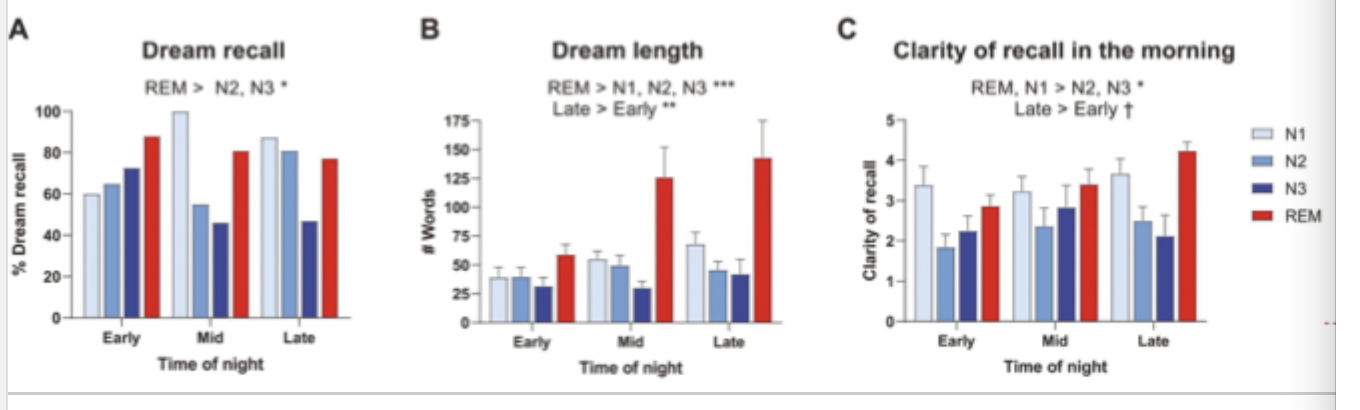
all stages showed dream recall, particularly REM
but dream reports are longer for REM, particularly later in the night
dreams rated for clarity the next morning, REM and N1 dreams were clearest
What is involved in Freud and Solm’s Psychodynamic theory of dreaming?
Dreams fulfil unconscious wishes/desires
REM sleep not a good model
dream amnesia → repression
function: preserve sleep in face of unconscious need for excitement/unknown
dreaming is the day’s residue
What is involved in Hobson’s Activation-Input Modulation (AIM) theory of dreaming?
three factors: activation, input and modulation
REM sleep is a good model
Dream amnesia due to REM sleep brain state dependence
function: virtual reality model (protoconsciousness). Approach difficult problems in a safe place
unrelated to the previous day
What is involved in Foulkes and Domhoff’s neurocognitive theory of dreaming?
what occurs when brain is activated. Draws on memory schemas, general knowledge etc
REM sleep not a good model
dream amnesia → context effect, lack of external narrative
no function → byproduct of the evolution of sleep and consciousness
not related to previous experience apart from LTM
AIM model visualised, different sleep states

conscious state determined by combination of the 3 variables: activation, input-out gating, modulation
any brain state described as a point in this cube
NREM → midpoint in the space, some brain activity, some modulation
REM → just as much brain activity as during wake, little input/output gating, little modulation (protoconsciousness)
lucid dreaming → higher than REM for input/output
What is involved in the idea of virtual reality/protoconsciousness?
general account
general account: REM sleep offers opportunity to fine-tune “predictive model” of the world
update predictive model based on day’s sensory input
fits nicely with observation that newborns have large amounts of REM sleep (lots to update)
What is involved in the idea of virtual reality/protoconsciousness?
specific account: Threat Stimulation Theory (TST)
consistent with activation of amygdala during REM sleep
predicts that incidence of threatening events will be more common in dreams than everyday life
a good opportunity for rehearsal of threat avoidance relevant to surroundings?
What did Abbas and Samson (2023 find regarding Threat Simulation Theory?
analysed dream and wake reports during the COVID-19 pandemic
introspectively, it makes sense that dreams will have more threat than wake

clear overrepresentation of negative events in dreams compared to waking life
but do our dreams particularly involve avoidance practice?
What did Malcom-Smith et al (2012) find regarding whether there is a bias towards threat avoidance in dreams?
categorised dream reports in terms of whether they were related to approach or avoid scenarios
also looked at whether incidence changed for populations more or less likely to encounter life-threatening events (south-africans(more dangerous) vs welsh)

found prevalence of approach dreams, plus no effect of environment
more consistent with general protoconsciousness account than TST?
What have PET studies of REM sleep compared to wake and SWS found?
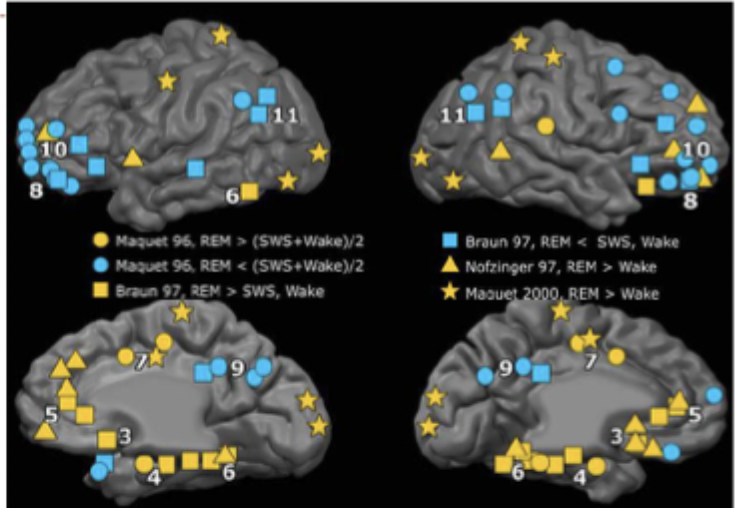
activation of
visual areas (occipital cortex)
memory (medial temporal) and emotional (amygdala) systems
deactivation of
inhibitory system (frontal lobe; cf, freud & lack of repression
generally, activity in REM fits our understanding of dreams, but in many cases brain areas have more than one function - danger of selection bias
can we “decode” visual areas of the brain during dreaming?
What is involved in dream reading?
Horikawa et al 2013
only 3 ppts but collected lots of wakenings
fell asleep in the scanner + eeg to determine stage of sleep
about dreaming in N1
woken up after short while and asked for dream report
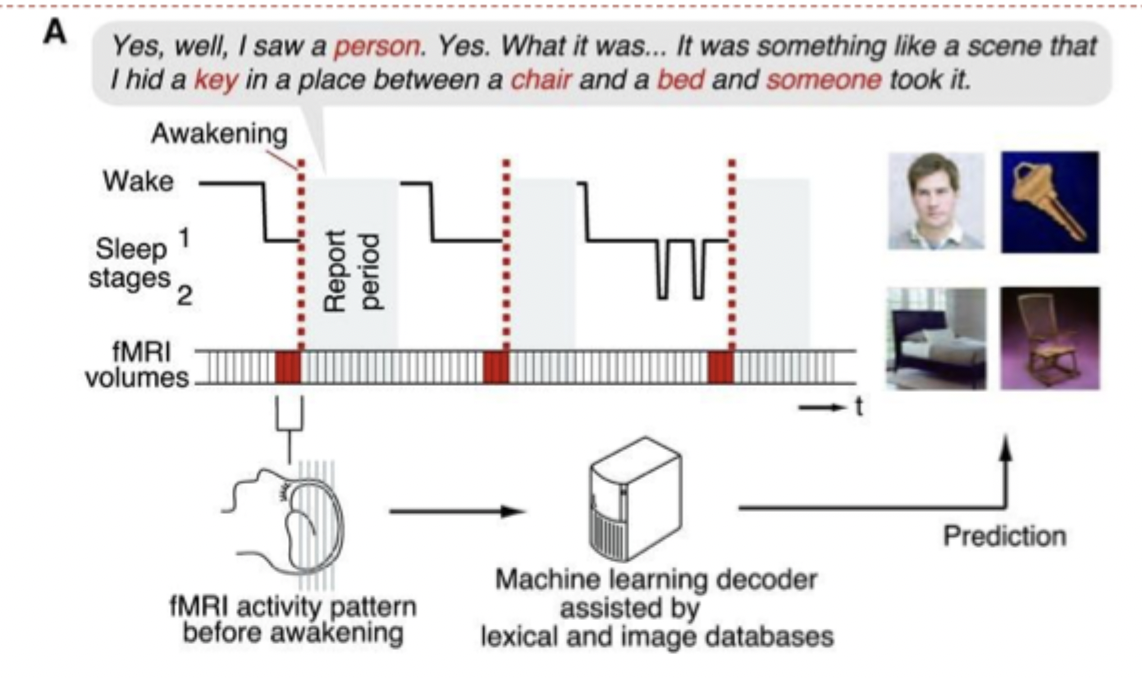

presented pictures from dream items to ppts in a waking fMRI to see what their brain signature is for that item - decoded to sleep volumes to see which of the objects are being dreamed about
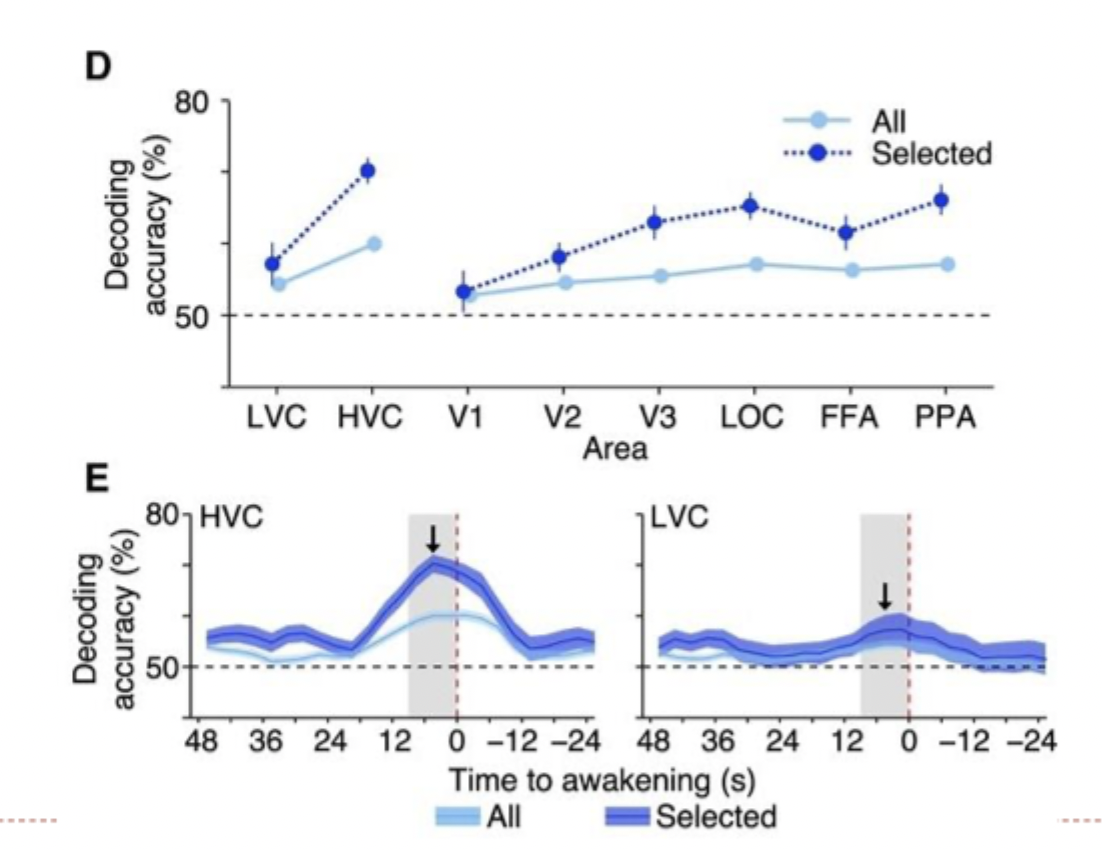
what extent do you beat chance for different brain areas
experimenters were able to make good predictions about what the brain images were in sleep → the brain areas are processing those stimuli as if they were really there
most activity for the item just before the moment of awakening - a snapshot
Dream reading summary
clear neural link between visual imagery in dreams and actual visual perception in wake
decoding dreams is an exciting prospect in terms of objective measure of dreams
but fMRI is not very practical
more recent studies have focused on polysomnography
What did Walmsley et al 2010 find regarding the first two minutes of dreams?
intensive training (several hours over 3 days) on immersive visuomotor task (Alpine Racer 2)
ppts woken in early stages of sleep
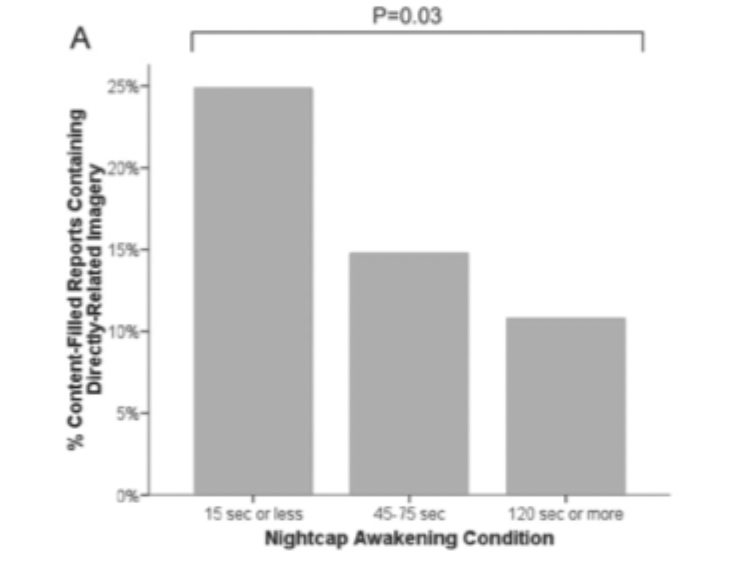
first 15 secs (wake or Stage I) dominated by directly related imagery

beyond 75 secs (stage 1 or 2) dominated by indirectly related imagery
cognitive replay very common in early sleep stages
not captured by diary approach (forgotten)
What did Horowitz et al, (2020) find about whether early night dreams aid creativity?
we know that waking from N1 can help with problem solving in the number reduction task but their study didn’t find a link with dreaming
Targeted Dream Incubation (TDI) may help
Dormio - hand-worn device for tracking N1 onset
links to a laptop or phone to enable verbal dream reports and deliver instructions
can use the instructions to guide N1 dreaming (e.g., “remember to think of a tree”
does this help creativity post-sleep?

ppts repeat a cycle of waking after a period in N1, deliver verbal dream report, receive instructions “remember to think of a tree”
subsequent to 45 mins of this cycle, ppts took part in creativity tests related to the tree theme: creative storytelling, alternative uses test, verb generation
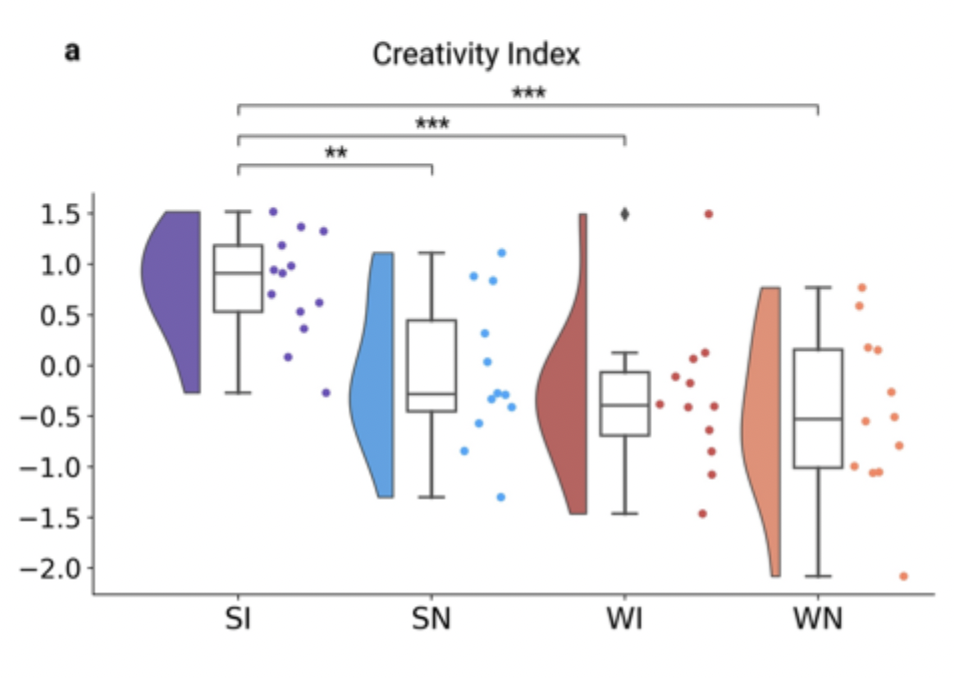
clear benefit of sleep + incubation, compared with sleep + no incubation and wake controls
plus, participants who had the most incubation-related dream reports showed the most creativity
N1 dreaming associated with dream-related creativity
great example for experimental manipulation of dreams
What did Fosse et al (2003) suggest regarding why recent events feature in dreams?
dreaming is not episodic replay
65% of spontaneous waking sleep reports contained recent life events (cf freuds day residue)
but few (1-2%) were episodic in nature (detailed, contextualised)perhaps a more integrative or interactive role?
What did Picard-Deland show (2023) in their more detailed analysis of why recent events feature in dreams?

lots of day-residue memories
but some older episodic memories, plus semantic memories as well

after controlling for sleep stage, recent memories tend to dominate early-night sleep
distant memories feature more later in the night
the integrative aspect may occur later in the night?
What did Blagrove et all (2011) find regarding the Dream-lag effect and sleep stages?
when do events resurface in dreams? compared daily diary reports with dream reports to gain ratings of event incorporations in dreams (0-5 scale)

examined dream similarity over a period of 2 weeks after events

results showed evidence for lots of matches for dream reports the night after events (day residue)
these matches diminish over the next few days, but then recur on days 5-7 (“dream lag effect”)
a second study using awakenings replicated the dream lag effect for REM awakenings, but not s2
hard to know why there is a u-shaped profile of dream incorporations for REM, possibly this is marking the latter stages of memory consolidation?
What did Picard-Deland & Nielson, 2021 find regarding TMR and the Dream-lag Effect?
participants played immersive VR flying game containing sound sequences prior to a morning nap
sound sequences played during nap in either REM or NREM
researchers looked to see whether targeted memory reactivation (TMR) of the sounds impacted on later dream reports (outside the lab)
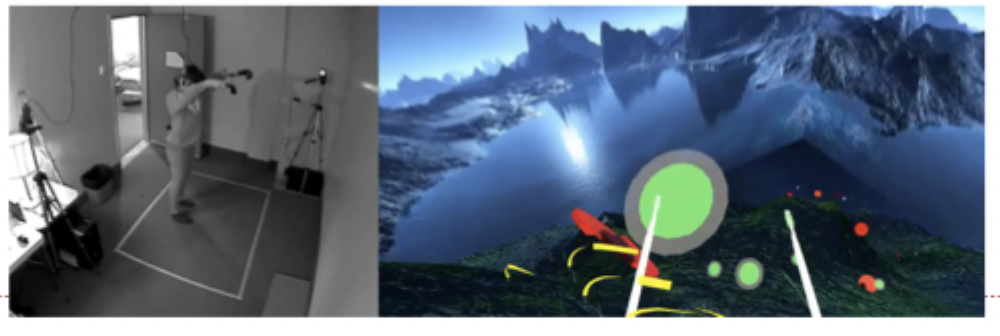

dreaming of the lab environment was largely restricted to the nap period and unaffected by TMR
later dreaming of the video game was influenced by TMR at different times
for TMR in REM, day residue effect. TMR makes the day’s event more salient?
for TMR in NREM, dream lag effect. TMR enhances likelihood of consolidation, reflected later in REM as a dream lag effect?
What did Wamsley & Stickgold (2018) find regarding whether dreaming offers a window on hippocampal replay?
trained on the virtual maze task
wired for polysomnographic recording and ask to report mentations at different points throughout sleep
sleep ppts that directly incorporated the maze task into at least one dream report showed greater overnight improvement in both completion time and distance travelled, compared to those without direct task incorporations
What did Hudacheck & Wamsley (2023) find regarding whether task-related dreaming predicts subsequent memory?
meta-analysis of the literature (16 studies, 45 effects)
overall, there was a significant effect - task-related dreams were associated with better subsequent memory
when broken down by REM vs NREM, only NREM benefit found
task did not influence effect size
overall, at least in NREM, dreaming seems to be a window on memory consolidation processes

What did Spano et al (2020) find regarding dreaming with hippocampal damage?
dream reports after awakenings during NREM and REM for HC patients (N=4) and matched controls (N=10)


dream frequency much lower for patients (despite no difference in “blank” dreams) and content of dreams was impoverished
could be problem with incorporation of recent memories
but also perhaps weaker reconstruction of intact memories (cf. scene construction theory)
Conclusions
all stages of sleep involve some form of dreaming
dreams reflect recent events and not so recent events in complex manner
swift descent into indirect incorporation - within a couple of minutes (wamsley)
recent memories dominate early-night dreams (Picard-Deland et al)
late night dreams feature recent and older memories, plus semantic knowledge
What is dreaming for?
N1 dreams seem to promote creativity (Horowitz et al)
NREM dreams may be a window on memory consolidation (Wamsley)
REM as usual is the most difficult stage to classify
May be a form of protoconsciousness/sandbos for dealing with threat?
But REM also shows a dream lag effect, which could reflect completion of consolidation process (Blagrove)
As with sleep more generally, it’s unlikely that there is a single role for dreaming