niche acadeca art history
 Call Kai
 Learn
 Practice Test
 Spaced Repetition
 Match
 Flashcards
 Knowt Play
1/85

There's no tags or description
Looks like no tags are added yet.
86 Terms
What is art history?
"An academic discipline dedicated to the reconstruction of the social, cultural, and economic contexts in which an artwork was created"
Which two fields does art history often overlap with?
aesthetics and art criticism
How is "Art" defined today?
any kind of visual material that is created by people and invested with meaning and/or valued for its aesthetic appeal
formal analysis
Approach to studying art that is focused on the visual qualities of a work
contextual analysis
Approach to studying art that is focused on examining the context in which a work was created and consumed by its viewers.
Pliny the Elder
An ancient Roman historian and author of "Natural History", a text that analyzed historical and contemporary art.

Giorgio Vasari
An author and artist in the Renaissance who complied the biographies of Italian artists in his text "The Lives of the Artists".

Johann Joachim Winckelmann
A German scholar who shifted from Vasari's biographical approach to art history, instead studying style and the formal qualities of art.

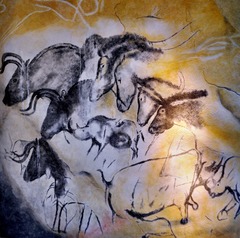
Chauvet cave paintings
Paintings discovered in the Chauvet caves of France. Dated to the Old Stone Age/Upper Paleolithic period. They were created with red ochre + black charcoal and depict animals such as horses, rhinos, and lions.
Venus of Willendorf
An example of a stone "fertility figure" created in the Old Stone Age. These small sculptures often had exaggerated bellies, breasts, and pubic areas.

What's the big difference between art of the Old Stone age and art of the Middle Stone Age?
The Middle Stone Age saw a warming climate, causing cave dwellers to move outside and build rock shelters. They began to paint in these shelters instead of caves, and the subject matter changed too. The paintings started to show human figures for the first time, usually dominating animals.
Stonehenge
An example of art work in the New Stone Age, which often consisted of massive rock structures. Stonehenge features rings of sarsen and bluestone rocks in post and lintel construction.

Sumerian art
Massive temples and ziggurats (a stepped pyramid that had many functions)

Akkadian art
Tends to reflect an emphasis on the monarchy, with Akkadian rulers depicted in freestanding and relief sculptures.

Babylonian art
The best known art work from this period is a depiction of the Babylonian king Hammurabi. Hammurabi consolidated several city-states into one powerful empire under his legal code. This artwork shows Hammurabi receiving inspiration for this code from the sun-god, Shamash.

Assyrian art
Notable artwork included relief carvings, often depicting battles, sieges, and hunts.

Persian art
Notable for their architectural achievements. including the palace at Persepolis

Hierarchical scale
An ancient Egyptian art style that uses the status of figures or objects to determine their relative sizes. An example would be the Palette of King Narmer, which shows the king much larger than his enemies.

Fractional representation
An ancient Egyptian art style that is meant to show each part of the body as clearly as possible. The head appears in profile (to the side), the torso is in full frontal view, and the legs and feet are in profile.

Cycladic art
Included simple, geometric nude female figures and decorated pottery.

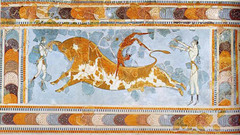
Minoan art
Minoan artwork was characterized by a naturalistic pictorial style, and often took one of two forms: frescoes on palace walls or pottery designs.
Mycenaean art
Showed considerable knowledge of goldsmithing in their art, also noteworthy for their relief sculptures.

Ancient Greek column styles
Doric -- The boring ones; just a standard column
Ionic -- Shaped like an I with some decoration at the top and bottom
Corinthian -- the most decorated columns, with a lot of ornamentation at the top and bottom.

Contrapposto
A pose that was frequently used in Ancient Greek sculpture. The subject stood upright with its weight shifted on one leg.

Two "masterworks" in Ancient Greek art
Venus de Milo and the Laocoon Group (pictured), both freestanding sculptures

Etruscan art
Most of the remaining artwork is from tomb decorations including sarcophagus lids and other art forms made of clay. The only paintings that remain from this culture are those on the walls and cielings of tombs. These were done in bright, flat colors and show figures participating in funeral celebrations.

Roman concrete
Romans discovered the equivalent of modern concrete, which was a groundbreaking step forward for architecture because it allowed the Romans to construct huge domed buildings.
Arch
A curved, doorway-like shape that is often found in architecture. The Romans pioneered the use of the arch, using it to build bridges and aqueducts.

Byzantine art
Best known for mosaic work that was largely Christian in content. Exemplified in the churches of Ravenna, Italy. The Byzantines also designed and built the Hagia Sophia in Constantinople.

Medieval art
mostly preserved only by the church. Most people were illiterate; only upperclass and clergy could read. monks handcoppied books onto parchment. these books were beautiful artworks, most famously The Book of Kells (pictured) and Coronation gospels.

Giotto di Bondone
Defined transitional period between Gothic and Renaissance art. He was best known for his frescoes- paintings on a wet lime plaster. His simple perspective allowed a 3-dimensional view of his figures. His work was potent among the society which was used to the flat expressions of gothic art; he features powerful gestures and emotional expressions.
later medieval art
Churches as the basis for most art. some took centuries to complete. Many of these churches borrowed the Roman arch, such as Saint Sernin in France. They were stone vaulted, or stone roofed. Many featured barrel vaults, which was a tunnel of vaults supporting the roof.
gothic style
part of later medieval art. mostly for religious buildings. Pointed arches and ribbed vaults. Ribbed vaults were a framework of thin arches built under the intersection of vaulted parts of the ceiling. Architects found that downward and outward pressure could be counteracted with flying buttresses, so more windows could be added.
Big art competition in Florence, 1401!
Winner: Lorenzo Ghiberti. He made door pannels for the citys new baptistery. They featured classic greek figures. He was asked to make a second set and it took TWENTY FIVE years. but they were so magnificent that michelangelo named them the "gates of paradise".
2nd place winner of Florence competition
Filippo Brunelleschi, decided to focus on architecture after losing :( He was commissioned to complete the dome of a cathedral in Florence. He was able to construct the massive vault which was needed to span the huge open space through a double shelled dome design. Brunelleschi is also credited with the invention of liner perspective
Donatello
founder of modern sculpture. greco-roman influences as seen in his most famous sculpture, David- the first freestanding nude statue since ancient times.
Botticelli
Known for the Birth of Venus, one of the first paintings of a full-length nude female
Leonardo da Vinci
The "Renaissance man". Iconic works are the Mona Lisa and the Last Supper. His key innovation was the sfumato technique which mellowed colors and blurred outlines.
Michelanglo
made ANOTHER David out of a flawed piece of marble (huge crack in the middle!) Made Moses, the Dying Slave, and The Bound Slave for the pope's tomb but the pope canceled on him. Then painted ceiling of Sistine chapel.
Raphael Sanzio
Learned a lot from Michelangelo. He covered the pope's chamber with frescoes, like The School of Athens. Also the most influential painter of the Virgin Mary.
Renaissance in Northern Europe
Smaller in scale than Southern Europe. Realistic detail because of oil paints. Not as inspired by Greek and Roman works.
Matthias Grunewald
Part of Northern Europe Renaissance. Grunewald was known for his religious scenes and depictions of Christ's crucifixion. The Isenheim Altarpiece consists of nine panels mounted on two sets of folding wings, considered to be one of his greatest masterpieces.

Baroque art
late 1500s to 1800s. characterized by movement and energy. rich color and ornamentation.
Caravaggio
Baroque. renowned for his use of light and dark, which made the subjects seem as if in a spotlight. This technique was known as chiaroscuro, a characteristic of Baroque art. Caravaggio was also known for his naturalism- he painted subject how it really was instead of prioritizing beauty.
Artemisia Gentileschi
Baroque. Had the unusual opportunity to study in her father's studio. she adapted the caravaggesque look. most of her work are self portraits or depictions of the old testament
Gianlorenzo Bernini
child prodigy! his most important piece is The Ecstasy of Saint Teresa in the Corano Chapel. This piece features gold lighting projected by a stained glass window, as if the subject were on stage. Bernini pushed the boundaries of his medium and tried to make stone look like fabric or even clouds.
Rococo
celebrated romance, frivolity, and courtly life. Rich people 4 eva. A lot of gold and pastels, lead by Jean-Antoine Watteau who pioneered a style called fete galante: rich people dressed up and living it up in the countryside
Rembrandt van Rijn
Painter of The Night Watch, a painting where several people paid to be depicted. His career began to decline because he gave more attention to certain subjects than others, breaking with tradition.
Neoclassicism
A return to celebration of greco-roman classical art. This was brought on by the Revolution in France and Enlightenment thinking too. Rejected Rococo and the focus on aristocracy. Exemplified by Jacques Louis David's The Oath of Horatii.
Rococo artists
Jean-Antoine Watteau, Francois Boucher, Jean-Honore Fragonard
what did Jacques Louis David do that was so not cool yet completely understandable
exemplify the complicated relationship between artist and patron; his later works showed propaganda which did not agree with his earlier revolutionary ideas. But this later work was requested by those who could pay, so David went through with it
Realism
idea that painting needs to reflect ALL of its subject. i.e the good and bad. Ordinary people were considered worthy subject matter.
Gustave Courbet
Realist painter. Made the conventional audience really mad when he painted two workmen repairing a road outside an official salon (Salon in the art world means any large art exhibition). This work was called The Stonebreakers and implicated the many revolutions spreading across Europe.
Impressionism
These artists didn't like the stringent salon rules. Named for Claude Monet's Impression, Sunrise
Romanticism
Emotional emphasis of Baroque, highly imaginative and dreamlike. Usually features exotic elements and natural wonders. Some artists belonging to this movement include Eugene Delacroix, Theodore Gericault, and William Blake
Luncheon on the Grass by Edouard Manet
shown in the Salon des Refuses, which was an exhibit of works rejected by the official Salon. It was ridiculed for showing a nude woman among clothed men.
Edouard Manet
Usually known as the first impressionist although he did not agree with the label. he juxtaposed bright colors and such strategies inspired the subsequent wave of artists we call impressionists. He also urged fellow artists to work outside.
Post-Impressionism
Unified by brilliant color
Paul Cezanne
post-impressionist. wanted to redefine "form" so structured painting as a series of planes: foreground, middleground, and background. Also reduced all figures to the most basic underlying shape: sphere, cube, or cone.
George Seurat
post impressionist. placed emphasis on scientific rules of color and applied tiny dots of paint which blended together during optical mixing.
Vincent Van Gogh
post impressionist. said: colors should not be accurate but should convey the emotion that subject evokes.
Paul Gauguin
left his family and life as a successful stockbroker to pursue art, worked with van Gogh before moving to Tahiti in search of intense color and a more relaxed style, painting the island's lush setting and native people through the lens of colonialism
Modernism
artists kept searching for new means of expression that digressed from traditional. They used color arbitrarily. Natural form also became less common -- artists wanted to use wild shapes to represent their subjects instead of painting them as they were
Henri Matisse
modernist. Continuing Van Gogh's ideas about color, him and his friends used color arbitrarily, earning them the name fauves or "wild beasts"
Cubism
movement within modernism. Psychologists began to understand that we remember a scene not from a fixed perspective, but as an overlay of visual impressions seen from different angles and moments in time. As such, artists (like Pablo Picasso and Georges Braque) broke figures into multiple overlapping perspectives to represent the complexity of human experience and memory.
What type of art was cubism partially inspired by?
African art, which they saw as closer to nature than European art
Expressionism
wanted to make the inner workings of the mind visible and directly represent emotion by abstraction. Included artists such as Der Blaue Reiter and Piet Mondrain
Die Brucke
group of artists in Germany who combined brilliant colors with intense feelings; belong to the expressionist movement.
Bauhaus
School of design that attempted to reconcile industrial mass-manufacturing with aesthetic form. They were shut down by the Nazis, prompting most of the faculty to move to the United States and teach there.
Abstraction
Work with no pictorial subject
Abstract expressionism
art could be free of pictorial subject matter. wanted to represent feelings directly rather than focusing on subject. Of two kind:Action painting which took from a Jackson Pollock technique where he gave up on brushes and just dripped paint onto canvas.or Color field painting which focused on a broad area of color with simple, geometric figures only.
Pop art
Incorporated images of mass culture. Andy Warhol, Roy Lichenstein, and Robert Indiana were all famous pop artists.
Minimalism
Reduced art to its barest essentials, using very simple forms and monochrome palettes. Notable artists include David Smith and Dan Flavin
Photorealism
Hyper-real looking art
Earthworks
Land or environmental art. Famous artists include Michal Heizer and Robert Smithson
Performance art
Combination of theater and art where the artist themself becomes the work.
Guerrilla Girls
group of female artists who remain anonymous and wear gorilla masks, giving speeches and posting flyers to challenge an art world dominated by white men
Postmodernism
Reaction to modernist styles. Reintroduces modern techniques but in an exaggerated manner. Philip Johnson was an important leader of this movement.
Chinese art
The Golden Age of China -- great ceramic sculptures, influences by Buddhism
Ink drawings meant for contemplation
Longstanding art traditions interrupted by the 1949 Communist Revolution, which politicized art/made it propaganda-y
Emperor of Qin
Qin Shi Huangdi had a full army of life-size soldiers and equipment built from clay and buried with him.
Indian Art
Strong Buddhist and Hindu influence
Greek art influenced their classical images of Buddha.
Japanese Art
Influenced by Buddhism. Their art remained traditional for a long time because they were closed off to the West.
During the Impressionist movement, Japan sent a group of artists to study in France. The techniques they brought back (e.g. linear perspective) were used briefly before Japan largely returned to traditional art.
Best known fro printmaking.
African Art
Nok civilization (in present-day Nigeria) created lifelike terracotta sculptures.
Benin Kingdom (also in Nigeria) produced Bronze portrait heads and other objects to reinforce the power of the Oba.
Many artifacts destroyed by early European settlers.
Functional art objects and masks used for performances.
Oceanic art
Tattoos used to express social stature.
One group in Melanesia once engaged in head-hunting. They would carve wooden shields with abstract patterns for protection.
They also carved masks for ceremonial use.
Islamic Art
Beautifully produced copies of the Koran
Abstract and calligraphic decoration on architecture (e.g. Dome of the Rock in Jerusalem)
Mosque architecture
Art in the Americas
Great pyramids were the central features of large cities (e.g. Pyramid of the Sun in Mexico)
Clay and stone statues, textiles, jewelry.
Most artifacts are only from last 2,000 years, not well-preserved before.