BIOL2204 Marine Biology - Week 8
 Call Kai
 Learn
 Practice Test
 Spaced Repetition
 Match
 Flashcards
 Knowt Play
1/62

There's no tags or description
Looks like no tags are added yet.
63 Terms
Plankton define?
Free-floating organisms that cannot swim strongly enough to overcome ocean currents drift with the water. I.e a way of life - not a taxonomic classification
What are phytoplankton?
Microscopic, photosynthetic organisms
Primary energy production is autotrophic (primary producers), with chloroplasts/pigments.
They exist as single cells or in chains.
What are zooplankton?
Drifting animals (or animal-like protists) that eat other plankton.
Primary feeding strategy is heterotrophic: they are grazers, predators, or detritivores.
Visible gut/ingested food.
They frequently have cilia or appendices that enable directed swims/jumps
What are mixoplankton?
Contain both chloroplasts and vacuoles; may produce energy in an autotrophic or heterotrophic way
What are holoplankton?
Organisms that spend their whole life as plankton.
Drive primary productivity and grazing.
E.g diatoms, dinoflagellates, copepods, chaetognaths, krill, jellyfish
What are meroplankton?
Organisms that have a planktonic or larvae phase only as part of their life.
E.g veliger (molluscs), trochophore (annelids), and naupilii/zoea (crustaceans) larvae.
What are lecithotrophic larvae?
A type of meroplankton that only spends hours to days in the planktonic stage.
Form larger, yolky eggs (requiring more parental investment); fed by the yolk.
Shorter planktonic period and higher survival per larva, but shorter dispersal and lower fecundity.
Trade-off: higher investment > lower output > higher survival
What are planktotrophic larvae?
A type of meroplankton that spends weeks to months in the planktonic stage.
Require lower parental investment; larvae must feed in the plankton and develop rapidly.
High mortality (predation, sensitivity to food supply)
Trade-off: low Investment → high output → low survival
Orders of magnitude of plankton?
Span 7x orders of magnitude (microscopic to jellyfish). Pico → Nano → Micro → Meso → Macro → Mega
Why does size matter for plankton?
3x main reasons:
- Nutrient uptake → A decrease in size = an increase in SA:V ratio. Results in highly efficient nutrient uptake
- Sinking rate → An increased size = increased sinking potential. Larger plankton therefore usually equipped with structures that allow floating or motion
- Predator/prey match → gear vs. gape
Different roles of plankton?
- Primary production and oxygen production
- Forming the base of marine food webs (energy flow)
- Climate and biogeochemistry → Carbon storage and nutrient cycling
- Biodiversity and connectivity
- Water quality
- Environmental monitoring → can be early indicators of climate change; sensitive to changes
What are the key adaptations required for planktonic life?
Staying afloat, feeding, avoid predators (defence), and persist (reproduce)
Staying afloat adaptations in Plankton
- Storage of low density fluids (e.g., lipids)
- Flattened and elongated shapes such as spines and chains
- Structures for motility including flagella or ciliary bands
Feeding adaptations in plankton
- Capture gear, e.g filters and nets. Includes mucus nets and oral cilia
- Raptorial/grasping tools (common in predators). Includes grasping spines, tentacles, spiny mouth parts
Defence adaptations in plankton
- Armour and shape making the organism harder to bite or have more drag (thecal plates, horns and spines, chains, colonies)
- Camouflage and optics, typically transparency or bioluminescence
- Chemical defence including toxins or noxious metabolites
- Behavioural adaptations → diel vertical migration (up at night, down by day)
Persistence adaptations in plankton
- Phytoplankton → resting stages as spores or cysts
- Zooplankton → resting eggs produced in harsh conditions; slowing metabolism
- Protected development and provisioning; embryo development in capsules or chambers or protected by a yolk rich sac.
Cyanobacteria plankton type?
Phytoplankton - photosynthetic bacteria (NOT algae/plants. No membrane bound organelles. Can cause hypoxia)
Can also convert Nitrogen to Ammonia

Cyanobacteria pigments
Chlorphyll-a + phycobiliproteins (give it an orange-red/teal colour)
Diatom plankton type?
Phytoplankton

Diatom covering?
Glassy, porous, with two box-like valves. Fine striae and no flagellar grooves. Have a silica shell (frustule: epitheca + hypotheca) covered in pores/striae
Diatom symmetry?
Radial or bilateral
Diatom motility?
Glide slowly rather than swim. Single cells may form chains.
Diatom pigments?
Chlorophyll a + c and fucoxanthin (give it a golden brown colour)
Diatom resting stage?
Resting spore. Made of silica; heavy, look glassy/refractive
Diatom shapes?
Centric - radial symmetry; drift
Pennate - bilateral symmetry, many have a raphe slit and glide along a surface via the raphe

Dinoflagellate plankton type?
Mixoplankton

Dinoflagellate covering?
Cellulose thecal plates with two flagellar grooves. Grooves are cingulum (belt) + sulcus (vertical). Transverse flagellum in the cingulum = spin motion. Longitudinal flagellum in the sulcus = forward steer motion
Dinoflagellate symmetry/shape?
Asymmetrical, often due to their unequal flagella
Dinoflagellate motility?
Swim with flagella, spin + drift motion
Dinoflagellate pigments?
Generally have chlorophyll
Dinoflagellate resting stage?
Resting cyst. Spiny, not glassy, with organic walls
Dinoflagellate shapes?
Thecate (armoured) - have cellulose plates and visible sutures. Often with horns/spines
Athecate (unarmoured/naked) - smooth

Ciliate plankton type?
Zooplankton (some are mixoplankton)
Key features of ciliates?
Single-celled eukaryotes with hair-like cilia (movement and feeding)
Feeding gear: Adoral zone of membranelles = a collar/arc of fused cilia that creates feeding currents
Rapid life cycles - ability to respond quickly to changes - rapid growth at warm temps
Reproduction: Mostly binary fission; conjugation for gene exchange
Generally exhibit directional, fast swimming
Ciliate shapes?
Oligotrich/Choreotrich (naked) = Soft, naked cell. Free-swimming, agile; rotate & dart
Tintinnids (loricate) = sit in a lorica "vase". Pulse water with cilia; can exit/re-enter, slow swimmers

Foraminifera plankton type?
Zooplankton
Foraminifera key characteristics?
Single-celled organisms
Build complex shells around themselves from minerals in the seawater - adding chambers as they grow
Feed using their reticulopodia nets to trap small plankton
Some host algal symbionts, which can give a faint golden hue and provide extra energy

Radiozoa plankton type?
Zooplankton
Radiozoa key characteristics?
Single-celled predators that build ornate mineral skeletons
Spherical, amebae-like body with a spiny skeleton of silica
Feed using axopodia—stiff, microtubule-supported threads
Delicate 3D lattices with radial spines; no chambers (≠ forams); no glassy valves/striae (≠ diatoms).

Copepod plankton type?
Zooplankton (they are small crustaceans and the dominant holoplankton)

Copepod life stages?
Nauplius → copepodite → adult

Copepod body plan?
Teardrop body (prosoma + urosome), large antennules, 5 pairs of swimming legs; escape jumps
Copepod reproductive structures?
Strong sexual dimorphism (males with geniculate antennules). Females carry egg sacs or broadcast eggs.
Copepod feeding strategies?
Calanoids = filter grazers/omnivores (feathery setal basket, create feeding currents)
Cyclopoids = raptorial/ambush (fewer, stouter spines)
Harpacticoids = mostly benthic scrapers (occasionally planktonic)
Amphiblastula larvae
The larvae stage of Porifera. Sexually produced.

Planula larvae
The larvae stage of Cnidarians

Cydippid larvae
The larvae stage of Ctenophores

Pilidium larvae
The larvae stage of Nemerteans

Trochophore larvae
The first larvae stage of Annelids and Molluscs

Polytroch larvae
The second larvae stage of Annelid worms (specifically Polychaeta)

Veliger larvae
The second larvae stage of Molluscs

Cyphonautes larvae
The larvae stage of Bryozoa

Lobate larvae
The larvae stage of Brachiopods
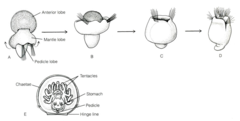
Actinotroph larvae
The larvae stage of Phoronids

Cuticular loricate larvae
The larvae stage of Priapulida
Naupilus/Zoea larvae
The larvae stage of Arthropods (Crustacea)

Tadpole larvae
The larvae stage of Chordates

Tornaria larvae
The larvae stage of Hemichordata

Doliolaria larvae
The larvae stage of Crinoidea
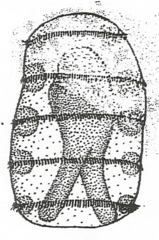
Bipinnaria larvae
The larvae stage of Asteroidea

Ophiopluteus larvae
The larvae stage of Ophiuroidea

Echinopluteus larvae
The larvae stage of Echinoidea

Auricularia larvae
The larvae stage of Holothuroidea