Module 5: Matter
 Call Kai
 Learn
 Practice Test
 Spaced Repetition
 Match
 Flashcards
 Knowt Play
1/41

There's no tags or description
Looks like no tags are added yet.
Name | Mastery | Learn | Test | Matching | Spaced | Call with Kai | Chat |
|---|
No analytics yet
Send a link to your students to track their progress
42 Terms
What happens to the number of neutrons as we progress up the periodic table to larger and large atoms
# of neutrons increases exponetially
faster than the # of protons
what has no neutrons
hydrogen
Z=1
number of neutrons and protons balance normally
helium (Z=2) to chlorine (Z=17)
where do neutrons outnumber protons
Z=18 and above
Z=17 chlroine
element where neutrons start to outnumber the protons
why do the neutrons outnumber the protons
takes less nuclear energy to hold neutrons together
why does it take less nuclear energy to hold neutrons together
because they do not electrically repel each other like protons do
what is the advantage of having more neutrons than protons
when combined into very large nucleei it takes less energy to hold nucleus together when neutrons outnumber protons
atomic mass?
# of protons and neutrons
what letter represents atomic mass
A
atomic mass does not equal?
atomic weight
radius of a typicall atom is?
1 A (angstrom) or 10^-8cm
radium of a typical nucleaus?
abt 0.0001 A (angstrom) or 10^-12 cm
1 AMU =?
1/12 the mass of carbon atom
electron mass
0.000549 amu
proton mass
1.000759 amu
neutron mass
1.000898 amu
proton neutron and electron mass from smallest to largest
electron, proton, neturon
what is each element deterimed by
# of protons in the nucleus
Z =?
atomic number
number of protons
N =?
number of neutrons
this can vary
A=?
mass number
approximated mass of atom
number of protons and neutrons together
N + Z =?
A
nuclear shorthand?
A = mass number
Z= atomic number
N = neutorn number
X = chemical symbol for element

what do we call a variation of an element
nuclide
over 1500 nuclides known to exist
isotope?
same # protons
atoms vary in the number of neutrons they possess even tho Z remains constant
A and N differ
What is constant in isotope?
Z number
A and N differ
Isobar?
same mass number (A)
chemically different elements that have the same mass becuase they contain the same total combined number of neutrons and protons
what is constant in an isobar
A (mass number)
Z and N diffent
example 3He and 3H
Isotone?
same number of neutrons
what is constand in an isotone?
N (neutron number)
A and Z differ
Isomer?
differ in energy levels
atoms that are exactly alike but one is an energized transitional state or a different state of stability
denoted by placing an m beside the A
what is constant in an isomer
A Z and N
what is energized state called
metastable
ground state?
more stable state
what is most important isomer in nuclear medicine
99mTc - technetium

what is this?
isotope
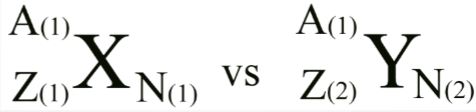
what is this
isobar

what is this
isotone

what is this
isomer
what does the line of stability refer to?
nucleus configuration prefers an equal number of protons and neutrons until chlorine (17) after which extra neutrons are needed to keep the nucleus from falling apart
radionuclidic purity?
the percentage of that element, in the desired chemical form and of the desired radionuclide