Biological Anthropology Quiz 2: Bones and Osteology
 Call Kai
 Learn
 Practice Test
 Spaced Repetition
 Match
 Flashcards
 Knowt Play
1/59

There's no tags or description
Looks like no tags are added yet.
60 Terms
What types of bones are there?
long bones, short bones, flat bones, irregular bones, sesamoid bones
Define osteology
the study of bone and the skeletal system
Most functions of the skeleton can be placed into the following five categories:
Support - structural support, framework for attachment of soft tissues, holds organs
Protection - protects vital organs
Movement/Leverage - framework for muscle attachment; allows movement at the joints
Mineral and lipid (fat) storage - stores calcium and phosphate which can be released as needed (calcium is the most abundant mineral in the body)
Blood Cell Formation (hemopoiesis) and Storage - blood cells are produced in red bone marrow
____ bones are the limb bones, the bones of the hand and foot
Long
Portion of the skeleton that develops first; consists of midline structures such as the skull, vertebral column, rib cage, sternum, and hyoid
axial skeleton
Portion of the skeleton that develops later; consists of limb bones and bones of the pelvic and pectoral girdles
appendicular skeleton
anatomical position
standing, arms down at the sides, palms of the hands facing forward and thumbs out to the sides

Midsagittal (medial) plane
divides the body into equal left and right halves

Coronal (frontal) plane
divides the body into front and back portions

Transverse (horizontal) plane
divides the body into upper and lower parts
Which directional term:
closer to the midline, or the median plane
medial
Which directional term:
farther from the midline, or the median plane
lateral
Which directional term:
toward the front
toward the back
anterior (ventral)
posterior (dorsal)
Which directional term:
above (closer to the top of the head)
below (closer to the bottom of the feet)
superior
inferior
Which directional term:
closer to the body’s surface
further from the body’s surface; internal
superficial
deep

Which directional term:
closer to the attachment of the limb to the trunk of the body (nearer hip or shoulder)
proximal

Which directional term:
farther from the attachment of the limb to the trunk of the body (away from the hip or shoulder)
Distal
Which directional term:
back of the hand
palm of the hand
Dorsal (posterior)
Palmar (anterior)
Which directional term:
the top of the foot
the sole of the foot
Dorsal
Plantar
Which directional term:
the ears are _______ to the nose
the wrist is ______ to the elbow
the head is ________ to the feet
the thumb is _______ to the fourth digit
lateral
distal
superior
lateral
the point at which two bones come together is called an….
articulation, or joint
the type of articulation between two bones influences the shape at their meeting points
______ __________ causes movement at joints
muscle contraction
the 22 skull bones are separated from one another by…
sutures
fuse together after brain and skull growth is complete
forehead bone (single)
Frontal bone (skull)

Which bone:
articulate with the frontal bone; make up the “walls” of the skull; meet at the suture that runs in the midsagittal plane on top of the head
Parietals

which bone:
on the sides of the head; houses the “ear holes”; provides articulation for mandible
Temporals

which bone:
midline bone at the back of the skull; houses large hole at skull base for passage of spinal cord
occipital bone

which bone:
bones that compromise much of the face between orbits and mouth, and most of roof of mouth (paired)
Maxilla

which bone:
cheek bones
Zygomatics

which bone:
small bones; lie just superior to the nasal opening between orbits (paired)
nasal bones

which bone:
entirely within the skull
ethmoid bone

which bone:
large, butterfly-shaped; mostly within the skull
sphenoid bone

which bone:
houses canal for tear ducts
Lacrimal bones

which bone:
the lower jaw
mandible

which bone:
small, curved bones on each side within the nasal opening
inferior nasal conchae

which bone:
small; lie just posterior to bony palate of maxillae
Palatine bone

which bone:
small; runs down midline of inferior nasal aperture
Vomer bone

ethmoid bone

sphenoid bone

sagittal suture

lambdoidal suture
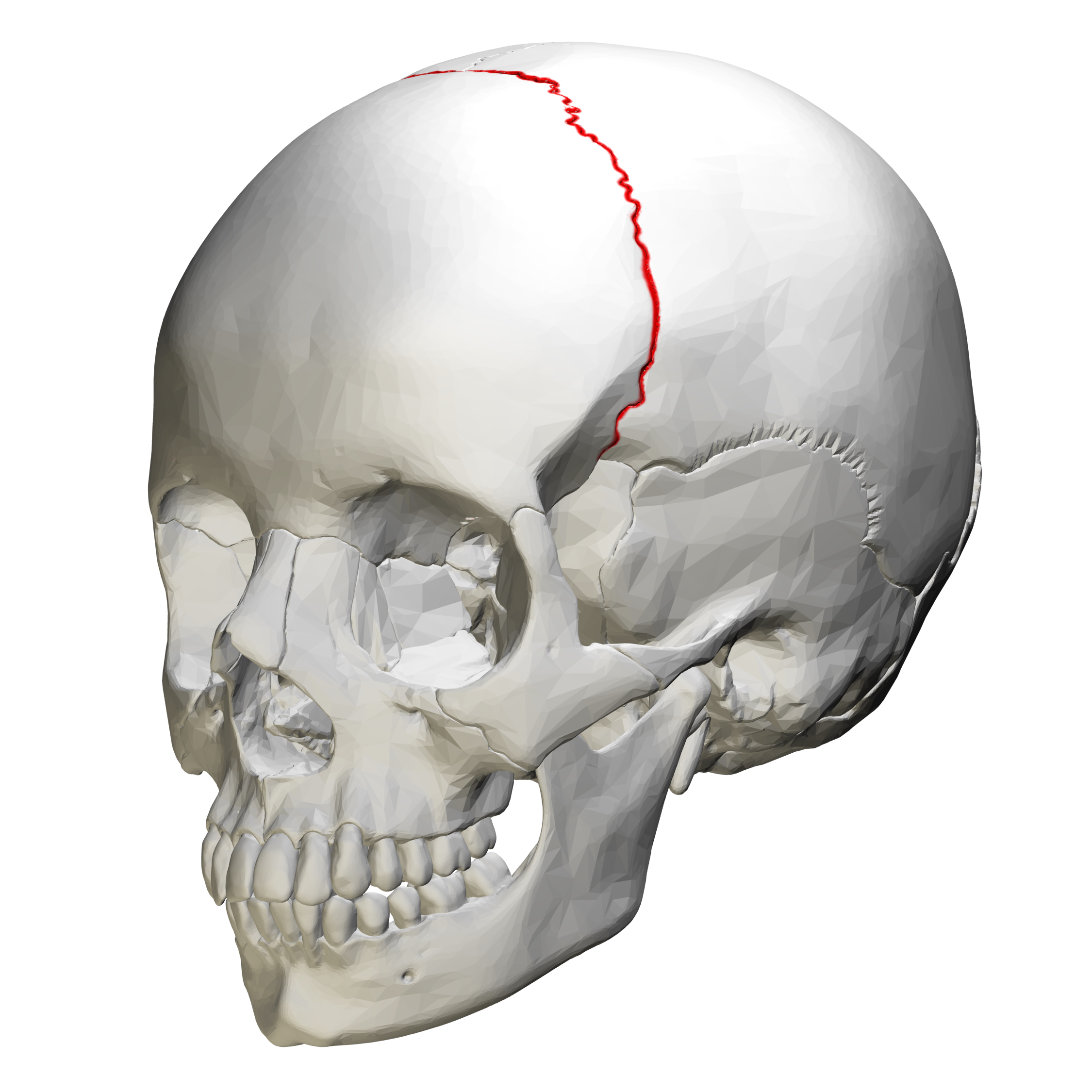
coronal suture

squamosal suture

styloid process

foramen magnum (opening for spinal cord as it exits cranium)
bony support for the larynx (voice box)
hyoid bone
the human vertebral column is made up of __ individual vertebrae
24
the _______ vertebrae are found in the neck
all mammals have 7 of these
cervical
unlike thoracic and lumbar vertebrae, which have only the one large vertebral foramen, all seven of the cervical vertebrae also have…
transverse foramina
all five _____ vertebrae bear the most weight and thus are the largest
lumbar
spinous process projects directly posteriorly

the ______ provides protection for the heart and lungs
consists of sternum, ribs, and costal cartilage
thorax

sternum
manubrium
body
xiphoid process

clavicle
remember S-shape

scapula

humerus

ulna

What are the groups of bones in the hands
carpals, metacarpals, phalanges
what is the name of the big toe?
hallux

os coxa
innominate bone made up of the ilium, the ischium, and the pubis

femur