5. Diagnosis of Accommodative Disorders - Clinical Binocular Vision Fall 2026
 Call Kai
 Learn
Learn Practice Test
 Spaced Repetition
 Match
Match Flashcards
 Knowt Play
1/88

There's no tags or description
Looks like no tags are added yet.
Name | Mastery | Learn | Test | Matching | Spaced | Call with Kai | Chat |
|---|
No analytics yet
Send a link to your students to track their progress
89 Terms
What tests provide us information about eye alignment?
-phoria at distance (CT)
-phoria at near (CT)
-fixation disparity
-AC/A ratio
-CA/A ratio
What are the direct tests for positive fusional vergence (PFV)?
-BO fusion ranges
-NPC
-Vergence facility with BO
What are the indirect tests for positive fusional vergence (PFV)?
-Binocular accommodative facility when looking though plus lenses
-NRA
-Binocular Accommodative response
What are the direct tests for negative fusional vergence (NFV)?
-BI fusion ranges
-Vergence facility with BI
What are the indirect tests for negative fusional vergence (NFV)?
-Binocular accommodative facility when looking though minus lenses
-PRA
-Binocular Accommodative response
What are the direct tests for accommodative ability?
-Monocular accommodative amplitude
-Monocular accommodative facility
**Binocular would be testing the vergence + accommodative system
What are the indirect tests for accommodative ability?
-Binocular accommodative amplitude
-Binocular accommodative facility
-NRA/PRA
-Accommodative response
What are the direct tests for oculomotor skills?
-DEM (Developmental Eye Movement Test)
-NSUCO
-Visagraph/EyeTrac/Readalyzer
What are the possible accommodative anomalies that a patient can have?
-Accommodative insufficiency
-Accommodative excess
-Accommodative infacility
-Accommodative fatigue

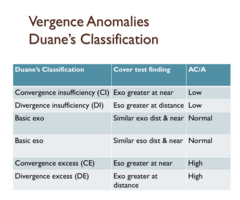
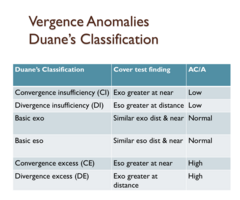
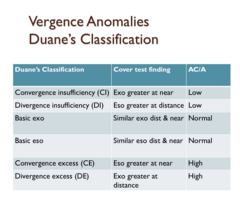
Vergence Anomalies Duane's Classification
Convergence insufficiency CT finding
exo greater at near

Vergence Anomalies Duane's Classification
Convergence insufficiency AC/A
Low AC/A
Vergence Anomalies Duane's Classification
Divergence insufficiency CT finding
eso greater at distance

Vergence Anomalies Duane's Classification
Divergence insufficiency AC/A
Low AC/A

Vergence Anomalies Duane's Classification
Basic exophoria CT finding
Similar exo at distance and near

Vergence Anomalies Duane's Classification
Basic exophoria AC/A
Normal AC/A

Vergence Anomalies Duane's Classification
Basic esophoria CT finding
Similar eso at distance and near

Vergence Anomalies Duane's Classification
Basic esophoria AC/A
Normal AC/A

Vergence Anomalies Duane's Classification
Convergence excess (CE) CT findings
Greater eso at near
Vergence Anomalies Duane's Classification
Convergence excess (CE) AC/A
High AC/A

Vergence Anomalies Duane's Classification
Divergence excess (CE) CT findings
greater exo at distance
Vergence Anomalies Duane's Classification
Divergence excess (CE) AC/A
High AC/A

Vergence Anomalies Duane's Classification
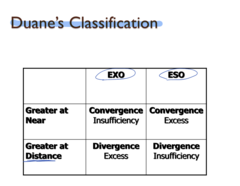
Exo greater at near
convergence insufficiency

Vergence Anomalies Duane's Classification
Eso greater at near
Convergence excess
Vergence Anomalies Duane's Classification
Exo greater at distance
Divergence excess
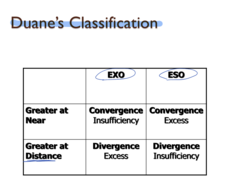
Vergence Anomalies Duane's Classification
Eso greater at distance
Divergence insufficiency

Vergence Anomalies Duane's Classification
High AC/A with exo deviation
Divergence excess

Vergence Anomalies Duane's Classification
High AC/A with eso deviation
Convergence excess
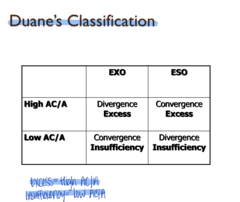
Vergence Anomalies Duane's Classification
Low AC/A with exo deviation
Convergence insufficiency

Vergence Anomalies Duane's Classification
Low AC/A with eso deviation
Divergence insufficiency
What is the problem when a patient has fusional vergence dusfunction?
Reduced fusional ranges and/or facility with ORTHO or a small phoria
What is the prevalence of accommodative insufficiency?
around <1% to 62%
True or False:
Accommodative insufficiency = accommodative paralysis
False
What is accommodative paralysis?
Rare
Associated with an organic cause
Can be unilateral or bilateral
Acute onset
What are the common symptoms of accommodative insufficiency?
-Blurred near vision (59%)
-Headaches (56%)
-Eyestrain (45%)
-Diplopia
-Reading problems
-Fatigue
-Difficulty focusing from one distance to another
-Photophobia
-Suppression
-Dizziness
-Discomfort with near work
-Difficulty attending/concentrating during sustained near task
-Words move on the page
-Avoidance of near work
What is the common score for accommodative insufficiency on the CISS survey?
Score higher on the symptom survey compared to those with normal binocular vision
What are the common clinical signs of accommodative insufficiency?
-Low amplitude of accommodation
-Decreased MONOCULAR accommodative facility with MINUS
-High Lag of accommodation
-Decreased binocular accommodative facility testing with minus
-Low PRA
What was the sign MOST COMMONLY associated with accommodative insufficiency?
Failure on MAF testing
What is considered a LOW amplitude of accommodation?
>2D below minimum for age
**15-0.25(age)
Why is a LOW PRA associated with accommodative insufficiency?
-PRA = stimulating convergence/accommodation
-Patient will have a hard time doing this
True or False:
Accommodative insufficiency is often associated with other binocular vision problems
true
What other binocular vision problems is accommodative insufficiency associated with?
-Esophoria at near
-CI
-Exophoria at near (Pseudo-Convergence insufficiency)
What are possible DDx for accommodative insufficiency?
-Accommodative excess
-Accommodative infacility
-Pseudoconvergence insufficiency
-Basic exophoria
-Divergence excess
-Accommodative paralysis
-Nonfunctional Bilateral Accommodative Dysfunction
-Nonfunctional Unilateral Accommodative Dysfunction
What can nonfunctional Bilateral Accommodative Dysfunction be d/t?
-Drugs
-Systemic Disease
-Neurological origin
What can nonfunctional Unilateral Accommodative Dysfunction be d/t?
-Local disease
-Systemic Disease
-Neurological origin
What is the management of accommodative insufficiency?
-Correction of refraction error
-Therapy
-Plus lenses
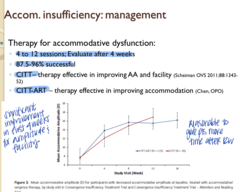
How long does therapy usually take for accommodative insufficiency?
-4-12 sessions
-Patients will be re-evaluated after 4 weeks

What is the success rate of therapy for accommodative insufficiency?
87-96%

What are the physiological changes that can be seen with accommodative insufficiency therapy?
-Real effect on amplitude of relative accommodation
-Increase in speed of accommodative response, latency, and velocity
-Increase in amplitude
-Normalization of accommodative findings, maintained effort
-Changes in the thickness of the ciliary muscle

Is Accommodative insufficiency management shown to be more successful with +1.00 Add or with flipper therapy?
With flipper therapy

What add is recommended for patients with accommodative insufficiency?
+1.00

Accommodative Insufficiency Clinical Findings
Amplitude of accommodation
Below expected

Accommodative Insufficiency Clinical Findings
Facility
Difficulty with minus lenses (monocular and binocular)

Accommodative Insufficiency Clinical Findings
Accommodative response
High Lag
What is the prevalence of accommodative excess?
15% of accommodative problems
True or False:
Accommodative excess = spasm of the near reflex
False
What is spasm of the near reflex?
-Intermittent attacks of accommodation, convergence, and miosis
-Often accompanied by bilateral or unilateral limitation of abduction and myopia
What are common symptoms of accommodative excess?
-Intermittent blurred vision at distance (worse at the EOD)
-Asthenopia/HAs with near work
-Ocular pain
-difficulty relaxing focusing
-Frequent Rx changes
-diplopia
-Nausea
-Micropsia/Macropsia
What are common signs of accommodative excess?
-Variable VA
-Variable static Retinoscopy and subjective findings
-Plano or negative accommodative response (Lead)
-Variable accommodation
-Decreased monocular and binocular accommodative facility (difficulty with plus)
-Low NRA
-Variable suppression
-Variable responses
-Low BI to blur at near
True or False:
Accommodative excess is often associated with other binocular vision problems
True
What other binocular vision problems is accommodative excess associated with?
-Accommodative excess may result in Eso deviation
-Accommodative excess secondary to convergence insufficiency
What are the possible DDx for accommodative excess?
-Accommodative insufficiency
-Accommodative infacility
-Convergence excess
-Basic esophoria
-Nonfunctional Bilateral accommodative dysfunction
-Nonfunctional Unilateral accommodative dysfunction
What is the proper management for accommodative excess?
-Correction of refractive error
-Cycloplegic refraction as indicated
-Take breaks and look at distance
-Therapy for accommodative dysfunction
-Severe = short course of cycloplegics (with plus for near work)
Are plus lenses usually effective for accommodative excess?
No
Is accommodative therapy usually effective for accommodative excess?
Yes -- 87-96% success in 4-12 sessions

Accommodative Excess Common Clinical Findings
Amplitude
Expected
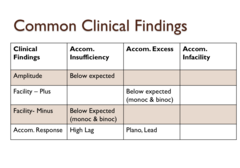
Accommodative Excess Common Clinical Findings
Facility
Below expected with plus (monocular and binocular)

Accommodative Excess Common Clinical Findings
Accommodative response
Plano, Lead
What is the prevalence of accommodative infacility?
30% of accommodative problems, 12% of accommodative dysfunctions
What are the common symptoms of accommodative infacility?
-Blur (64%)
-Difficulty focusing from one dist to another (43%)
-Headaches
-Eyestrain
-Diplopia
-Fatigue
-Reading problems
-Difficulty attenuating/concentrating when reading
-Avoidance of near work
What are the common signs of accommodative infacility?
-Decreased monocular and binocular accommodative facility testing
-Difficulty with both plus and minus lenses
-Low NRA and PRA

Age Expected Accommodative Facility Testing Results
Binocular 8-12yo with +/-2.00 flipper
5cpm
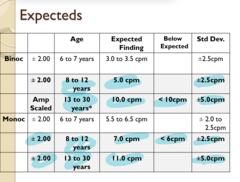
Age Expected Accommodative Facility Testing Results
Binocular 13-30 with amp scaled flipper
10com

Age Expected Accommodative Facility Testing Results
Monocular 8-12yo with +/-2.00 flipper
7.0cpm

Age Expected Accommodative Facility Testing Results
Monocular 13-30yo with +/-2.00 flipper
11.0 cpm
What are the DDx for accommodative infacilty?
-Accommodative insufficiency
-Accommodative excess
-Convergence excess
-Basic esophoria
-Nonfunctional bilateral accommodative dysfunction
-Nonfunctional unilateral accommodative dysfunction
What is the management for accommodative infacility?
-Correction of RE
-Therapy

What is the success rate for accommodative infacility therapy?
76-96%

How many sessions can you expect to do before seeing improvement in a patient with accommodative infacility?
12-16 sessions, monthly F/Us needed

Will added lenses be helpful for patients with accommodative infacility?
Prob not
Patients with accommodative infacility will likely have a (high/low) NRA/PRA
low
Patients with accommodative infacility will likely have trouble clearing (plus/minus) lenses
both
Patients with accommodative infacility will likely have a _____ AA
normal
Patients with accommodative infacility will likely have a _____ accommodative response
normal
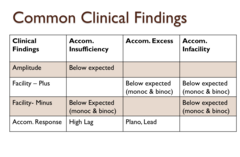
Accommodative Infacility Common Clinical Findings
Amplitude of accommodation
Normal

Accommodative Infacility Common Clinical Findings
Facility
Below expected when clearing plus and minus (monocular and binocular)

Accommodative Infacility Common Clinical Findings
Accommodative response
Normal
What are the common symptoms of accommodative fatigue?
-Blurred near vision
-Eyestrain
-Fatigue and discomfort with near work
-Difficulty attenuating/concentrating during sustained near tasks
What are the common signs of accommodative fatigue?
-Normal AA initially; will decrease with repeated testing
-Low PRA
-Decreased monocular and binocular accommodative facility with minus lenses (rate will decrease over time)
-High Lag of accommodation (increases over time)
-Esophoria at near?
What is the management of accommodative fatigue?
-Accommodative therapy
-Plus lenses at near