EE 91 Project Scheduling
 Call Kai
 Learn
 Practice Test
 Spaced Repetition
 Match
 Flashcards
 Knowt Play
1/35

There's no tags or description
Looks like no tags are added yet.
36 Terms
PROJECT SCHEDULING
a documented process for communicating the tasks that needs
to be done in the specific span of time and with the given
resources.
PROJECT SCHEDULING
aims to construct a timetable for the project where start and
finish times are assigned to individual project activities
PROJECT SCHEDULING
shows the sequence of activities in order to help plan for
the manpower, resources, and time
PROJECT PLANNING
essential to be done together with scheduling
information documentation required for an effective PLANNING:
a. Statement of Work (SOW)
b. Project Specifications
c. Milestone Schedule
d. Work Breakdown Structure (WBS)
STATEMENT OF WORK (SOW)
a description of work to be accomplished that includes
objectives, brief description, funding constraints, specifications,
and schedule
two Statement of Work,
the SOW used in proposal
that contract SOW when the bid was won
PROJECT SPECIFICATIONS
a list identified as part of statement of work
used for man-hour, equipment, and material estimates
used as “definitive rulebook” and quality standard that dictates
how a project schedule must be built, maintained, and measured
MILESTONE SCHEDULE must have’s
a. Project start date
b. Project end date
c. Other major milestones
d. Data items such as deliverables or reports
WORK BREAKDOWN STRUCTURE (WBS)
a detailed statement of work into smaller structure
must be manageable and assignable to personnel
must be independent or with minimum interaction with other work but must be integrated in the whole project.
WBS progress must be measurable
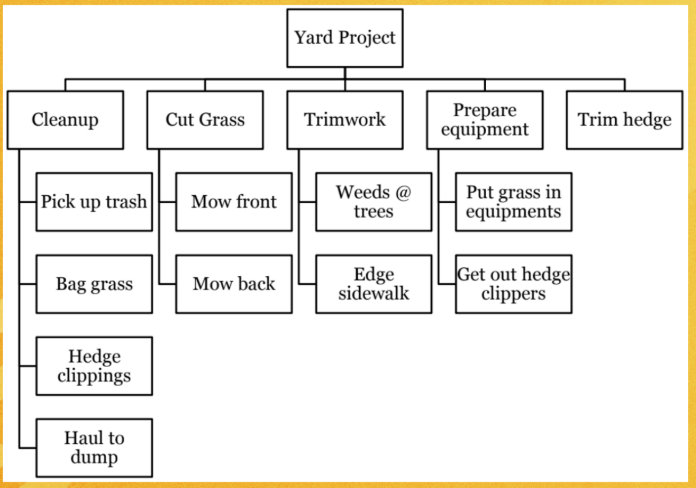
WORK BREAKDOWN STRUCTURE (WBS)

PROJECT SCHEDULE MANAGEMENT
a process of establishing policies, procedures, and
documentation for planning, developing, managing, executing,
and controlling the project schedule
recommended steps for managing SCHEDULE
1. Define activities
2. Sequence of activities
3. Estimate the activity duration
4. Develop schedule
5. Control the schedule
SCHEDULING TECHNIQUES
1. Gantt Charts
2. Milestone charts
3. Line of Balance (LOB)
4. Networks

GANTT CHART
a bar chart that illustrates a project
schedule on a horizontal timeline. The beginning and the
end of a bar is the start and end dates
developed by Henry L. Gantt

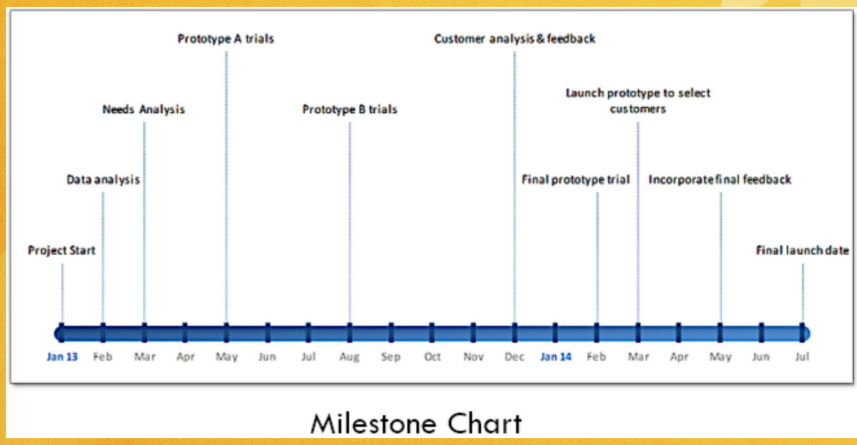
MILESTONE CHARTS
focused on significant events scheduled at a planned time

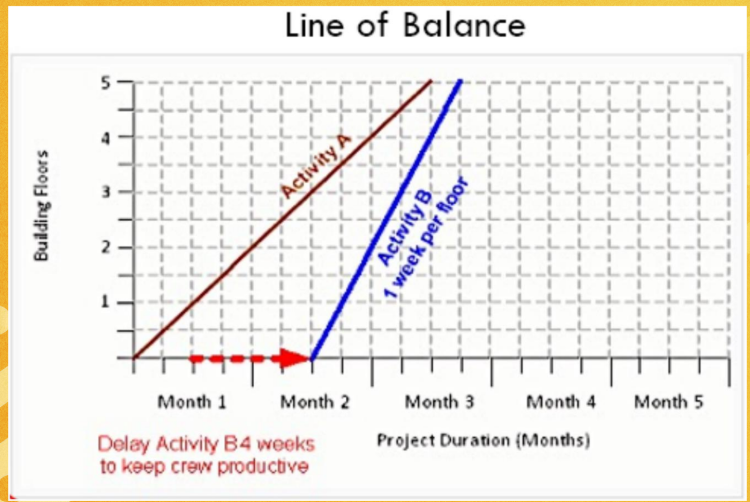
Line of Balance (LOB)
usually straight-line schedule that list a finite number of deliverables in each period

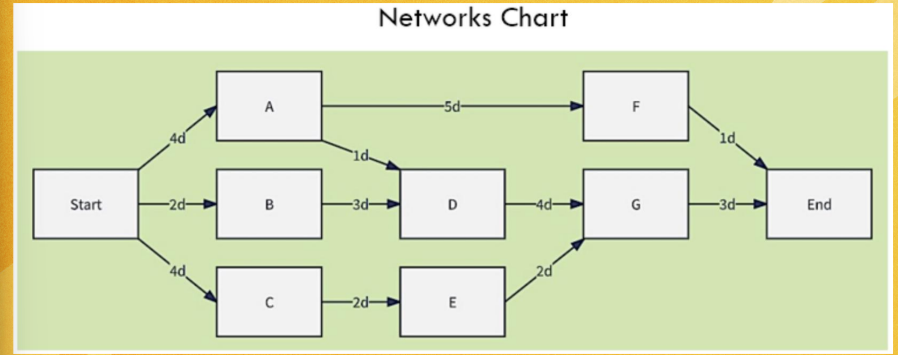
Networks (a.k.a. Precedence Network)
a form of
scheduling that shows interdependencies between
events and activities through a construction of networks

Types of NETWORK SCHEDULING
Precedence Diagram Method (PDM)
Critical Path Method (CPM) – also called as Arrow Diagram Method (ADM)
Program Evaluation and Review Technique (PERT)
Graphical Evaluation and Review Technique (GERT)

PRECEDENCE DIAGRAM METHOD (PDM)
a visual representation of the activities and their sequence in the
project.
- the method consists of constructing nodes/boxes to represent
activities and connect them with arrow to show dependencies

Q for PRECEDENCE DIAGRAM METHOD (PDM)
• Precedence: What activities must precede the activity?
• Concurrence: What activities can go at the same time?
• Succession: What activity must follow the activity?
Predecessor Event
an event that immediately follows some
other event without any other events intervening. An event can
have multiple predecessor events and can be the predecessor of
multiple events
Successor Event
an event that immediately follows some other
event without any other intervening events. An event can have
multiple successor events and can be the successor to multiple
events.
PROGRAM EVALUATION AND REVIEW TECHNIQUE (PERT)
a network scheduling that analyzes the relationship of each task in a project and the main objective is to determine the minimum time to complete the project.
an event is the start and end point for a group of activities, and an activity is the work required to proceed from one event to another.
the letter represents events, and the number represents the time needed to go from one event to another.

MERGE EVENTS
when more
than one activity comes and
joins as an event


BURST EVENTS
when more
than one activity leaves an
event

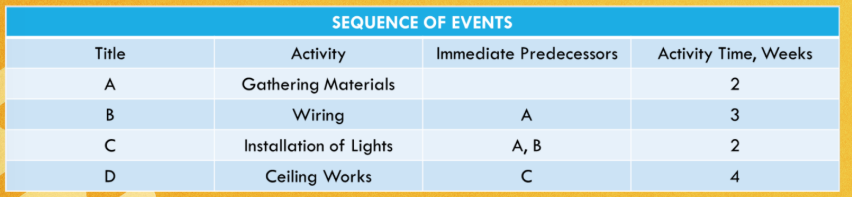
PROGRAM EVALUATION AND REVIEW TECHNIQUE (PERT)
often constructed from the end to start of
events and activities as the end date are usually fixed by
Owner’s Company, the contractor will have a front-end flexibility
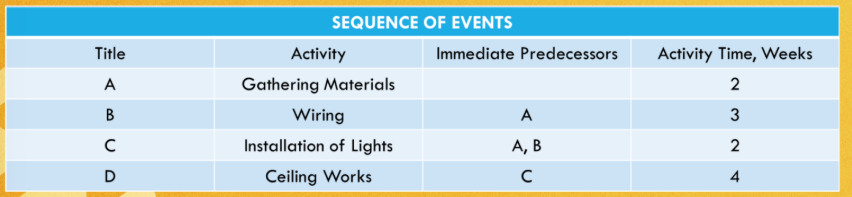
CRITICAL PATH METHOD (CPM)
also known as Arrow Diagram Method (ADM)
type of network scheduling that analyze, scheduling constraints, interdependent activities and time for the tasks using the network diagram
a type of network scheduling which is used in PERT
determines the minimum time required for the project completion since it begins in the start and end point events
used in simpler planning than PERT
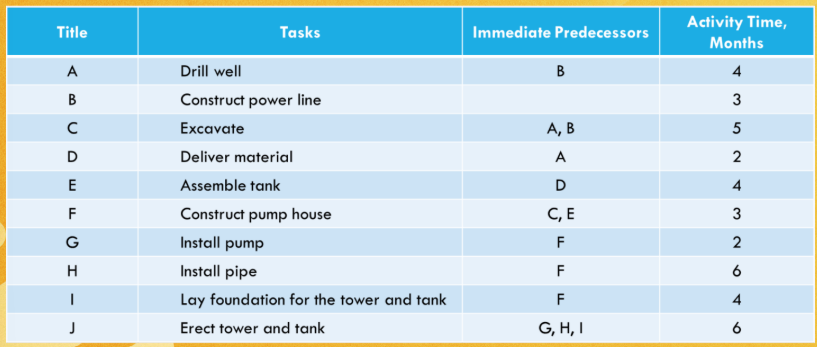
To begin with CPM, we should have:
a. A list of all the activities required to complete the project
b. The time or duration that each activity will take to
complete the project
c. The relationship or dependencies between activities


CPM network diagram:
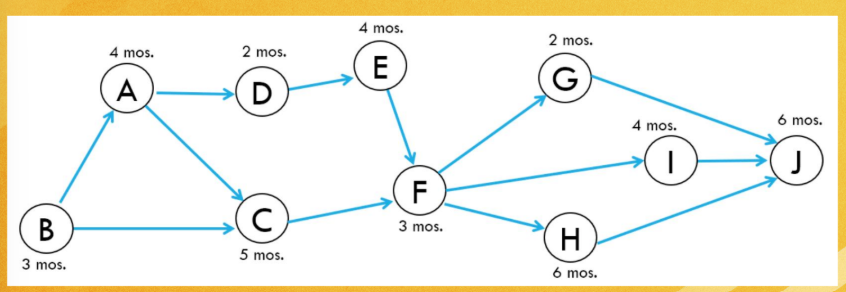
Early Event Time or Forward Pass
To calculate for the critical path:
“Event cannot occur until activities leading into the event
have been completed.
”When two or more activities meet at an event, the largest
possible early event time is chosen
Late Event Time or Backward Pass
To calculate for the critical path:
““Event must occur before any activity leading out of an event
may start.”
When two or more activities meet at an event, the lowest
value of possible time is chosen

Using Forward Pass:


Using Backward Pass:


SLACK or FLOAT
other terminologies of CPM
the amount of scheduling leeway available to an activity. It is the spare time available to an activity not on the Critical Path.


WORK BREAKDOWN STRUCTURE (WBS)
