In Org. Chem Final Exam material
 Call Kai
 Learn
 Practice Test
 Spaced Repetition
 Match
 Flashcards
 Knowt Play
1/28

There's no tags or description
Looks like no tags are added yet.
29 Terms
explain why 1st row transition metals generally have the following electron configuration 3dn4s2
4s is more diffuse therefore it can handle more than one e-(e- to e- repulsion)
3d is lower in energy because it has 0 radial nodes while 4s has 3 radial nodes, making its energy higher
explain why as one goes from Sc to Zn the energy of the 3d decreases faster tjan the 4s as the 3d electrons are filled in
When going from Sc to Zn, the (+) charge increases b/c the # of p+ increases. 3d e- are not completely shielded from the increased (+) charge. The energy of the 3d e- drops as e- are added b/c they’re being held more tightly by the nucleus. 4s orbital has a diff e- density and more shielding than 3d, so its energy decreases more slowly
what is the scandide contraction and what is its origin
it is the decrease in atomic and ionic size across the first transition metals that are usually smaller than expected due to the increasing nuclear charge being partially offset by the added 3d e-. It originates from poor shielding ability of 3d e- as e- are added, resulting in a increase of nuclear change and decrease in atomic radius. This affects post transition metals because usually atoms are meant to become larger based on the atomic radius trend. But when you look atoms like Al and Ga, even though Ga is after Al, it is relatively the same size b/c Ga 3d e- shields poorly, resulting in the outer e- being pulled in more tightly. This is called the d block contraction
What is slater’s rule used for
to determine the effective nuclear charge(Zeff). It helps determine how strongly the nucleus attracts a particular e-
explain the following trends in the acidity of ethane, ethene, and ethyne: ethane pka= 50; ethene=44; ethyne=25
hybridization and stability of the conjugate base that forms when the molecule loses an H+. As the s character increase, e- are held more closely to the nucleus and carbon stabilizes the (-) charge when the H+ is removed. As the conjugate base stabilizes, the molecule becomes more acidic as well. The hybridization of ethane, ethene, and ethyne: sp3, sp2, and sp→ the s character increases
Does BH3 exist as a monomer? If not, why BF3 (and BCl3, BBr3 exist)?
compare MO theory and VB theory?
Unlike valence bond theory, which focuses on localized bonding (i.e. Lewis dot pairs), molecular orbital theory looks at bonding through the lens of delocalized electrons. While VB was closely related to shape, molecular orbital theory is often used to rationalize the spectroscopy of molecules. Molecular orbital theory uses wavefunctions that are described as being linear combinations of atomic orbitals (LCAOs).
what are the 3 requirements to form a bond?
1. The spatial distance must be close enough to provide sufficient overlap.
2. The energies of the orbitals must be sufficiently close to mix.
3. The atomic orbitals/fragments must have the same symmetry to mix
what is the difference between sigma(g) and sigma(u) in an MO diagram
the g represents a inversion center and the u tells us that there are no inversion centers
Bent’s rule
Bent’s rule states that hybrid orbitals that are pointed towards more electronegative substituents, tend to have greater p-character. This is because it is easier to pull electron density from a p-orbital versus an s-orbital
why do PF5 and SF6 exist but PH5 and SH6 do not exist?
Bent’s rule is demonstrated here: orbitals with high p-character point towards more electronegative substituents(such as Fluorine) while orbitals with high s-character point towards more electropositive substituents(Hydrogen). F is able to hold the e- more tightly to itself, and stabilize, H cannot hold the e- as tightly as F.
What is a blackbody
an object that absorbs and emits all frequencies of light.
radial nodes of 1s, 2s, 3s, 3p, 2p, and 3d
1s= 1 RD
2s= 2
3s= 3
2p= 1*
3p= 2*
3d= 3*
*the first node doesn’t start right up against the y axis

radial wavefunctions of 1s, 2s, 3s, 2p, 3p, and 3d
DRAW THIS OUT!

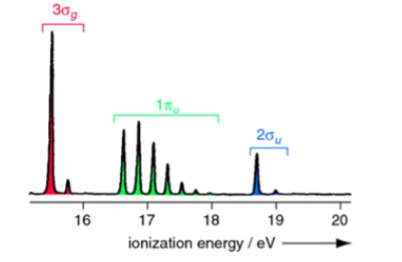
what does photoelectron spectroscopy tell us
it tells us energy filling; energies of the orbitals within a molecule
The red peak requires the least amount of energy needed to remove, so its the lowest energy bonding. it represents sigma(g)
the green peak represents pi(u)
the blue is sigma(u) antibonding
donor types(coordination chemistry)
3 types of sigma donors: sigma donors, sigma donor and pi donor, sigma donor and pi acceptor
sigma donors: hydride, ammonia
sigma donor & pi donor: sulfides, hydroxides, amides, carboxylates
sigma acceptor & pi acceptor: CO, nitrosyl, CN-, bipyridine, and phenanthroline
why would an IR spectrum for free CO show 2143 cm-1 but when CO is paired with Cr(CO)6, CO peak decreases to 2000 cm-1
Cr depopulates the HOMO(highest occupied molecular orbital) from CO, which weakens the bond of CO resulting in the decreased IR stretch
provide the rationale for why 3d transition metal compounds seem to all all +2 oxidation states
When the 3d transition metals lose their 2 e-( so gain a +2 oxidation state), it is taken from the 4s first because 4s e- are higher in energy
Also important to note that 4s is also filled completely before the 3d orbital bc its more diffuse and handles e- — e- repulsion better. That is why for Sc for ex., the configuration isn’t [Ar]3d3, its [Ar]3d14s2 :)
What is the e- configuration state for of Ni for Ni(CO)4? Why
Originally Ni has 28 e-, its configuration is [Ar]3d84s2. CO is a neutral ligand, so Ni oxidation state is 0. Because of this no e- added or taken from the full 3d10 orbital. In other complexes, like [Ni(CN)4]2-, the oxidation state of CN is -1, resulting in the oxidation state of Ni to be +2. That means its d e- count is d8 because the +2 means you took away 2 e-.
What is the hybridization of NH3 and how do you know? refer to #3a on practice exam 3 to look at how its drawn
N have 5 ve-
it have 3 N-H single bonds, and 1 lone pair = 4 e- groups
sp= 2 e- groups
sp2= 3 e- groups
sp3= 4 e- groups
lewis base vs lewis acid
lewis acids accepts e- ( you will know if its a lewis acid if another pair of e- can be bonded to the atoms)
lewis bases donate e- ( you will a molecule is a lewis base if it has lone pairs)
question 7b on practice exam:
so how can you tell whether an atom(F) or a molecule (CN-) is a sigma donor, sigma donor and pi donor, or a sigma donor and pi acceptor
sigma donors have lone pairs to donate via sigma bond
σ donor and π donor also donate lone pairs as well as give e- density
σ donor and π acceptor donate lone pairs through a sigma bond, accepts e- density
As one goes down the PT, some trends are noted in oxidation states. For instance, Al and Ga are always +3(Al2O3, GaCl3). In fact, Al+1is pyrophoric. Indium is found as both +1 and +3, and Tl is found almost exclusively as +1. Explain why that is
Think configuration:
Al 3s23p1
Ga 4s24p1
In 5s25p1
Tl 6s26p1
According to the question, Al, Ga have a oxidation state of +3, meaning they lose 3 e-. Based on that thinking, if In has both +1 and +3, that means its losing 3 e- and 1 e- from 5p. Tl is losing 1 e- from its 6p orbital.
What this tells us e- are harder to remove from the s orbital as Z increases
Paramagnetic vs Diamagnetic
paramagnetic molecules will have one or more unpaired e-. It attracts the magnetic field. So in MO diagrams, orbitals with one e- are paramagnetic and have high spin
diamagnetic molecules have all e- paired. they repel magnetic field. in an MO diagram, all orbitals have 2 e-, opposite spin, thats low spin