CHEM1101 11/6-11/20
 Call Kai
 Learn
 Practice Test
 Spaced Repetition
 Match
 Flashcards
 Knowt Play
1/149

There's no tags or description
Looks like no tags are added yet.
150 Terms
Mole definition
A mole is the amount of any substance that contains as many elementary particles as there are atoms in exactly 12 g of carbon 12
Mole= 6.023 × 10^23 atom
Fundamental unit for stoichiometry and reactivity
Scaling factor for measurement (mass)
What is the number of moles of S in 1.9 × 10^24 atoms of S?
A) 1.0
B) 3.0
C) 1.1 × 10^45
B because 1.8×10^24 atoms times (1 moles/6.023 × 10^23 atoms)= 0.298 × 10^1→3
The subscripts in a chemical formula show…
The relationship of atoms of each element in the formula
The moles of each element in 1 mole of compound
The chemical formula subscripts specify the…
Atoms in 1 molecules
Moles of each element in 1 mole
(Above are same)
How do moles relate to grams?
Atomic mass: mass of 1 mole of an element (beneath the element on pt… ex: Na atomic mass is 22.99)
Molar mass: mass of 1 mole of a chemical compound (based on molecular formula and atomic masses of the element in the compound)


Introduction to chemical reactions
A chemical change (chemical reaction) converts 1 substance to another (involve breaking and forming bonds… breaking in reactants, forming in products)
Chemical reactions are based on moles
Reactants turn into products
On both sides, when multiple reactants or porducts, they are seperated with +
On both sides the physcial states are denoted
Balanced equations
Chemical reactions must be balanced in order for the reactions to be used for quantitation (law of conservation of mass)
In. a balanced equation no elements can be lost or gained (number of moles on LHS=number on RHS)


Avogadro’s number
6.023 × 10^23 molecules
Moles (relative to molar mass)
Mass, atomic mass, molar mass (MM), useful relationship between atomic mass or MM and moles
Moles= (mass g)/ (MM or atomic mass g/mole)


Steps in balancing a chemical equation
1.) count each element on the LHS and RHS
2.) Use coeffciients to balance each element
3.) Subscripts refer to the number of moles of an element in a compund, subscripts cannot be changes
4.) make sure coefficients are lowest common denominator (cheak your work)


Types of chemical reactions (list)
Chemical reactions can be classified as: combination reactions, decomposition reactions, single replacement reactions, double reactions, combustion reactions, redox reactions
Combination reactions
Two or more reactants combine to form one product
Format: A + B → AB
Example: 2 Na (s) + Cl2 (g) → 2 NaCl (s)
Decomposition reactions
One reactant decomposes into two+ products (simpiler substances)
Format: AB → A + B
Example: 2HgO (s) → (delta) 2Hg (l) + O2 (g)
Single replacement reactions
One reactant element replaces another element in a reactant
Format: AB + C → A + CB
Example: Zn (s) + 2 HC; (aq) → H2 (g) + ZnCl2 (aq)
Double replacement reactions
Reactants switch partners when they react
Format: AB + CD → AD + CB
Example: AgNO3 (aq) + NaCl (aq) → AgCl (s) + NaNO3 (aq)
Combustion reactions
Carbon containing reactans react with oxygen and decompose to form simple gases including CO2 (g) and H2O (g)… energy is released as heat as a product
Format: R + O2 → CO2 (g) + H2O (g) + heat
Example: CH4 (g) + O2 (g) → 2H2o (g) + CO2 (g) + heat


A) single replacement reaction
B) Combination reaction
C) Combustion reaction
Redox reactions
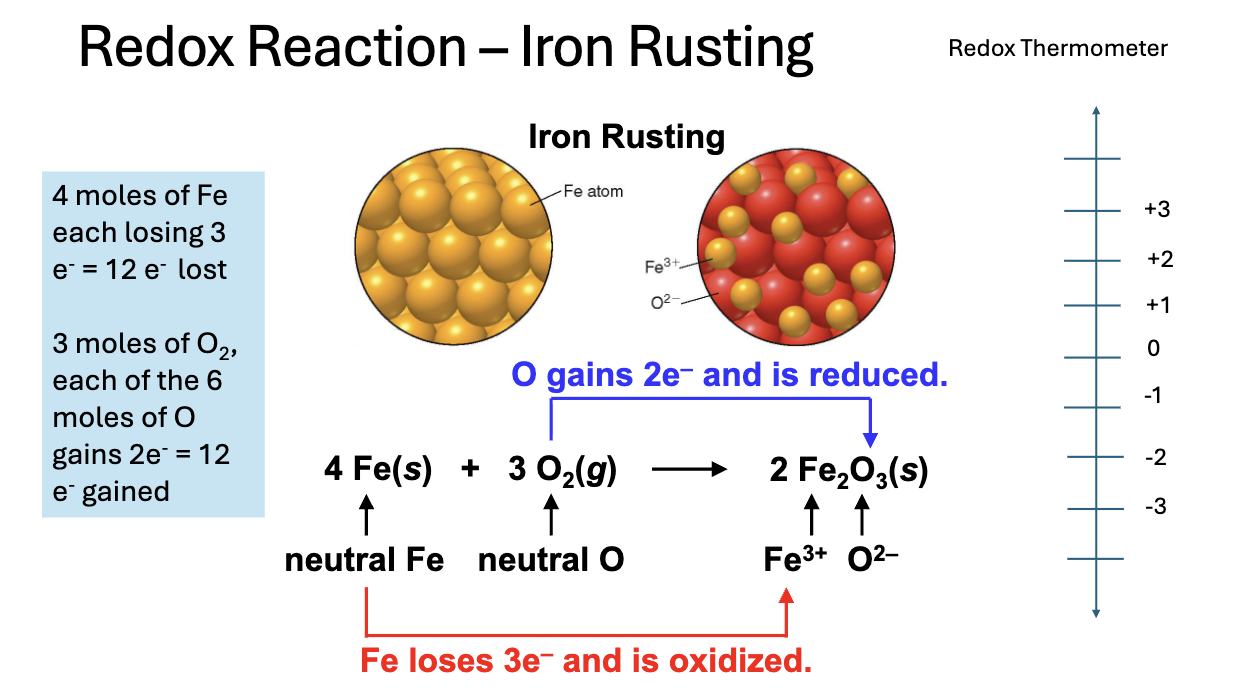
Are reactions in which oxidation and reduction occur in a single reaction: electrons are transferred between reagents
Oxidation is the loss of electrons
Reduction is the gain of electrons
In the image Zn is being oxidized and Cu is being reduced

Oxidation and reduction
Each redox reaction can be written as separate half reactions
Conservation of energy: tells us that the number of moles of electrons lost in a redox process must be equal the number of moles of electrons gained

Example of oxidation and reduction reaction: copper plating (Zn transfers electrons to Cu2+)

Oxidation and reduction relative to electrons
Loss of electrons is oxidation
Gain of electrons is reduction
Redox reaction: iron rusting

A.) oxidized: Cl-
B.) reduced: Ag+
Because you are comparing charge on left side to right side
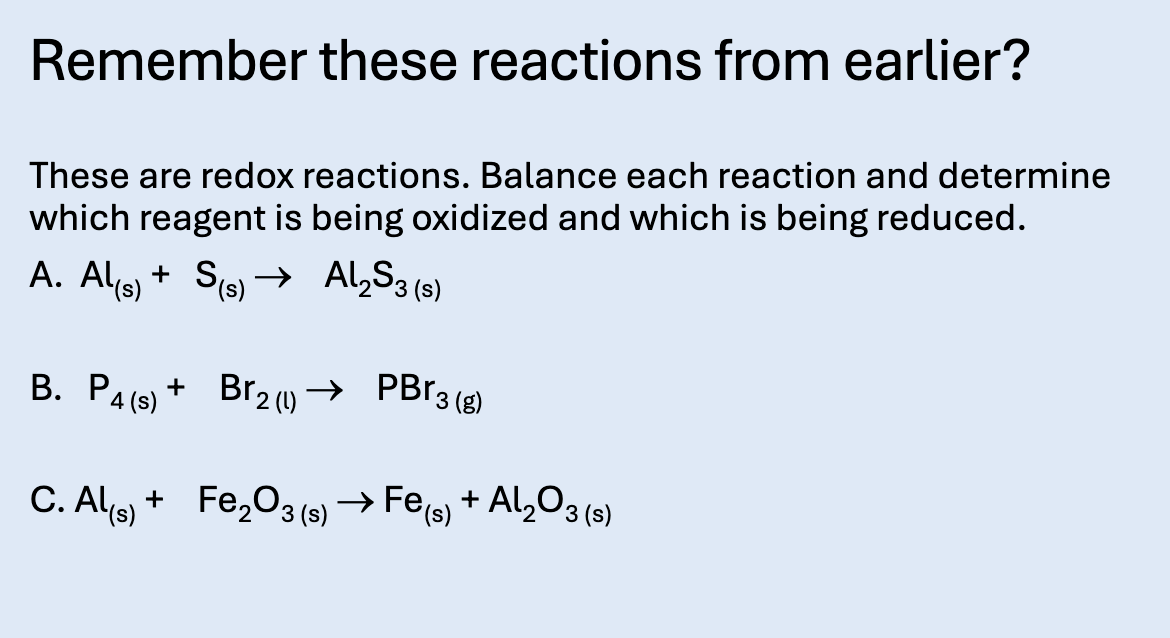
Redox in biological processes
Oxidation: addition of O or loss of H
Reduction: addition of H and loss of O


Chemical equation are based on…
Moles… the chemical equations tell you how many moles of the reactants are required for a reaction and how many moles of the product are produced
Consider the attached equation
It is read as “2 moles of Fe react with 3 moles of S to produce one mole of Fe2S3

Relating mass to moles through balanced chemical reactions
Solid reagents are often weighed out in order to carry out a reaction, and the amount of product is determined based on mass
Typical process: often grams starting material → moles starting material… moles starting material related to moles product through balances reactions… grams products→ moles… moles are the universal currency

Example of relating mass to moles through balanced chemical reactions
Ethanol (C2H5OH, molar mass 46.1 g/mol) is synthesized by reacting ethylene (C2H4, molar mass 28.1 g/mol) with water. How many grams of ethanol are formed from 14 g of ethylene?…22.97 g


Theoretical yield, actual yield, and % yield
Most reactions do not go to completion
The theoretical yield is the ideal amount (can be calculated)
Usually we obtain less than the theoretical yield in a lab
The actual yield is the amount of product isolated from the reaction (experimentally obtained)
The percent yield is the ratio of the actual yield to the theoretical yield expressed as a percentage (% yield= (actual yield in grams/theoretical yield in grams) x 100%)


Calorie (cal)
The amount of energy needed to raise the temperature of 1g of water by 1°C and the unit of energy in the english system
Joule (J)
The unit of energy in the SI system… 1 cal=4.184 J
Energy in chemical reactions
When molecules come together and react, bonds are broken in the reactants and new bonds are formed in the products
Bonds breaking always requires an input of energy
Bond formation always releases energy

Collision theory
Three conditions for a reaction to occur:
1.) collision: molecules must collide (kinetic energy)
2.) orientation: reactants must be oriented properly to form and break bonds (shape)
3.) Energy: to be successful, collisions must provide the necessary amount of energy (activation energy)
Energy changes in reactions
∆H is called the heat of reaction or the enthalpy change… it represents the energy absorbed or released in a reaction
When energy is absorbed, the reaction is said to be endothermic and ∆H is positive
When energy is released, the reaction is said to be exothermic and ∆H is negative

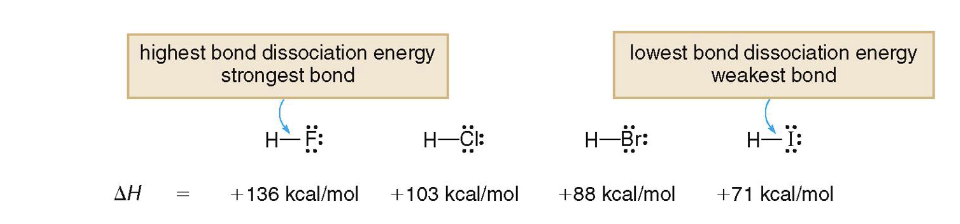
Energy changes in reactions: bond dissociation energy
∆H indicated the relative strength of the bonds broken and formed in a reaction… the stronger the bond the greater its bond dissociation energy (endothermic)… the greater the amount of energy you need to break the bond… in comparing bonds formed from elements in the same group, bond dissociation energies generally decrease going down a group
Colds packs and hot packs (heat of solution)

Energy diagrams (collision and orientation)
For a reaction to occur, two molecules must collide with enough kinetic energy to break bonds
The orientation of the two molecules must be correct too

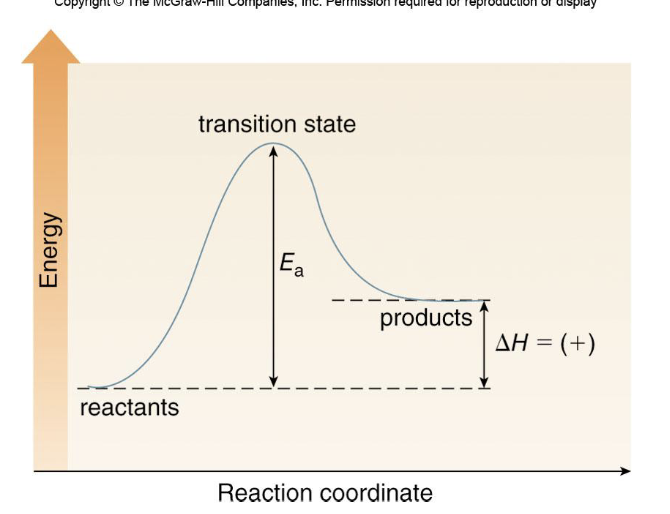
Energy diagrams (energy)
E(subscript a) is the energy of activation, and it is the difference in energy between the reactants and the transition state

Transition state
The highest-energy most unstable configuration of atoms that occurs during a chemical reaction as reactants transform into products

Energy diagrams definitions
The E(sub a) is the minimum amount of energy that the reactants must posses for a reaction to occur
E(sub a) is called the energy barrier and the height of the barrier determines the reaction rate
When the E(sub a) is high few molecules have enough energy to cross the energy barrier and the reaction is slow
When the E(sub a) is low many molecules have enough energy to cross the energy barrier and the reaction is fast
Energy diagram: exothermic reaction/heat released
The difference in energy between the reactants and the products is ∆H… if ∆H is neg. the reaction is exothermic
In a exothermic reaction heat is realeased, the energy of the product is less thant the energy of the reactants, heat is a product (neg)

Energy diagram: endothermic reaction/heat absorbed
If ∆H is pos. the reaction is endothermic
In an endothermic reaction heat is absorbed, the energy of the products is greater than the energy of the reactants, heat is a reactant (added/pos)
Reaction rates: how concentration and temp. affect reaction rate
Increasing the concentration of the reactant increases the number of collisions and the reaction rate
Increasing the temp. increases the kinetic energy of molecules and the reaction rate


Catalysis, catalysts, and reaction rates
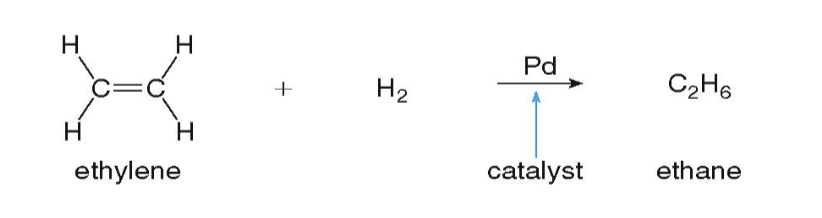
Catalyst: a substance that speeds up the rate of a reaction… one is recovered unchanges in a reaction and does not appear in the product
In the attached reaction, Pd acts as a catalyst
Catalysts accelerate a reaction by lowering E(sub a) without affecting ∆H
Reaction rates: catalysts
Catalysts lower the activation energy E(sub a) required for the reaction… uncatalyzed reaction is slower, catalyzed is faster, ∆H is the same for both

Reaction rates: biological catalysts
Enzymes (usually protein molecules) are biological catalysts held together in a very specific three-dimensional shape
The active site binds a reactant, which then undergoes a very specific reaction at an enhanced rate
The enzyme lactase converts the carbohydrate lactose into the two sugars glucose and galactose
People who lack adequate amounts of lactase suffer from abdominal cramping and diarrhea because they cannot digest lactose when it is ingested
3 factors that increase reaction rates
Increase temperature (more collisions, more collisions with energy of activation)
Increase reactant concentration (more collisions)
Add a catalyst (lowers energy of activation E(sub a))


Pure substances
Elements, covalent compounds, and ionic compounds
Mixture
Most matter we come into contact with… two or more pure substances
Homogeneous mixture: a uniform composition throughout the smaple
Heterogeneous mixture: does not have a uniform composition throughout the sample
A mixture is a physical combination os substances tht retain their individual properties, while a solution is a homogeneous mixture where one substance dissolves completely in another
Solution
A homogeneous mixture where one substance dissolves completely in another
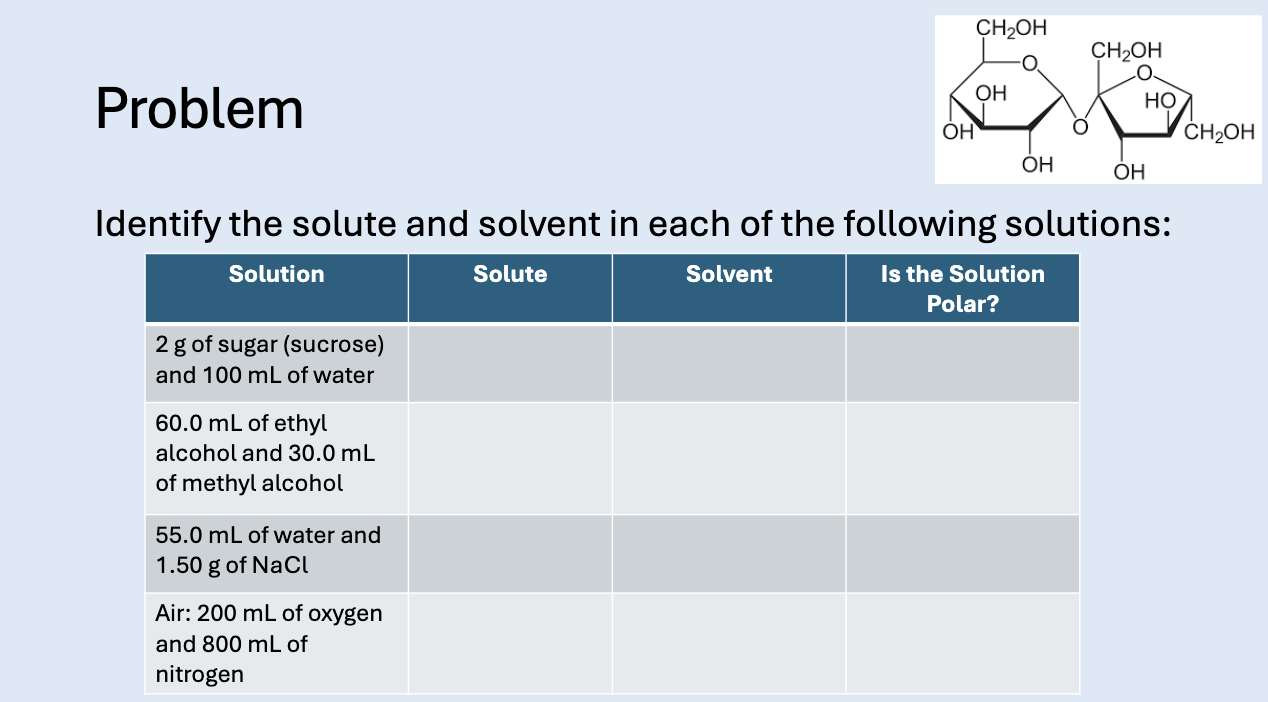
2 components: solute and solvent
Solute
The substance present in the small(er) amount (ex: salt)
Solvent
The substance present in the largest amount (ex: water… when water is the solvent, we call the solution aqueous)
What can be a solute?
May be liquids, gases, or solids
Are spread evenly throughout the solution
Mix with solvents, so the solute and solvent have the same physical state
Cannot be separated by filtration but can be separated by evaporation
Are not visible but can give a color to the solution
Solute examples

Water as a solvent
Water is one of the most common solvents in nature, it is a polar molecule because of polar O-H bonds, molecules form hydrogen bonds which is important in many biological compounds


Formation of solutions
Solutions form when the solute-solvent interactions are large enough to overcome the solute-solute interactions and the solvent-solvent interactions
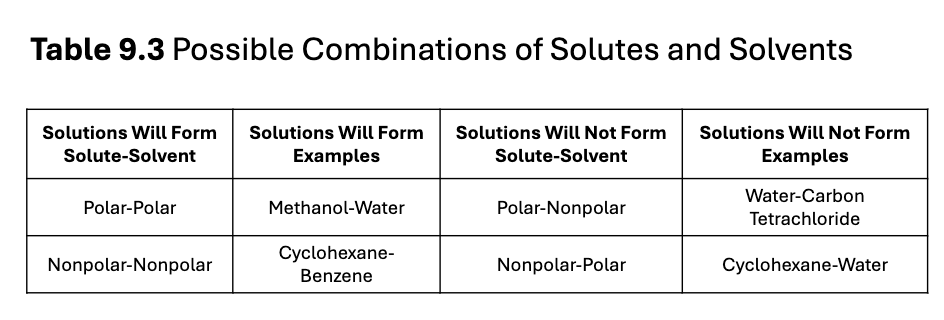
Like mixes (non-polar mixes with non-polar, polar mixes with polar)

Solutions: like dissolves like
Solutions will form when the solute and solvent have similar polarities/ like dissolves like
Intermolecular forces: like dissolves like
Ionic compounds dissolve by forming ion-dipole interactions (attractive interactions between the charged ions and the polar ends of water)
Polar solutes dissolve by forming dipole-dipole interactions between the solute and the solvent molecules
Nonpolar solutes dissolve by forming dispersion interaction between solute and solvent molecules


Solutions with ionic solutes
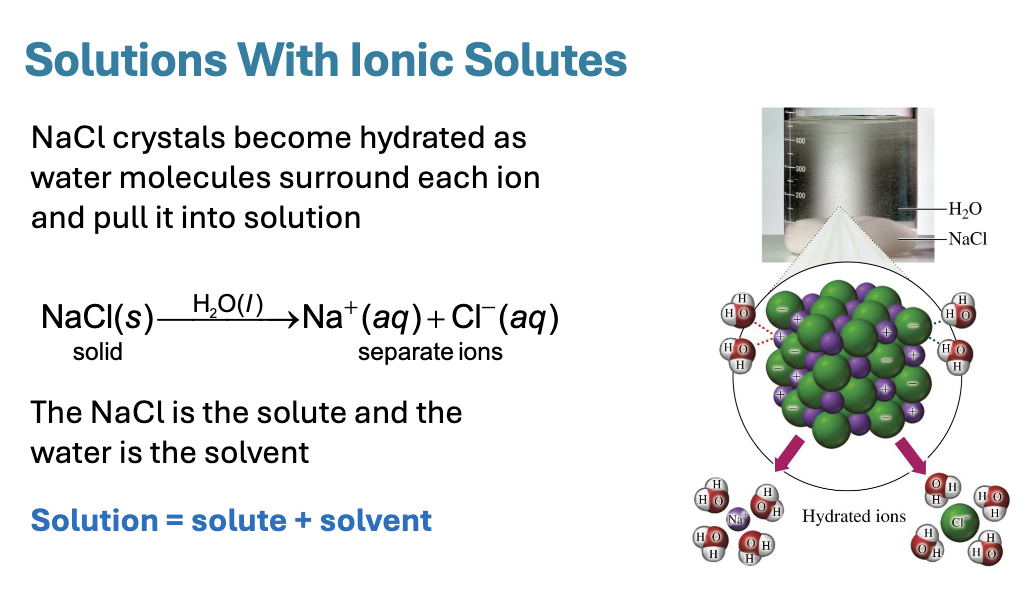
NaCl crystals become hydrated with water molecules surround each ion and pull it into solution
The NaCl is the solute and the water is the solvent
Solution=solute+solvent
Solutions with polar solutes
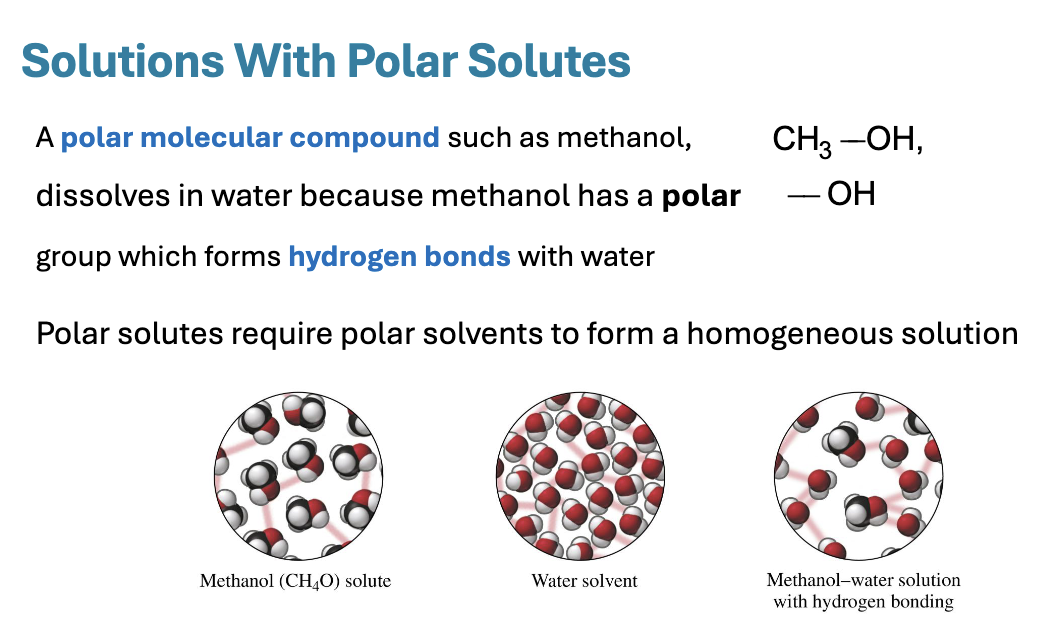
A polar molecular compound like methanol dissolves in water because methanol has a polar group which forms hydrogen bonds with water
Polar solutes require polar solvents to form a homogeneous solution


Electrolytes and nonelectrolytes
Electrolytes in the body play an important role in maintaining proper cell and organ function
Electrolytes like sodium, potassium, chloride, and bicarbonate can be measured in a blood test
Biochemically important electrolytes

Strong electrolytes
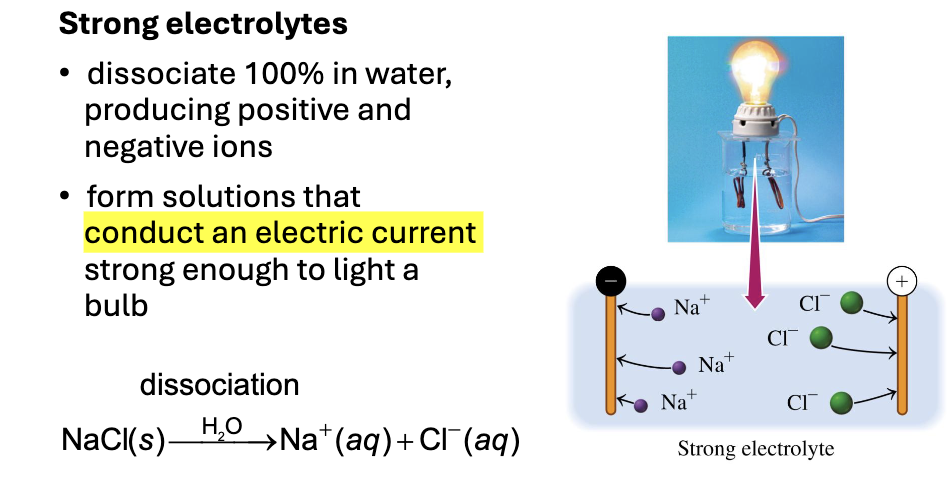
Strong electrolytes: dissociate 100% in water, producing positive and negative ions… form solutions that conduct electric current strong enough to light a bulb

Weak electrolytes
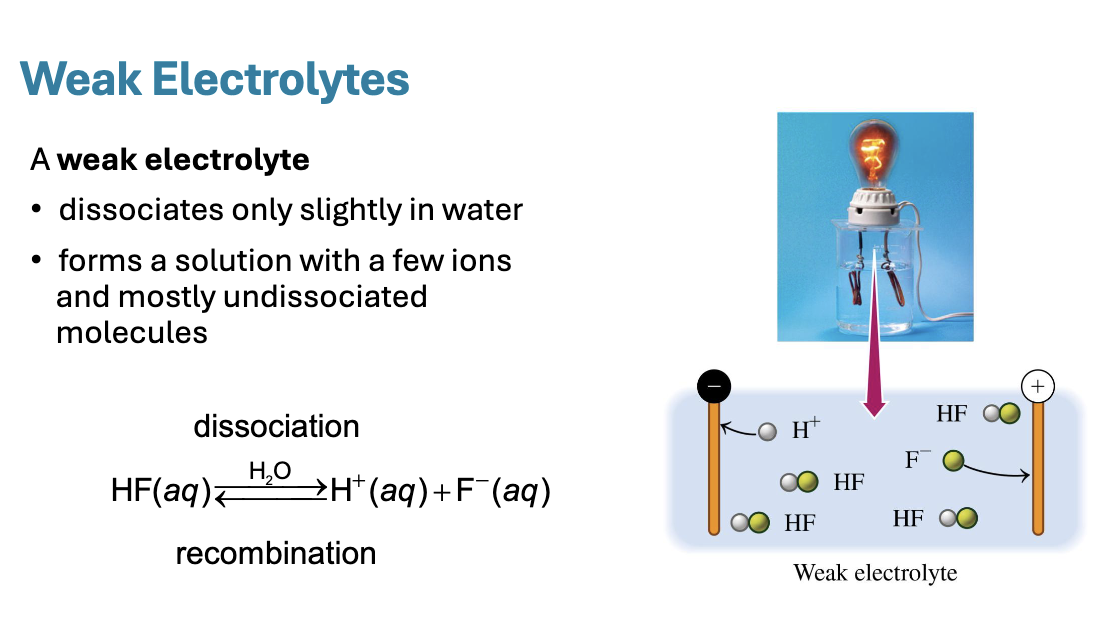
A weak electrolyte dissociates only slightly in water… forms a solution with a few ions and mostly undissociated molecules
Nonelectrolytes
Nonelectrolytes dissolve as molecules in water, do not produce ions in water, do not conduct an electric current
Biological examples: glucose, urea, lipids

Solutes in aqueous solutions


Equivalents
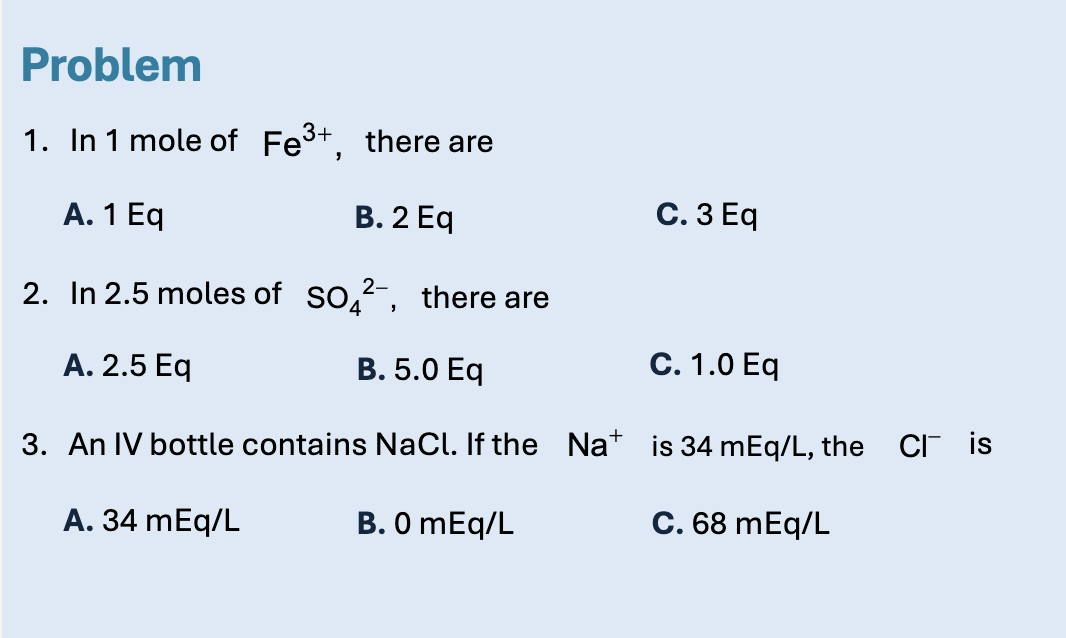
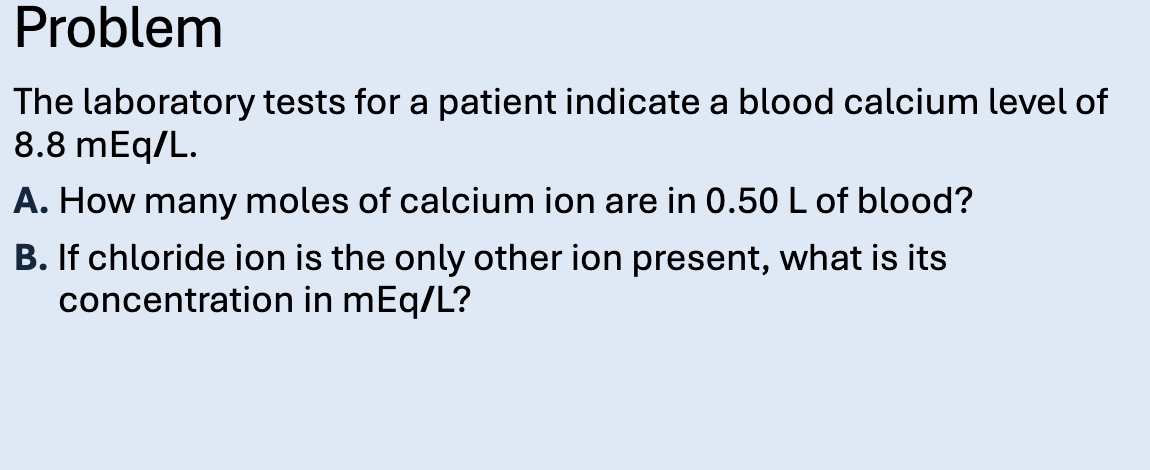
An equivalent (Eq) is the amount of an electrolyte or an ion that provides 1 mole of electrical charge (+ or -)
In solution the charge of the pos ions is always balanced by the charge of the neg ions… the concentrations of electrolytes in intravenous fluids are expressed in milliequivalent per liter (mEq/L)
1 Eq=1000mEq
mEq=mmol x lchargel
Equivalents, milliequivalents
For example, a solution containing…
25 mEqL of Na+ and 4 mEq/L of K+ has a total pos charge of 29 mEq/L
Cl- as the only ion must also have a concentration of 29 mEq/L
25 mmole/L of Ca²+ has a concentration of 50 mEq/L
Equivalents, miliequivalents table



Solubility
The maximum amount of solute that dissolves in a specific amount of solvent
Temp. affects solubility
Expressed as grams of solute in 100g of solvent, usually water
(g of solute)/(100g of water)
Effects of temp. on solubility
Solubility depends on temp.
Of most solids increases as temp. increases (think about sugar water)
Of gases decreases as temp. incrreases (think about soda)


Nonpolar solvents

Ion dipole interaction
Solubility
How much solute dissolves in a specific amount of solvent
Expressed as grams of solute in 100g of solvent (usually water)
Solubility= (g of solute)/(100g of water)
Temperature effects solunility
Increases with increasing temp. for many solids
Decreases with increasing temp for many gases (Gas + Liquid → solution + heat)


KBr (s) solubility will increase
SO2 (g) solubility will decrease
Unsaturated solution
Contain less than the maximum amount of solute
Can dissolve more solute
Evidence: you can keep adding more solute and there is no precipitation

Saturated solutions
Contain a maximum amount of solute that can dissolve
Evidence: if you add any more solute, precipitation occurs
