9.1 oxidizing organic molecules
 Call Kai
 Learn
 Practice Test
 Spaced Repetition
 Match
 Flashcards
 Knowt Play
1/50

There's no tags or description
Looks like no tags are added yet.
51 Terms
the flow of energy into an ecosystem
comes in as sunlight and leaves as heat
ATP is used instead of food molecules
ATP produces the right amount of Kilo calories instead of the overly large amount that food molecules produces. reactions do not need a lot of energy, so its good to split it smaller
catabolic pathways
breaks high energy less complex molecules into lower energy less complex molecules
organic compounds possess potential energy as a result
of the arrangement of electrons in the bonds between atoms
compounds that can act as fules
compounds that participate in exergonic reactions
energy transfers
plays a major role in the release of energy via these pathways
organic compounds posses potential energy
as a result of the arrangement of electrons in the bonds between atoms
with the help of enzymes to catalyze exergonic reactions
a cell systematically degrades complex organic molecules that are relatively high in potential energy into simple molecules
Some of the energy extracted from
higher energy organic molecules can be used to do work while the rest dissipates as heat
cellular respiration
transforms larger molecules into ATP and smaller waste molecules
Areobic Respiration
requires the presents of oxygen (O2)
Anaerobic Respiration
Similar to aerobic but does not require the presents of oxygen
Fermentation
a partial degradation of sugar that does not require the presents of oxygen, but it yeilds very little ATP

what is this
the basic process for the conversion of compounds into energy
Why is glucose often the example for the organic compound broken down for ATP
it is helpful to trace cellular respiration
what releases the energy stored in molecules
the transfer of the repositioning of electrons during chemical reactions
Electrons in chemical bonds posses potential energy based on
their position within the bond
during a catabolic reaction when electrons are either
transferred from one reactant to another or repositioned energy is released
chemical reactions that transfer electrons between reactants are called
oxidation reduction reactions or redox reactions
Oxidation
a substance loses electrons or is oxidized
reduction
a substance gains electrons or is reduced (the amount of positive chnarge is reduced)
LEO says GER
Lose electrons oxidize gain electrons reduced
In NaCL
Na becomes oxidized and loses an electron, Cl becomes reduced and gains electrons

what is the reducing agent
Xe- is the electron donor

What is the oxidizing agent
(Y) is the electron acceptor
some redox reactions do not transfer electrons but
Change how the electrons are shared within covalent bonds
the reaction releases energy to the surrounding because the
electrons lose potential energy when they end up being shared unequally spending more time near more electronegative atoms

During aerobic cellular respiration
C6H12O6 is oxidized and O2 Is reduced
Organic molecules with an abundance of electrons associated with hydrogen atoms
are excellent high energy energy fuels, because they have equally shared electrons that become less equally shared
NAD+
coenzyme, that is formed first from the electrons from organic compounds
as an electron acceptor NAD+ functions
as an oxidizing agent during cellular respiration
When NAD+ accepts electrons and is reduced it becomes
NADH and represents stored energy that can be tapped to syntheize ATP

what is this
the synthesis of NADH

what is this
NAD+
what reduces NAD+ to NADH
the enzymatic transfer of 2 electrons and one proton (H+) from an organic molecule in food to NAD+ reduces the NAD+ to NADH the second proton (H+) is released most of the electrons are transferred initially to NAD+
NADH passes the elctrons to the electron transport chain which consists of a number of molecules located
in the inner mitochondrial membrane
the electron transport chain
passes electrons in a series of steps
Electrons removed from glucose are shuttled
by NADH to the higher energy end of the chain
at the “bottom” or lower energy end
O2 captures these electrons along with hydrogen (H+) to form H2O
energy yielded form the transfers is used to
regenerate ATP

what does this show
during aerobic cellular respiration most electrons travel the following energetically downhill route
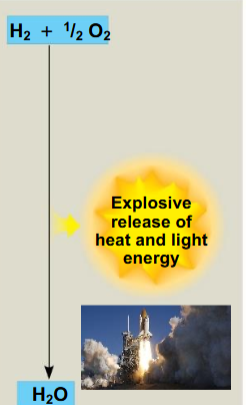
what is this
an uncontrolled reaction

what is this
cellular respiration
Harvesting energy from glucose has three stages
1) Glycolysis
Brakes glucose into two molecules of pyruvate
2) the citric acid cycle
completes the breakdown of glucose
3) oxidative phosphorylation
accounts for most of the ATP synthesis

what cycle is this
Aerobic cellular respiration
the process that generates the most ATP
is oxidative phosphorylation
why is oxidative phosphorylation the best producer of ATP
it is powered by redox reactions and oxygen must be present
what percent of ATP is produced by oxidative phosphorylation
90%
A smaller amount of ATP is formed by
substrate-level phosphorylation, which does not require oxygen
for each molecule of glucose degraded how much ATP was formed
32 molecules of ATP

what is this
some ATP is made by direct phosphate group transfer from organic substrate to ADP by an enzyme. Only way that ATP is formed during glycolysis and citric acid cycle