Cranial nerve POLLEV
 Call Kai
 Learn
Learn Practice Test
 Spaced Repetition
 Match
Match Flashcards
 Knowt Play
1/14

There's no tags or description
Looks like no tags are added yet.
Name | Mastery | Learn | Test | Matching | Spaced | Call with Kai | Chat |
|---|
No analytics yet
Send a link to your students to track their progress
15 Terms
CN I
anosmia: loss of smell
If your patient is experiencing anosmia - which cranial nerve has been affected?
C. CN XI left side
Your 32 year old patient s unable to raise her left shoulder and turn her head towards the right. Which CN has been affected?
A. CN X left side
B. CN XI right side
C. CN XI left side
D. CN IX left side
E. CN XII right side
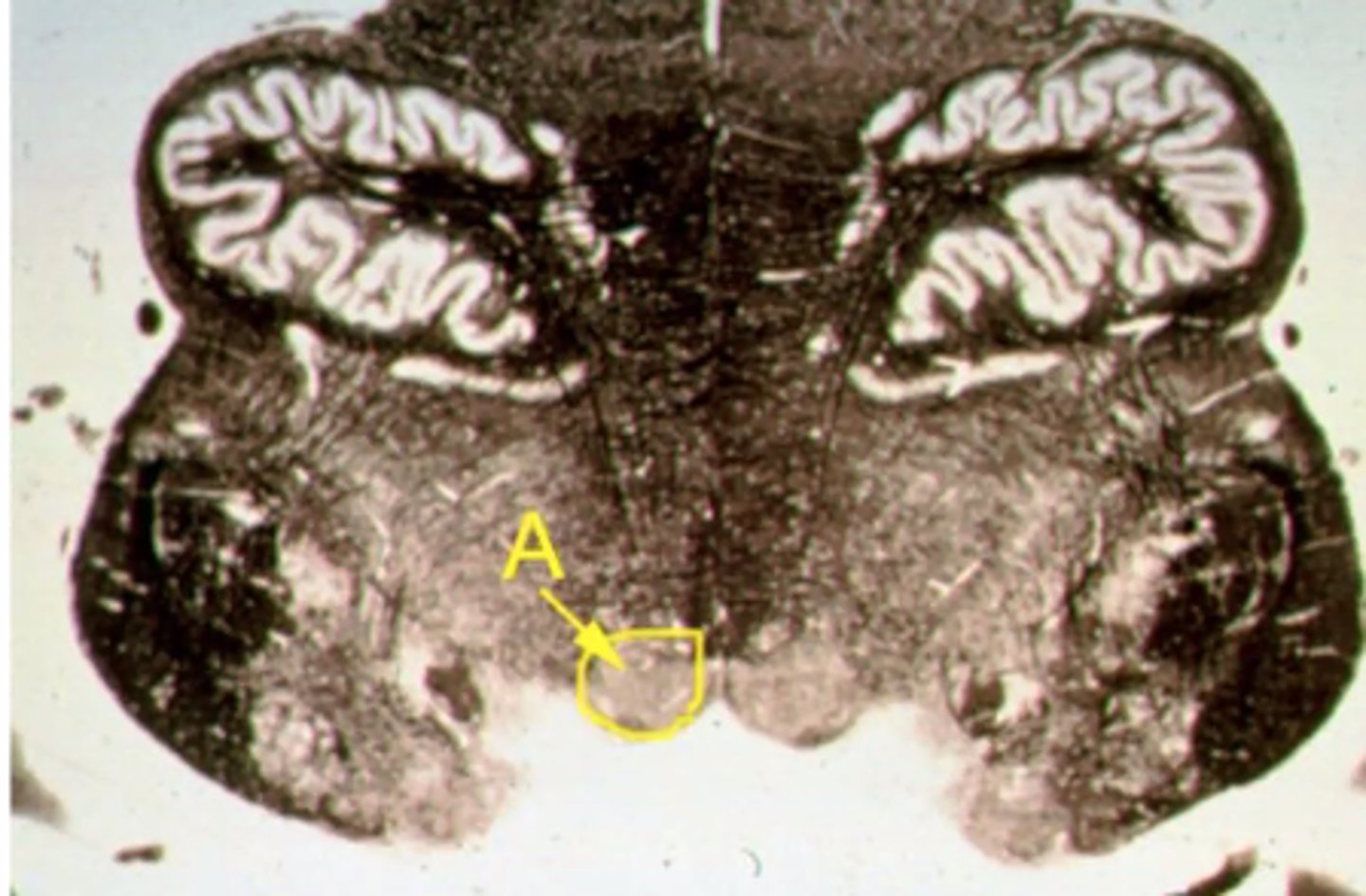
A. The tongue will deviate to the ipsilateral side when protruded
- CN XII innervates the tongue
A lesion to structure "A" will results in:
A. The tongue will deviate to the ipsilateral side when protruded
B. Loss of gustatory sensation
C. Loss of parasympathetic function
D. Ipsilateral eye will deviate towards the midline
E. Ipsilateral loss of pain & temp from the face
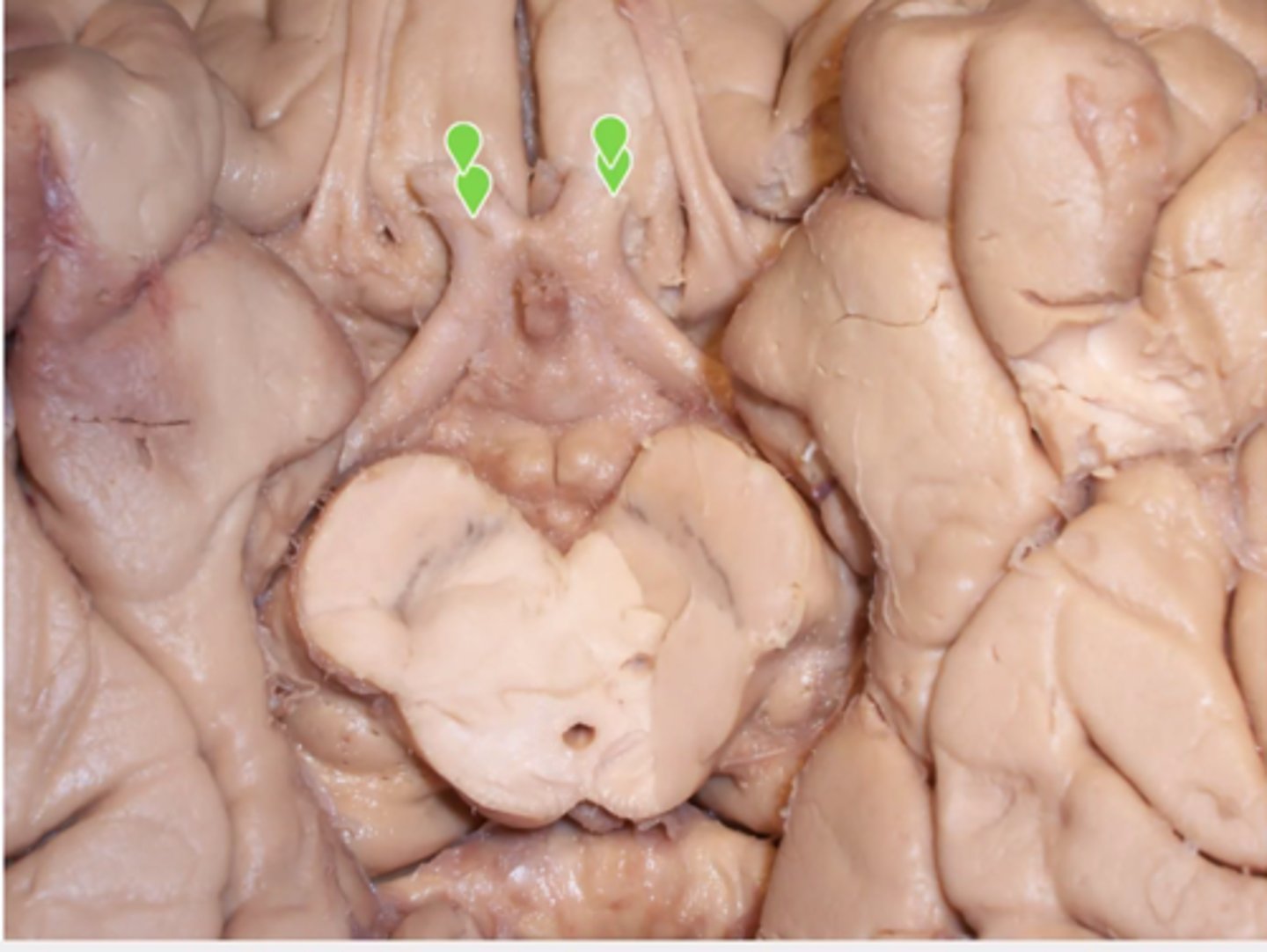
Optic nerve (CN II)
- carries visual information
Identity the marked structure
D. CN VIII
vestibulocochlear nerve
- relays auditory information
Which CN relays auditory & vestibular information into the CNS?
A. CN V
B. CN VI
C. CN VII
D. CN VIII
E. CN IX
True
The pupillary light reflex involves CN II ( afferent) & CN III (efferent).
(T/F)
D. VII, IX, X
Which 3 cranial nerves synapse here to relay taste & visceral sensations?
A. V, VII, X
B. V, VIII, IX
C. VI, IX, XII
D. VII, IX, X
E. VII, X, XII
Trochlear (CN IV)
Which cranial nerve innervates the superior oblique eye muscle?
D. Trigeminal motor nucleus (CN V)
Which CN nucleus projects axons out to innervate the ipsilateral muscle mastication?
A. Spinal trigeminal nucleus
B. Mensencephalic nucleus
C. Principle sensory nucleus
D. Trigeminal motor nucleus
E. Facial motor nucleus
True
The CN in the gag reflex are CN IX (afferent) & CN X (efferent) & sometimes CN XII (efferent)
(T/F)
B. V(ophthalmic division) & VII
Which CN are involved in the corneal blink reflex?
A. II & III
B. V(ophthalmic division) & VII
C. V (maxillary division) & III
D. VI & III
E. IV & VII
C. VII & VIII
Which 2 cranial nerves resides in the cerebellopontine angle and are lesioned in a vestibular schwannoma?
A. IX & X
B. VIII & IX
C. VII & VIII
D. VIII & X
E. VI & VIII
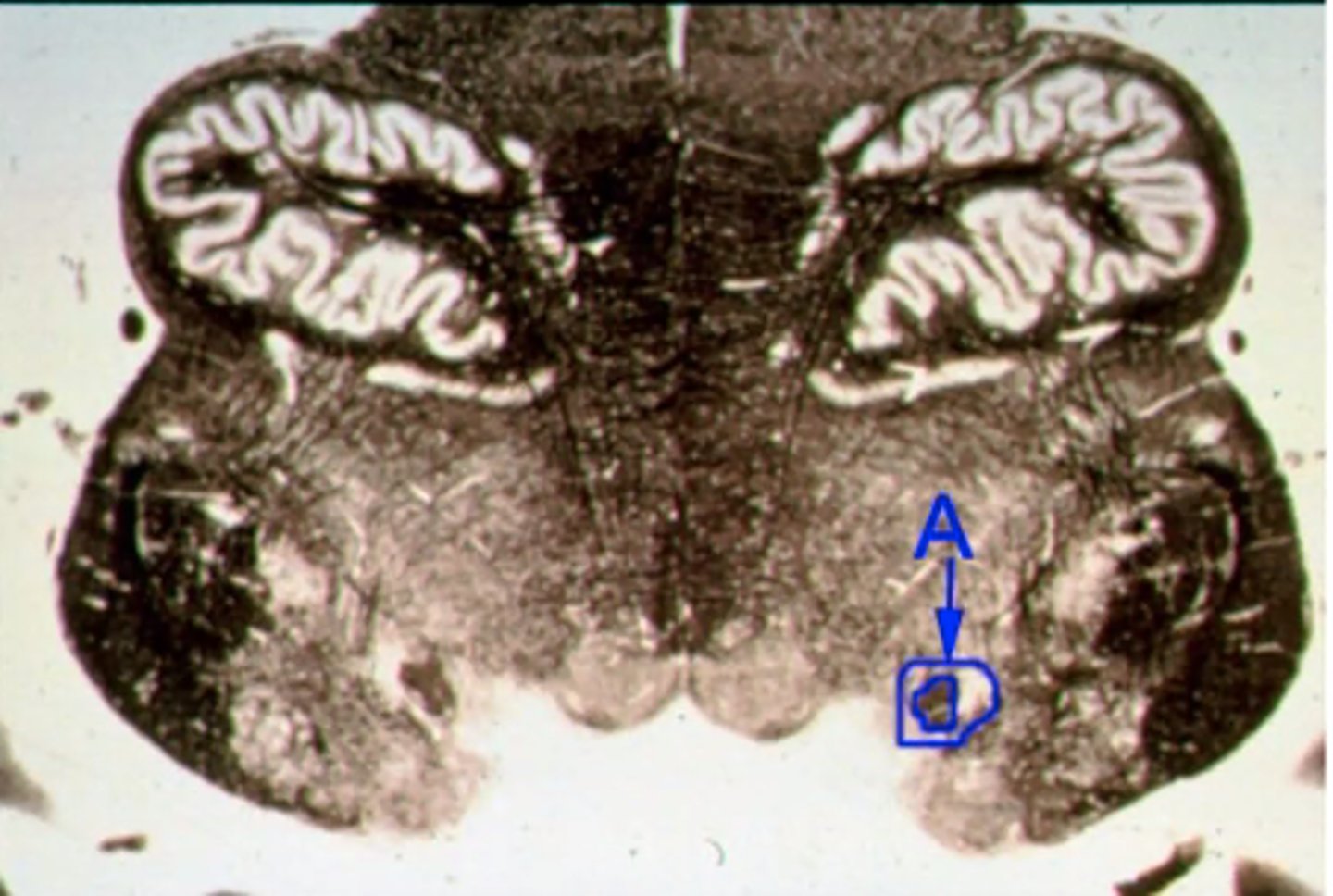
A. Receives fine touch sensation from the ipsilateral face
What is the function of structure "A"?
A. Receives fine touch sensation from the ipsilateral face
B. Receives pain & temperature sensation from the ipsilateral face
C. Contains cell bodies whose axons innervates the ipsilateral muscle of mastications
D. Contains cell bodies whose axons innervates the ipsilateral muscles of facial expression
E. Receives pain & temp from contralateral face
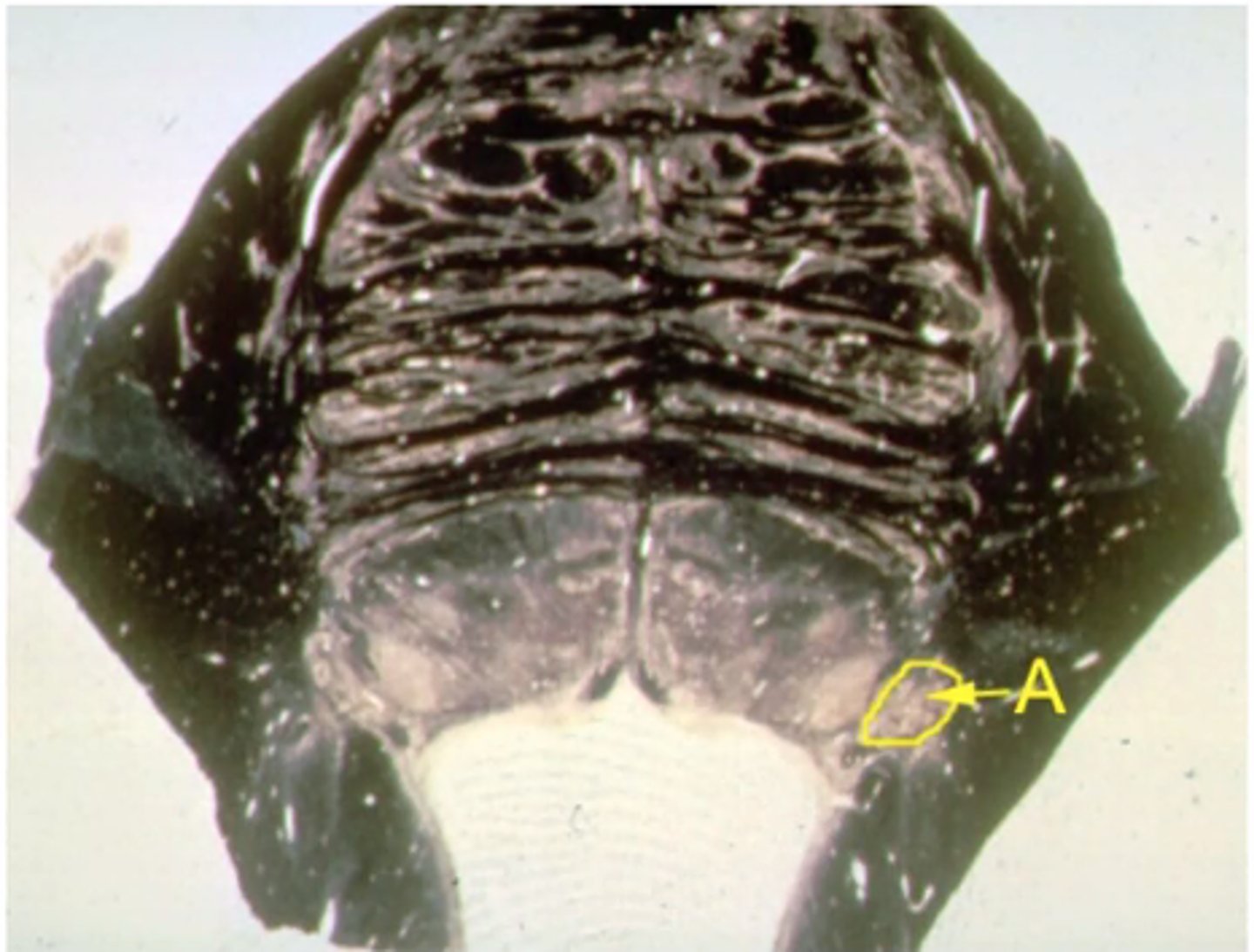
D. Ipsilateral flaccid paralysis of the facial expression muscles (Bell Palsy)
A lesion to structure "A" will result in
A. Ipsilateral dysarthria & dysphagia
B. Ipsilateral loss of parasympathetic control
C. Ipsilateral loss of pain & temp to the face
D. Ipsilateral flaccid paralysis of the facial expression muscles (Bell Palsy)
E. Ipsilateral loss of tactile sensations to the face
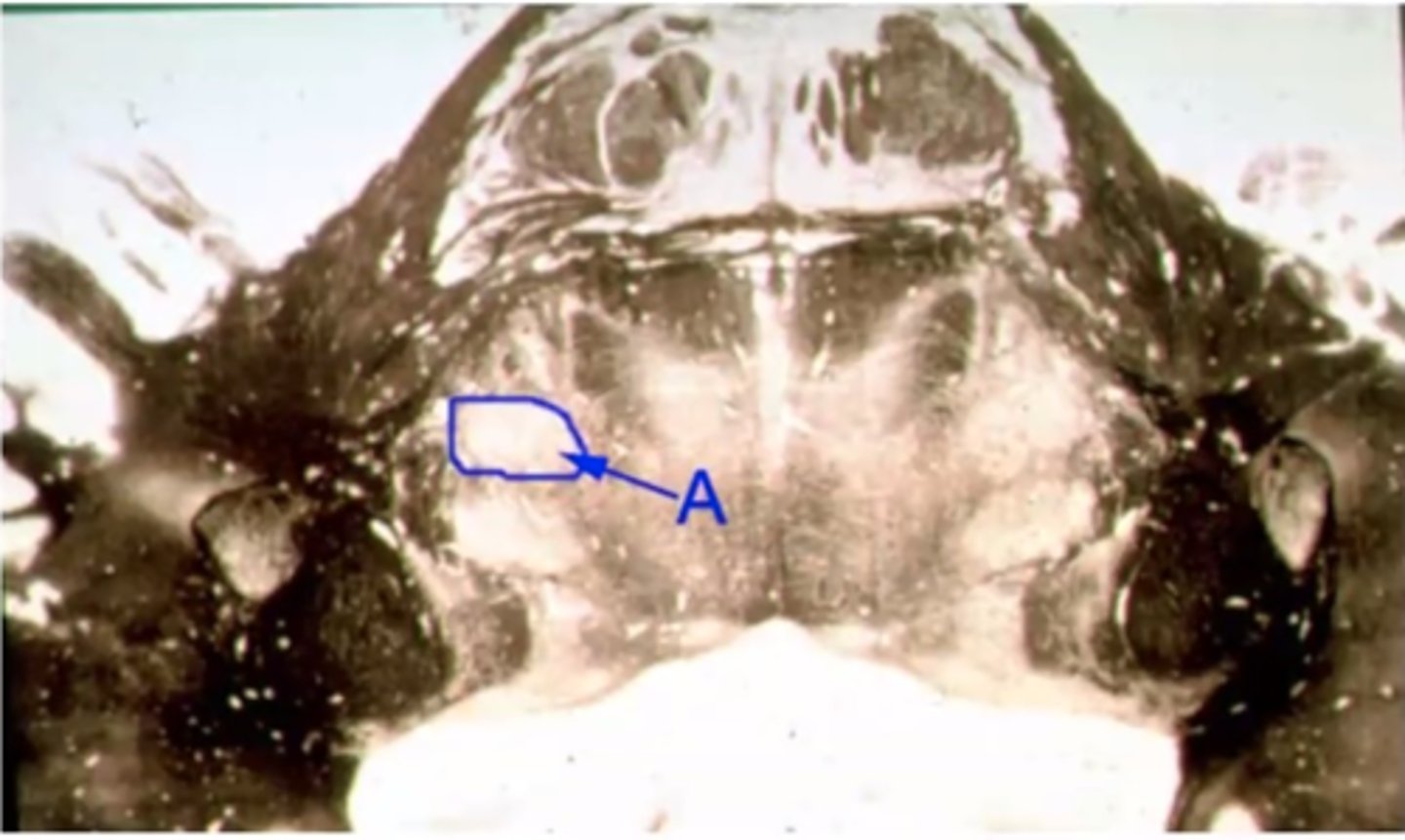
E. Innervates ipsilateral lateral rectus eye muscles
What is the function of the abducens nerve?
A. Innervates ipsilateral tongue mucles
B. Innervates ipsilateral muscles of facial expression
C. Innervates ipsilateral superior oblique eye muscles
D. Innervates ipsilateral muscles of mastication
E. Innervates ipsilateral lateral rectus eye muscles