ACCT 331- Exam 1 Concepts (short answers)
 Call Kai
 Learn
Learn Practice Test
 Spaced Repetition
 Match
Match Flashcards
 Knowt Play
1/28

There's no tags or description
Looks like no tags are added yet.
Name | Mastery | Learn | Test | Matching | Spaced | Call with Kai | Chat |
|---|
No analytics yet
Send a link to your students to track their progress
29 Terms
Outline the primary sources of law and understand the hierarchy of those sources of law
Federal Law- US constitution, federal statutes, and administrative law
State Law- state constitutions, state statutes, administrative law, and local ordinances
Case Law- appellate opinions and stare decisis
Understand stare decisis and explain why the doctrine is important
“To stand on decided cases”
Tradition of common law system
A court should not overturn its own precedents unless there is a compelling reason to do so.
Decisions made by a higher court are binding on lower courts.
Be familiar with jurisdiction (personal; subject matter; original; appellate)
Personal Jurisdiction- is the court’s authority over parties to the case – or over persons or property located in court’s boundaries'
Subject Matter Jurisdiction- is the power over the particular issues involved in the case
Original Jurisdiction- the authority of a court to hear a case before any other court
Appellate Jurisdiction- the authority of a court to review a lower court’s decisions
Analyze whether a federal court has jurisdiction through the following categories: federal question cases and
diversity of citizenship cases
Federal Question- interpretation of U.S. Constitution, federal law, or treaty; no monetary minimum for this category of cases
Diversity of Citizenship- the plaintiff and defendant are residents of different states; and the dollar amount in controversy exceeds $75,000
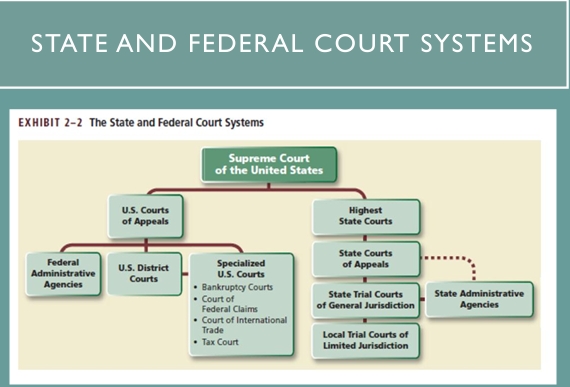
Understand the basics relating to our dual court system
Supreme Court of the US → US courts of appeals or highest state courts
Define and differentiate the three types of alternative dispute resolution
Negotiation- informal settlement talks “meeting of the minds”
Arbitration- parties select an arbitrator (a neutral third party or a panel of experts) who hears a dispute and imposes a resolution on the parties
Mediation- utilizes the services of a neutral third party, called a mediator and the mediator acts as a communicating agent between the parties and suggests ways in which the parties can resolve their dispute

Outline the basic litigation phases (pretrial; trial; posttrial) and explain what happens at each stage
Pretrial → Trial → Posttrial
Pretrial- pleadings, discovery, pretrial motions
Trial- actual trial with defendant, prosecution, and jury
Posttrial- appeal process

Identify pleadings and explain, generally, what is contained within each pleading
Complaint- Plaintiff describes the allegations; Addresses the Court’s jurisdiction; States the relief sought.
Answer- Defendant admits or denies each allegation in complaint; Contains affirmative defenses.
Counterclaims- Defendant can assert claims against the Plaintiff. Defendant describes the allegations. States the relief sought.
Define discovery and identify the various forms of discovery
Discovery- allows both parties to be fully aware of the facts involved in the case and of the intentions of the parties.
Interrogatories- series of written questions to be answered by the opposing party
Requests for Production of Documents- requests for production of specific documents
Depositions- oral questions to the witness transcribed by a court reporter
Requests for Admissions- requests for the opposing party to admit or deny certain issues
Explain the difference between the trial court and appellate court
Trial Courts- a judge or jury determines the facts of the case and reaches a verdict; “try” cases
Appellate Courts- this court reviews decisions made by a trial court when one party believes a legal error occurred; “review” cases
Define contract and outline the elements of a contract
Contract- an agreement that can be enforced in court; formed by two or more parties; with each party agreeing to perform or refrain from performing some act
Elements of a contract
Agreement- an offer and acceptance
Consideration- something of value received or promised to convince someone to make a deal
Capacity- both parties must have the contractual capacity (ex. competence) to contract
Legality- purpose of the contract must be legal and not against public policy
Understand the difference between a valid, voidable, unenforceable, and void contracts
Valid- the person had the capacity to know the legal consequences despite intoxication or mental incompetence
Voidable- the person was in a state where they lacked mental capacity to enter into the contract
Unenforceable- Lack of Voluntary Consent (consent must be voluntary) and Improper Form (the contract must be in whatever form the law requires)
Void- a court has determined a person is mentally incompetent and appointed a legal guardian
Be familiar with how a court interprets a contract and the general rules of interpretation
A court will enforce a contract according to its obvious terms when it is clear and unambiguous.
General Rules of Interpretation
A reasonable, lawful, and effective meaning will be given to all of a contract’s terms as much as possible
Contracts are interpreted as a whole
Terms that are negotiated separately are given greater weight than standardized terms
Words will be given their ordinary, commonly accepted meanings
Specific wording given greater weight than general language
Written or typewritten given greater weight than preprinted
Ambiguous terms will be interpreted against the drafter
Trade usage, prior dealing, and course of performance can be used to clarify the contract
Express terms are given the greatest weight, followed by course of performance, course of dealing, and custom and usage of trade—in that order.
Explain offer and how and when offers can be terminated
Offer- proposal made by one party (the offeror) to another party (the offeree) that shows a present intent to enter into a contract
When an offer can be terminated
by action of the parties: revocation, rejection, and counteroffer
by operation of law: lapse of time, destruction of the specific subject matter of the offer, death or incompetence of the offeror or the offeree, and supervening illegality of the proposed contract
Explain acceptance and how and when offers can be accepted
Acceptance- voluntary act by the offeree - either by words or conduct - that shows that the offeree agrees to the terms of the offer
Ways to show acceptance
Agreeing to perform as requested
Completing the requested act
Define consideration and outline the types of agreements that lack consideration
Consideration- is “the value given in return for a promise (in a bilateral contract) or in return for performance (in a unilateral contract).
Types of agreements that lack consideration
Preexisting obligation
Past consideration
Promise to make a gift
Explain contractual capacity, the groups with special protections, and what a party can do if he/she lacks capacity
Contractual capacity- parties to a contract must have the legal ability to be bound by a contract
Groups with special protections
Minors
Intoxicated persons
Mentally incompetent persons
Be familiar with examples of illegal contracts (violation of law or public policy)
Contracts that violate a law-
contract to sell illegal drugs
contract to rob a bank
Contracts that violate public policy-
contracts restraining trade
exculpatory clauses
unconscionable contract
contracts that obstruct justice
Explain various situations when a contract may lack voluntary consent
contracts that are a result of fraud, undue influence, mistake, or duress
Define the statute of frauds and outline exceptions
Statute of frauds- a statute that stipulates what types of contracts must be in writing (denies enforceability to certain contracts that do not comply with its writing requirements)
Exceptions to the statute of frauds
partial performance
full performance
admission in court
Define privity of contract and outline exceptions
Privity of contract- a principle that a contract is a private agreement between the parties that have entered into it and that the parties alone have rights and liabilities under the contract
Exceptions
assignments and delegations
third party beneficiaries
Understand the difference between assignment and delegation
Assignment- is the transfer of contractual rights to a third party
Delegation- is the transfer of contractual duties to a third party
Be familiar with the difference between intended beneficiaries and incidental beneficiaries
Intended beneficiary- a third party to whom performance is rendered directly and/or who has the right to control the details of the performance or who is designated a beneficiary in the contract (CAN SUE TO ENFORCE THE CONTRACT)
Incidental beneficiary- a third party who benefits from a contract but whose benefit was not the reason for the contract and/or who has no rights in the contract (CANNOT SUE TO ENFORCE THE CONTRACT)
Define condition and outline types of conditions
Condition- a qualification in a contract based on a possible future event
Types of conditions
condition precedent
condition subsequent
concurrent condition
express condition
implied condition
Explain and differentiate discharge by performance, discharge by agreement, and discharge by operation of law
Discharge by performance- complete performance and substantial performance
Discharge by agreement- mutual rescission, novation, settlement agreement, accord and satisfaction
Discharge by operation of law- material alteration, statute of limitations, bankruptcy, impossibility, impracticability, and frustration of purpose
Understand the differences between a material breach of contract and a minor breach of contract
Material breach- occurs when performance is not at least substantial
Minor breach- a breach that is not material
Define remedies in law and remedies in equity
Remedies in law- monetary damages
Remedies in equity- awarded when money is inadequate
Identify various forms of monetary damages
monetary damages- compensatory damages, consequential damages, and liquidated damages
Be familiar with Uniform Commercial Code (UCC) and distinctions between the UCC and common law
Uniform commercial code- the single most comprehensive codification of the broad spectrum of laws involved in a total commercial transaction
UCC- offer can be more open-ended, but quantity must be identified
Common law- offer must include all terms