Future Innovation Developments
 Call Kai
 Learn
 Practice Test
 Spaced Repetition
 Match
 Flashcards
 Knowt Play
1/42

There's no tags or description
Looks like no tags are added yet.
43 Terms
Earth and Human-Centric Innovation
Starts from the health of the planet and its ecosystems
Treats humans as part of nature, not the center of it
Starts from human needs, users and markets
Treats nature as a resource and a constraint
Sustainable innovation
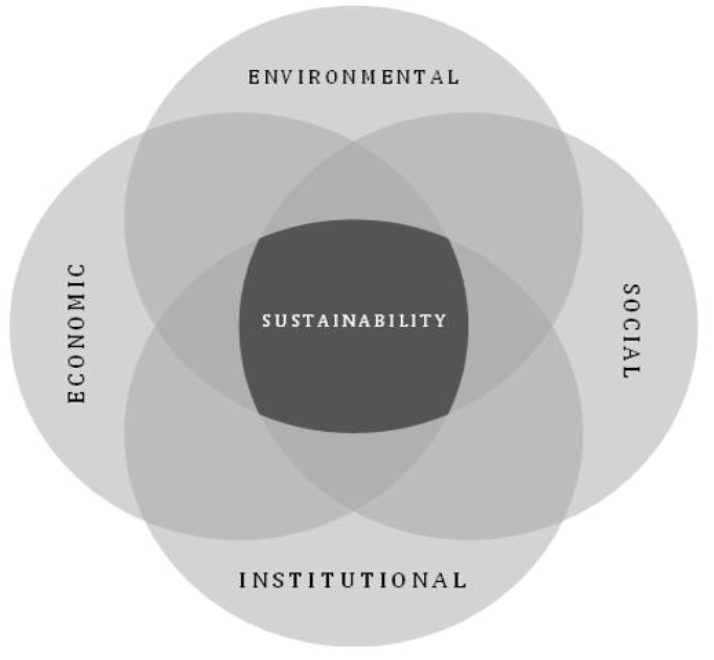
4 Sustainability pillars
Environmental protection, resource management
Social equity and community resilience
Economic viability and long-term stability
Institutional governance and policy support
Environmental and Social Sustainability
Emphasizes the protection and management of natural resources to prevent degradation
Involves reducing pollution, conserving biodiversity, and mitigating climate change through sustainable practices
Organizations adopt strategies such as life cycle analysis, renewable energy integration, and waste reduction
Focuses on equity, inclusiveness, and well-being of individuals and communities
Organizations implement programs that enhance working conditions, engage with communities, and promote ethical practices
Economic Sustainability
Emphasizes the need for long-term financial viability without depleting resources
Aims for economic growth, employment opportunities, and fair distribution of wealth
Integrating sustainability intro economic planning is necessary for stability and resilience
Institutional Sustainability
Focuses on governance, policies, and mechanisms that support sustainable development
Institutions set regulations and ensure compliance with sustainability initiatives
balanced score card

Sustainability balanced score card

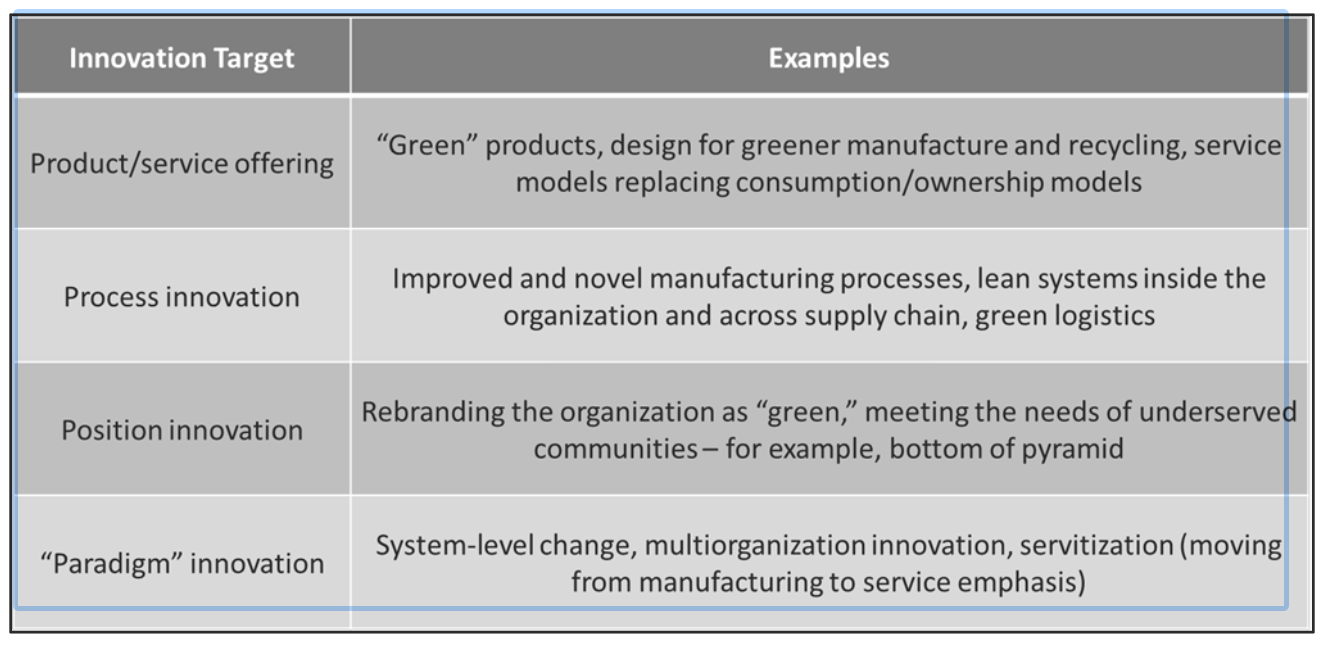
Incremental Sustainable Innovations
Small, gradual changes to existing products or processes, such as improving energy efficiency or using recycled materials. Easier to implement but may not fully address larger sustainability challenges
Radical Sustainable Innovations
Transformative changes, such as creating entirely new technologies or business models. Examples include wind turbines or electric vehicles. While they tackle systemic change, they require significant investment and face more resistance
Eco-innovation
Almost synonym of sustainable/environmental innovation.
The environmental benefit is the necessary, defining feature, and economic and social goals come along with it.
Green innovation
Sub-set of eco-innovation, focuses on specific environmental improvements in products, processes, or services. Often driven by regulatory and market demands
Regenerative innovation
Innovation that goes beyond reducing harm, aiming to actively restore and replenish natural and social systems, creating net positive impact
Sustainable Business Innovation Models
Align organizational strategies with environmental, social, and economic goals, aiming to create value for businesses, society, and the environment
Embed sustainability goals into value creation, delivery, and capture
Value proposition → Delivering value beyond economic gains. E.g., circular economy promotes resource efficiency and waste reduction
Stakeholder collaboration → Multi-stakeholder engagement is central. Fosters shared responsibility among suppliers, customers and communities
Resource optimization → Prioritizing efficient resource use and waste minimization. E.g., renewable energy adoption and recycling
Innovative practices → Emphasizing innovation strategies, such as adopting product-service systems, which reduce environmental impact, while maintaining profitability
Circular Economy
Closed loops → Materials remain within the production cycle through reuse, remanufacturing, or recycling
Open loops → Materials or by-products are transferred between industries to reduce overall resource use
Reuse → Extending product life via refillable packaging and repair systems
Remanufacture → Restoring products to near-new conditions, vital in electronics and automative sectors
Recycle → Transforming waste into raw materials to reduce dependence on virgin resources
Link with Best- HR Practices?
Recruitment and Selection ⇒ Hire for environmental values and systems thinking, employer brand attracts candidates who care, screen for willingness to work across boundaries
Training and Development ⇒ Environmental awareness and circular design skills, cross-functional training so engineers understand supply chain and end of life
Performance Management ⇒ Add environmental and social targets to appraisal, measure team and long-term outcomes, not only individual short-term output
Compensation and Rewards ⇒ Link bonuses to sustainability KPIs, recognize green ideas and green citizenship behavior, not only revenue
(Green) Branding
Has a company ever released something that killed its own best product?
Cannibalization →When a new product takes sales from its own existing products, instead of from competitors
What about sustainability?

Green washing
a deceptive marketing or public relations practice where an organization makes false, exaggerated, or unsupported claims about the environmental benefits of its products, services, or goals
Social Innovation
Creating and implementing novel ideas, products, services, or practices aimed at addressing unmet social needs - innovation for the greater good
Prioritizes social well-being over economic gain
Involves business, public and third sector organizations
Examples of applications include poverty relief, health and welfare, arts, education

Inclusive Innovation
Innovation processes that actively involve marginalized or underserved populations
Addresses the needs of those often excluded from traditional innovation systems
Is a €1,200 iPhone with excellent accessibility features inclusive innovation?
Frugal Innovation
Reducing the complexity and cost of a good and its production
Often associated with sustainability because it minimizes the use of resources (raw material, energy, fuel, water, waste, financial resources), it is more affordable, and accessible
Enables enterprises to access low-income markets in developing countries
Simplicity, creativity and agility - “Doing more with less”
Ratan Tata wanted to create a market for lower-class families who could afford two-wheelers but not a car
No radio, air conditioning, anti-lock brakes, airbags, power windows, airbags, remote locks, etc. were installed in a car
The cheapest car in the world! ($2000)
Success Competencies of Frugal Innovation
Affordability:
Simplicity
Resource of efficiency
Scalability
Durability
Accessibility
Sustainability
Cultural fit
Collaborative innovation
Adaptability

Designing a Frugal Strategy: €10 table

Responsible Innovation
Prioritizes the social, ethical, environmental and cultural impacts, along with financial ones
Anticipate, reflect, include, respond
Examples of “responsible/irresponsible” industries/products?
The general view is that organizations, governments and the public must strive to follow a process that seeks to promote opportunities for science and innovation that are socially and
environmentally desirable and undertaken in the public interest
Public and Non-profit Sector Innovation
Innovations that create public value and address societal challenges
Improving the efficiency, equity and effectiveness of public and non-profit organizations
Service-dominant innovation focusing on societal value
Complex stakeholder ecosystems and regulatory constraints
Regulatory compliance
Access to public funds, grants, and open data
Community co-creation enhances stakeholder engagement
Bureaucratic processes slow implementation speed
Resource constraints limit innovation capacity
Types of PSI
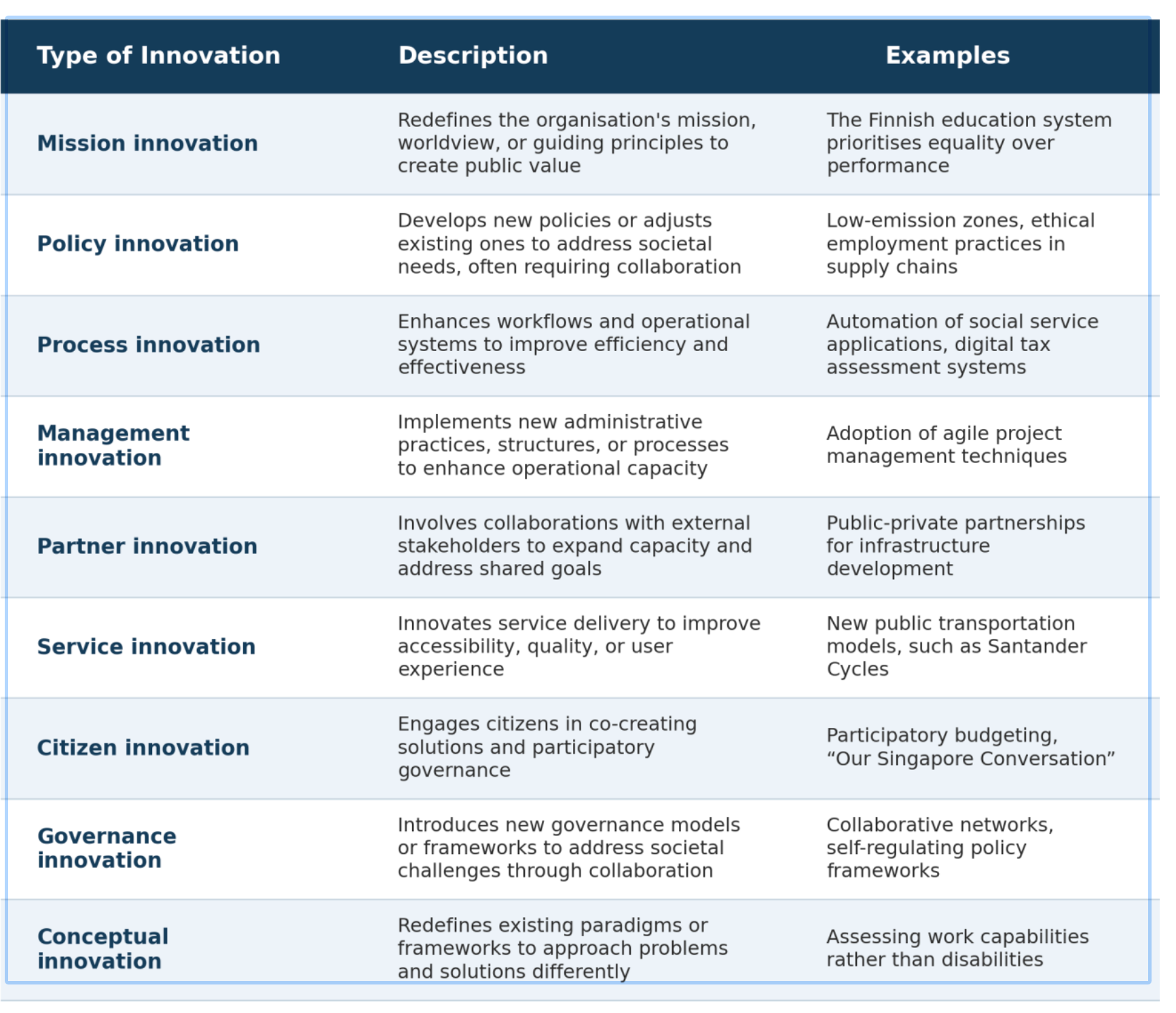
Examples of PSI

Drivers of PSI
Societal, Economic & Political Pressures
Demands for transparency and fairness
Calls for equitable services
Budget pressure drives efficiency
Regulation shapes innovation priorities
Technology & Adoption
AI platforms boost service efficiency
Perceived usefulness drives acceptance
Readiness shapes technology adoption
Globalization & Diffusion
Cross-border networks share practices
Benchmarking drives policy learning
Transnational initiatives speed uptake
Collaboration spreads best practices

Sustainable innovation
each type serves at least one pillar, not necessarily all four

The Role of Uncertainty in Innovation
Pressure compresses innovation cycle timelines
Limited data fosters creative solutions
Uncertainty increases organizational risk tolerance
Flexibility improves resource allocation efficiency
Chaos and Crisis AI-driven forecasting
Automation and robotics
Biotech and healthcare
E-commerce, digital platforms
Financial sector
Chaos in Innovation Management
A state of unpredictability where small variations in initial conditions can lead to significant and often unforeseen outcomes
Introduces long-term uncertainty, relevant to technological disruptions, economic shifts, and environmental challenges that create instability
Small changes trigger big outcomes
Systems show nonlinear complex behavior
Bifurcation points cause system shifts
Self-organization emerges amid unpredictability
Chaos in Organizational Settings
Real-world markets often exhibit volatile, nonlinear behavior, where minor disruptions can lead to significant and unexpected consequences
First actions for companies in chaos
Return to cash-generating products: Prioritizing offerings that provide reliable income
Short-term cost management: Cutting unnecessary costs and focusing on operational efficiency
Measure and adjust: Companies track financial and market conditions for further investments
Strategies for directing chaos
Balancing exploration and exploitation
Adaptive planning and scenario analysis
Simple rules for decision-making
Leveraging feedback loops for innovation
Self-organization and dynamic capability development
Investing in strategic alliances and joint ventures
Crisis in Innovation Management
Sudden disruptions that demand immediate, high-stakes action, often reshaping industries and accelerating crisis-driven innovation by compressing timelines and forcing rapid adaptation and experimentation
Features of crisis-driven innovation
Acting under extreme uncertainty and pressure
Highly improvisational
Unconventional collaborations
Fast decision-making
Strategies for managing crises
Rapid pivoting and crisis innovation
Emergency response and resilience building
Public-private collaboration
Common Barriers to Innovation
Resource constraints
Institutional rigidity
Lack of coordination and collaboration
Focus only on short-term survival
Chaos and crises as sources of innovation
Crises create urgency that bypasses traditional barriers
Chaos adopts disruptive innovation breaking down existing systems
Critical for both: the ability to reallocate resources dynamically
Chaos and crises as sources of innovation
Crises creates urgency that bypasses traditional barriers
Chaos adopts disruptive innovation breaking down existing systems
Critical for both: the ability to reallocate resources dynamically
Organizations must embed adaptive capabilities into their long-term strategies
Post crisis evaluations, knowledge-sharing platforms, and flexible governance structures

Innovation is expanding beyond profit
earth-centric approaches put planetary health at the core of strategy, not as an afterthought
Public and non-profit sector innovation creates societal value under unique constraints
regulation, bureaucracy, and complex stakeholder ecosystems
Social, inclusive, and frugal innovation each address different gaps
unmet social needs, excluded populations, and affordability (“doing more with less”)
Chaos and crisis are not only threats
they compress timelines, bypass barriers, and can trigger breakthrough innovation
Organizations should build adaptive capability before disruption hits