4.3 Population Ecology II
 Call Kai
 Learn
 Practice Test
 Spaced Repetition
 Match
 Flashcards
 Knowt Play
1/18

There's no tags or description
Looks like no tags are added yet.
19 Terms
Question 1: Imagine you are a population ecologist in the ‘outback’: what are some questions about the Cane Toad population in Australia you would want answered to effectively control their potential expansion?
A. Current population of cane toads
B. Rate of growth of cane toads
C. Range of the cane toad population
D. All of the above
D. All of the above
growth rate equation

Question 2: You are studying a population of ladybugs that are devastating potato crops in Peru. In 2015 you estimate N to be 8,762 and in 2018 the N increased to 9,140. Calculate r for this group of beetles
C. 0.014
Question 3: You are studying a population of cane toads in their native range in Central America in a small community in Costa Rica. In 2017, you estimated that there were 1,153 toads. In 2020, the population size grew to 1,232. Calculate the per capita growth rate (r).
A. 0.02
how to predict the future (?)
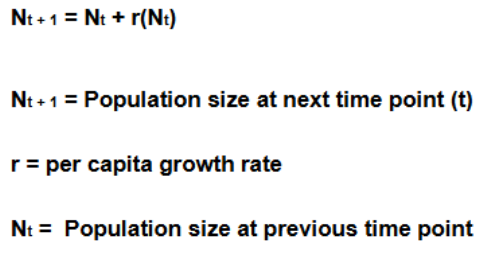
exponential growth equation

Question 4: You are studying human population growth in the state of Arizona. In 2018 the population in Arizona was estimated a 7,171,000 and grew to 7,275,000 in 2019. If this growth rate remains constant, what will be the population in 2050?
r = 104,000/7,171,000 = 0.015
Nt = 7171000 (1 + 0.015) ^32 = 11,547,635
What kind of populations would you expect to observe experiencing exponential growth?
Will the Cane toads grow exponentially forever? What might eventually limit their growth?
Question 5: Which of these factors impacting population size is independent of the density of a population?
A. Resources will become limiting and intraspecific competition will increase.
B. Risk of disease goes up as the number of individuals in the population increases.
C. A hurricane wipes out over half of a population of fish
D. All of the above
E. A and B only
C. A hurricane wipes out over half of a population of fish
Question 6: Which of these factors impacting population size is dependent of the density of a population?
A. Resources will become limiting and intraspecific competition will increase.
B. Risk of disease goes up as the number of individuals in the population increases.
C. A hurricane wipes out over half of a population of fish
D. All of the above
E. A and B only
E. A and B only
What prevents continued exponential growth?
1). Density dependent factors
o Resources becoming limited (competition)
o Disease risk increases
o Predation
2). Density independent factors
o Weather, hurricanes, floods, drought, etc…
o Catastrophic events
o Results often in instantaneous drop in population size
logistic vs exponential growth

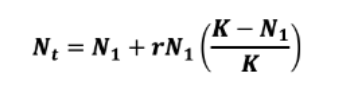
logistic growth model

Question 7: True or False? Carrying capacity is the maximum number of individuals a habitat can support.
A. True
B. False
A. True

Question 8: At what point are we at on the graph below?
Population of giraffes: N1 = 100; r = 2; K = 1000

logistic growth model rules
At first, N is much smaller than K, thus the population grows nearly exponentially.
• When N is half of K, population growth is at its highest.
• When N = K, the population no longer increases.
Question 9: If a population has a birth rate of r = 1, a carrying capacity of 1000, and currently has 600 individuals, how would you expect it to change over time?
Question 10: If a population has a birth rate of r = 1, a carrying capacity of 1000, and currently has 2000 individuals, how would you expect it to change over time?
population will shrink