Perio 15 - Professional Dental Hygiene Therapy Phase I (Dr. Levi)
 Call Kai
 Learn
 Practice Test
 Spaced Repetition
 Match
 Flashcards
 Knowt Play
1/86

There's no tags or description
Looks like no tags are added yet.
87 Terms
Phase I therapy
What phase of dental therapy is the following?
- Disease control therapy
Phase II therapy
What phase of dental therapy is the following?
- Corrective surgical therapy
Phase III therapy
What phase of dental therapy is the following?
- Corrective final restorative therapy
Phase IV therapy
What phase of dental therapy is the following?
- Professional Dental Hygiene Therapy (PDHT); Maintenance
Phase I therapy
What phase of dental therapy is the following?
- Patient plaque removal education
- Scaling and root planing
Phase I therapy
What phase of dental therapy is the following?
- Extraction of non-treatable and caries control
Phase I therapy
What phase of dental therapy is the following?
- Occlusal therapy (occlusal adjustment or an occlusal guard)
A complete examination (radiographs, periodontal chart, photos, diagnostic casts)
What is essential for treatment planning and must be periodically updated?
Always observe brushing and flossing techniques BEFORE charting
What should you do before you begin charting?
Because knowing your patient is essential for your success
Why do you want to take a comprehensive medical, dental, and social history?
B) After completing their intraoral exam (this enables them to practice before their Phase I therapy)
When can you offer patient advice about their oral habits?
A) Before completing their intraoral exam
B) After completing their intraoral exam
Diagnoses
Are all of the following diagnoses or classifications?
- Periodontal health
- Gingivitis
- Periodontitis
- Peri-implant health
- Peri-implant mucositis
- Peri-implantitis
Classifications
Are all of the following diagnoses or classifications?
- Pristine periodontal health
- Clinical periodontal health
- Stages I-IV periodontitis
- Grades A, B, C periodontitis
Emergency therapy (pain, infection)
What is the first step in the initial treatment sequence after an examination?
Phase I
What phase begins with Plaque Control Instruction review and Scaling and Root Planing?
- Plaque Control Instruction Review
- Scaling and Root Planing
Disease Control Therapy includes what two components?
- Emergency Therapy
- Medical Consultations
- Dental Consultations
- Disease Control Therapy
- Periodontal Re-evaluation
- Restorative Therapy
What is the correct order of the following treatments?
- Medical Consultations
- Restorative Therapy
- Emergency Therapy
- Dental Consultations
- Periodontal Re-evaluation
- Disease Control Therapy
Toxins from bacterial plaque
What is the primary etiological risk factor?
It contains toxins from bacterial plaque
Why does calculus contribute to periodontal disease?
Etiological risk factors
What are the following in relation to plaque?
- Systemic diseases or conditions (Lowers the immune system).
- Dental factors that cause plaque retention or the inability to remove dental plaque (malposed teeth, anatomical issues, open contacts, grooves, enamel projections, open contacts, etc)
Scrubbing brushing techniques
What is an example of physical trauma as a risk factor?
Parafunctional habits such as clenching or bruxism
What is an example of occlusal trauma as a risk factor?
Phase I therapy
What phase of dental therapy is the following?
- Plaque Control Instruction
- Scaling
- Root Planing
- Stain and biofilm removal
Phase I therapy
What phase of dental therapy is the following?
- Caries Control (Provisional restorations)
Phase I therapy
What phase of dental therapy is the following?
- Exodontia as needed (May include ridge preservation)
Phase I therapy
What phase of dental therapy is the following?
- Occlusal Adjustment
Phase I therapy
What phase of dental therapy is the following?
- Re-evaluation 6-8 (or more) weeks following initiation of therapy
Chemical therapy (antiseptics, antibiotics)
In addition to scaling and root planning, what therapy might also be indicated?
Sickle scaler
ID the type of periodontal instrument:

Universal curette
ID the type of periodontal instrument:

Gracey curette
ID the type of periodontal instrument:

NO!
Are scalers used subgingivally?
Scaling and root planing and may be used supra and subgingivally
What are curettes used for?
Scaler
ID the type of periodontal instrument:
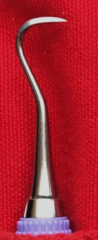
Universal Curette
ID the type of periodontal instrument:

Gracey curette
ID the type of periodontal instrument:

Gracey curette
ID the type of periodontal instrument:

Gracey curette
ID the type of periodontal instrument:

Hand scaler
What periodontal instrument is used supragingivally?
Hand scaler
What periodontal instrument is good for heavy calculus deposits and particularly useful just under contact areas because the blade is triangular in cross section and tapers to a sharp point?
H 6/7
What is a curved sickle hand scaler?
34/35
What is a straight sickle hand scaler?
Shank
ID the part of the blade at 1:

Face
ID the part of the blade at 2:
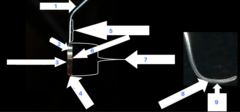
Lateral edge
ID the part of the blade at 3 and 6:

Tip or toe
ID the part of the blade at 4:

Terminal (end) shank
ID the part of the blade at 5:
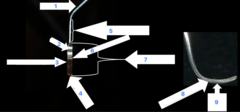
Blade
ID the part of the blade at 7:
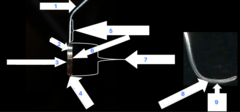
Lateral surface
ID the part of the blade at 8:

Back of blade
ID the part of the blade at 9:

70°
What is the correct angle of the face of the blade to the tooth for efficient scaling or root planing?
Scaling
Define the following:
Instrumentation of the tooth surfaces exposed to the oral environment to remove accumulated plaque, calculus and stains
Scaling
What is being shown in this image?

Subgingivally
Root planning is done ONLY ____________ with curettes
Root planning
Define the following:
A treatment procedure designed to remove cementum or surface dentin that is rough, impregnated with calculus, or contaminated with microorganisms and bacterial toxins (waste products).
Scaling and root planing
The following are objectives of what?
- Remove calculus, plaque and stain from the tooth surfaces.
- Achieve a smooth root surface to facilitate the patient's plaque removal.
- Remove cementum exposed to oral bacteria and oral fluids.
- Ensure that the patient is comfortable using local anesthesia.
True
T/F: When a patients presents with pockets of ≥ 5mm, and moderate to heavy calculus deposits and rough root surfaces, rarely can complete scaling and root planing be accomplished in a single visit
During active or maintenance therapy for patients with present or past periodontitis.
When is root planning done?
Root planning
What removes subgingival plaque, calculus, and cementum to assure smooth subgingival root surfaces regardless of the probing depths?
- To achieve a very smooth root surface removing the coronal cementum, 16-60 microns thick, about the thickness of a hair and apical cementum is 150-200 microns thick.
- Since Sharpey's fibers have vacated, there is a rough root surface now exposed to oral bacteria.
Why do we root plane?
Root planning
What is being shown in this image?

True
T/F: Hand curettes are designed to be used both supragingivally and subgingivally
Scaler
Does a scaler or curette have a pointed tip?
Curette
Does a scaler or curette have a rounded tip?
Scaler
Is this a scaler or curette?

Curette
Is this a scaler or curette?

Younger-good 7/8
What universal curette has the following characteristics?
- Can be adapted to most tooth surfaces
- Useful for gingival curettage
Three - two lateral edges and the toe
How many cutting surfaces do universal curettes have? What are they?
- Vertical stroke
- Oblique stroke
- Horizontal stroke (toe oriented apically)
When doing subgingival scaling and root planing, what strokes should be employed?
Vertical stroke
What type of stroke is shown?

Oblique stroke
What type of stroke is shown?

Horizontal stroke (toe oriented apically)
What type of stroke is shown?
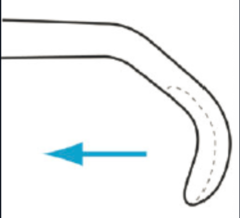
Two - one lateral edge and the toe
How many cutting surfaces does the Gracey curettes have? What are they?
Hold the instrument vertically with the toe pointing towards you
How can you determine the cutting edge of the Gracey Curette?
The cutting edge slopes towards the floor
When the terminal shank of any Gracey curette is held perpendicular to the floor, how does the cutting edge appear?
70°
When the TERMINAL SHANK of any Gracey curette is maintained parallel to the tooth surface that is being scaled or root planed using any stroke (vertical, oblique, horizontal), then the blade will always be ______° to the tooth.
Parallel
Any Gracey may be used to scale or root plane any surface of any tooth as long as the terminal shank can be maintained ___________ to the tooth surface being treated
90°
The face of a universal curette is positioned at what angle to the terminal shank?
110°
The face of a Gracey curette is offset at what angle to the terminal shank?
D. Offset to form a cutting edge that is lower
Compared to a universal curette, the Gracey curette's face is:
A. Parallel to the shank
B. Perpendicular to the shank
C. Tilted away from the lower shank
D. Offset to form a cutting edge that is lower
Gauze
If you do not have an assistant while doing an SRP, what can help with blood control?
1. Dampen it and roll it tight like a cotton roll.
2. Place it in the vestibule facial and lingual of the mandible and facial of the maxilla.
3. Wipe your instrument blade.
4. Blot blood from gingival margin.
5. Provides a dry and comfortable non-skid finger rest.
6. Helps to keep tongue away from work area.
7. Retracts lip and cheek.
8. Provides access and more visibility.
How do you use a 2x2 gauze with hand scaling or root planning?
It must be done prior to using an instrument and when the instrument becomes dull during use
Hand instrumentation sharpening is vastly important! When must sharpening be done?
- Much more precise in cutting
- Less pressure against the tooth
- Good control of the instrument with optimum tactile sensitivity
- Less chance of the instrument slipping
- Less operator fatigue and frustration
Why must hand instrument sharpening must be done BEFORE every procedure?
True
T/F: The combination of ultrasonics and hand instrumentation is more effective than either technique alone.
1. Assess (Observe plaque control techniques, periodontal probing, calculus detection)
2. Disclose for instruction (Visualize supragingival plaque)
3. Motivate and educate: (Teach by explaining why)
4. Therapy:
4. Airflow® Supragingival
5. Perioflow® Subgingival
6. Ultrasonic scale PIEZON® PS tip
6. Hand instrumentation
7. Evaluate
8. Recall (Maintenance)
What is an excellent sequence for your PDHT?
False (it CAN be predictably achieved and maintained)
T/F: Dental health cannot be predictably achieved and maintained by the patient's daily hygiene therapy and regular professional dental hygiene therapy visits