Buhler patho
 Call Kai
 Learn
 Practice Test
 Spaced Repetition
 Match
 Flashcards
 Knowt Play
1/18

There's no tags or description
Looks like no tags are added yet.
19 Terms
NT: Dopamine
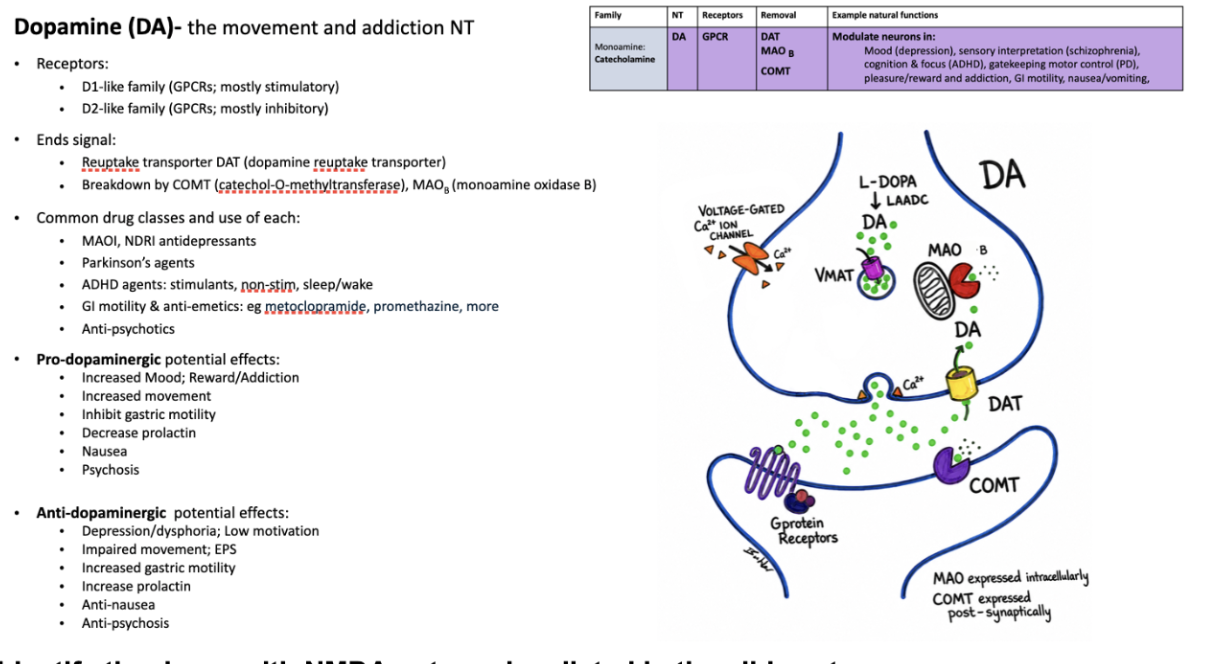
Recognize the molecular targets at the DA synapse and predict the synaptic effects of drugs that may impact each of these targets.

Correctly recognize the symptoms of PD.

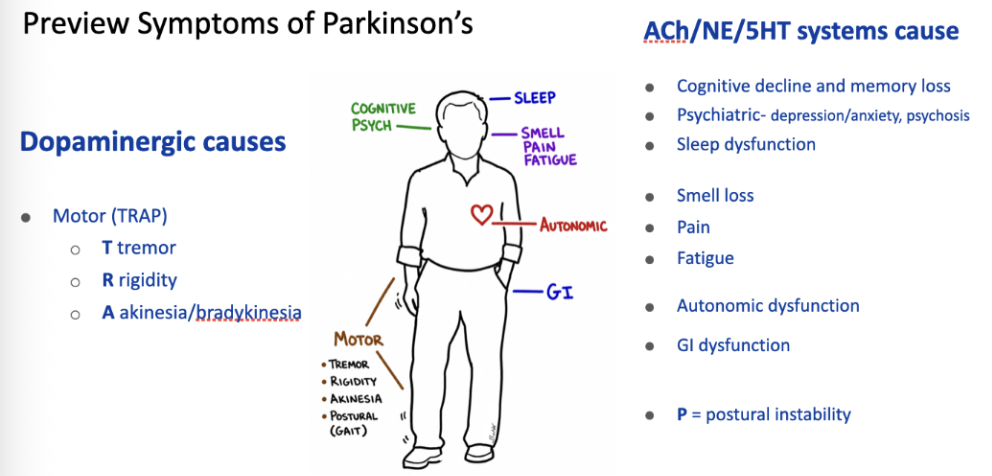
Correctly describe the change in dopaminergic neurons and DA levels in the motor pathway in PD.
Parkinson’s Neurodegeneration
Parkinson’s is a disease or neurodegeneration
There is a physical damage to and loss of brain tissue
No treatment for degeneration
Symptomatic treatment only
Dopaminergic motor pathways are our focus
SCAN theory: non-motor symptoms occur because a network links motor, cognitive, and ANS!

Don’t need to know in detail:
Molecular Pathophysiology
Defining feature of PD: intracellular Lewy body formation
Lewy bodies: deposits of misfolded alpha-synuclein and cell debris
What is alpha-synuclein?
Involved in docking and recycling vesicles
Regulates NT release
Aggregated misfolded a-synuclein is neurotoxic
Multiple mechanisms of toxicity:
Synaptic dysfunction - clustering of vesicles
Membrane disruption
Calcium dysregulation
Oxidative stress and mitochondrial toxicity
Defective protein degradation and clearance
Models of Parkinson’s disease
1st step: misfolding
GI bacteria, mitochondrial dysfunction, neuroinflammation
2nd step: spread-Prion like spread
Gut-to-brain model: bacterial misfolding; transmission via vagal nerve
Brain-first model: begins in olfactory
Cause for misfolding/spread varies by person
Patho of PD and AD

Explain the circuitry and effect of the Glutamate and DA/ACh&Adenosine balance on the target neuron in the striatum.
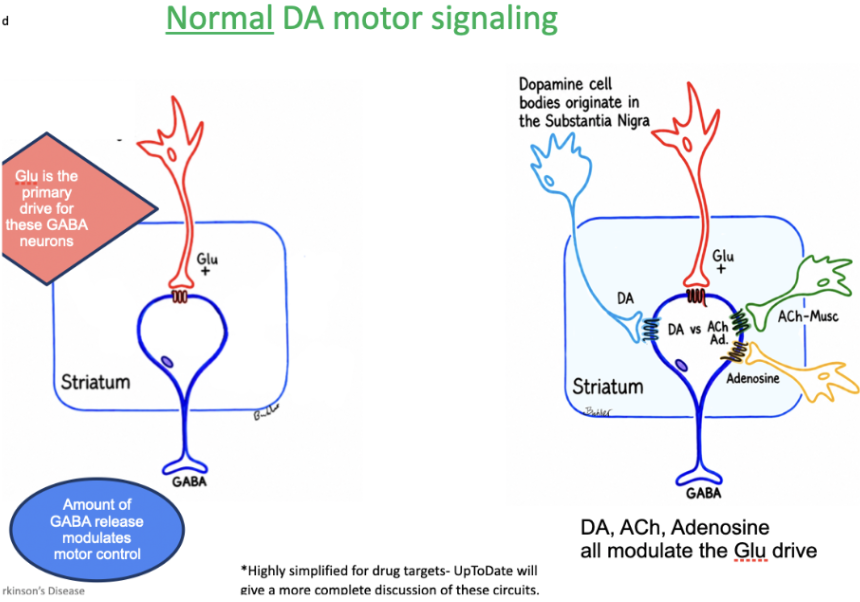

Normal: Healthy brain’s basal ganglia
In the stratum:
Target neurons are activated by glutamatergic inputs
Output is modulated by balance of:
Dopamine receptors (focus on D2)
Muscarinic + Adenosine receptors
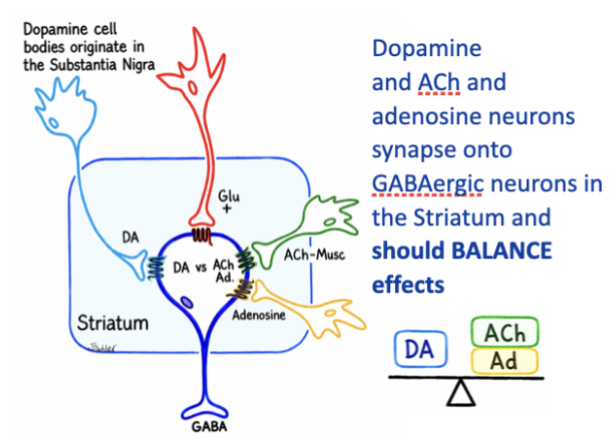

Disease: Death of Dopamine neurons
Movement symptoms result from death of dopaminergic neurons within the basal ganglia
Death of the substantia nigra cell bodies decreases release of DA in the stratum

How to rebalance NTs?
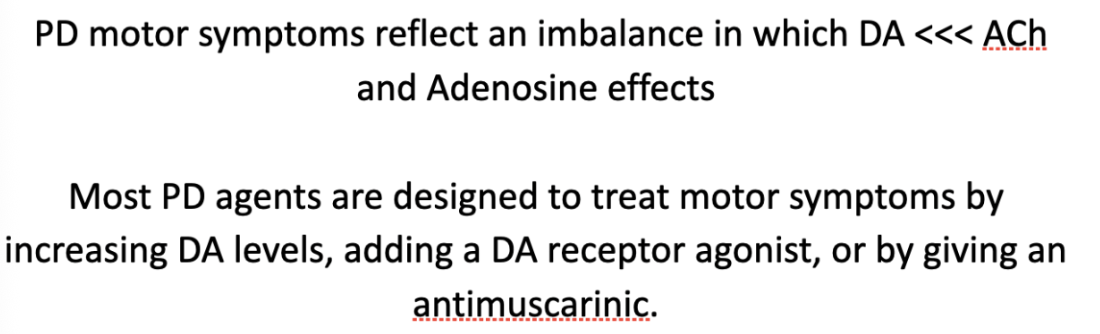
Increase DA signaling
Decrease cholinergic or Ad signaling agents.
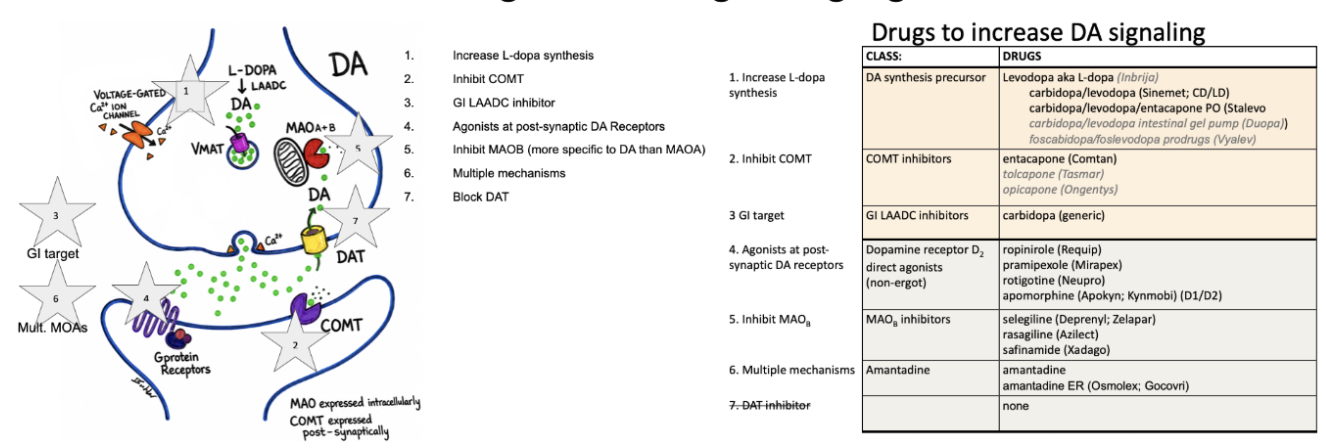
prodopinergic ade

Correctly describe the clinical barriers involving metabolism and kinetics of L-DOPA when given alone, and explain in detail how COMT inhibitors and LAADC inhibitors mitigate these difficulties.
Why can’t we just give dopamine? → Dopamine cannot cross BBB well
Why can we use L-DOPA? → Crosses BBB
But, PO L-DOPA:
DA extensively metabolized in GI
Short DOA when given alone
Lots of ADEs
PO L-dopa and dopamine synthesis
Encounters peripheral COMT + LAADC
GI ADEs 1-2% PO dose crosses BBB
Taken up by live neurons
Converted to DA within neurons by LAADC
DA released

LAADC inhibitor Carbidopa is given with L-dopa because it:
Inhibits peripheral conversion of L-dopa to DA
Reduces nausea and vomiting by reducing DA production in GI
Decreases oral dose of L-dopa needed
Important that it not cross BBB
L-dopa
Goal: increase synaptic DA levels
Class MOA:
precursor for DA synthesis
increases synaptic DA release at EVERY DA synapse globally!
Boosts function of the basal ganglia motor control pathway
Agents: Levodopa (aka L-dopa)
L-dopa + LAADC inhibitor
Carbi dopa→ inhibits decarboxylase for L-dopa
MOA:
Inhibits LAADC in gut & blood, blocks peripheral L-dopa -> DA
Increases L-dopa in brain, increases synaptic DA levels in striatum
Boosts function of the basal ganglia motor control pathway
Agents:
carbidopa/levodopa (Sinemet; CD/LD)
carbidopa/levodopa/entacapone PO (Stalevo)
COMT inhibitors
MOA:
Inhibits COMT in gut and blood, blocks L-dopa -> peripheral breakdown products
Increases L-dopa in brain, increases synaptic DA levels in striatum
Boosts function of the basal ganglia motor control pathway
Agents:
carbidopa/levodopa/entacapone (Stalevo)
entacapone (Comtan)

DA receptor direct agonist
MOA:
DA receptor agonists (D2-like + other subtypes)
Directly increases DA receptor activation
Boosts function of the basal ganglia motor control pathway
Agents:
ropinirole (Requip)
rotigotine (Neupro)
pramipexole (Mirapex)
apomorphine (Apokyn; Kynmobi) (*D1/D2 non-selective)
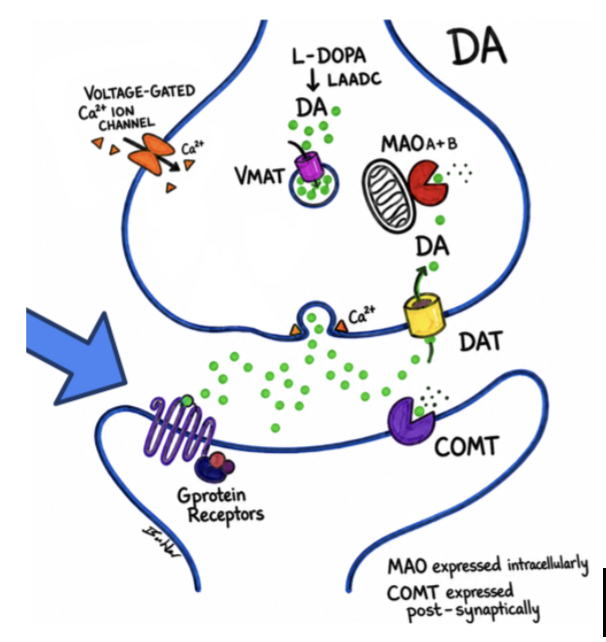
MAO-B inhibitors
MOA:
irreversible inhibitor of MAO-B (low-dose selective for MAO-B)
blocks breakdown, increases DA within synapse
Boosts function of the basal ganglia motor control pathway
Agents:
selegiline (Deprenyl; Zelapar)
rasagiline (Azilect)
safinamide (Xadago)

NMDA antagonist
Class: Amantadine (anktidyskinetic)
Class Dual MOAs:
MOA 1. Multiple mechanisms to increase DA activity
DA effect treats motor symptoms
MOA 2. Glu NMDA receptor antagonist (favors overactive channels)
NMDA effect decreases l-dopa dyskinesias
Agents:
Amantadine
Amantadine ER (Gocovri; Osmolex)
Identify the drugs with NMDA antagonism listed in the slide set
NMDA receptor mediated effects (Glutamate)
Glu inputs drive this pathway
Local alpha-synuclein increases Glu function and increases NMDA-induced excitotoxicity
NMDA antagonists help regulate responses
Drugs with NMDA antagonism
Memantine
Amantadine
Dextromethorphan
Ketamine
Methadone

Antimuscarinic drugs
MOAs:
Muscarinic receptor antagonists
Counterbalances loss of DA inputs to GABA neurons
Boosts function of the basal ganglia motor control pathway
Agents:
Benztropine (Cogentin)
Trihexyphenidyl (Artane)
Points of interest:
Bypasses DA circuits! Does NOT affect DA levels here
Know your antimuscarinic profile! DRY
Adenosine A2A antagonist
This region also has important adenosine inputs
MOAs:
Adenosine receptor A2A antagonist
Counterbalances loss of DA inputs to GABA neurons
Boosts function of the basal ganglia motor control pathway
Agent:
istradefylline (Nourianz)
Point of interest:
Bypasses DA circuits! Does NOT affect DA levels here
Caffeine and theophylline are adenosine antagonists!