ch 16 ais the production cycle
 Call Kai
 Learn
 Practice Test
 Spaced Repetition
 Match
 Flashcards
 Knowt Play
1/23

There's no tags or description
Looks like no tags are added yet.
24 Terms
production cycle activities
product design
planning and scheduling
production operations
cost accounting
inaccurate or invalid master data
Human error during data entry,
inconsistencies across departments,
software malfunctions, unauthorized
changes, or ineffective data migration
and integration practices
impacts
If data about factory operations are incorrect,
products may be costed incorrectly, and inventory
may be misvalued
• Errors in inventory records may result in failure to
timely manufacture finished goods (understock) or
unnecessary production (overstock)
• Errors in product specifications (bills of materials
and operations lists) can result in poorly designed
products.
general threat to production cycle
unauthorized disclosure of sensitive information
Cyber-attacks like hacking, insider
misuse of access privileges, device
theft, or insufficient data security
measures
impacts
Leak of trade secrets and process
improvements that provide a
competitive advantage
general threat to production cycle
loss or destruction of data
Hardware failure, software issues,
human error, or cyber-attacks
Only interrupt the functioning of
information systems, but also disrupt
manufacturing activities
controls for inaccurate or invalid master data
Data validation and verification with
processing integrity controls
• Restriction of access to master data
• Maintain and review logs of changes
to master data
ex.,
the system may reject any attempts to
alter inventory records from a
terminal located in the engineering
department
• Role-based access controls (RBAC)
that limit user access based on job
function, coupled with strong
authentication mechanisms.
unauthorized disclosure of sensitive information controls
Access Controls
• Encryption
• Tokenization (Masking)
• Employee Training and Awareness Programs
• Data Governance Policies
ex.,
precise procedures for manufacturing
a particular product, should be
encrypted both while in storage and
during transmission to manufacturing
plants and business partners
loss or destruction of data
Regular Backups
• Disaster Recovery Plan
• Access Controls
ex.,
Additional copies of critical master
files, such as open production orders
and raw materials inventory, should
be stored off-site
product design
determine what to manufacture and what materials, labor, and processes are required
main objective is to create a product that satisfies customer demands regarding quality, durability, and functionality, while also minimizing production costs
bill of materials
operations list
poor product design resulting in excess costs
threats and controls to product design
analysis of costs arising from product design choices
analysis of warranty and repair costs
ex.,
Using too many unique components
when producing similar products
results in higher costs for purchasing
and maintaining raw materials
inventories
• Leverage data from the revenue cycle
to identify the primary causes of
product failure and suggest
opportunities for product redesign to
improve quality and lower warranty
costs
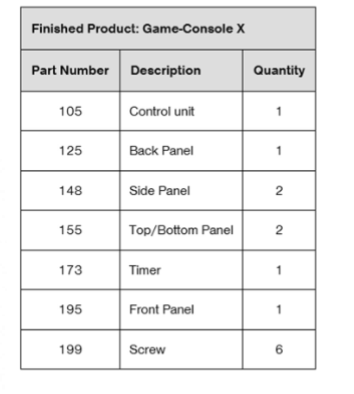
bill of materials
outlines the part number description, and qty of each component required to produce a finished product
operations list
Details the step-by-
step sequence to be
followed in the
manufacturing
process, the necessary
equipment, and the
time required for each
step

planning and scheduling
Determine how much to produce, when to
produce it, and what resources are needed
• Main objective is to develop an efficient
production plan to meet existing orders and
anticipated short-term demand while minimizing
inventories of both raw materials and finished
goods
docs: master production schedule, production order, materials requisition, move tickets
over and underproduction
threats and controls to planning and scheduling
Production planning systems
• Review and approval of
production schedules and
orders
• Restriction of access to
production orders and
production schedules
master production schedule
The production planning
department utilizes
information about sales
forecasts and customer
orders, along with data
on current inventory
levels, to create the
Master Production
Schedule (MPS) and
authorize the production
of specific goods
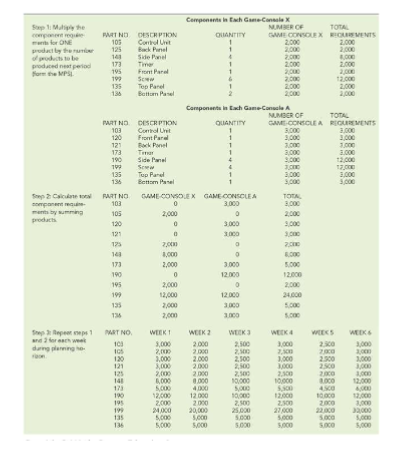
documents in planning and scheduling

exploding the bill of materials
to determine the
immediate raw materials
requirements to meet the
production goals listed in
the MPS
• This helps determine raw
materials purchases need,
and Purchase Requisitions
(Ch. 15) are thus forwarded
to the purchasing
department
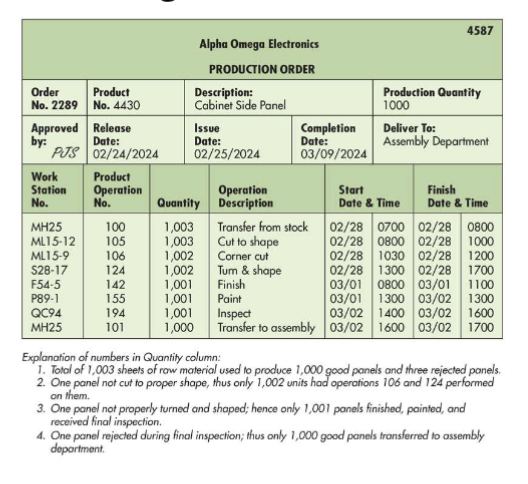
production order
Authorizes the manufacture of a
specific quantity of a particular
product.
• It lists the required operations,
production quantities, and the
delivery location for the finished
product.
• It collects data on each of these
activities
docs in planning and scheduling
materials requisition
authorizes the removal of
the necessary quantity of
raw materials from the
storeroom to the factory
location where they will
be used.
• Contains the production
order number, date of
issue, and, based on the
Bill of Materials, the part
numbers and quantities of
all necessary raw materials
requesting of materials → factory (vs purchase requisition is asking that they buy the materials)

move ticket
Transfers of raw
materials
throughout the
factory are
documented on
move tickets, which
identify the parts
being transferred,
the destination
location, and the
time of transfer

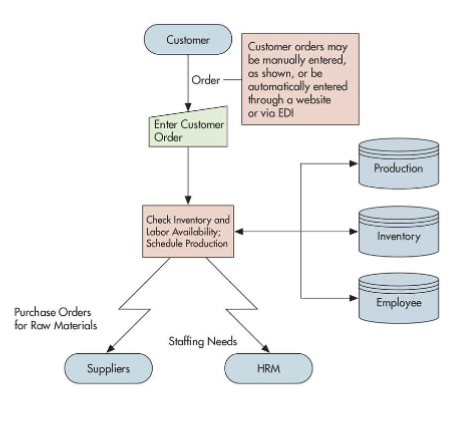
production cycle info integration
Accurate production planning
requires integrating information
about customer orders (from the
Revenue cycle) with information
about purchases from suppliers
(from the Expenditure cycle),
along with information about
labor availability (from the
HR/payroll cycle).
production operations
issue materials, use labor and equipment, and manufacture FG