[ECE21118] M1-M3 (before Practical Message Signal)
 Call Kai
 Learn
 Practice Test
 Spaced Repetition
 Match
 Flashcards
 Knowt Play
1/161

There's no tags or description
Looks like no tags are added yet.
162 Terms
Communication
process of exchanging information
Language
Distance - strength of signal is inversely proportional to square of distance
What are the two main barriers of human communications?
Electronic Communication
increased our ability to share information like the telephone (wired), radio (wireless)
process of transmission and reception of information through electronic devices
1837 (patented 1844)
When did Samuel Finley Breeze Morse make the Telegraph (morse code)?
1847
When did James Clerk Maxwell postulate the Electromagnetic Radiation Theory?
1864
When did James Clerk Maxwell establish Electromagnetism
Theory of Radio (Electromagnetism)
held the rapidly oscillating electromagnetic waves exist and travel at through space with the speed of light
1876
When did Alexander Graham Bell and Thomas A. Watson make the Telephone? (commercial use)
1882
When did Nikola Tesla outline basic principles of radio transmission & reception?
1887
When did Heinrich Hertz detect EM waves with oscillating circuit and establishes the existence of radio waves?
1895
When did Marchese Guglielmo Marconi discover ground-wave radio signals? (used in AM broadcasting and military)
1901
When did Reginald A. Fessenden transmit the world’s first radio broadcast, and Marconi transmit the first successful transatlantic transmission of radio signals (England to Newfoundland)?
1906
When did Reginald Fessenden invent Amplitude Modulation, Lee De Forest make the triode, and Ernst F.W. Alexanderson invent the Tuned Radio Frequency Receiver (1 channel)?
1918
When did Edwin H. Armstrong invent the Superheterodyne Receiver?
1931
When did Edwin Armstrong invent the Frequency Modulation?
1945
When did Arthur C. Clarke propose the use of satellites for long distance radio transmissions?
Moon
the first passive satellite that does not use power
Sputnik 1
the first active satellite
1946
When did AT&T introduce the first mobile telephone system?
1951
When did the first transcontinental microwave system began?
1957
When was the Troposcatter Radio Link established by Florida and Cuba, and Sputnik 1 was launched by Russia?
1967
When did K.C. Kao and G.A. Bockam propose cladded fiber cables (fiber optic cable) as new transmission medium?
Fiber Optics
refers to technology that uses light for communications
1983
When was Cellular Telephone networks introduced? (Group Special Mobile)
Telegraph
forerunner in digital communications, short sequences are frequent letters
1904
When did John Ambrose Fleming invent the vacuum-tube diode?
1948
When did Walter H. Brattain, John Bardeen, and William Shockley make the transistor?
1958
When did Robert Noyce produce the first silicon integrated circuit?
Jack Kilby
Who made the integrated circuit?
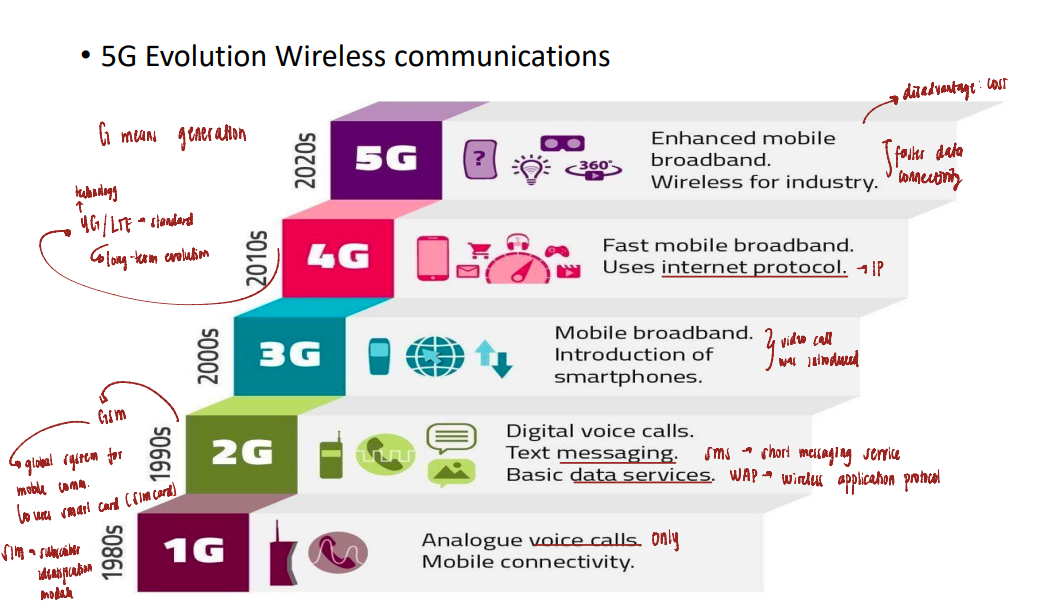
What are the 5G Evolution of Wireless Communications?
Message
referred to as information or an intelligence signal (In electronic communication systems)

Analog Signals
time-varying and continuously changing voltages/currents
Digital Signals
voltages/currents that change in discrete steps
originate in digital form but converted to analog to match transmission medium
A/D → sampling → quantizing → coding to be used by computers and digital circuits
Converting to Electronic Form
first step in sending a message
Transducers
device that converts energy from one form to another
to covert physical characteristics into electrical signals (voice messages, television, computer systems)
Transmitter (Tx)
collection of electronic components and circuits to convert electrical signal to signal suitable for transmission over medium
made up of oscillators, amplifiers, modems, etc.
Communication Channel
medium by which electronic signal is sent from one place to another (interface between Tx (transmitter) and Rx (receiver)
Guided Channel (Wireline Channel)
communication channel that uses wire conductors, fiber optic cable, or waveguides (carries EM wave)
bounded medium
Unguided Channel (Wireless Channel)
communication channel when signals are transmitted over free space
unbounded medium, signals may take different paths
Electronic Conductors
wireline channel that use coaxial cables, twisted-pair cables used in LAN
Optical Media
wireline channel that uses fiber-optic cables that carries message on a light wave
Radio
a wireless channel that uses free space
Acoustic
wireless channel used in underwater communication
Optical
wireless channel seen through infrared such as a remote control
Receiver (Rx)
accepts transmitted message from channel and converts it back to a form understandable by humans/machines
main objective is to retrieve the transmitted signal

Noise
unwanted signals, distrubs the quality of received signal in a communication system.

Simplex
simplest method of electronic communication
one way (AM/FM radio and TV broadcasting, beeper sa jollibee)
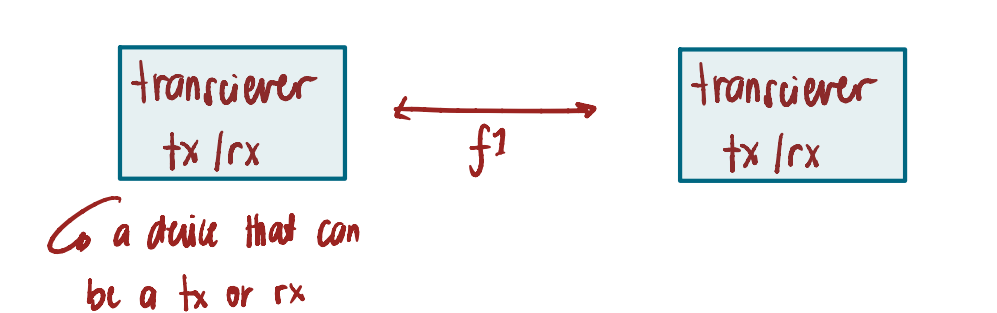
Half Duplex
form of two-way communication, only one part transmits at a time
examples are police/military radio transmissions, citizen bands, amateur radio

Full Duplex
form of two-way communication, can talk and listen simultaneously both directions
ex: telephone, internet, cellular mobile
Baseband Signals
refers to original unmodified information signal (DO NOT MODULATE)
Modulated Signals
to transmit baseband signals by radio, modulation techniques must be used first
can also be used by wired communication
Radio-Frequency Wave / Radio Wave
electromagnetic signal that’s able to travel long distances through space
Modulation
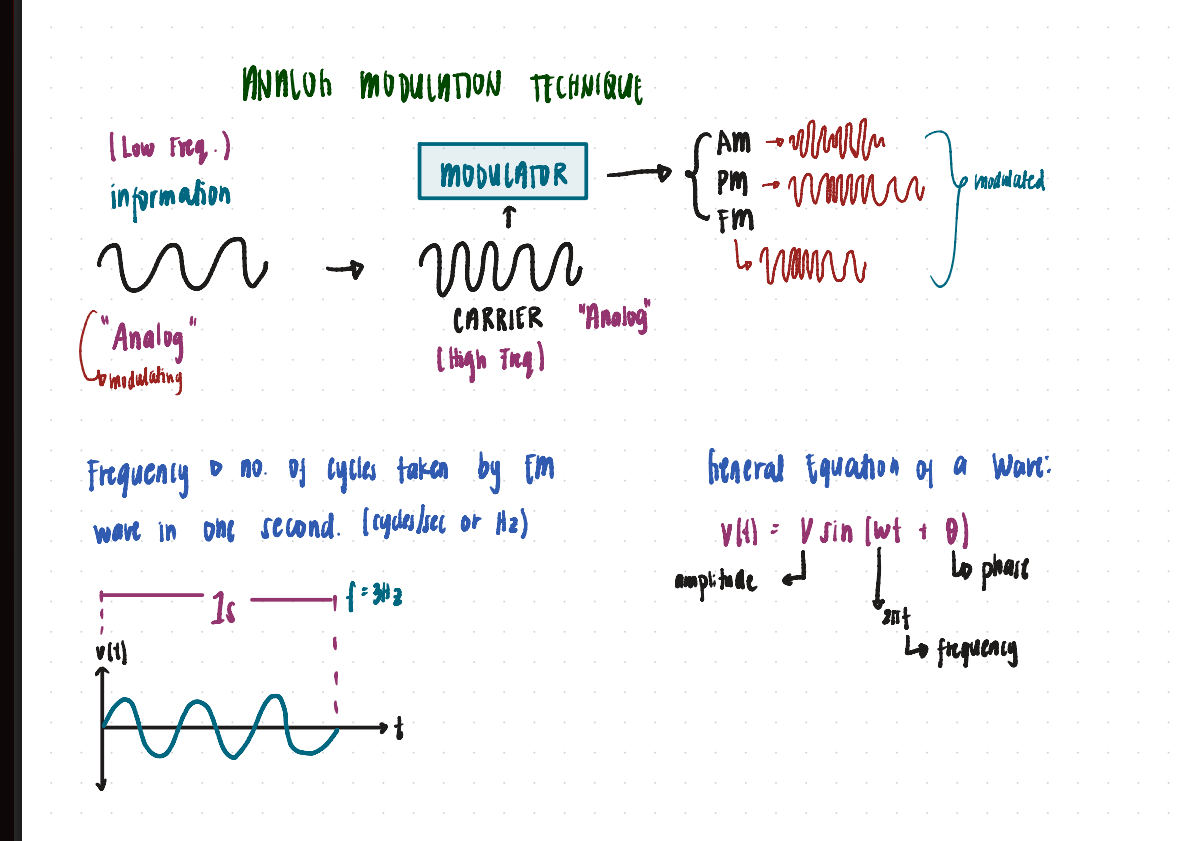
process of varying the characteristics of a wave (carrier0 in accordance with the message signal
process of having baseband voice (modulating signal) modify another high-frequency signal called the carrier.
makes the information signal more compatible with medium
changing properties of analog carrier in proportion with information signal
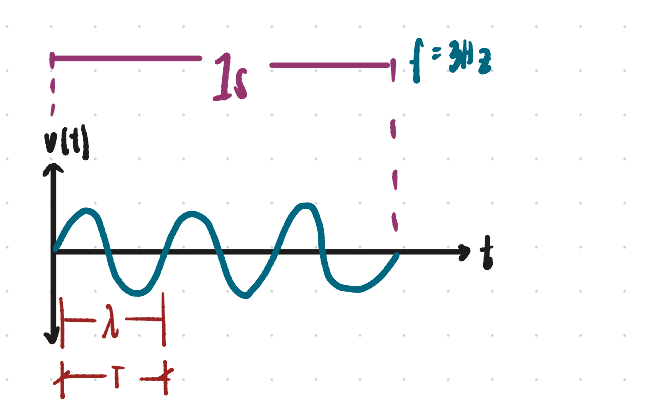
Frequency (f) in cycles/sec or Hz
no. of cycles taken by EM in one second
Period (T) in seconds
time taken for an EM wave to complete one cycle
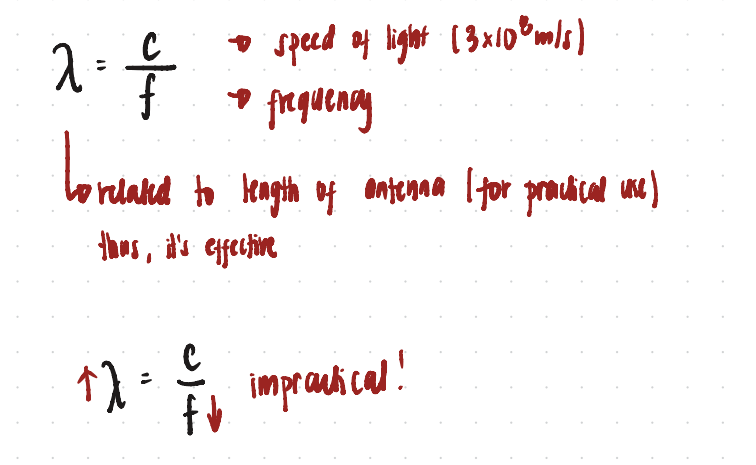
Wavelength (λ) in meter
distance travelled by EM wave in one cycle
Baseband Transmission
takes place when carrier signal is modulated, amplified, and sent to the antenna
Phase Modulation
where phase angle of the sine wave is varied

Modulation and Multiplexing
these are electronic techniques that transmit information efficiently
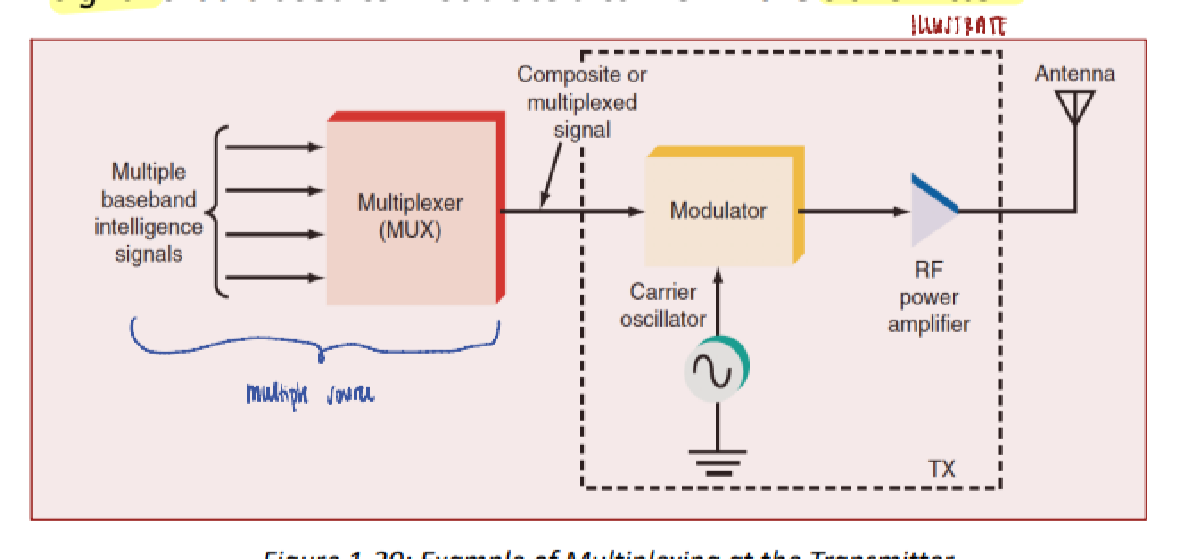
Multiplexing
allows more than one signal to be transmitted concurrently in a single medium
converts indiv baseband to composite signal to modulate a carrier in transmitter
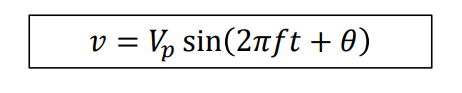
Carrier
high frequency signal that’s to be modulated
sine wave generated by an oscillator
Information Signal
usually called the Modulating Signal
Interference (avoid this!)
when information signals occupy same frequency band, or when sources are transmitted at the same time.
Antenna
extremely difficult to radiate low frequency signals from an _____ in the form of electromagnetic energy
this focuses on length

vary amplitude, frequency, or phase angle
what are the three ways to make baseband signal change carrier sine wave
Amplitude Modulation (AM)
when you vary the amplitude but constant iba
Frequency Modulation (FM)
when you vary the frequency, nothing else
Phase Modulation (PM)
when you vary the phase angle, vary by intelligence signal
indirect FM
Amplitude Shift Keying (ASK)
this is when information signal is DIGITAL, and amplitude of carrier (ANALOG) is varied proportional to it.
Frequency Shift Keying (FSK)
this is when information signal is DIGITAL, and frequency of carrier (ANALOG) is varied proportional to it.
Phase Shift Keying (PSK)
this is when information signal is DIGITAL, and phase of carrier (ANALOG) is varied proportional to it.

Demodulation
reverse process of modulation, converts modulated carrier back to original
performed in receiver called demodulator

Demultiplexer
opposite of multiplexer
individual basebands are regenerated

Frequency Division Multiplexing (FDM)
analog
intelligence signals modulate subcarrier on different frequencies then add together, composite signal modulates the carrier
transmission at different freq, same time
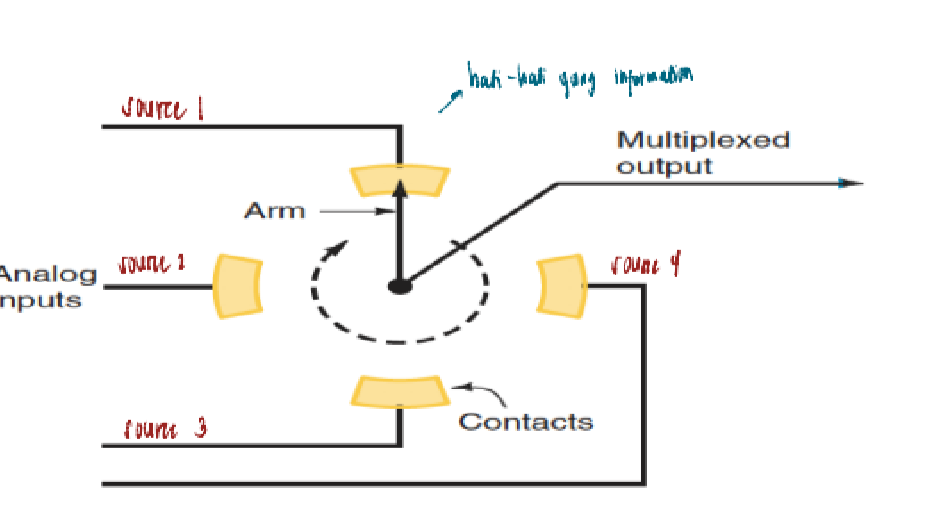
Time Division Multiplexing (TDM)
multiple intelligence signals are sequentially sampled, small piece each to modulate carrier
transmission at same freq but diff time slot
Code Division Multiplexing (CDM)
combination of FDM and TDM
signals transmitted are converted to digital data uniquely coded with faster binary code
unique coding is used at receiver to select desired signal, uses spread spectrum

Electromagnetic Spectrum
information is converted into electromagnetic signals that consist of electric and magnetic fields
they oscillate and vary a lot in lots of frequencies
this is the range of those frequencies
the spectrum is divided into subsections or bands
International Telecommunications Union (ITU)
international agency in control of allocating frequencies and services
Europe (ITU-R,D,T)
National Telecommunications Commission (NTC)
attached agency of DICT, they oversee telecommunication services, radio, and TV networks in the Philippines
Extremely Low (30-300Hz)
Voice (300Hz-3kHz)
Very Low (3-30kHz
Low (30-300kHz)
Medium (300kHz-3MHz)
High (lam mo na)
Very High
Ultra High
Super High
Extremely High
the usable radio frequency (RF) spectrum is divided into?
EVVLMHVUSE (Evil Mh Vuse)
Extremely Low Frequency (ELF)
frequency band that include AC power line and low end human audio
Voice Frequency (VF)
frequency band of normal range of human speech
Very Low Frequency (VLF)
frequency band of musical instruments, used by government and military comms
Low Frequency (LF)
frequency band of primary communication services, aeronautical and marine navigation
Medium Frequency (MF)
frequency band of AM radio broadcasting
High Frequency (HF)
frequency band known as short waves, simplex and half duplex are in this range
Very High Frequency (VHF)
frequency band that’s popular, used ba radio, marine, aeronatical, uuses FM radio broadcasting and TV channel 2 to 13
Ultra High Frequency
frequency band that includes TV channel 14 to 51, for land mobile, cellular, and military comms
Microwave and Super High Frequency (SHF)
frequency band known as microwaves, for satellite communication and radar, LANs and cellular phones
Extremely High Frequency (EHF)
frequency band of electromagnetic signals, known as millimeter waves
Optical Spectrum
above the millimeter wave region
occupied by light waves
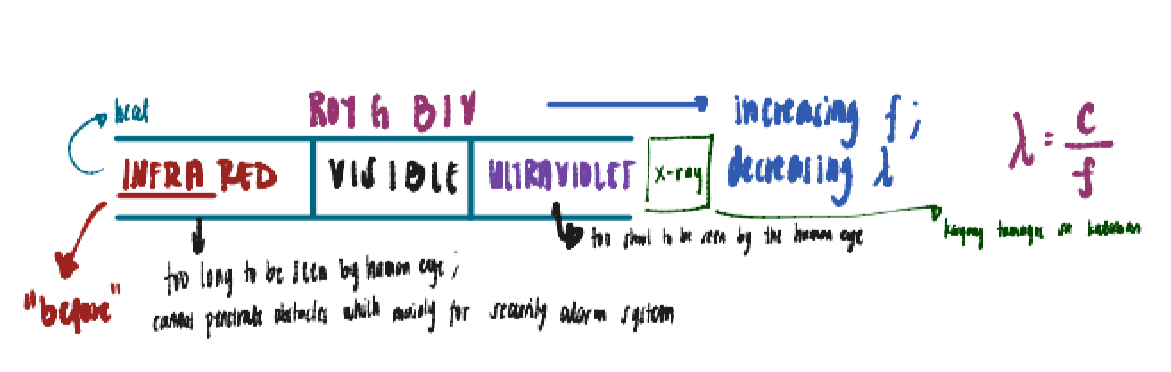
Infrared
optical range between 0.1mm and 700nm
basis for all fiber optic communication
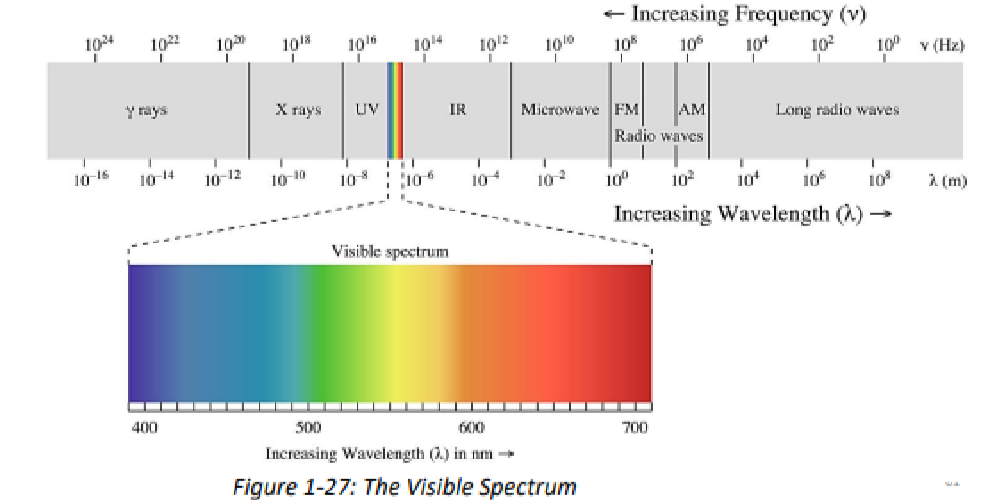
The Visible Spectrum
light is electromagnetic radiation of wavelength 0.4 to 0.8um, expressed in Angstroms (Å)
red is low-freq, long-wavelength, violet is high-freq, short-wavelength
they handle tremendous amount of information
Ultraviolet Spectrum
covers 4 to 400nm, not for communication but for medical field

Electromagnetic Waves
travel at the speed of light, v=3×10^8 m/s

Bandwidth (BW or B)
frequency range of comm system operates
information capacity depends on this
difference between highest and lowest frequency

Channel Bandwidth
range of frequencies REQUIRED to transmit desired information
higher BW = lower needed capacity for information = more information can be transmitted/contained
Information Thoery
study that deals with accurate transmission of message subject to transmission of failure and effect of noise and bandwidth
study of efficient use of bandwidth to propagate information through electronics
key measure is ENTROPY
Entropy
quantifies the amount of uncertainty involved in value or outcome of random variable/process
this is used because receiver is not aware what’s to be received
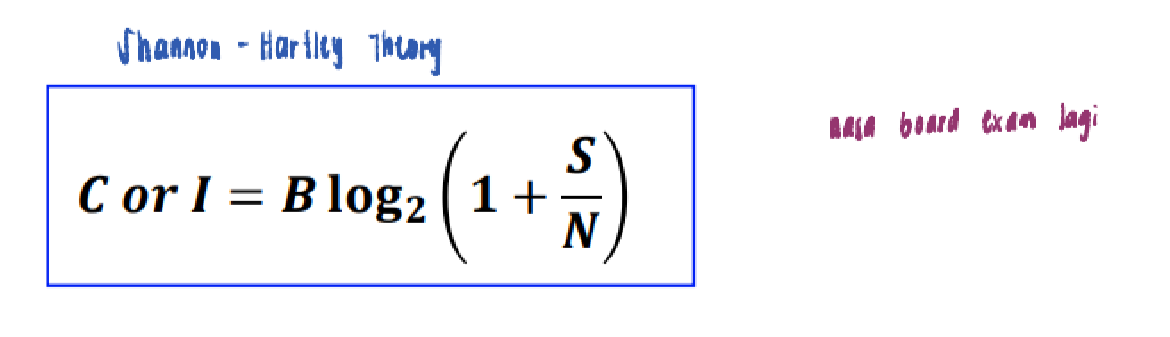
Information Capacity
measure of how much information can be propagated
function of bandwidth and transmission line
number of independent symbols carried through system per unit time
most basic is binary digit or bit
expressed as BIT RATE or bits transmitted per second (bps)