A&P Lesson 3 - Cellular Form and Function
 Call Kai
 Learn
Learn Practice Test
 Spaced Repetition
 Match
Match Flashcards
 Knowt Play
1/49

There's no tags or description
Looks like no tags are added yet.
Name | Mastery | Learn | Test | Matching | Spaced | Call with Kai | Chat |
|---|
No analytics yet
Send a link to your students to track their progress
50 Terms
Organelles
the internal structures of a cell that carry out specialized metabolic tasks
What are the 2 main categories of organelles?
non-membranous organelles
membranous organelles
Non-membranous organelles
do not have a membrane surrounding them
includes cytoskeleton, microvilli, centrioles, cilia, ribosomes, and proteasomes
Cytosol
a clear, viscous, watery colloid within the cell that contains enzymes, other proteins, amino acids, ATP, electrolytes, dissolved gases, and metabolic waste
Cytoskeleton
a network of protein filaments and cylinders

What are the functions of the cytoskeleton?
structural support
organizes cell content
Directs movement of materials within cell and contributes to movement
What are the elements/components of a cytoskeleton?
microfilaments, intermediate filaments, and microtubules

Microfilaments
smallest - 6nm thick
made of actin protein
What are the functions of microfilaments?
form terminal web
provide mechanical strength by anchoring cytoskeleton to plasma membrane proteins
interacts with cytosolic proteins to adjust liquidity of cytosol
can interact with thick filaments for muscle cell contraction
If microfilaments make dense interactions, what happens to the cytosol?
it becomes dense and gelatinous
If microfilaments make dispersed interactions, what happens to the cytosol?
it becomes more fluid
Intermediate filaments
8-10 nm thick
within skin cells
made of protein keratin
What are the functions of intermediate filaments?
give cell shape, strength/durability and resists stress
stabilizes organelle position
stabilized cell onto a substrate/other cells
Microtubules
largest - 25 nm thick
consists of protofilaments made of protein tubulin

What are the functions of microtubules
dynamic and can readily assemble/disassemble
maintains cell shape (changes to microtubules can change cell shape)
holds organelles
“highway system” - motor proteins can use ATP energy to move organelles that are attached to them along microtubule “tracks”
makes axonemes of cilia and flagella
forms mitotic spindle
attaches to the centrosome

Microvilli
extensions of the plasma membrane (1-2 um in length)
core composed of microfilaments
provide 15-40x more surface area to cells that have them
best developed in cells specialized in absorption
brush border

Cilia
small hair-like processes 7-10 um long
can be motile or non-motile
beat in waves to sweep material across a surface

Where are cilia found?
found in respiratory tract, uterine tubes, ventricles of brain, and ducts of testes
What is cilia composed of?
microtubules
How many cilia are found on each cell?
50-200
What is the difference between microvilli and cilia?
Microvilli - short and finger like Cilia - long and hair like
-1-2 nm -7-10nm
-add surface area -move material across cell
Centriole
a short cylindrical assembly of microtubules arranges in 9 groups of 3 microtubules each
What is the function of the centriole?
play important role in cell division (mitosis)
form spindle apparatus during mitosis

Ribosomes
small granules of protein and RNA responsible for producing proteins
free ribosomes
fixed ribosomes
What are the functions of the ribosomes?
read the coded genetic messages in mRNA
assemble amino acids into proteins
Where are ribosomes found?
in nucleoli, in cytosol, on outer surfaces of rough ER, and nuclear envelope
Free ribosomes
found in the cytoplasm to produce cytosolic proteins
Fixed ribosomes
attached to the endoplasmic reticulum; start off as free ribosomes
How do free ribosomes become fixed ribosomes?
mRNA attaches to the free ribosome, the ribosome can be signaled to attach onto the ER if destined
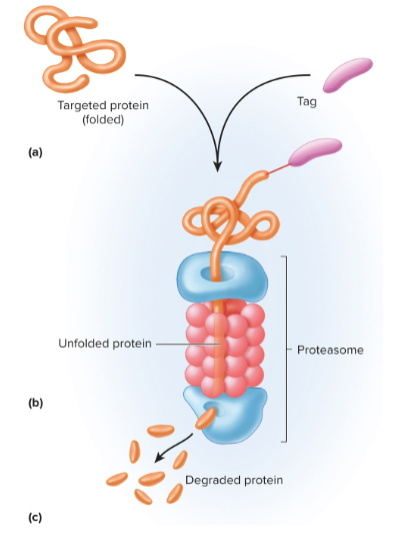
Proteasomes
hollow, cylindrical organelles that dispose of surplus proteins
contain enzymes (proteases) that break down tagged, targeted proteins into short peptides and amino acids
can destroy tagged damaged cell proteins or viral proteins
Membranous organelles
surrounded by a membrane
includes nucleus, endoplasmic reticulum (rough and smooth), Golgi complex, lysosomes, peroxisomes, and mitochondria
Membrane flow
continuous exchange membranes from one organelle to another via vesicles
Endoplasmic reticulum (ER)
network of interconnected membranous channels called cisterns
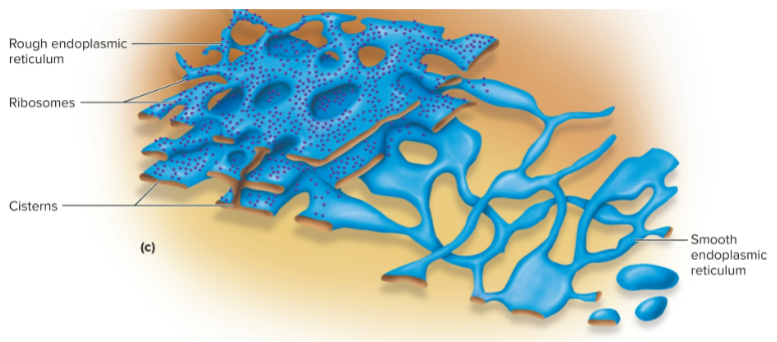
Rough ER
parallel flattened sacs covered with ribosomes attached to its outside
produces phospholipids and proteins of nearly all cell membranes
synthesizes proteins that are packaged in other organelles of secreted from cell by exocytosis
Smooth ER
tubular ER that lacks attached ribosomes
synthesizes lipids and steroids
detoxifies alcohol and other drugs
calcium storage
Golgi complex
a system of membranous cisterns that synthesize carbohydrates and modifies newly synthesized proteins
sorts protein, splices some, adds carbohydrate moieties to some and packages them into membrane-bound Golgi vesicles

What happens to the Golgi vesicles?
some become lysosomes, some migrate and fuse to plasma membrane, and some become secretory vesicles
Lysosomes
package of enzymes bound by a membrane
What are the functions of lysosomes?
intracellular hydrolytic digestion of substances
can be used to break down invading bacteria or recycled damaged organelles
Primary lysosomes
formed by the Golgi complex, enzymes inside are inactive
Secondary lysosomes
formed when primary lysosome fuses to an endosome or damaged organelle which activates the enzyme
Autophagy
digestion of cell’s surplus organelles
Autolysis
digestion of a cell by itself; cell suicideL
Lysosomal storage disease
> 30
caused by lack of specific lysosomal enzyme which causes waste build up in cells
Tay-Sachs disease
rare genetic disease caused by lack of lysosomal enzyme which causes build up of lipids in brain cells causing them to die
Peroxisomes
resemble lysosomes but contain different enzymes; are produced by ER and mitochondria and from other peroxisomes
present in all cells

Where are peroxisomes abundant?
kidney and liver
What are the functions of peroxisomes?
use molecular oxygen to oxidize organic molecules
neutralize free radicals, detoxify alcohol, other drugs and blood borne toxins
break down fatty acids into acetyl groups for mitochondrial use in ATP synthesis
reactions produce hydrogen peroxide (H2O2) but peroxisomes contain the enzyme catalase that breaks it down
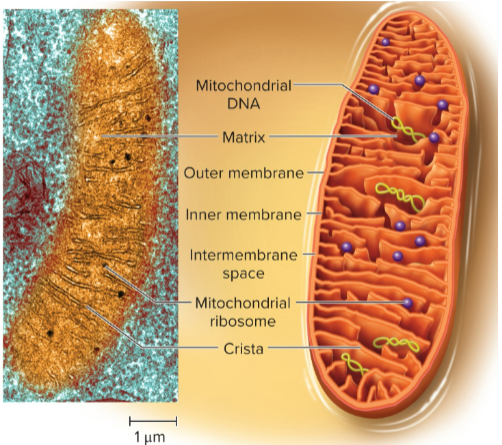
Mitochondria
organelles specialized for synthesizing ATP when oxygen is abundant
change shape from spheroidal to thread-like
surrounded by double membrane
problems with mitochondria can cause metabolic disorders
Metabolic disorders
inherited from maternal side and cause problems with mitochondrial ATP generation; all cells in body are affected