Histotechnology - Lecture 1 - Safety in the Histology Department
 Call Kai
 Learn
Learn Practice Test
 Spaced Repetition
 Match
Match Flashcards
 Knowt Play
1/126

There's no tags or description
Looks like no tags are added yet.
Name | Mastery | Learn | Test | Matching | Spaced | Call with Kai | Chat |
|---|
No analytics yet
Send a link to your students to track their progress
127 Terms
What are the 6 most common safety protocols in the Histology department? (Even though all hospitals establish their own safety protocols)
a) Practice standard precautions - Treat everything as infectious
b) Wear proper PPE
c) Do NOT touch “clean” areas with gloves
d) Wash hands frequently
e) Disinfect all instruments
f) Minimize chemical contact
What is the first step when responding to a chemical spill in the histology lab?
Notify your supervisor
What PPE is essential when handling formalin-fixed tissues?
Safety glasses, nitrile gloves, lap coat (all of the above)
What is a basic safety rule in any laboratory?
The proper labelling of chemicals
What is a significant hazard when working with xylene in the histology lab?
Fire hazard
What is the primary health risk associated with prolonged exposure to formeldehyde?
Respiratory issues
What are exposure limits in the context of laboratory safety?
The maximum amount of concentration from a chemical that workers can be exposed to
What are some possible hazards in histology?
infection
needle-stick injury
cuts
carcinogenic agents
flammable chemicals (xylene)
allergenic agents
physical hazards (microtome)
What two types of SOP’s MUST be in place when detailing an exposure control plan?
Institutional and Laboratory SOPS
What should the SOP’s exposure control plan be detailing?
Housekeeping details (how garbage is removed)
PPE
Waste disposal
What tasks in the histology lab may expose one to blood or potentially infectious materials?
Frozen sectioning
Autopsy
Gross dissection
Cytology preparation
What are the four major classes of hazards in the histology lab?
Biological/Infectious
Technical
Chemical
Health/physical
What are 5 potential Biological/Infectious hazards?
Mycobacterium tuberculosis (TB)
HIV, HBV, HCV
Creutzfeldt-Jakob disease (CJD)
Infectious aerosols
Infectious wastes
What specimens are not considered infectious unless visible blood is present?
Sputum, stool, vomitus
What is always required when dealing with potential TB?
Respiratory protection - N95 mask
What is the mode of transmission for TB?
Airborne and droplet nuclei
What is the inoculation period for TB?
10 bacilli via inhalation
What is the incubation period for TB?
1-3 months from exposure
What 5 disinfectants is TB susceptible too?
5% Phenol
Glutaraldehyde
Iodine w/ high concentration
Formaldehyde (longer contact time)
1% bleach (longer contact time)
What is TB inactivated by?
Moist heat 121 degrees for 15 mins
What is the infectious dose for HIV?
It is very low, small amount entering bloodstream or mucus membranes can result in infection
What is the incubation period for HIV?
6 months to 7 years
What 4 disinfectants is HIV susceptible to?
1% bleach
2% Glutaraldehyde
Formaldehyde
Ethanol
What decreases the reactivity of HIV to below detectable amounts?
Heating specimen at 56-60 degrees (pasteurization)
When is HIV destroyed outside of the host?
Within several hours
What are direct contact hazards in regards to HIV?
Skin (un-intact skin), mucous membranes (mouth, nose, eyes), accidental percutaneous (through skin) injuries
What are the two forms of pathogenicity?
Symptomatic (looks like you got it)
Asymptomatic (doesn’t look like you got it)
What is the infectious dose for HBV?
Unknown, one mL of blood can contain 102-109 HBV particles (not a lot)
What is HBV’s mode of transmission?
Through percutaneous or permucosal exposure with infected body fluids
What is the incubation period for HBV?
24-180 days (2-3 months)
Is HIV and HBV stable or fragile?
HIV is fragile, HBV is stable
What 4 disinfectants is HBV susceptible too?
1% bleach
2% Alkalinized glutaraldehyde
Formaldehyde
70% ethanol
What is the most frequently encountered lab associated infection?
HBV
What type of disease is CJD?
Prion disease - Prions are abnormal proteins that can cause disease
How does CJD affect one?
CJD affects nervous tissue, causes changes to the white matter of the brain called spongiform encephalopathy
How is CJD transmissible?
Transplants, exposure to brain tissue and CSF
How long can it take CJD for symptoms to appear?
It can take up to 20 years
How do you destroy a prion?
They are very resistant to destruction and basically have to be incinerated
What 4 things are prions susceptible too?
Autoclave for one hour at 121 degrees, 132-134 degrees is preferred
5% sodium hypochlorite (bleach) for two hours (destroys instrument)
Concentrated formic acid for 1 hour
1N sodium hydroxide for 1 hour
What are the 3 classifications of CJD?
Sporadic - unknown cause
Familial - genetic predisposition
Iatrogenic - accidental contamination
Can standard fixation kill CJD microorganisms?
False
What is vCJD associated with?
Associated with eating meat from cows infected with “bovine spongiform encephalopathy” (BSE) = “known as mad cow disease”
What to disinfect steel instruments with after possible CJD exposure?
2N NaOH for 1 hour
In regards to infectious aerosols, should cryogenic sprays be used on frozen sections or poorly fixed tissue?
No
In regards to waste tissue specimens, how should all materials that came into contact with tissue be disposed of?
In a BIOHAZARDOUS bag with a biohazard warning
What are the four classifications of infectious waste?
Pathologic material specimens
Blood
Microbiological or Culture specimens
Sharp objects
What methods is recommended for all waste except pathological waste?
Steam sterilization or incineration, only incineration for pathologic
Can blood be poured down the drain?
Yes
What are some hazards within the category of mechanical hazards?
knife blades
razors
scalpels sharps container for disposal
needles
glass
electrical
What is an engineering control?
What we put in place to get rid of the hazards
What must be preformed on all electrical equipment within the lab?
Grounding, condition of wires checked periodically, extension cords surge protected, must all be documented
What are the two classes of chemical hazards?
Physical
Health
3 examples of Physical Chemical hazards?
Flammable, explosive, oxidizers
5 examples of Health Chemical hazards?
Carcinogens, sensitizers, toxins, corrosives, irritants
What is PEL?
Permissible exposure limit - Maximum allowable airborne concentration of a chemical that a worker may be exposed to in a 8hr workday, 5 days a week, for a lifetime without receiving damaging effects
What is TWA?
Time Weighted Average - The average exposure to a chemical workers may be exposed to without adverse effects over a period such as 8hr day or 40 hr week
What is STEL?
Short Term Exposure Limit - The measurement of exposure over a short period of time (15 mins) where the worst exposure occurs (STEL always higher than TWA)
What is CL?
Ceiling Limit - Maximum permissible instantaneous exposure to a chemical during any part of the work shift. Reserved for very dangerous substances
What is the TWA for formaldehyde?
0.75 ppm - average 8hr work shift)
What is the action level for formaldehyde?
0.5 ppm calculated for 8hr TWA
What must occur if intial TWA is greater than 0.5 ppm?
Monitoring must be done every 6 months to look for improvement
When formaldehyde levels are at or above action level or STEL in areas what must be done?
Must be stated and respirators must be worn
Does a TWA greater than 0.5 ppm but WITHIN stel limits require monitoring?
No, only if theres an employee present with symptoms
What 3 things must chemicals be evaluated for?
Carcinogenic potential
Reproductive toxicity
Acute toxicity
What are the five health hazards?
Biohazards
Irritants
Corrosive chemicals
Sensitizers
Carcinogens
Define biohazard:
Has potential to cause disease in humans
Define irritants:
Reversible inflammatory damage effecting site of contact
Define Corrosives:
Irreversible damage, physical and health hazard (acid)
Define Sensitizers:
Causes allergic reactions
Define Carcinogens:
Can cause cancer
What 4 carcinogens can cause cancer?
Benzene (replaced with xylene now), formaldehyde, chromic acid, chloroform
What 3 dyes (aromatic compounds) are also carcinogenic?
Basic fuchsin
Auramine
Ponceau 2R
What are 4 physical hazards?
Combustibles (needs help to catch on fire)
Flammables (can catch on it’s on)
Explosives
Oxidizers
Is it better to choose a combustible product over a flammable product?
Yes
How do combustibles catch on fire?
When they’re FP (flashpoint) is at or over the specified temperature
What has lower FP combustibles or flammables?
Flammables, vapours must be carefully controlled
Most common explosive?
Picric acid, some silvers
What is an oxidizer?
They can initiate/promote combustion in any other material
What is an insidious chemical hazard?
Hazards that develop gradually, and are very subtle but in a HARMFUL way
What are 3 examples of insidious chemical hazards?
Ethers
Mercury
Picric acid
How are ethers insidious chemicals?
They progress with exposure to air and are accelerated by light, and oxidize to form peroxides
How is mercury a insidious chemical hazard?
Liquid mercury releases vapors at levels exceeding exposure limits
How does one store picric acid?
Store wet always, never dry
What must be present for hazard identification?
· Chemical containers MUST contain correct labels
· Signage must be available where specific reagents are used
· Data sheets (DS) must be available for ALL chemicals
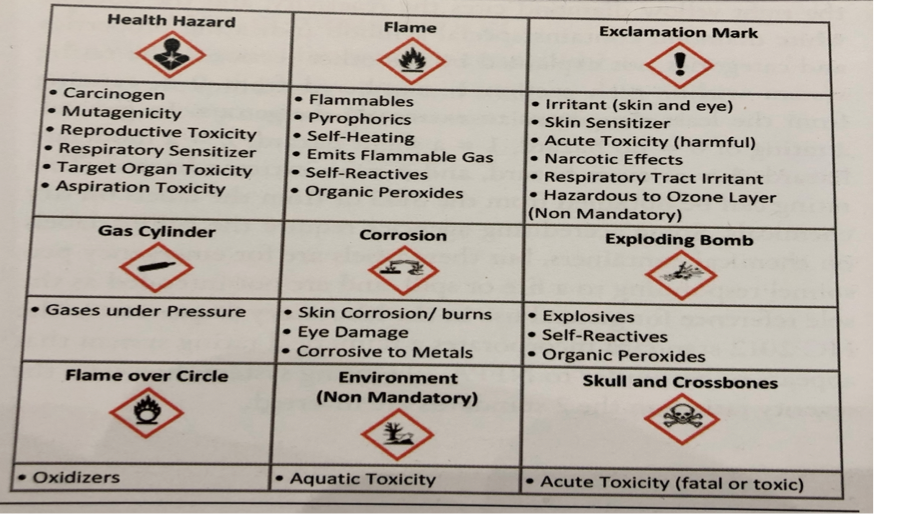
What is toxic dose?
Lowest dose of a substance that can result in a toxic effect by means other than inhalation
What does “toxic concentration low” mean?
If toxic by inhalation
What is LD50?
Calculated dose of a chemical expected to cause death of 50% of an experimental animal population by exposure by any route except inhalation
What are three toxic chemical examples?
Formaldehyde
Metallic compounds – mercury, chromium, Ag
Hydrocarbons: xylene and toluene
What inhalation concentrations of formaldehyde result in difficulty breathing?
10-20 ppm
What can inhalations above 20 ppm cause?
Pulmonary edema (fluid in lung)
What can 0.5-2.0 ppm of formaldehyde cause?
Irritation of eyes, nose, throat
What can chronic exposure to formaldehyde cause?
Respiratory issues
What occurs when formaldehyde reacts with HCL?
Produces ether vapor which is very carcinogenic
Is formaldehyde a sensitizing agent?
yes
Is formaldehyde flammable?
Yes flammable liquid and vapours
Potassium Dichromate:
Carcinogen
Corrosive
Sensitizer
Oxidizing agent
Non-flammabe
Methanol:
Highly flammable
Osmium Tetroxide:
Not explosive or fire hazard, just very toxic