COSI 305: Basal Ganglia
 Call Kai
 Learn
Learn Practice Test
 Spaced Repetition
 Match
Match Flashcards
 Knowt Play
1/44

There's no tags or description
Looks like no tags are added yet.
Name | Mastery | Learn | Test | Matching | Spaced | Call with Kai | Chat |
|---|
No analytics yet
Send a link to your students to track their progress
45 Terms
What are the 6 main basal ganglia structures?
Caudate Nucleus
Putamen
Globus Pallidus
globus pallidus internus
globus pallidus externus
Thalamus
ventral anterior nucleus
ventral lateral nucleus
subthalamic nucleus
substantia nigra
pars compacta
pars reticularis
What are the two parts of the globus pallidus?
globus pallidus internus
globus pallidus externus
The caudate nucleus and the putamen make up what?
our striatum
the putamen and globus pallidus make up what?
lentiform nucleus
what two thalamic nuclei are associated with the basal ganglia?
ventral anterior nucleus
ventral lateral nucleus
What are the 3 main things the basal ganglia is responsible for?
initiating movement, stopping movement, and modulating movement
Discuss the relationship between the basal ganglia and the motor cortex
Basal ganglia works a lot with motor cortex
Primary motor cortex, premotor cortex, and primary somatosensory cortex will work together to send an initial motor plan to our basal ganglia system → the basal ganglia will modulate and create a perfect motor plan and send it back to these areas → those areas will then send it down to the spinal cord in order for our muscles to be moved
All of this prework happens before we even move our arm
What is GABA?
An inhibitory neurotransmitter → the more gaba you have the more something is inhibited
GABA is going to decrease something from happening and the more you have it the less something is going to work
What happens to movements if you have a lot of GABA? What about too little GABA?
for motor movements, the more gaba the less movement you have → increased gaba means decreased movement
Decreased gaba → more movement
How does GABA lead to hyperpolarization?
GABA will bind to a ligand gated channel → this binding will open the gate and allows + ions to move our or - ions to move in
The result from this is that there will be a whole lot of negative change within the cell and decreases our resting membrane potential (IPSP) → hyperpolarization
If membrane potential is too low action potential will not reach its threshold
What is glutamate?
an excitatory neurotransmitter
will do the same with the ligand channel as GABA but will make the cell more positive instead causing depolarization
glutamate send positive ions into the cell while GABA sends negative ions into the cell
In the direct pathway of the basal ganglia, where are these fibers going to originate? Where are they first going to synapse?
Fibers start at the cortex and go down to the striatum (caudate and putamen) → they will synapse on the caudate and putamen
What is the goal of the direct pathway of the basal ganglia?
the goal for this direct pathway is to initiate, increase, or stimulate movement
If a person with parkinson’s is experiencing difficulty with the initiation of movement, which basal ganglia pathway is being affected?
People with parkinson's have difficulty with initiating movement → problem with direct pathway
In the direct pathway, after fibers from the cortex synapse on the striatum, where are they going to go?
When they synapse at the striatum they will go specifically to the globus pallidus internus → synapse here and go to the ventral anterior thalamic nuclei and then goes back up to the cortex
From cortex it will go back down through something like the corticospinal tract to initiate movements
What do we need to initiate movement?
NEUROTRANSMITTERS
What neurotransmitter is being released while we are at rest?
When you aren't moving/ at rest→ gaba is being released → makes it so you are not sending an action potential → allows for inhibition and not move muscles when you don't want to
If we are at rest but want to move, what does our circuitry have to do?
Our circuitry knows that we need to decrease gaba so that we can move
How does our direct pathway decrease GABA?
The cortex is going to send down glutamate and stimulates the neurons in the striatum.
These same neurons are then going to send GABA to the globus pallidus internus
GABA from the striatum neurons is going to inhibit GPi neurons from constantly sending GABA to the thalamus, which is what is keeping us at rest.
The GPi produces a lot of GABA and sends it to the thalamus → inhibits movement/keeps us at rest
Because the GPi is inhibited, not as much GABA is going to reach the thalamus. If there is not as much GABA, less and less action potentials are going to be able to be stopped bc IPSPs are decreasing.
When the thalamus notices that there is a decrease in GABA, what does this mean?
The decreased level of GABA alerts the thalamus that it can move. The thalamus then sends glutamate back up the cortex so that we can initiate that movement
What is the purpose of the indirect pathway of the basal ganglia?
inhibiting any unwanted motor movements
Discuss the course of the indirect pathway
Glutamate comes from the cortex to the striatum
Glutamate will synapse on the neurons of the striatum causing the release of GABA, similarly to the direct pathway
Except in this pathway that GABA coming from the striatum neurons is going to go to the Globus Pallidus Externus (GPe)
GABA will inhibit the neurons of the GPe
When the globus pallidus externus (GPe) is inhibited, it releases less GABA onto the subthalamic nucleus (STN), resulting in less inhibition of the STN, which then increases its firing rate and glutamate release
the STN is going to send these increased action potentials and glutamate to the Globus Pallidus Internus
Glutamate is going to synapse on the neurons of the GPi which is going to release GABA
A lot of GABA is going to be sent to the thalamus which results in a strong inhibition of the thalamus
The thalamus will very little action potentials to the motor cortex resulting in no motor activity
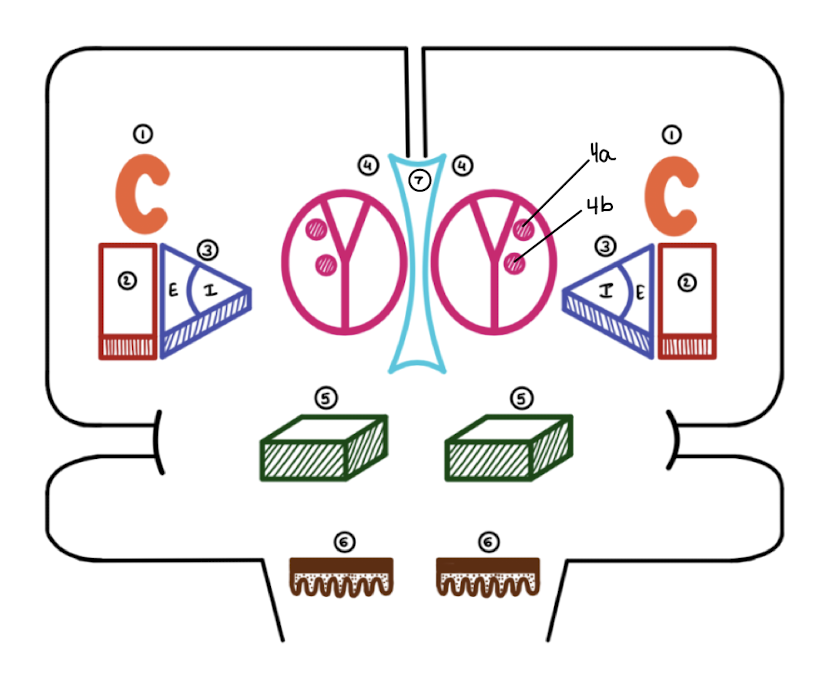
Which basal ganglia structure is labeled 1?
Caudate Nucleus
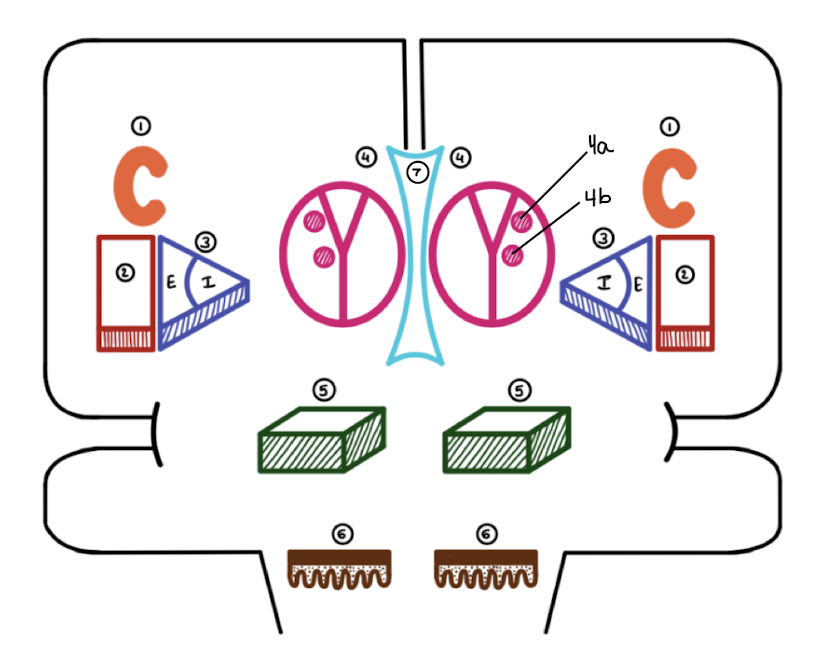
Which basal ganglia structure is labeled 2?
Putamen
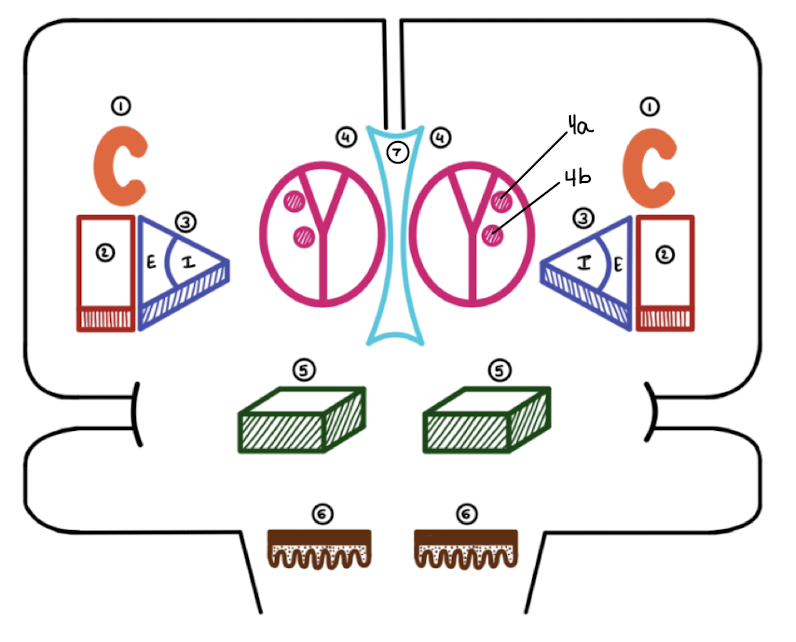
Which basal ganglia structure is labeled 3?
Globus Pallidus
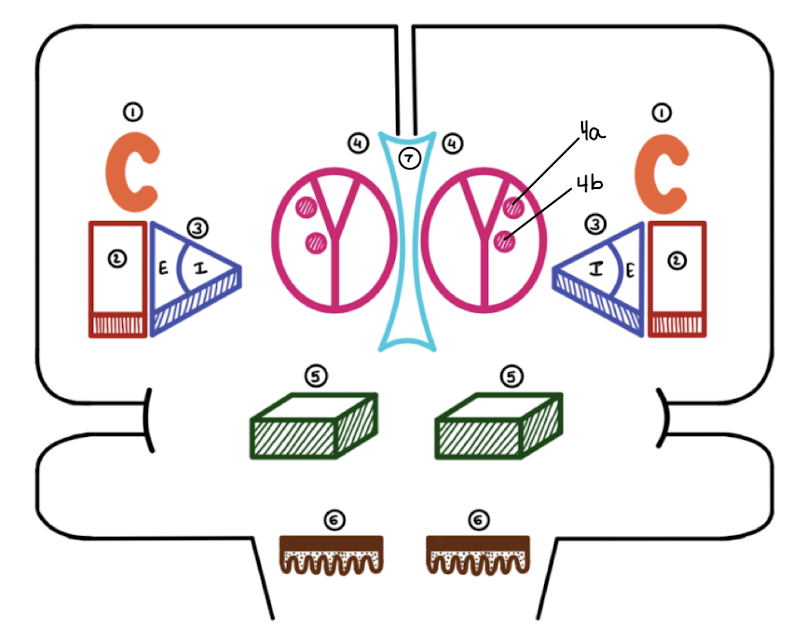
Which basal ganglia structure is labeled 4?
Thalamus
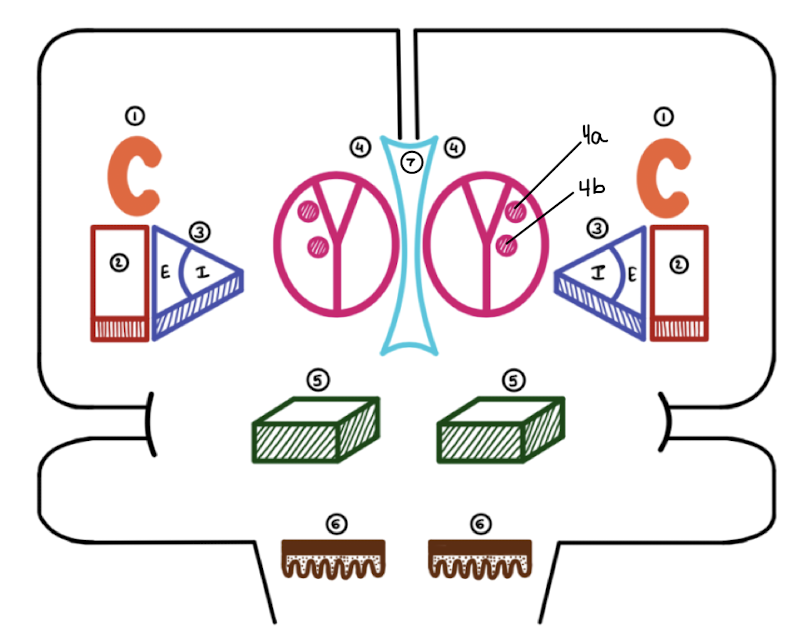
Which basal ganglia structure is labeled 5?
Subthalamic nucleus
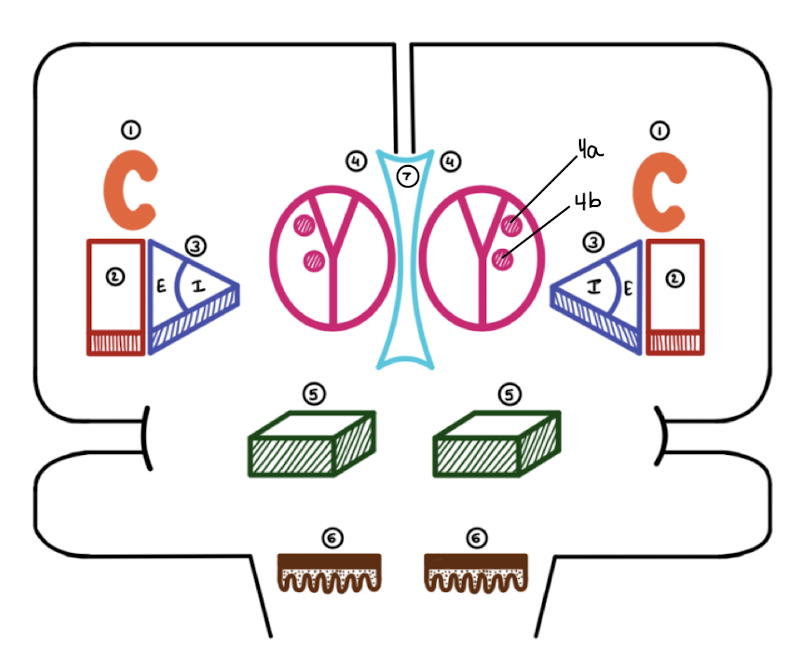
Which basal ganglia structure is labeled 6?
substantia nigra
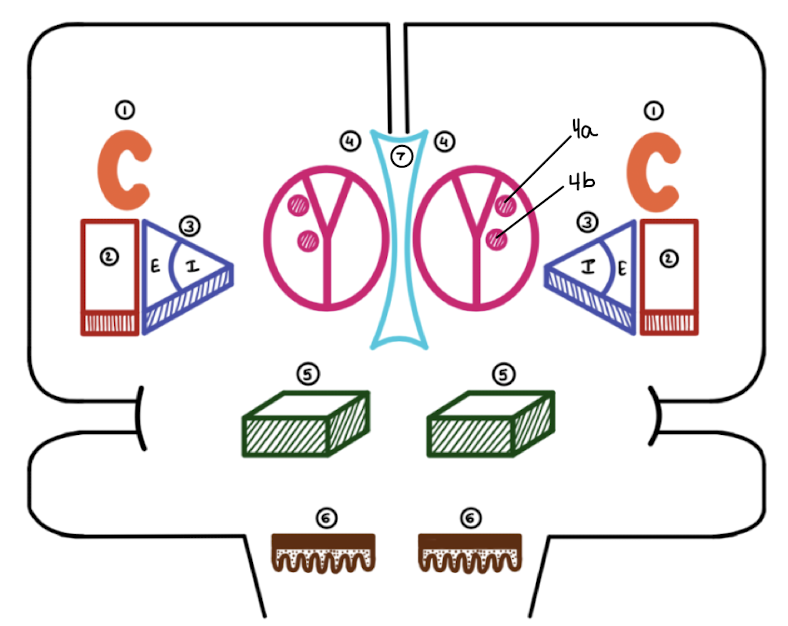
1 and 2 make up what?
striatum
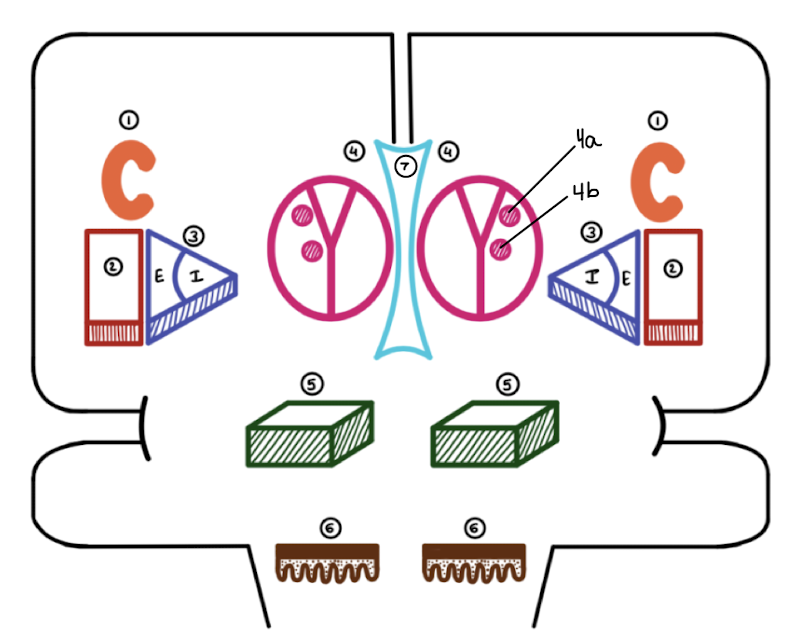
2 and 3 make up what?
lentiform nucleus
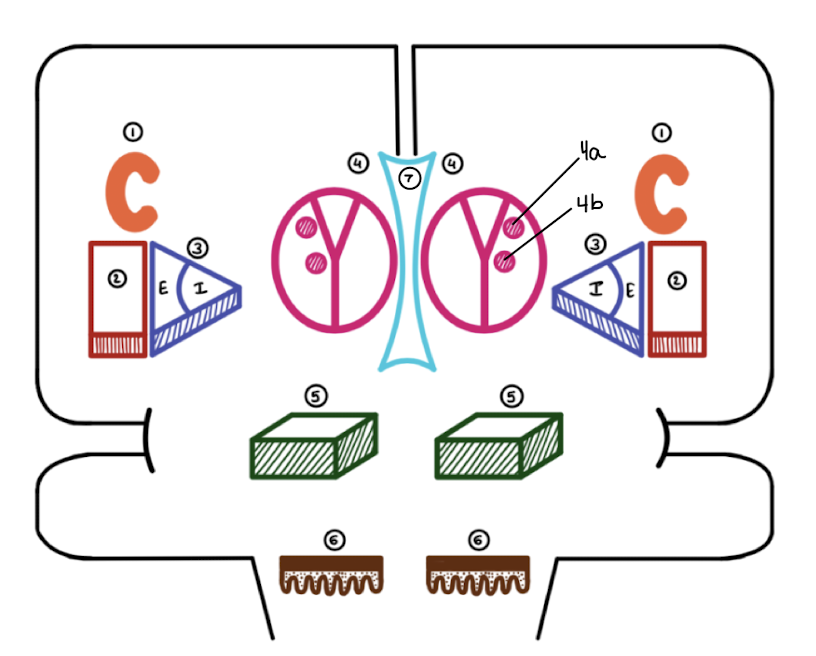
What is 3I and 3E?
3I
globus pallidus internus
3E
globus pallidus externus
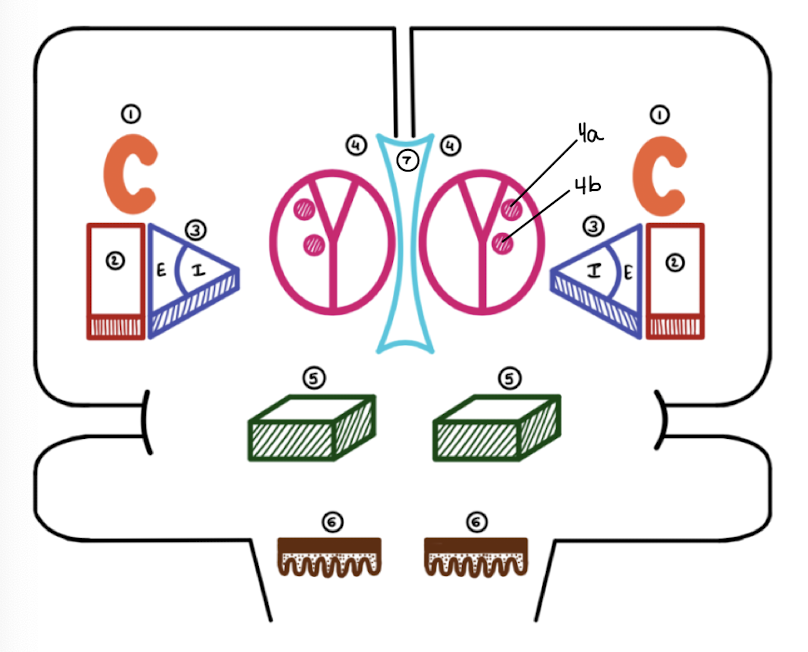
Which basal ganglia structure is labeled 7?
third ventricle
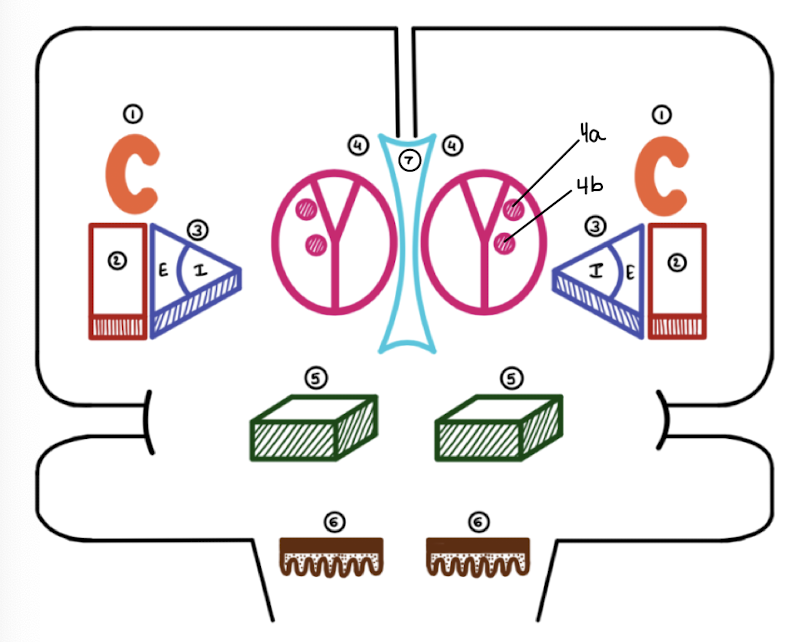
Which basal ganglia structure is labeled 4a?
ventral anterior nucleus of the thalamus
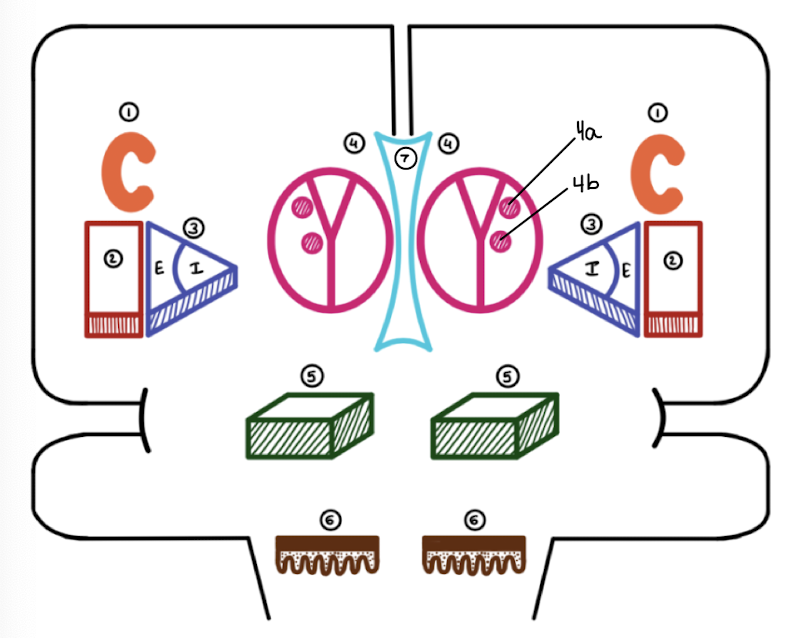
Which basal ganglia structure is labeled 4b?
ventral lateral nucleus of the thalamus
what are the two Nigrostriatal Pathways?
indirect pathway
direct pathway
what is the purpose of the nigrostriatal pathway?
in order to keep both our direct and indirect pathways happy we need to have a modulation system/pathway that is involved in keeping the movements precise. We don’t just want to move, we want our movements to be precise and accurate movements. The nigrostriatal pathway does this.
What does the nirgrostriatal pathway bring in?
dopamine
What does the nigrostriatal pathway add to the direct and indirect pathways?
involves the substantia nigra, which allows for dopamine to come into play
particularly the pars compacta, where dopamine is produced
What is different about the dopamine released in the direct vs indirect pathways?
Both pathways will receive dopamine from the substantia nigra but are going to bind to different receptors in the striatum
of the direct pathway → dopamine will bind with d1 receptor which is stimulatory
makes sense since this pathway is stimulating movement
of the indirect pathway → dopamine will bind with d2 receptor which is inhibitory
makes sense since this pathway is inhibiting movement
These stimulatory and inhibitory dopamine receptors are going to modulate movement experiences
Discuss the influence of the nigrostriatal pathway on the direct pathway
while the direct pathway is taking place and synapsing on the neurons, fibers (neurons) are going to come up from our pars compacta and they are going to synapse on the striatum causing the release of dopamine that will then bind to D1 receptors
Since the striatum is receiving stimulation from the glutamate from the cortex and stimulation from the substantia nigra it is going to result in this increased release of GABA
This means we have a lot of GABA being sent to the GPi causing the increased inhibition of the GPi → allowing for very little GABA to be sent to the thalamus
When there is decreased GABA being released to the thalamus, the thalamic nuclei are going to be very stimulated
Stimulation of these thalamic nuclei are going to send lots of action potentials to the cortex tell it we can move
Ultimately, this pathway results in increased motor activity of wanted motor movements
basically the direct pathway but adding in this level of modulation (fine tuning)
Describe the influence of the nigrostriatal pathway on the indirect pathway.
while the indirect pathway is taking place and synapsing on the neurons, fibers (neurons) are going to come up from our pars compacta and they are going to synapse on the striatum causing the release of dopamine that will then bind to D2 receptors
D2 are inhibitory meaning when the fibers from the substantial nigra bind to these receptors the result will be the release of inhibitory dopamine. This inhibiting dopamine is going to inhibit the striatum
with the striatum inhibited it would be able to send a lot of GABA to the GPe like it normally does in the direct pathway
Since not a lot of GABA is being sent to the GPe, the GPe is going to be stimulated and send a bunch of GABA to the subthalamic nucleus
The GABA is going to inhibit the subthalamic nucleus not allowing for all of that Glutamate to be released and sent to the GPi.
Since we have less Glutamate being sent to the GPi, less GABA will be sent to the thalamus
This is going to allow for some movement to occur
Therefore, inhibiting the indirect pathway
The purpose of this is to prevent rigid movements. we are letting up on that GABA just enough so that our movements can be smooth and coordinated and not rigid and robotic.
The nigrostriatal pathway is going to stimulate movement in both the direct and indirect pathways but to different degrees.
The increase in unwanted motor movements does not represent large, flailing movement but simply a balance of stimulation and inhibition that can allow for the fluidity of movements.
What are can happen if dopamine receptors in the basal ganglia are not working?
In parkinson’s disease, we have a decrease in dopamine meaning that these two modulary dopamine receptors are not working properly
if they are not working properly it will look like:
Direct Nigrostriatal Pathway: if the D1 receptors are not working it will result in problems initiating and maintaining movement
Indirect Nigrostriatal Pathway: if the D2 receptors are not working it will result in problems with rigidity, increased inhibition of movement
going to be supressing movement more than you want to and body could appear very rigid
Discuss the basal ganglia involvement in cognition
the basal ganglia plays a role in cognition and self control
What is extrapyramidal syndrome?
can happen if patient is given first generation psychotics (haloperidol)
“snowed” presentation → goal of a medication like this is to sedate the person and shut down their CNS so they don’t feel extreme anxiety of suicidal ideations
Older adults who are very aggressive are given haloperidol
When someone is snowed from something like haloperidol that affects the indirect pathway they can very easily fall
increased inhibition of movement
rigidity
cannot move
When this indirect system is not working properly you might cognitive issues like decreased attention, mental clarity, and mental flexibility
Difficulty with goal directing —> if there is a goal you want to achieve you have to initiate getting to that goal
cognitive and physical
What is executive dysfunction?
Executive dysfunction: don’t know the skills to complete certain executive functions → lack of skills could be because of the basal ganglia and these pathways are not working like they should